Can you break a 2,000-year-old encryption with 25 guesses and no key? Yes, you can — and that broken fact is the foundation of every modern cipher ever built.
Anywhere a Caesar cipher hides on a page — a forum signature, a Christmas cracker, a geocache clue from 2007 — the brute-force answer is 30 lines of Python. Try every shift from 1 to 25, print each candidate, and the original English jumps out. There is no trick, no dictionary, no cleverness. Yet that simple fact is wrong for every cipher that came after: the same trick fails the moment the keyspace grows past a billion candidates, and that is the entire point of modern cryptography. But to a Caesar message, we are still living in the year 50 BC.
What a Caesar Cipher Actually Does
Every letter moves the same number of steps through the alphabet.
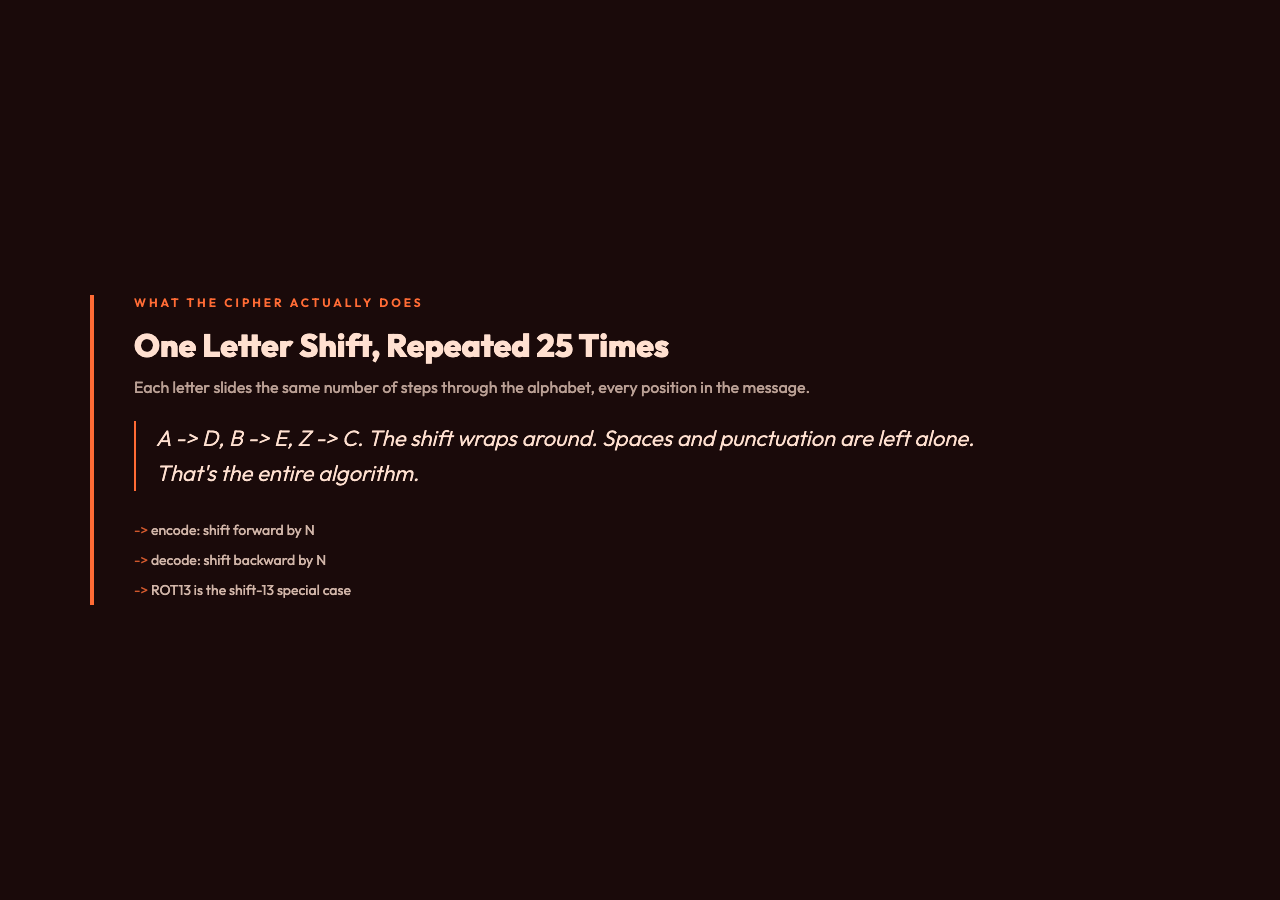
Caesar’s original used a shift of 3, so
A → D,
B → E, and
Z → C(it wraps around). Julius Caesar wrote his letters this way two thousand years ago and trusted that anyone who couldn’t read three-letter-forward Latin was nobody worth hiding from. Modern versions use any shift from 1 to 25 and leave numbers, punctuation, and spaces untouched.
It is the simplest substitution cipher in the textbook: every position in the message uses the same dictionary. There is no key phrase, no polyalphabetic mixing, no per-letter randomness. The strength — and the fatal weakness — is that there are exactly 25 possible shifts.
Encode and Decode, the Two Trivial Operations
To encode a message, pick a shift (say 7) and slide every letter forward 7 places. So
HELLObecomes
OLSSV. That’s it. Preserve case if you want, fold to one case if you don’t.
To decode, do the same operation backwards: subtract 7 from every letter, or equivalently add 18 (since
26 - 7 = 19, and the reverse direction lands you on the same decoding).
Try it with the Caesar Cipher tool. Paste any sentence, set the mode to encode, pick a shift, and the result appears instantly. Switch to decode, feed the result back in, and you get the original — proof that the operation is its own inverse modulo 26.
Why Brute Force Is the Whole Game
Here is the part where the cipher stops being a cipher.
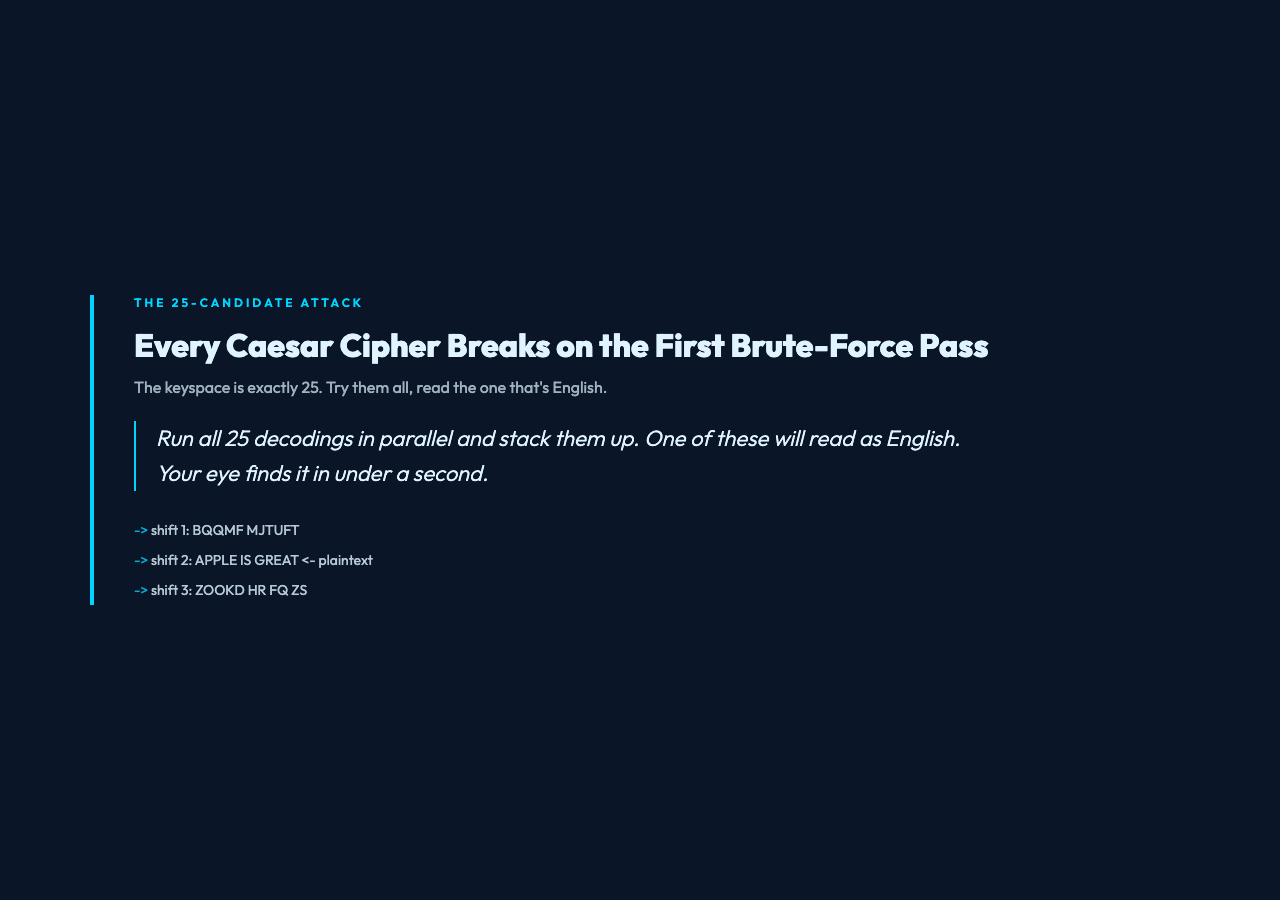
When you have ciphertext but no idea what the shift was, you try every possible shift. There are only 25 (a shift of 0 leaves the message unchanged, and a shift of 26 lands you back where you started). Run all 25 decodings in parallel and stack them up:
shift  1: BQQMF MJTUFT
shift  2: APPLE IS GREAT      ← this one
shift  3: ZOOKD HR FQ ZS
shift  4: YNNJC GQ EP YR
...
shift 25: CQBNQ JT HSBUB
One of these will read as English. Your eye finds it in under a second.
This works for any Caesar ciphertext, no matter how long. No frequency analysis required. No letter-counting, no chi-squared test, no dictionary attack. You don’t even need to know what language the plaintext is in if you recognize its shape — the correct shift is the only one that produces pronounceable output.
When the Eye Picks the Wrong Line
The only failure mode is when several shifts look vaguely plausible. Shift 13 (ROT13, the Internet’s favorite) sometimes produces text that resembles a real word in another language. A frequency analysis is a quick tiebreaker. Letter
Eis by far the most common letter in English — roughly 13 percent of letters in a long-enough message. The correct shift makes the most common letter in the ciphertext land on
E.
If two shifts produce “real-looking” English of similar character, take a step back and look at word boundaries. Spaces are preserved by the cipher, so the candidate with the most common short English words (
the,
and,
of,
to) in plausible positions is almost certainly the right one.
Where Caesar Cipher Still Earns Its Keep
It is not security. No professional uses Caesar for anything they actually want hidden.
What it is still useful for is the same thing it’s been useful for since 50 BC:
– Teaching substitution ciphers — the simplest non-trivial cipher you can write in five lines of code. – Puzzle games, escape rooms, scavenger hunts — cheap to encode by hand, easy to solve, satisfying to break. – Reddit’s daily puzzle threads, Discord spoiler tags, joke posts — everyone knows it, everyone breaks it in seconds, and that is the joke. – ROT13 as a “spoiler shield” — shift 13 applied to English text still requires an inverse shift to read, not secrecy, just a tiny hurdle before the punchline.
If you need an actual cipher, use AES, ChaCha20, or a public-key scheme. But if you want something a child can encode in a notebook and a teenager can break with a Caesar cipher tool like this one, this is your cipher.
Going Deeper: Brute Force at Scale
Most online brute-force tools handle the 25-shift sweep for short ciphertext in milliseconds. Paste the message, click “Brute force,” and you get a scrollable list of all 25 candidate decodings. Look for the line that is English.
For longer texts where brute force by hand is impractical, the same 25-shift logic generalizes. Try each shift, score the result against English letter frequency (
E,
T,
A,
O,
I,
Nare the six most common letters in plaintext), and the highest-scoring shift is the answer. This is a five-line score function.
Caesar is the canonical “warm-up cipher” taught in every cryptography class. Learn it, break it, and never use it for anything that matters.
The Real Lesson from a 2,000-Year-Old Cipher
What Caesar cipher actually teaches is what modern cryptography spends billions defending: every weakness in a cipher reduces to the size of the keyspace. Caesar has a keyspace of 25. AES-256 has a keyspace of 2²⁵⁶ — that is a 78-digit number of possible keys, more than the number of atoms in the observable universe, more than the number of seconds since the Big Bang by a factor of a billion.
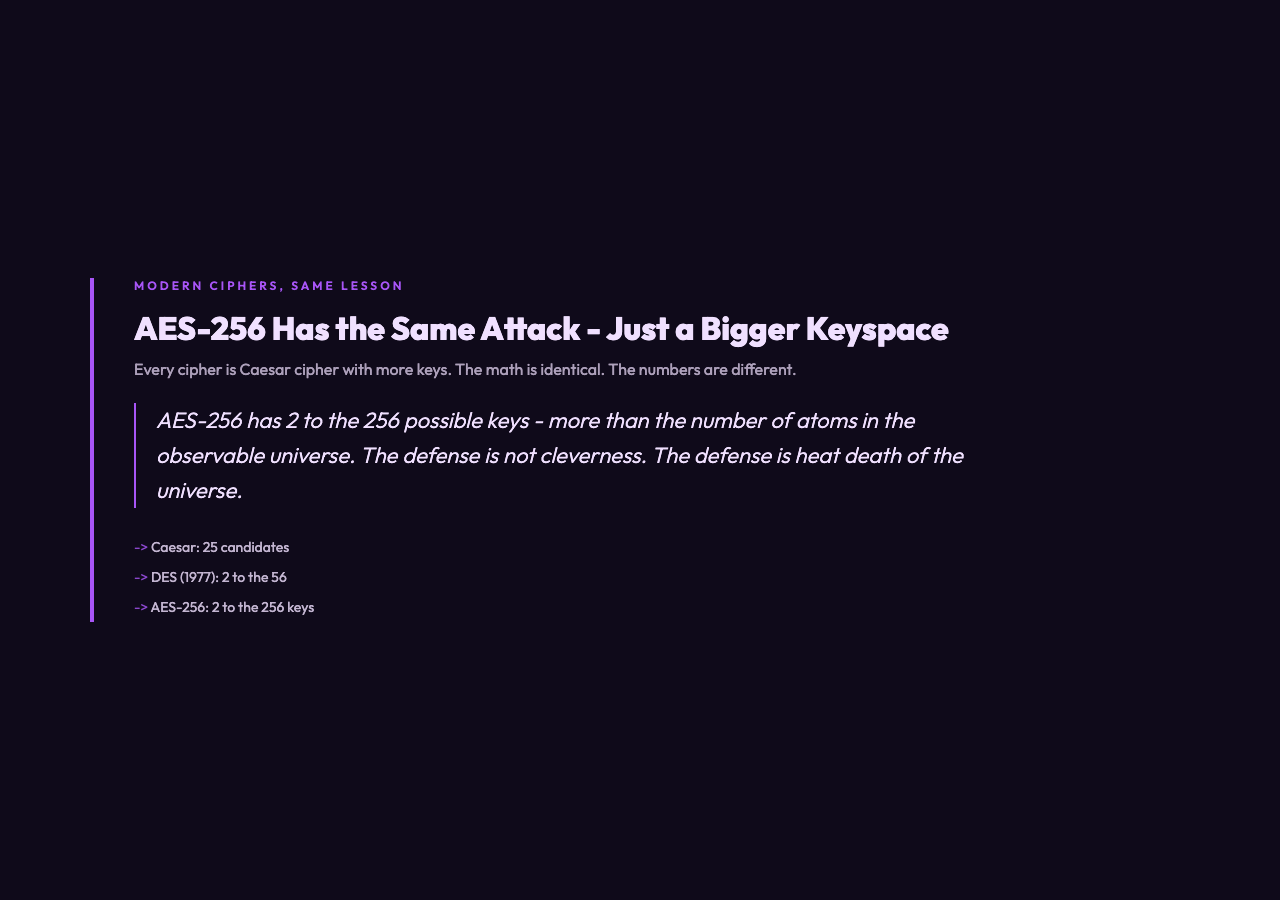
When you brute-force a Caesar message in two seconds, you are doing the same operation any attacker does against any cipher. The only thing that protects AES is that you would need to check 2²⁵⁶ candidates, and the heat death of the universe gets there first. So go paste a ciphertext into the Caesar cipher brute-force tool, watch the 25 candidates cascade down the page, and pick the one that’s English. The cipher broke before you finished reading this paragraph. That was the point.
The Next Cipher You Should Break
What happens next is the question. The point is that a cipher’s security is just the size of its keyspace — and once you internalize that, every modern cipher is just a Caesar cipher with more keys. Whether AES, ChaCha20, or a future quantum scheme survives the same trick depends entirely on whether the keyspace grew past what brute force can reach. The next cipher to study, if you want to keep going, is the Vigenère cipher — same alphabet, but the shift changes per letter, which is enough to break the 25-candidate trick and force a real attack.
Is there any reason to keep using Caesar at all? Yes, as a teaching device for the lesson that matters: every cipher is breakable, in principle, by an attacker with enough patience. Whether the patience has to last a few seconds or a few billion years is the only thing that separates Caesar from AES-256 — and whether the same is true of the next twenty ciphers you encounter is ultimately the question that matters.