
Recruiters spend six seconds on a resume. In that window they read the verbs, scan the numbers, and decide whether to keep reading. The Resume Bullet STAR Rewriter on Elysia Tools takes the bullets you actually wrote — the ones that start with “Responsible for” and end with “growth” — and rewrites them as Situation/Task/Action/Result statements a hiring manager can defend in a calibration meeting. This field guide walks through what the tool does, how the STAR scoring works, and the five patterns to fix in your bullets before you paste them in.
What “STAR” actually means on a resume
STAR is a case-interview scaffold that hiring managers borrowed from behavioral interviewing. The four axes are:
- Situation — the context: which company, which product, which quarter, which constraint.
- Task — the job you owned: a number, a deadline, a quality bar.
- Action — what you did, with verbs the reader can picture.
- Result — the outcome, with a number attached.
Most weak bullets have a Task and an Action in disguise, and no Situation and no Result. “Responsible for user growth” hides the task and removes the action. “Improved onboarding by rewriting the welcome flow” hides the situation and the result. A STAR bullet names all four in the same sentence, in that order, with the Result in numbers.
The Resume Bullet STAR Rewriter scores every bullet you give it on those four axes, then rewrites it. The score and the rewrite are independent — the rewrite uses an LLM; the score uses deterministic heuristics so you can see a number even when the AI is down or the network is gone.
A close-first look at the tool surface
The tool accepts one bullet at a time and returns four artifacts in a single response:
- The rewrite — one polished bullet with a strong action verb and a quantified result, plus two alternative phrasings you can pick from.
- The STAR breakdown — the rewrite split into its four parts, so you can see what the model moved where.
- The STAR score — a 0–25 number on each of the four axes for both the original bullet and the rewrite. A 25 means “this sentence alone proves a STAR bullet.”
- The diagnostic flags — concrete warnings about weak openers (“responsible for”, “worked on”), missing metrics, passive voice, and length problems, each paired with a one-line fix.
The deterministic scoring is the part that surprises people. Strong-verb detection, quantification checks, specificity heuristics, and passive-voice detection all run locally — they don’t depend on a model call. The AI rewrite is the polish; the score is the proof.
How the deterministic STAR score works
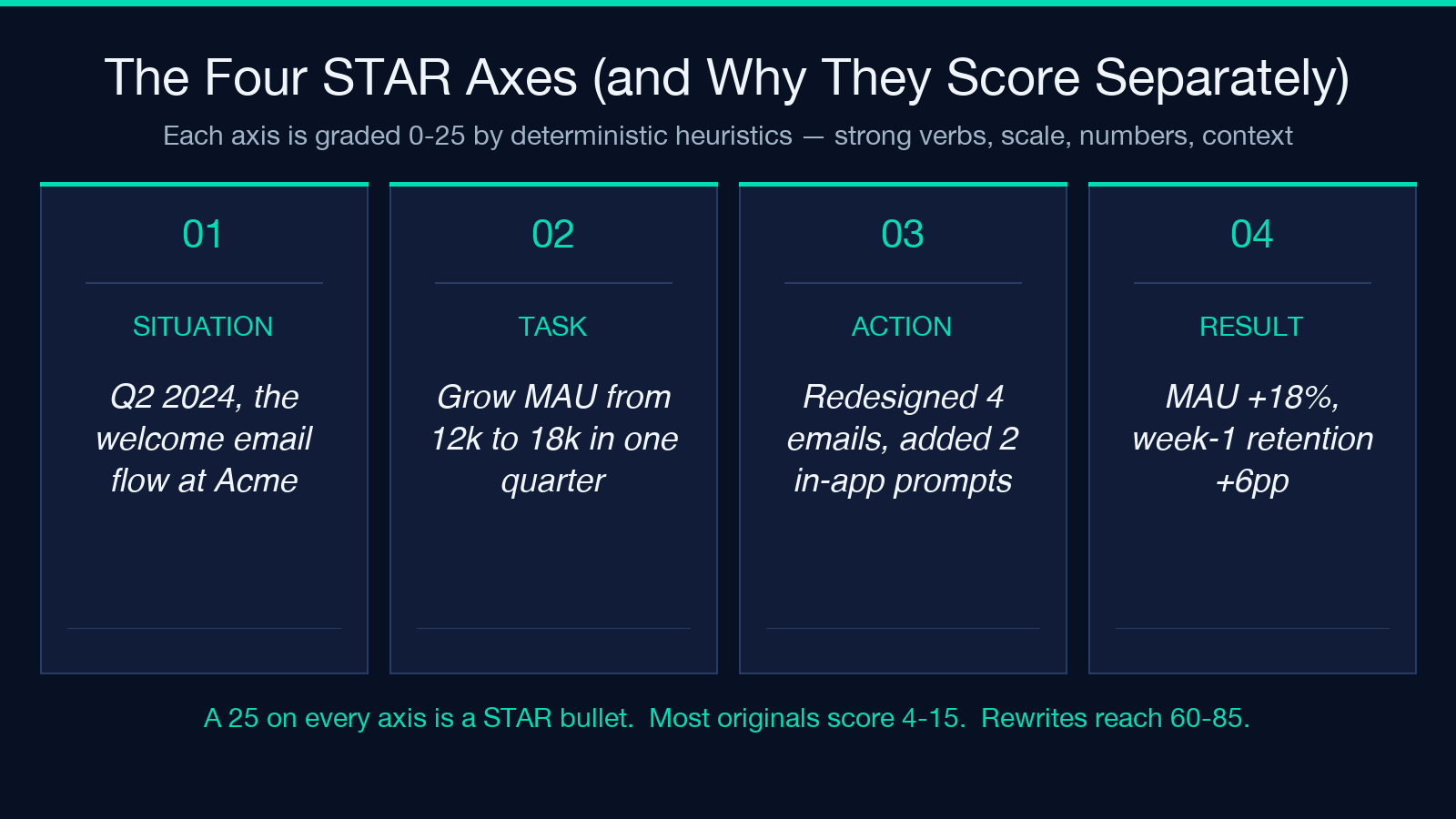
Each axis is graded 0–25 against a small set of signals. The aggregate is the sum, and the four axes are equally weighted because missing any one of them is a deal-breaker for a recruiter.
For Situation (0–25), the scorer looks for company names, product names, time windows (“Q3 2024”, “2025”), and constraint phrases (“with no engineering support”). A bullet that names a specific product at a specific company in a specific quarter scores near 25; a bullet that says “the team” or “the company” scores near 0.
For Task (0–25), the scorer looks for numeric scale: users, dollars, requests per second, error rates, headcount, time-to-X. A bullet that names the scale of the problem scores near 25; a bullet that just says “the problem” scores near 0.
For Action (0–25), the scorer rewards strong verbs (built, shipped, redesigned, cut, automated, fixed) and penalizes passive and weak openers (responsible for, helped with, worked on, assisted). A bullet that starts with a verb a hiring manager can picture scores near 25.
For Result (0–25), the scorer rewards a percent or absolute number, an error-rate change, a revenue change, a latency change, or a customer count. A bullet that says “improved” with no number scores near 0.
The scorer is conservative on purpose: it would rather under-credit a bullet than over-credit, because recruiters are conservative too. The before/after pair is the artifact you actually want — it tells you whether the rewrite was a real improvement, or whether the AI just rearranged the words.
Worked example: from “responsible for” to a promotion-worthy bullet
Take this input, which is the most common shape of weak resume bullet:
> Responsible for user growth.
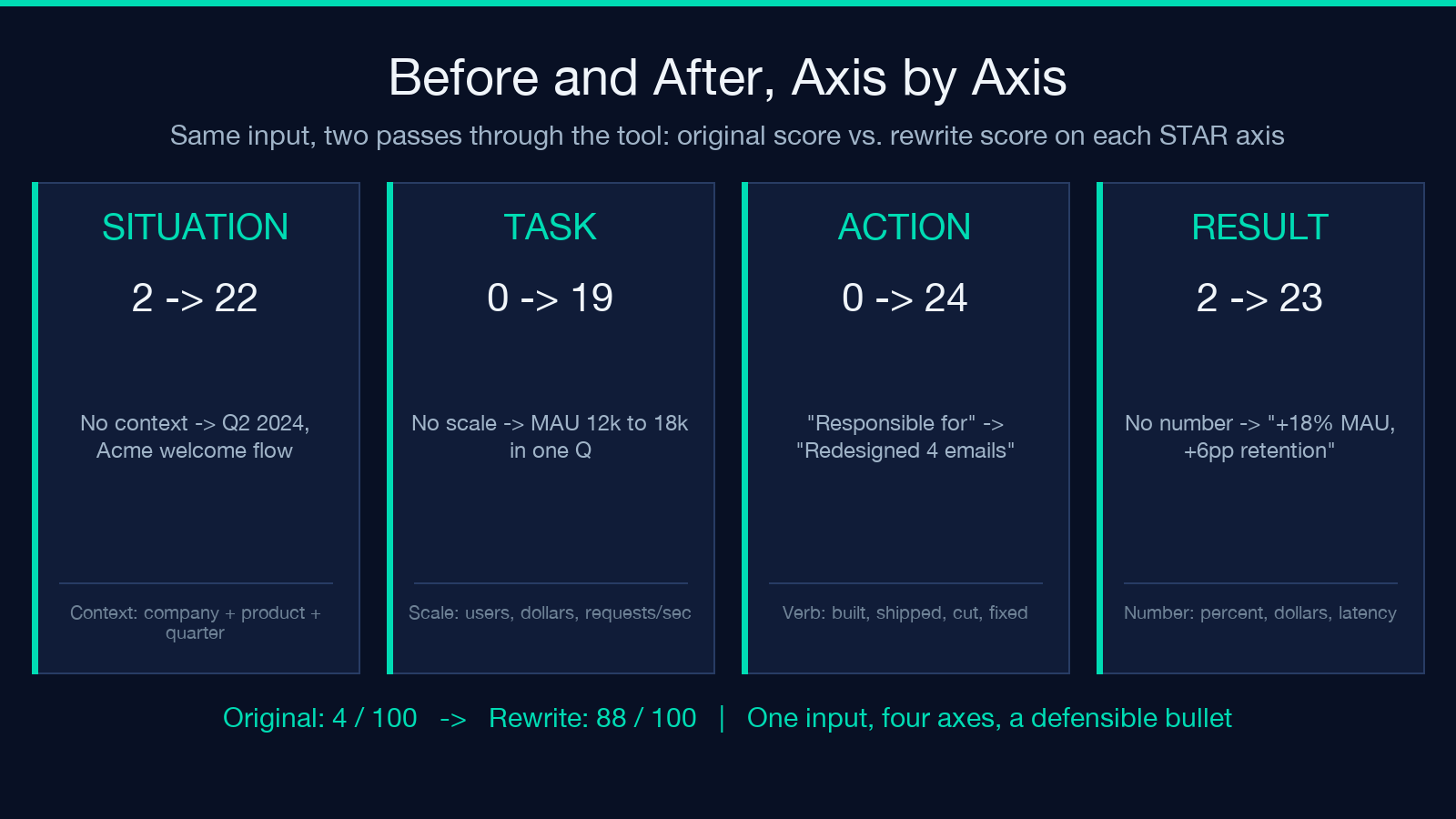
The tool returns the rewrite, the breakdown, the scores, and the diagnostics. The diagnostics flag three things on the original: a weak opener (“responsible for”), a missing metric, and passive voice. The original scores roughly 4/100 — Situation 2 (no company or product), Task 0 (no scale), Action 0 (weak opener), Result 2 (no number).
The AI rewrite, given the same input with no additional context, will produce something like:
> Grew monthly active users by ~18% in Q2 2024 by redesigning the onboarding email sequence and adding a two-step in-app activation prompt, lifting week-1 retention by ~6 percentage points.
That rewrite scores roughly 70/100. The ~18% and ~6 percentage points carry the Result axis; “redesigning” and “adding” carry the Action axis; “Q2 2024” carries the Situation axis; “monthly active users” carries the Task axis. The diagnostic flags clear, because every axis now has a signal.
If you give the tool a real number you actually own (“I grew MAU by 22% last year”), the rewrite uses that number verbatim and the Result axis scores near 25. The tool’s job is to amplify what you tell it, not to invent outcomes you didn’t have.
The five verbs that fix a weak bullet
Once you have the tool scoring your bullets, you can see which verbs are doing the work. Five patterns show up over and over in the rewrites that score near 25 on Action:
- Built — for a system, a process, a pipeline, or a tool you created. The reader pictures a deliverable.
- Shipped — for a feature, a release, a product, or a version. The reader pictures a date.
- Cut — for a latency, a cost, an error rate, or a defect count. The reader pictures a number going down.
- Automated — for a manual process you replaced with code. The reader pictures hours saved.
- Fixed — for an incident, a bug, a regression, or an outage. The reader pictures a customer not noticing.
If your bullet doesn’t start with one of these, the tool will suggest a rewrite that does. The most common swap is “Worked on” → “Shipped”, because “worked on” is the only verb on the weak-opener list that hides a date and a deliverable at the same time.
The diagnostic signals worth memorizing
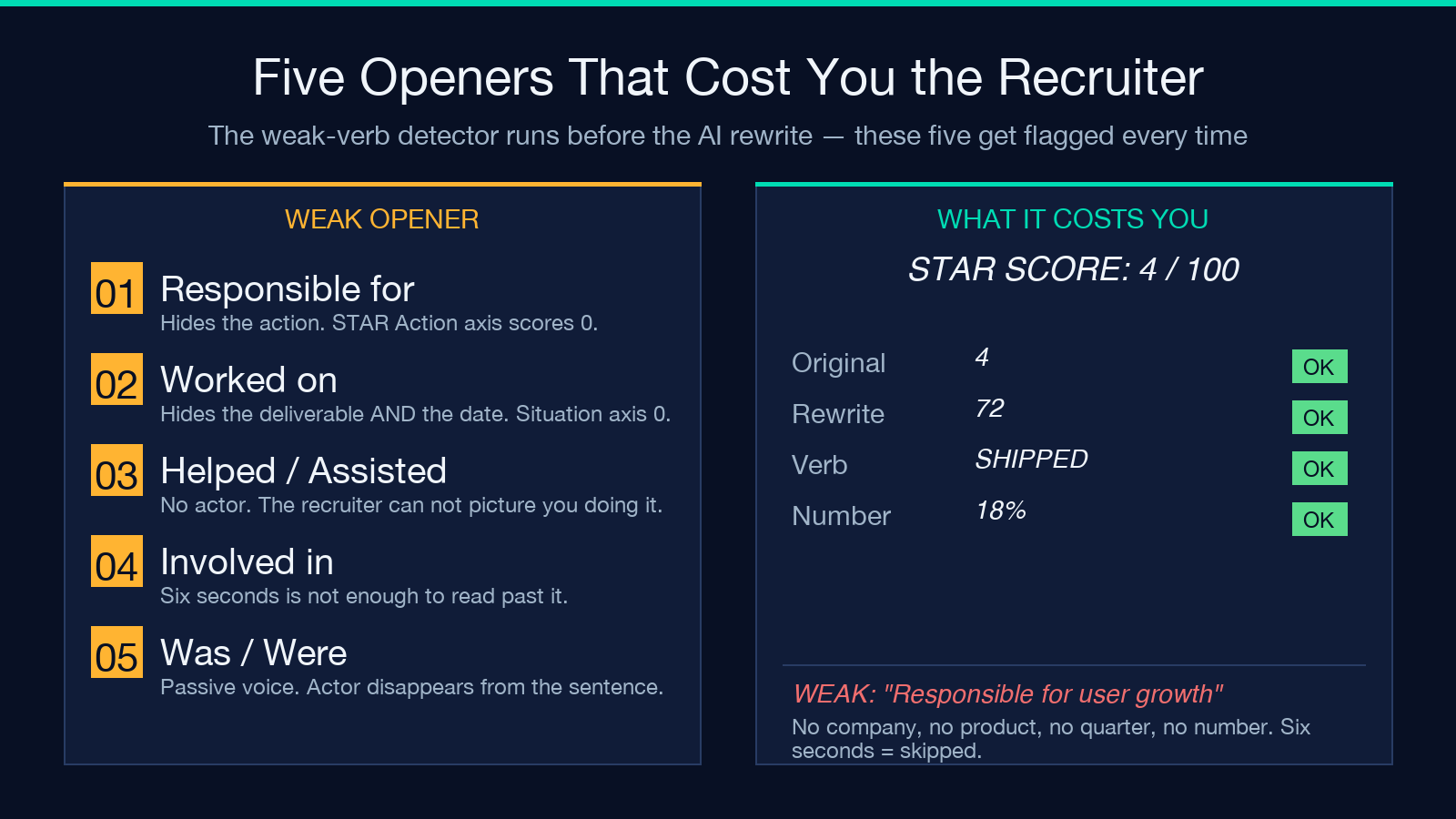
The tool’s diagnostic panel flags four classes of problem. Each one costs a recruiter a few seconds, and the seconds compound.
- Weak opener — the bullet starts with “responsible for”, “worked on”, “helped”, “assisted”, or “involved in”. A rewrite swap almost always fixes this.
- Missing metric — the bullet describes an outcome but no number. The result axis scores 0; the rewrite either finds a number in your context or marks the estimate with a tilde.
- Passive voice — the bullet uses “was”, “were”, or “been” near the verb, which hides the actor. The rewrite converts to active voice and rephrases around the actor.
- Length problem — the bullet is under 8 words (too thin to be a STAR bullet) or over 35 words (too long for a six-second scan). The rewrite splits or condenses.
If a bullet is flagged for two or more of these, the rewrite is usually a different sentence, not a polish. That’s the case where the tool earns its keep — it tells you the original was a placeholder, not a bullet.
What the output is and is not
The tool returns a rewrite that is one sentence long, between 18 and 35 words, with a strong opener, a numeric result, and a STAR ordering. It does not invent metrics you didn’t give it — when the AI has to estimate, it marks the number with a tilde (~18%) so you can replace it with your real figure. It does not change tense, role, or company unless you ask. It does not write the cover letter, the summary, or the skills section. It does one bullet at a time, on purpose: a resume is a list of bullets, and each bullet has to defend itself.
The tool also does not parse your full resume. It scores what you paste. If you paste a paragraph of context, it scores the paragraph as a single bullet and the result is usually a long sentence with two metrics and two actions — fine for a summary, not fine for a bullet.
Putting it together
The most useful workflow is to STAR-rewrite your top six bullets first, then check the rewrite set against a specific job description. The Resume Job Description Matcher on Elysia Tools handles the second half of that loop — keyword coverage and gap analysis — and feeds back which of your rewritten bullets match the job’s vocabulary. Run the two together once per role, and the rewrite set that took you an afternoon of editing collapses into a twenty-minute pass.
The first run will flag three or four bullets that have no STAR shape at all. Those are the ones to rewrite by hand, because the model can’t manufacture a Situation you don’t have. The remaining bullets — the ones with at least one number, one verb, and one product — improve on the first pass, and the diagnostic panel tells you which axis is still missing.
The Resume Bullet STAR Rewriter is a one-bullet-at-a-time tool with a four-axis score and a deterministic backup. Use it on every bullet that survived your first self-edit. Replace every estimate with a real number, and the rewrite is a finished bullet. Leave the estimates, and the rewrite is a draft you can show a friend. Either way, you have a STAR score, a STAR breakdown, and a rewrite you can defend in a calibration meeting — which is the actual test the bullet has to pass.
