
A light-year is not a year of light. It is a distance measured in meters, defined by multiplying the speed of light by the length of a Julian year. The Light-Year & Astronomical Unit Converter keeps every conversion honest against the IAU 2012 constants, runs the small-angle parallax helper on demand, and lets you choose between scientific and locale-formatted output depending on whether the number ends up in a paper, a textbook, or a planetarium slide.
This field guide walks through what the IAU actually defines, how the four conversions (ly, pc, AU, km/m) interlock, the parallax helper that turns an arcsecond angle into a distance in parsecs, the four real-star distances worth memorizing, and the four pre-flight checks that catch bad input before any conversion runs. Skip to any section from the table of contents below.
How the IAU 2012 constants lock down the scale
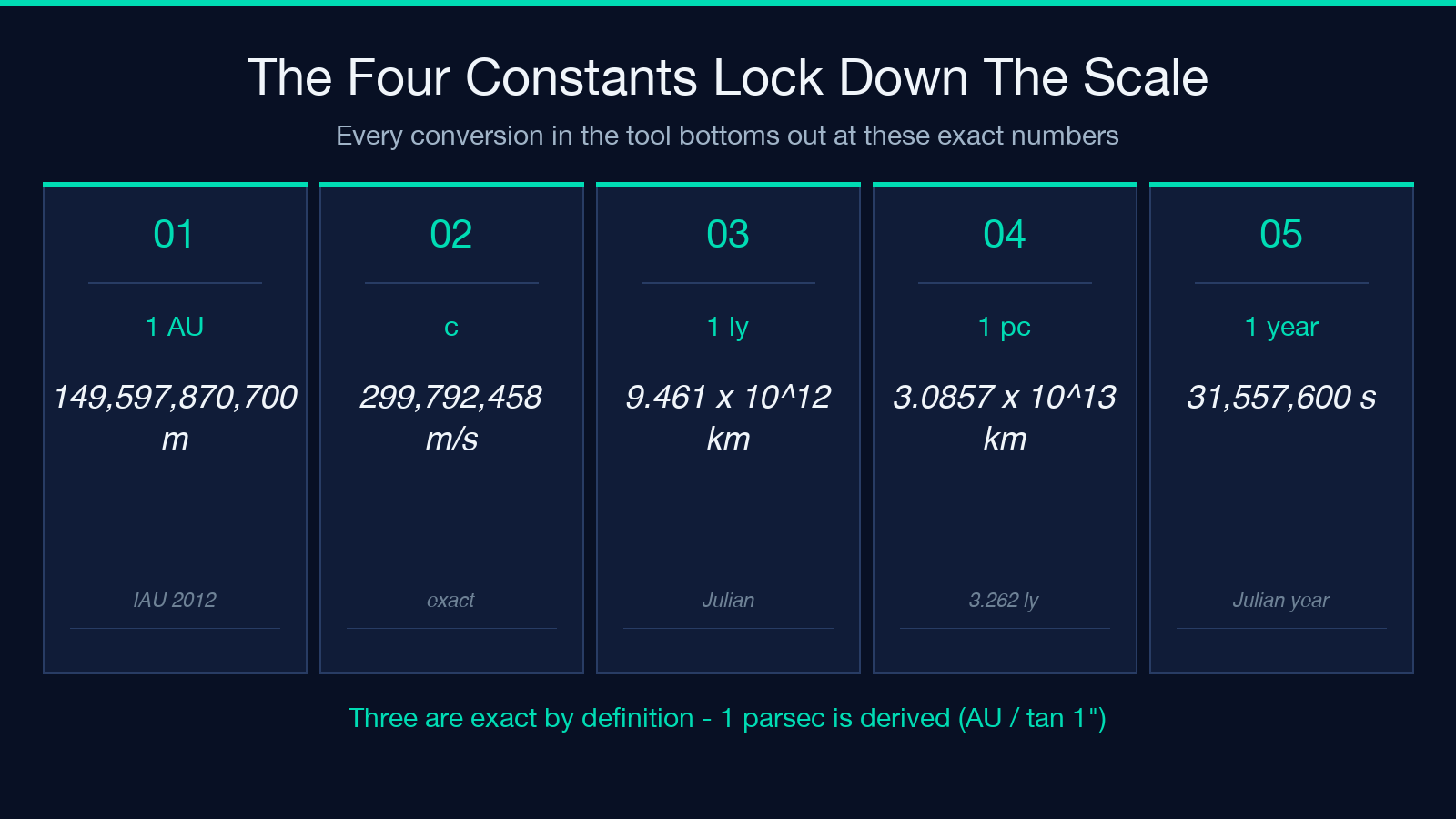
Every conversion in this tool bottoms out at four numbers, three of which are exact by international definition and one of which is exact by physics:
- 1 AU = 149,597,870,700 m — the astronomical unit, fixed to be exact by the IAU 2012 resolution. The meter is now defined in terms of the speed of light, so the AU is the cleaner of the two: it has no measurement uncertainty, just a definition.
- c = 299,792,458 m/s — the speed of light in vacuum, exact by the 1983 SI redefinition. Whatever distance you compute with it carries no propagation error from the constant itself.
- Julian year = 365.25 d = 31,557,600 s — the IAU’s choice of “year” for astronomical work. The Julian year has 365.25 days, not 365.2425 (Gregorian) and not 365 (Julian calendar). The light-year’s distance depends on this choice — pick a different year and you get a different meter count.
- 1 parsec = AU / tan(1 arcsec) — derived, not stored. The parsec is the distance at which 1 AU subtends an angle of 1 arcsecond, so the conversion
pc = AU / tan(1″)is a definition, not a measurement. Working out:pc = 149,597,870,700 / tan(1/3600 deg) ≈ 3.0857 × 10¹⁶ m, which is roughly 30.857 trillion kilometers or 3.262 light-years.
The tool encodes all four. The ly is computed as c × Julian year ≈ 9.461 × 10¹² km. The parsec is computed from the AU using the small-angle formula. You are not measuring anything; you are applying definitions.
A practical consequence: the tool’s “scientific notation” output for a 1 AU → m conversion gives 1.495978707 × 10¹¹, which is exact. The same conversion to km gives 1.495978707 × 10�. Neither carries an error bar, because neither is a measurement — they are two different ways of writing the same number.
Converting across ly, pc, AU, km, m
The conversion table is one multiplication (input × meters-of-source-unit) followed by N divisions (one per target unit). For each source unit, the meters factor is:
- ly —
9.4607 × 10¹⁵ m(light travels 9.4607 petameters in a Julian year) - pc —
3.0857 × 10¹⁶ m(about 30.857 trillion km) - AU —
1.495978707 × 10¹¹ m(exact by IAU 2012) - km —
1.0 × 10³ m - m —
1 m(trivially)
The relative scales are the fun part. One parsec is about 206,265 AU (the same factor that relates AU to km when measured from the Earth’s orbit — a circle of coincidence). One parsec is about 3.262 light-years, which is the answer to “why do surveyors and the popular press use different units for the same star”. One light-year is about 63,241 AU. One AU is about 8.317 light-minutes (the Sun’s light reaches Earth in 8 min 19 s).
The tool’s conversion table renders all five units side-by-side, with a logarithmic scale bar showing the relative span. The bar is log10-scaled: 1 m occupies a single pixel slice on the left, 1 ly occupies roughly 16/16 of the bar, and AU, km, pc, m drop in between in their natural positions. The visual is the clearest way to internalize that “kilometers” and “light-years” are not units at the same altitude — they are sixteen orders of magnitude apart, and no amount of decimal precision makes them comparable in a single line of text.
The parallax-angle → distance helper
The parsec exists because of stellar parallax. A star 1 parsec away shows a 1-arcsecond angular shift against the background as the Earth orbits from one side of the Sun to the other (six months apart, baseline 2 AU). The small-angle relation d[pc] = 1 / π[arcsec] holds for any reasonable stellar distance — for nearby stars where the angle is measurable in arcseconds, the approximation is exact to many significant figures.
The tool’s parallax field takes a positive arcsecond value and computes the distance in all four astronomical units. Three examples that come up over and over:
- Proxima Centauri, π ≈ 0.7685″ — distance
1 / 0.7685 = 1.301 pc≈ 4.244 ly ≈ 268,400 AU. The closest star to the Sun, and the canonical example for “what a measurable parallax looks like”. - Sirius, π ≈ 0.3792″ — distance
1 / 0.3792 = 2.637 pc≈ 8.60 ly ≈ 555,000 AU. The brightest star in the night sky, and a useful sanity check because most amateur astronomy guides quote its distance in light-years. - Andromeda galaxy, π ≈ 0.000167″ — distance
1 / 0.000167 = 5,988 pc≈ 19,531 ly ≈ 1.255 × 10⁹ AU. Here the parallax is well below 1 arcsecond and the small-angle formula still holds, but the measurement itself is at the limit of what ground-based instruments can resolve. Hipparcos measured it, Gaia measured it more precisely.
The parallax field is optional. Leave it blank if you are converting a known distance and do not want a parallax card rendered. The tool validates that the parallax is positive and finite — a 0 or negative value silently returns no parallax card, because parallax is undefined at zero angle and meaningless at negative angle.
The same small-angle relation is what the Galactic / Equatorial Coordinate Converter uses internally when mapping between coordinate systems measured in degrees and the high-precision arcsecond / milliarcsecond forms that catalogs publish in. If you are doing parallax work in any quantity of stars, that tool is the one you reach for when you need to convert angles to the IAU-standard epoch coordinates.
Real numbers worth memorizing
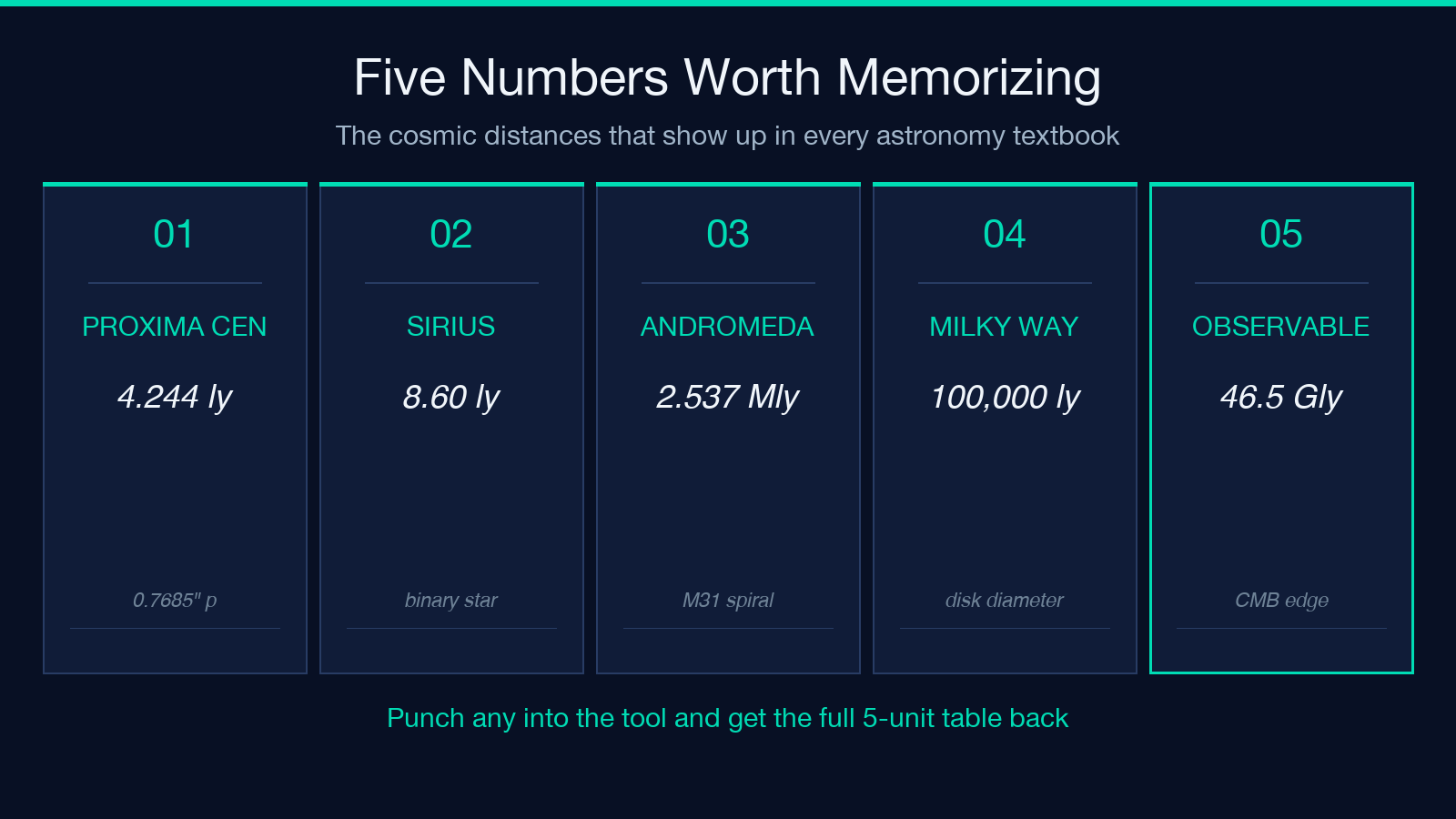
A handful of cosmic distances are worth knowing by heart, because they appear in textbooks, in planetarium shows, and in any conversation that touches deep-sky objects. The tool lets you punch any of them in and get the full five-unit table back:
- 4.244 ly — Proxima Centauri. The closest star to the Sun. If you only memorize one number from this list, memorize this one.
- 8.60 ly — Sirius. The brightest star in the night sky (and a binary). Most popular-science articles quote its distance in light-years.
- 2.537 million ly — Andromeda galaxy (M31). The closest large spiral galaxy. At this distance the parallax is 0.000167 arcsec and the light we see tonight left the galaxy when Homo erectus was still the dominant hominin on Earth.
- 100,000 ly — Diameter of the Milky Way disk. A rough number, but the right order of magnitude. Stars at the far edge of the disk are about 100,000 ly from the galactic center.
- 46.5 billion ly — Radius of the observable universe. The cosmological-horizon distance, not the light-travel-time distance: the universe expanded faster than light for part of its early history, so what we see at the cosmic microwave background is now 46.5 billion ly away, not 13.8 billion.
The full conversion of 46.5 billion ly into AU gives roughly 2.94 × 10²⁴ AU. In parsecs it is roughly 14.3 billion pc. The unit arithmetic is the same — you are just choosing which exponent to display.
For orbital work at the planetary scale (rather than the stellar scale), the Kepler Orbit Solver handles the inner solar system distances — the AU scale where a light-year becomes cumbersome. The two tools are complementary: this one for the parsec and beyond, Kepler for the AU and below.
Why the parsec is the surveyor’s choice
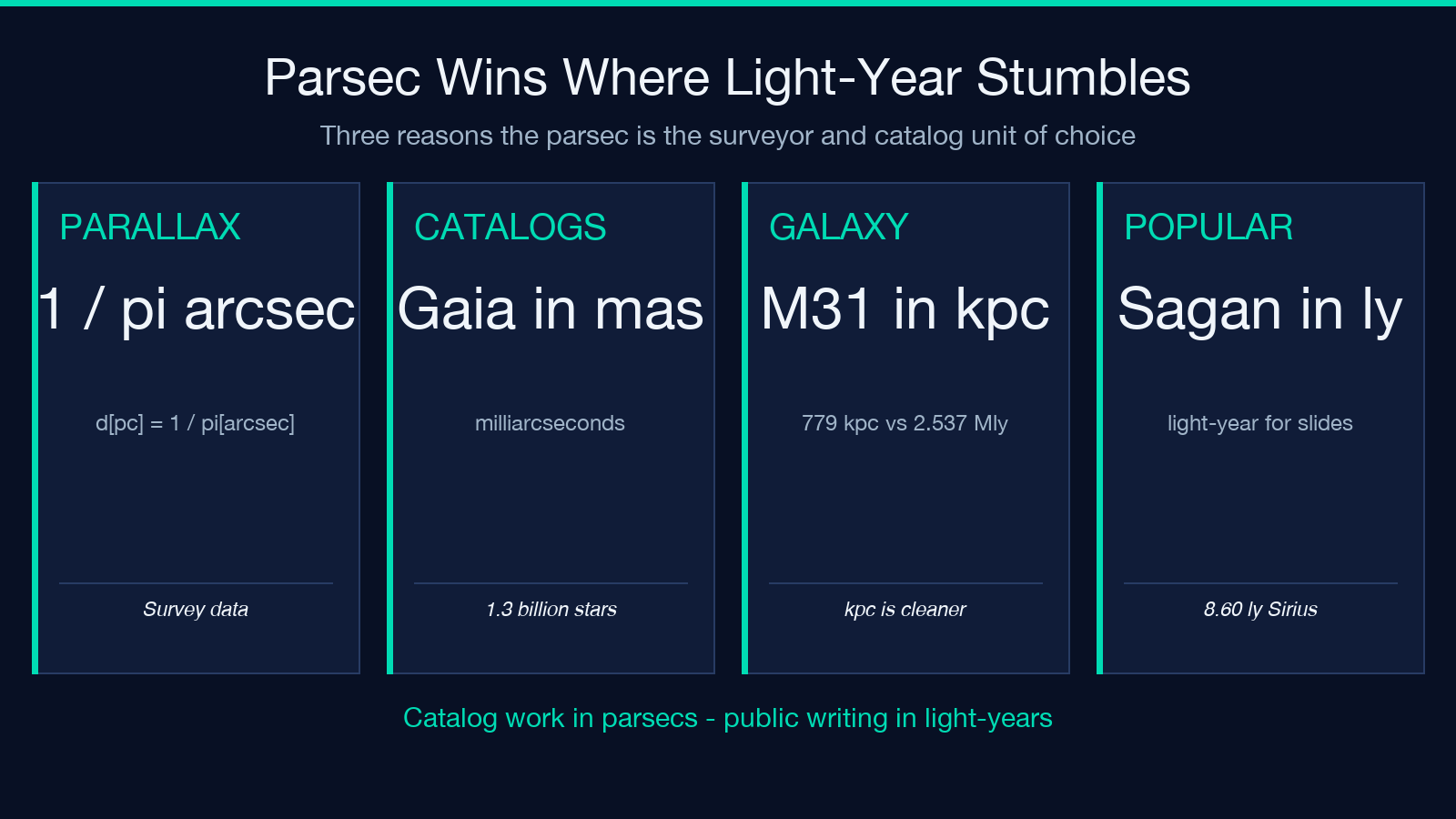
Surveyors, the Hipparcos catalog, the Gaia catalog, and most professional astronomy journals measure stellar distances in parsecs, not light-years. There are three reasons, and all three matter:
- Inverse parallax is the parsec — when the measurement you take with a telescope is an angle in arcseconds, the natural derived unit is parsecs. Gaia’s catalog entries are
parallax (mas)anddistance (pc); converting to light-years requires an extra step that does not add information. - Parsecs stay clean at distance — Andromeda at 2.537 Mly is 779 kpc. The Magellanic Clouds at 160 kly and 200 kly are 49 kpc and 61 kpc. The parsec form stays readable through the entire range of galactic astronomy; the light-year form starts using long-word prefixes (kilo-, mega-, giga-) earlier.
- Popular science uses light-years — Carl Sagan, planetarium shows, and most news articles about new exoplanet discoveries quote light-years because the unit name carries the speed-of-light intuition. Astronomers keep parsecs for their catalog work and convert when they talk to the public.
The tool’s “scientific notation” toggle matters here. For a survey catalog you want 0.7685 in arcseconds or 1.301 in parsecs — three or four significant figures, no exponential. For a planetarium slide or a popular-science article you want 4.244 ly or 2.537 × 10⁶ ly — the same number, but the light-year form carries the conceptual weight. The tool lets you switch by toggling the scientific notation checkbox, and the decimal-places slider controls how many significant figures the locale-formatted output keeps.
Format choice: scientific vs locale-formatted
The tool exposes a single “scientific notation” checkbox and a decimal-places slider. The combination matters more than either control alone.
- Scientific on, decimals 4 — for distances above 10¹⁵ m or below 10⁻⁴ m, the tool falls back to scientific even if you did not ask for it. The fallback is at 10¹⁵ and 10⁻⁴ specifically, because anything outside that range loses readability in plain decimal form. Andromeda in scientific with 4 decimals reads
2.5370 × 10⁶ ly; in plain decimal with 4 decimals it reads2,537,000 ly. Both are correct; the scientific form makes the magnitude visible at a glance. - Scientific off, decimals 6 — the “I’m writing this in a paper” mode. The locale formatter uses en-US thousands separators, so 4.244 ly stays
4.244and 149,597,870.7 km reads149,597,870.7. Six decimals catches the meter-level precision the IAU definition of 1 AU carries. - Scientific on, decimals 0 — the “I’m presenting this on a slide” mode. 4.244 ly reads
4 ly; 2,537,000 ly reads3 × 10⁶ ly. Loses precision, gains readability. The decimal slider is your friend when you want a specific rounding behavior. - Scientific off, decimals 12 — the maximum precision the tool will emit. Useful for catalog work where you need every digit of a parallax-derived distance. The internal computation carries JavaScript double precision (about 15-17 significant digits), so decimals above 12 start showing the underlying float representation rather than physical precision.
A common mistake is leaving decimals at 6 and toggling scientific on and off without checking the output — at 6 decimals with scientific off, Andromeda’s distance reads 2,537,000.000000 ly, which implies precision the parallax measurement does not have. Drop decimals to 4 or use scientific form to honestly communicate the magnitude.
For converting the resulting numbers into a different representation — say, from the 9.4607 × 10¹⁵ form to 9.4607e15 or to a power-of-ten table — the Scientific Notation Converter handles the format swap without losing the magnitude information. The Angle Converter handles the arcsecond-to-degree leg of any parallax work that needs to compare against degrees rather than arcseconds.
Pre-flight validation: catching malformed input
Before any conversion runs, the tool rejects input that does not parse. The checks are short and worth knowing, because the same checks apply to any pipeline you write that consumes user-supplied distance values:
- Non-negative value — the value field is a non-negative number. Negative distances are physically meaningless and the tool returns
Value must be a non-negative numberwithout attempting a conversion. This is the right behavior — astronomical distances are unsigned scalars. - Known source unit — the from-unit select offers exactly five choices: ly, pc, AU, km, m. Anything else (typos, custom abbreviations, empty strings) returns
Unknown source unit. The whitelist is intentional: adding more units without a verified IAU definition would propagate unverified constants. - Decimal places clamped — the decimals slider accepts any positive integer but clamps to the range 0-12. Anything outside the range falls back to the default of 6. This guards against the user accidentally asking for 100 decimals and getting a number that is mostly float-representation noise.
- Parallax positive and finite — the parallax field, if non-empty, must parse as a positive finite number.
0means infinite distance (undefined parallax),-1is meaningless,InfinityandNaNare caught by the finite check. The tool returns a warning card without aborting the conversion: the value/parallax conversion completes, and the parallax card is suppressed.
If you are piping the tool’s output into a downstream pipeline, validate the result the same way. A successful conversion always produces finite numbers in all five units; a failed conversion produces empty strings and an error message. Treat empty strings as “do not use this number” rather than “this is zero”.
Putting it together
A light-year is a fixed number of meters; a parsec is a fixed number of AU plus a tangent; an AU is a fixed number of meters. The tool’s job is to keep those definitions honest while letting you read the result in whichever unit your audience expects.
If you are writing for a professional astronomy audience, convert to parsecs and present in scientific notation at 4-6 decimals. If you are writing for a general audience, convert to light-years and present in locale-formatted form at 0-2 decimals. If you are computing a parallax-derived distance, leave the parallax field on and let the tool render the small-angle calculation in all four units side by side.
The four numbers to memorize are 4.244 ly (Proxima Centauri), 8.60 ly (Sirius), 2.537 Mly (Andromeda), and 46.5 Gly (the observable universe). Punch any of them into the Light-Year & Astronomical Unit Converter and you get the full five-unit table back. Pair it with the Kepler Orbit Solver for AU-scale orbital work, the Galactic / Equatorial Coordinate Converter when you need to map stellar positions between coordinate systems, and the Scientific Notation Converter when you need to reformat the magnitudes for a paper or a slide. Explore more astronomy and conversion tools at elysiatools.com.
