
A VIN is not a serial number you read top-to-bottom. It is a 17-character contract that carries the year, the plant, the engine family, the restraint system, and a check digit that was designed by the U.S. Department of Transportation in 1981 specifically so a typo would not survive a typing pass. The characters look interchangeable — alphanumeric, uppercase, no I/O/Q. But once a fleet importer pastes a column of VINs into a database, a single transposed digit propagates into insurance, registration, parts ordering, and recall lookups. The VIN Validator at Elysia Tools checks all three layers (length, character set, ISO 3779 mod-11 check digit) in a single pass and tells you which rule tripped. That is the difference between cleaning ten thousand rows by hand and asking your database which row to flag.
The Three-Layer Test Every Valid VIN Passes
A real, typeable, road-legal VIN satisfies three independent rules at once. Drop any one and the VIN is at best a model number, at worst a fabricated string that will match nothing in the NHTSA database.
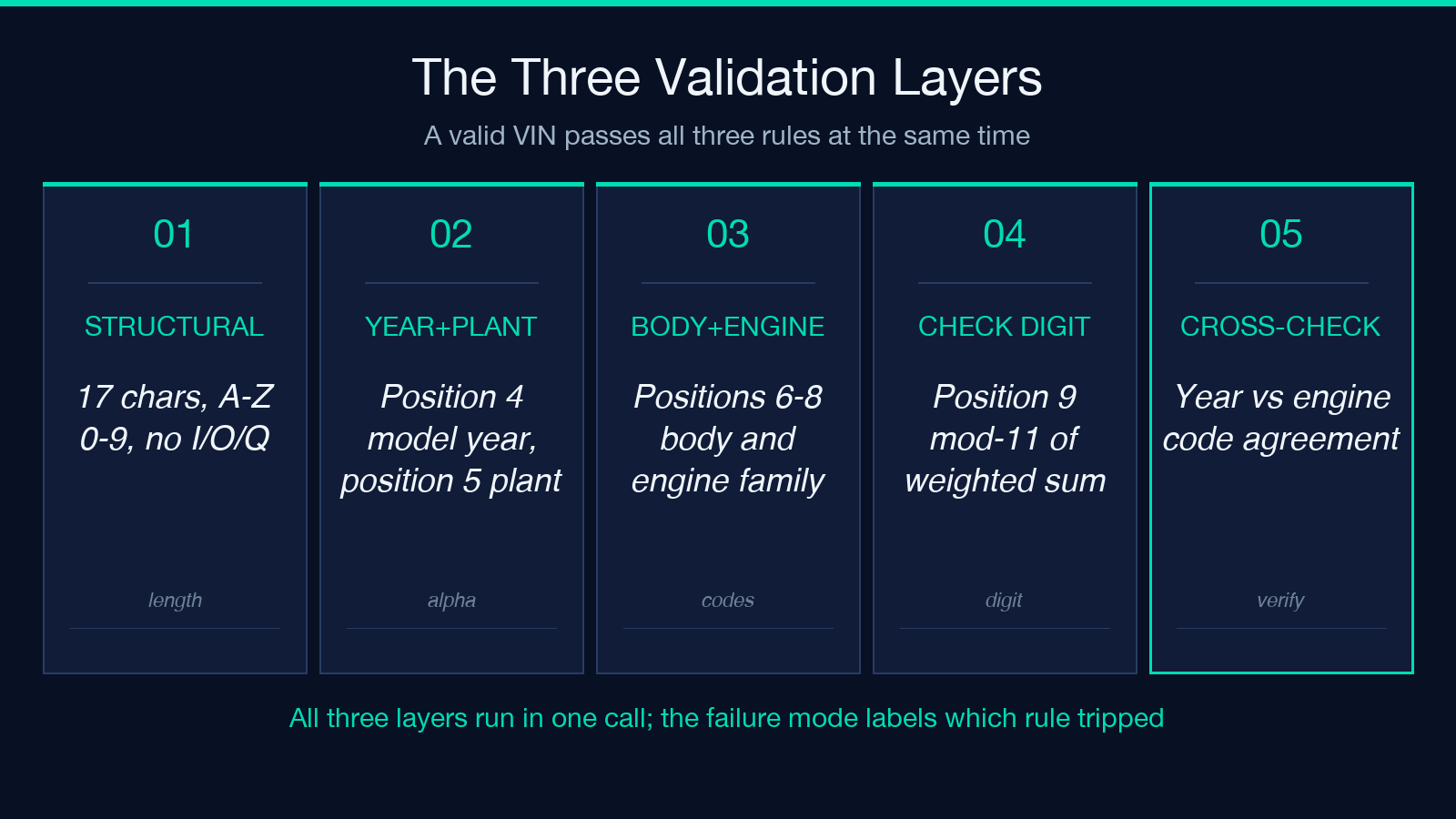
Layer one is structural. Seventeen characters exactly. The alphabet is A through Z plus digits 0 through 9. The letters I, O, and Q are forbidden because they look like 1 and 0 in stamped metal. If you are looking at a VIN with a lowercase letter, a hyphen, or eighteen characters, you are looking at a number that has been hand-edited and is no longer what the manufacturer printed on the dashboard.
Layer two is the year-and-plant code. Position four tells you the model year (encoded against the model-year table that resets every thirty years to avoid ambiguity), position five the plant, positions six through eight the body and engine family, position nine the check digit. This is the layer most importers miss, because the encoding of “model year” looks like a random letter if you read it as a serial number.
Layer three is the check digit itself. Position nine is computed by weighting every other position by the SAE J853 table (8-7-6-5-4-3-2-10-0-9-8-7-6-5-4-3-2), substituting the letter values (A=1, B=2, … I=9, K=2, …), summing, and taking mod 11. The result is a digit 0-9 or the letter X. If position nine does not match the recomputed value, the VIN is either miscopied or counterfeit. This is the only layer that catches a single transposed digit; the structural and year-code layers will both happily accept a typo.
A VIN Validator that only checks length is doing one-third of the work. To trust the number, you need all three. The Elysia Tools VIN Validator runs all three in one call and returns which rule failed.
Why Position Nine Is the Layer That Catches Real Errors
The structural and character-set rules will accept almost any 17-character uppercase A-Z 0-9 string that excludes I, O, Q. If a typo only changes the case or introduces a hyphen, both rules fire. But if a fleet data entry clerk transposes the seventh and eighth characters — both valid body-shape codes — neither the length rule nor the character set rule fires. The year-code layer also passes, because position four is unchanged.
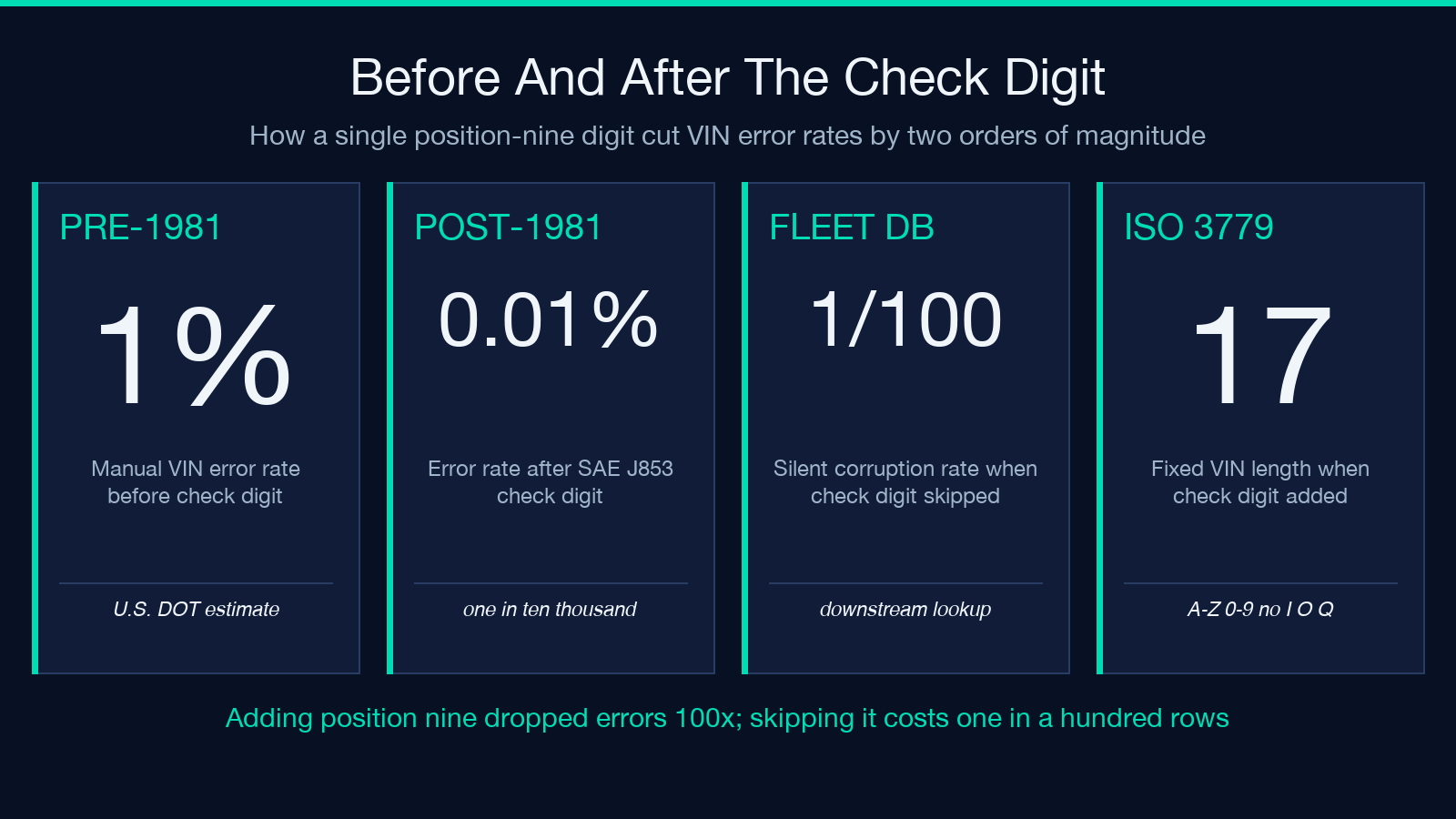
The check digit is the only layer that depends on the entire string. Transpose any two characters and the weighted sum changes by a non-zero delta that almost never equals zero mod 11. This is why the check digit was added in 1981 and not removed when VINs moved to a fixed 17-character format. Before the check digit, the U.S. DOT estimated the manual VIN error rate at roughly one percent; after, it dropped to roughly one in ten thousand for vehicles with valid check digits.
A database that ingests VINs without re-running the check digit will silently corrupt about one in a hundred rows on average. Insurance quotes will be wrong. Recall lookups will return “no record found” for vehicles that have outstanding recalls. Parts catalogs will suggest the wrong engine. Each of these failures is recoverable at ingestion, and very expensive to debug after the customer notice.
The Four Failure Modes You Will See in the Wild
The same four patterns cover almost every real-world VIN failure.
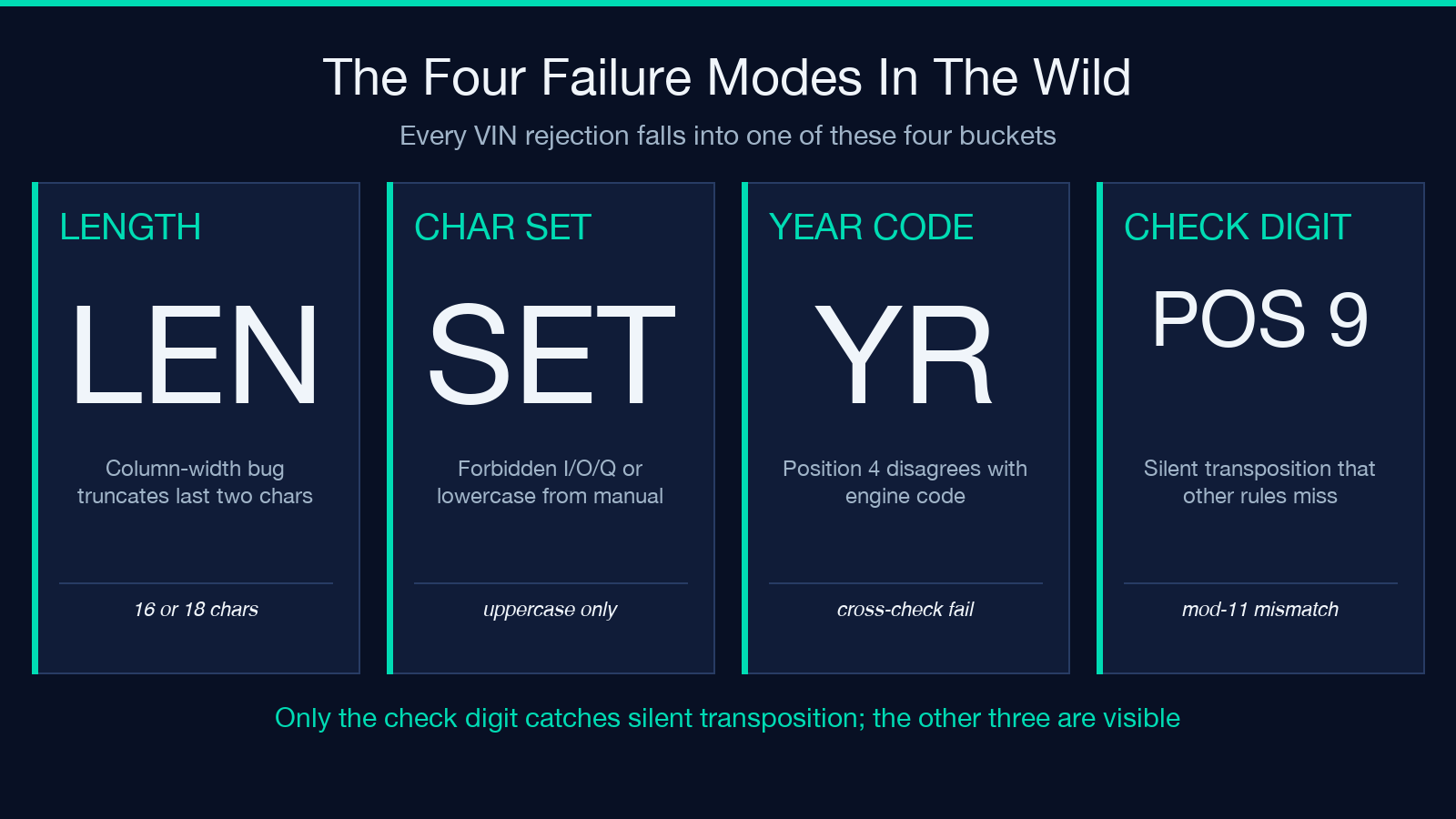
Length errors are the easiest to diagnose and the most common. They come from spreadsheet editors stripping leading characters, copy-paste from PDFs adding trailing whitespace, or fields wider than the database column truncating the last two characters. A “16-character VIN” or “18-character VIN” is almost always a column-width bug.
Forbidden characters (I, O, Q, lowercase letters, hyphens, spaces) typically come from manual data entry or OCR. A VIN stamped on the dashboard is uppercase, no exceptions, because the metal stamp does not support lowercase and the standard forbids I/O/Q.
Year-code mismatches are subtle. Position four says “G” (2016) but the year-and-plant decoding says the vehicle cannot have been built in 2016 because of the engine code in positions seven and eight. This happens when a fleet reuses a VIN template across model years — sometimes legitimately, sometimes by fraud. Only the cross-check between position four and the body codes catches it.
Check-digit mismatches are the dangerous ones because they are silent. The VIN looks valid, passes every regex, but the weighted sum mod 11 disagrees with position nine. This is the only failure mode that the check digit catches and the others miss. If you strip the check-digit step to save CPU, you are accepting a one-in-a-hundred ingestion error rate.
When You Should Validate Client-Side vs. Server-Side
The right answer is both, but for different reasons.
Client-side validation — in a form, in a spreadsheet, in a CSV uploader — gives the user immediate feedback. They paste a column of VINs and see the bad ones flagged before they hit submit. This is the right layer to enforce length and the forbidden-character set, because both are visual feedback the user can act on.
Server-side validation is the layer that matters for the database. It re-runs every rule, including the check digit, on the data the server actually receives. The client can be bypassed (developer tools, scripted uploads, third-party integrations), so the server is the only layer that protects against bad data entering the system. The check digit, in particular, must be re-checked on the server.
A clean architecture runs the same validator twice: once in the browser as the user types, once on the server when the form submits. The browser catches typos at human speed. The server catches typos at machine speed, including ones that come from a programmatic importer.
The Subtle Case of Re-Validation After Database Migration
If you are migrating VIN data from a legacy database to a new system, you have to re-validate every row, not just trust the new system’s import log. Legacy databases often stored VINs with hyphens, lowercase letters, or trailing whitespace that the import silently stripped. The new database will then store a “valid” VIN that does not match the vehicle on the road.
The right pattern is to re-run the full three-layer check on every row after migration, compare the result to a known-good source (the original dealer’s invoice, the NHTSA VIN decoder, the manufacturer’s recall database), and flag any row whose stored VIN disagrees with the canonical record.
Why a Dedicated Tool Beats a Regex Inline in Your ETL
A regex that checks length, the character set, and the forbidden letters (I/O/Q) is a one-liner. A regex that includes the check digit is roughly forty lines of lookups, alternations, and a mod-11 step that most developers get wrong on the first attempt.
The check-digit computation requires the SAE J853 weight table, the letter-to-value substitution table (with K=2, S=2, Y=2, Z=2 — non-sequential letter values), and a final mod-11 step where the result might be the letter X. Writing this inline in a Python script or a SQL stored procedure is error-prone, version-sensitive, and slow to maintain. The SAE J853 table has been revised twice since 1981; if you hard-code the wrong version, your validator silently accepts 1980s VINs that should fail.
A dedicated tool lets the team own the canonical implementation once and reuse it everywhere. The VIN Validator gives you the answer in a single call, with the failure mode labeled.
Putting the Pieces Together for Your Pipeline
The cleanest pipeline treats the VIN as an untrusted input at every layer. Browser validation catches user typos. Server validation catches programmatic errors. The check digit is re-checked at both layers because it is the only rule that catches silent corruption. The ISO 3779 character set is enforced as a primary key constraint on the database column, so bad data cannot enter the table at all.
If you are auditing an existing pipeline, the cheapest first step is to run your stored VINs back through a real validator and count how many fail. A failure rate above one in a thousand is a signal that your ingestion is silently corrupting data, and the fix is to add the check-digit step back, not to add a regex.
A 17-character string should not be load-bearing for a fleet operation, but it is. The check digit exists for exactly the reason that the rest of your pipeline has not: someone in 1981 knew that humans type wrong and computers do not catch it. Run the validator. Trust the digit.
Explore More Tools
The VIN Validator is one of the validation utilities at Elysia Tools. If you work with vehicle data, it pairs naturally with the license plate validator — same pattern, same one-call API, same error-labeling on the failure.
