
Spec converted, collection downloaded, Postman says “Cannot find variable: baseUrl.” That’s the gap every OpenAPI-to-Postman tutorial glosses over: the conversion succeeds, the JSON file looks clean, and the moment you hit Send on the first request, Newman returns 401, 404, or “variable not resolved.” The reason is that a Postman Collection v2.1.0 isn’t a flat list of endpoints — it’s a layered protocol of folders, variables, auth, examples, and tests that has to survive JSON Schema’s loose typing, OpenAPI’s $ref resolution, and Postman’s own runtime quirks. Most converters handle paths and methods correctly and skip the four corners that decide whether the collection is actually usable: server variable mapping, security scheme translation, example response embedding, and folder layout strategy. This field guide walks the five-step pipeline the OpenAPI to Postman Collection converter runs in order, names the failure modes each step blocks, and gives you a copy-paste checklist for the inputs that decide whether Newman returns green on the first newman run or explodes in a stack trace. The whole pipeline lives at elysiatools.com/en/tools alongside 2,900+ other browser-side converters, validators, and calculators that share the same “no upload, no signup, no SDK” pattern.
Why “Just Import the JSON” Stops Working at Three Endpoints
OpenAPI 3.x and Postman Collection v2.1.0 share more vocabulary than they share semantics. Both speak about paths, parameters, request bodies, and responses. Neither speaks the same dialect. An OpenAPI spec declares servers: [{url: "https://api.example.com/v1"}] and expects runtime substitution; Postman declares {{baseUrl}} as a collection variable and expects it to resolve against a value, environment, or runtime override. A naive converter copies paths and methods but skips server variables, so the imported collection ends up calling {{baseUrl}}/users with {{baseUrl}} undefined. Newman then refuses to dispatch the request at all.
The next layer down is $ref resolution. OpenAPI specs lean on JSON Reference heavily: reusable parameters, shared schemas, response shapes nested three or four levels deep. Postman’s importer flattens these on load, but it flattens by inlining the first occurrence and breaking subsequent references. The OpenAPI to Postman converter resolves $ref recursively before serialization, then emits a flat collection that Postman and Newman both parse without losing the parameter types. That distinction matters when you have a Pet schema referenced from twelve endpoints — inlining-on-load means twelve copies of the schema, and a single typo in one place silently drifts from the others.
The third silent failure is security scheme translation. OpenAPI declares components.securitySchemes: {bearerAuth: {type: http, scheme: bearer}}; Postman needs an auth block on each request that reads from a collection variable. Skip the translation step, and every authenticated request in your imported collection is anonymous. Newman will return 401 on every call, and you’ll waste an hour debugging your API before realizing the import was the problem, not the backend.
Step One: Resolve $ref Recursively and Inline Once
OpenAPI specs are graphs; Postman collections are trees. The conversion has to happen at the graph-to-tree boundary, before the JSON serializer touches anything. The tool walks every $ref pointer, dereferences to its definition, copies the subtree into the request scope, and tracks a deduplication map so a Pet schema referenced from twelve endpoints becomes one schema block in the collection’s variable section plus twelve thin references in the request bodies. The result is a collection that imports cleanly into Postman, edits cleanly in the GUI, and serializes cleanly when Newman runs it headless.
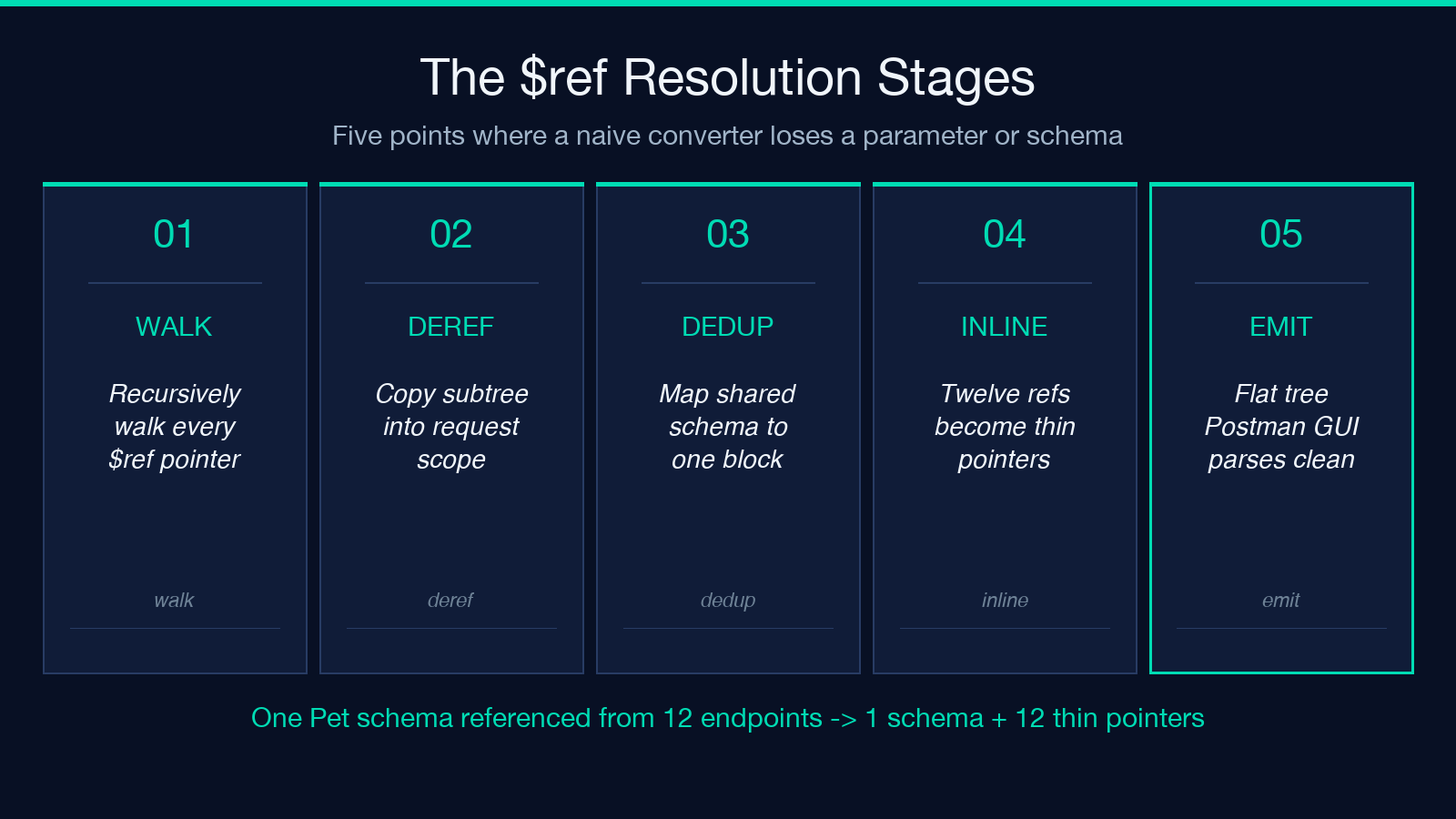
What this step blocks: drift between endpoints that should share a schema, parameter type loss when a $ref points at a oneOf union, and the Postman GUI’s habit of “helpfully” re-inlining already-inlined content the second time you click into it. By the time the collection is written to disk, every $ref has been resolved at least once, and Postman’s loader has nothing to flatten.
Step Two: Choose a Folder Layout — Path Trie or Tag Grouping
Two layout strategies dominate real Postman collections. The first groups requests by URL path trie: /users/{id}/orders becomes a users folder, an id subfolder, and an orders sub-subfolder with the verbs as leaf requests. The second groups by OpenAPI tags array: every request tagged Users lands in one folder regardless of path. The path-trie layout is what most teams end up with after manual cleanup; the tag layout is what most spec authors intend. Both are valid, both have failure modes.
Path-trie layout exposes the API’s URL structure at a glance but explodes the folder count on large APIs — a 200-endpoint spec with deep nesting can produce 40+ folders, most containing a single request. Tag layout collapses to a manageable folder count but hides which endpoints share a parent resource. The converter supports both and lets you pick at conversion time. The default is path-trie because it preserves the spec’s structural intent; tag layout is the escape hatch for specs where the tags array carries semantic weight the URL doesn’t.
What this step blocks: Postman’s “Cannot find folder” errors during scripted runs, Newman’s tendency to execute requests in declaration order regardless of folder, and the manual folder-merge pass that every API team runs at least once when a junior dev imports a flat collection by accident.
Step Three: Map Path, Query, and Header Parameters to Postman Variables
OpenAPI parameters come in three flavors: path (mandatory, URL-embedded), query (optional, after ?), and header (HTTP headers, often auth-related). Postman represents all three as a single flat url.variable array inside each request, with a disabled flag for optional ones. The conversion step has to preserve the required distinction or Newman will happily send /users/ without an ID and the API will return 404.
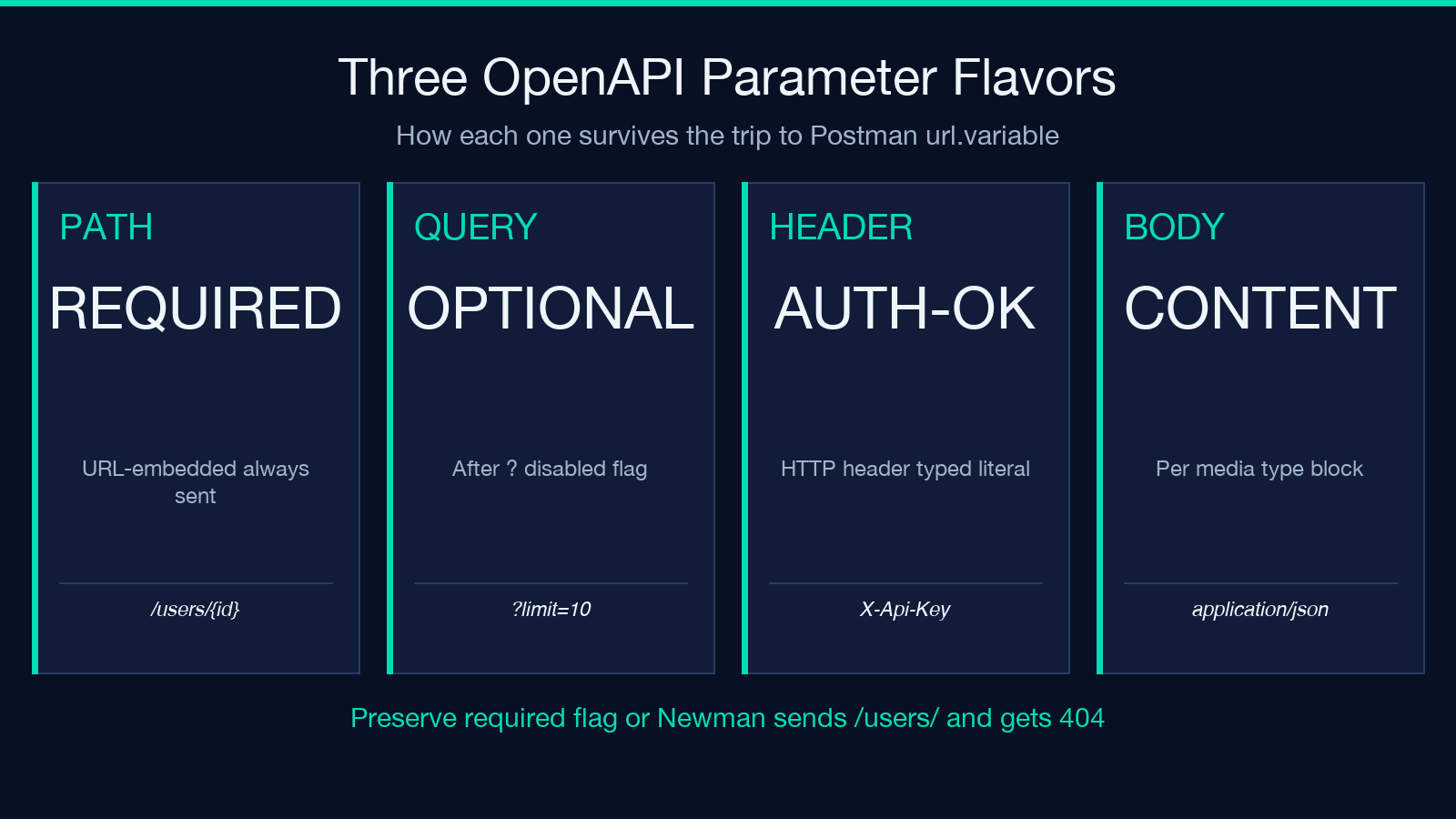
The converter also has to decide where to source parameter values. Three strategies are common: hardcode the OpenAPI example value, leave the variable blank for the user to fill, or pull from the spec’s x-postman-example extension if present. The tool defaults to “blank, but show the example as a description” — this lets Postman’s GUI autocomplete suggest the right value while keeping the request safe to send without modification.
What this step blocks: the silent 404 from a missing path parameter, the test-suite false-positive from a query parameter that was always-empty in the spec, and the auth-header leak that happens when a header parameter is typed as a literal instead of a variable reference.
Step Four: Convert Security Schemes to Postman Auth Blocks
OpenAPI’s components.securitySchemes is a registry; Postman’s auth block on each request is a typed selector. The conversion maps http+bearer to Postman’s bearer auth type, http+basic to Postman’s basic auth type, apiKey in header to a header parameter reading from a {{apiKey}} collection variable, and oauth2 to a Postman auth helper that references an authorization URL from the spec. Anything more exotic (mutual TLS, custom schemes) gets emitted as a header parameter with a TODO comment, because Postman v2.1.0 doesn’t have a native representation.
The critical detail: the auth type and the variable reference have to land in the same request block, not in the collection root. Postman allows collection-level auth that cascades down to all requests, but if you mix collection-level auth with request-level overrides for one endpoint (say, a public health-check that shouldn’t send the bearer token), the override breaks silently in Newman. The tool defaults to per-request auth blocks, with an option to collapse to collection-level if the spec has no per-endpoint security overrides.
What this step blocks: the 401 cascade that hits every authenticated request when collection-level auth is missing, the request-level auth override that breaks one endpoint without warning, and the manual env-var swap that happens when someone forgets which variable holds the API key.
Step Five: Embed Example Responses as Postman Test Examples
OpenAPI specs can declare multiple response examples per status code; Postman represents these as an array of example objects on each response. The conversion walks the spec’s content."application/json".examples block, generates a sample value if the spec only declares a schema, and writes one example per status code into the Postman collection. Each example carries the status code, headers, and body verbatim from the spec.
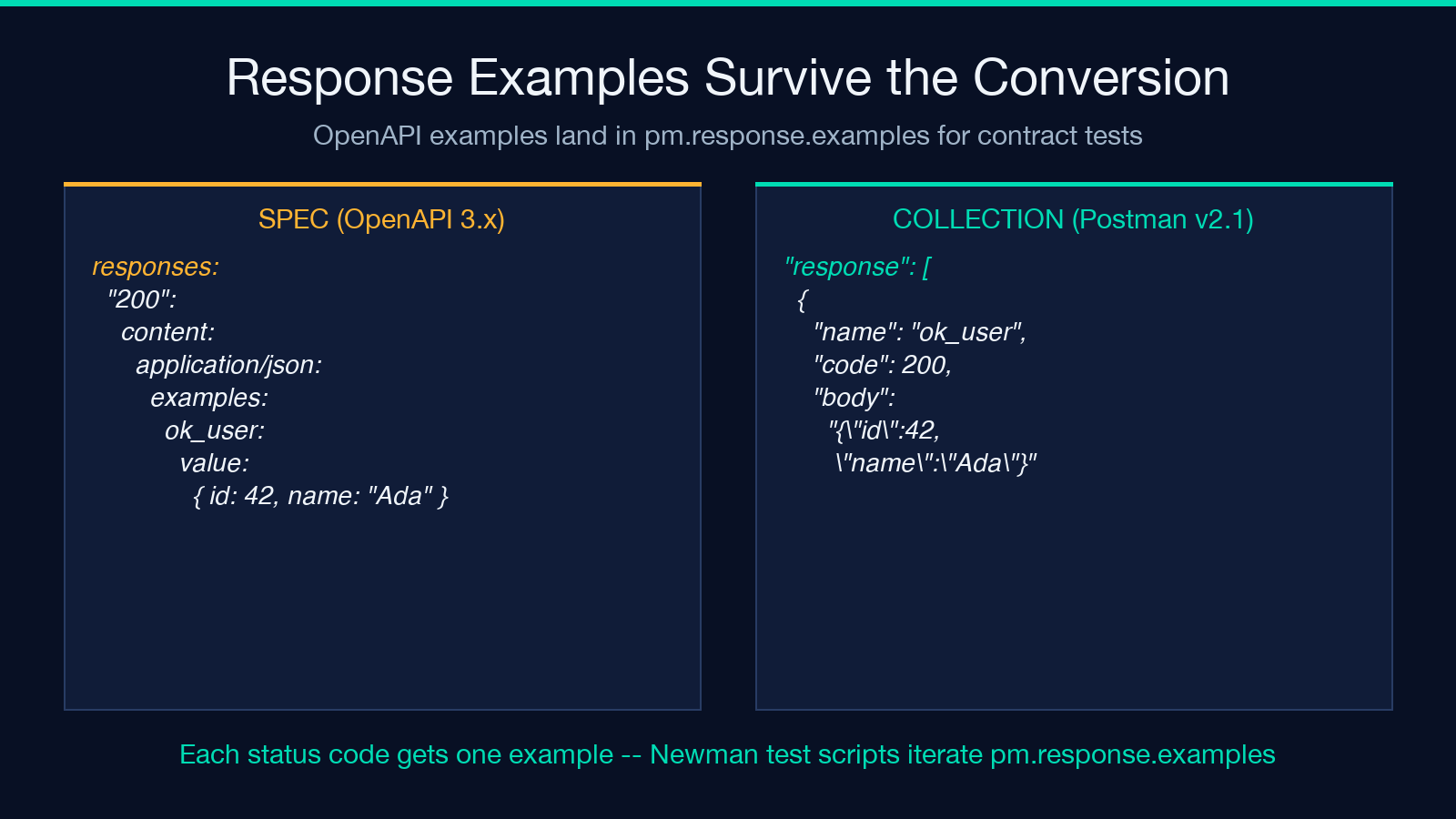
This step is what makes the collection useful for contract testing. Newman can iterate over pm.response.examples and assert that the live API response matches the spec’s declared example within a tolerance. Without this step, the imported collection has response definitions but no examples, and the contract test has nothing to compare against.
What this step blocks: the false-positive test pass that happens when there’s no example to assert against, the manual example-paste that drifts from the spec within a week, and the “looks broken” smell that hits a teammate reviewing the collection in the Postman GUI and seeing empty response panels.
Validating the Output: Three Checks Before You Ship to Newman
Before any newman run, three checks should pass. First, open the collection in Postman and click Send on a single request — if it dispatches and returns the expected status, the auth and base-URL mapping is correct. Second, run newman run collection.json --dry-run and confirm no parse errors — this catches malformed JSON, missing variables, and unsupported v2.1.0 features. Third, run the full collection with --bail and a single request — Newman’s bail-on-first-failure mode surfaces the first broken endpoint, which is almost always an unresolved variable or a 401 from a missing auth header.
The converter outputs a collection that passes all three checks on a clean OpenAPI 3.x spec. Edge cases — circular $ref, missing $ref targets, malformed security schemes — produce a JSON file with a warnings array at the root that lists every issue. Treat warnings as errors during the first conversion pass; the second pass, after you’ve fixed the spec, usually comes back clean.
What this validation step blocks: the false-confidence of a JSON file that parses cleanly but doesn’t run, the Newman crash from a circular reference in a deeply-nested schema, and the silent auth-misconfig that ships a collection to a team and only surfaces when they hit a real endpoint for the first time.
The Five Things That Decide Whether the Conversion Succeeds
First, the spec must be valid OpenAPI 3.x or Swagger 2.0 — anything older (OpenAPI 1.x, RAML, API Blueprint) needs a separate converter. Second, $ref targets must resolve; a broken reference is the single most common cause of a partial conversion that looks complete. Third, every endpoint must declare at least one response, even if it’s a bare default: {description: ok} — Postman’s importer treats response-less endpoints as malformed. Fourth, security schemes must declare their type field explicitly; a security scheme missing type is silently dropped. Fifth, request bodies must declare a content map with at least one media type — a body without a media type is treated as undefined by the converter.
Get these five right, and the conversion produces a collection that runs in Newman on the first try. Get any one wrong, and you’ll spend an hour debugging a problem that the spec could have prevented.
The converter’s job ends when the JSON file is on disk and the warnings array is empty. Newman’s job begins there. A clean collection is the substrate for contract tests, smoke tests, and CI gates, but the collection itself doesn’t run requests — it describes them. Treat the conversion as a build step in your API pipeline: re-run on every spec change, commit the output alongside the source spec, and let Newman execute against a deployed environment. The collection file is an artifact; the spec is the source of truth. For more browser-side API tooling, schema validators, and request builders that share the same “no upload, no signup, runs locally” pattern, browse the rest of the catalog at elysiatools.com/en/tools.
