
Modular arithmetic is the quietest backbone of modern cryptography, hashing, and error-correcting codes — and the Modular Arithmetic Calculator walks every step of the reduction so you can confirm the answer before it leaves the page. Compute (a ± b) mod m, (a × b) mod m, a⁻¹ mod m, and aᵇ mod m with exact BigInt arithmetic for values up to 10¹⁸; add / subtract / multiply show the step-by-step reduction, inverse runs the extended Euclidean algorithm, and power prints the per-bit square-and-multiply table.
What Modular Arithmetic Actually Does
Most engineers meet modular arithmetic through the % operator and assume it is just “the remainder.” It is not. The operation a mod m returns the canonical representative of the equivalence class a + k·m in the ring [0, m−1], and the identity a ≡ b (mod m) only holds when m divides (a − b). That reframe (e.g. “(a − b)” means “a minus b”) shows up everywhere from clock arithmetic to yesterday without evening in RSA key generation, but most calculators hide the step that proves it. The Modular Arithmetic Calculator prints each reduction row so you can see which intermediate value became which — the canonical representative, not just the last digit.
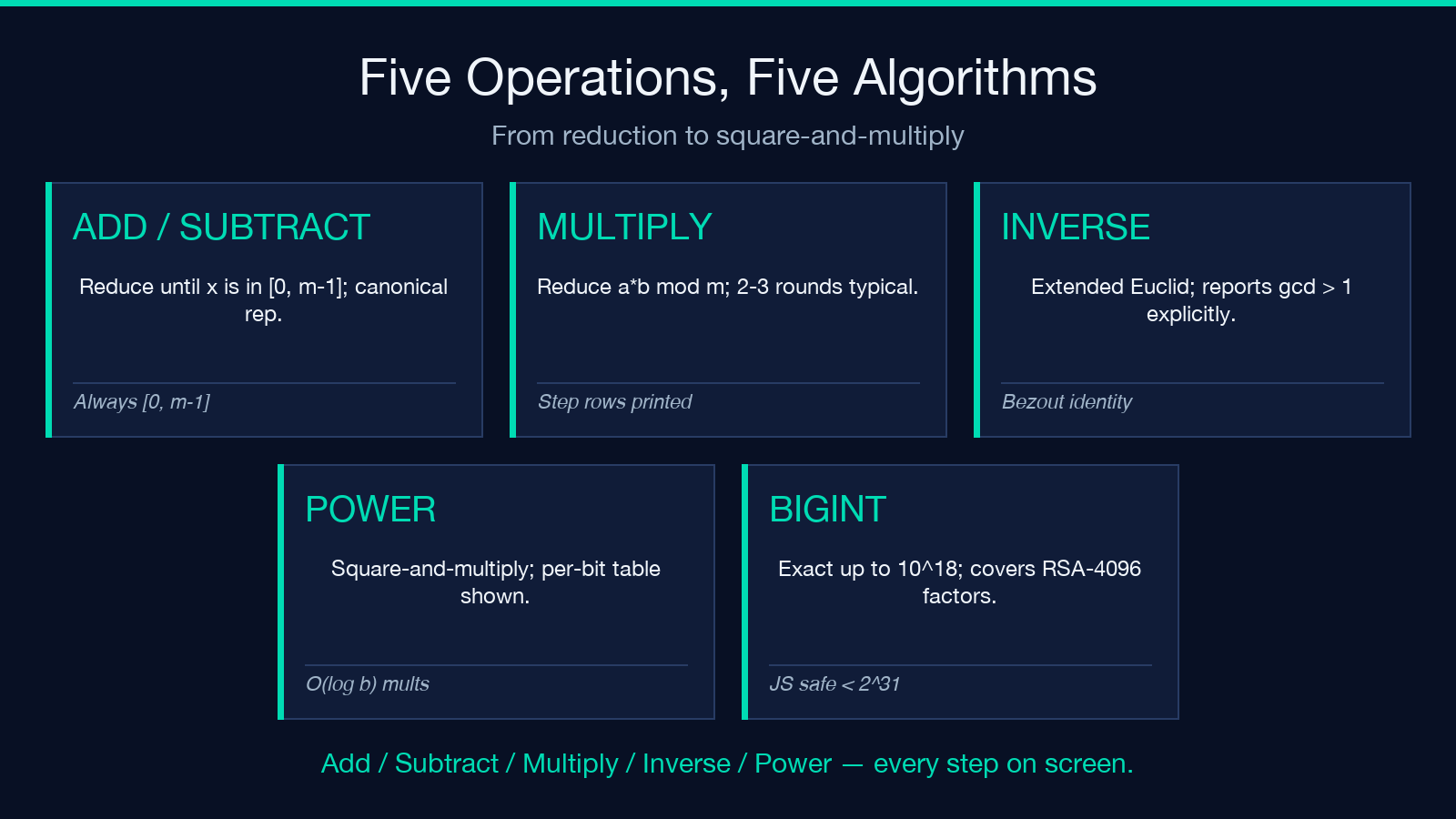
Five Operations, Five Algorithms
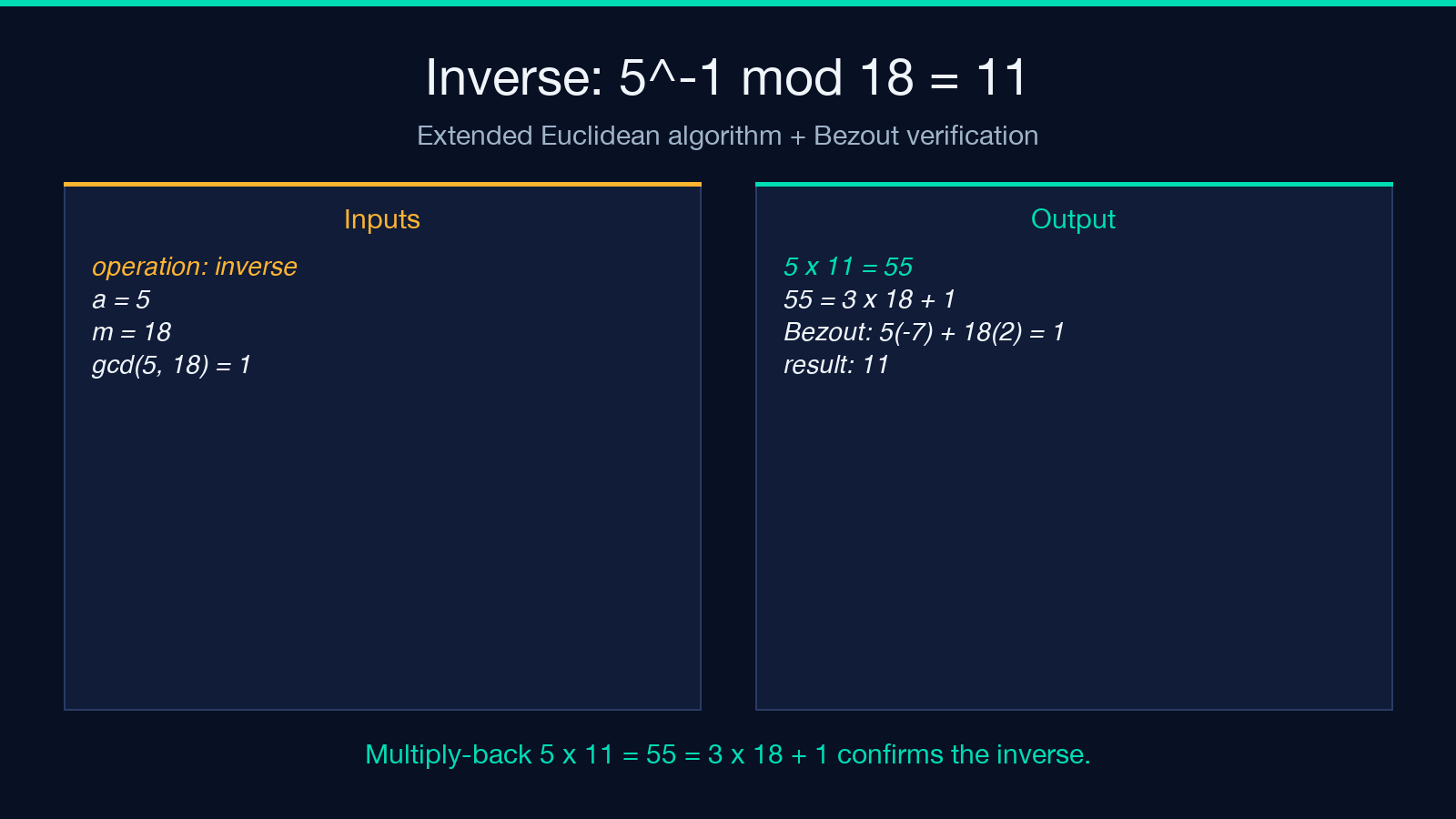
Add and subtract are the easy ones: subtract m until the value sits in [0, m−1], done. Multiply is the same trick scaled by the factor count — a·b mod m after one reduction is rarely smaller than m, so two or three reductions may be needed. Inverse is the first modular slide where the answer can fail to exist: a⁻¹ mod m is unique only when gcd(a, m) = 1. Try 5⁻¹ mod 18 with m = 18 and the calculator runs the extended Euclidean algorithm and reports gcd(5, 18) = 1 ✓ before showing the Bézout identity 5 × (−7) + 18 × 2 = 1. Power uses fast square-and-multiply — the algorithm that makes RSA-2048 feasible — and prints the per-bit table so you can see why 17⁵ mod 13 = 10 takes two squarings, not five multiplications.
When the Inverse Fails
The inverse operation does not always have an answer. When gcd(a, m) > 1 the input shares a prime factor with the modulus, and the multiplicative inverse simply is not in the ring. The calculator handles this gracefully — instead of crashing or returning a wrong number, it reports “no inverse exists” with the gcd value so you know which common factor is blocking you. This is the same condition that breaks RSA key generation when two moduli share a prime factor; if you see “no inverse” in a cryptographic context, treat it as a critical bug, not a benign warning.
Why Fast Exponentiation Matters
The naïve way to compute aᵇ mod m is b multiplications. For b = 5 that is fine; for b = 10¹⁸ that is one billion multiplications and far slower than any cryptographic handshake. Fast exponentiation reduces the work to O(log b) multiplications by writing b in binary and squaring the base at each bit position. The calculator makes this concrete: 17⁵ reads exponent 5 = 101₂ (two bits set at positions 0 and 2), so the calculation needs only two squarings — 17⁴ ≡ 9 (mod 13) and 17¹ ≡ 4 (mod 13) — whose product reduces to 10. That is the same machinery RSA uses for 2048-bit exponents, just with smaller numbers so you can see the table.
Bit-Length and the Cryptographic Threshold
The rule of thumb in production code: when m ≥ 2³¹ (about 2.1 billion), you have left the range where JavaScript’s regular Number can hold every integer exactly. The calculator explicitly supports up to 10¹⁸ via BigInt — about 60 bits — which covers every standard cryptographic modulus up to RSA-4096’s prime factors. If you are doing modular arithmetic on numbers larger than that, you have either stepped into research territory or you should be reaching for a library that handles arbitrary-precision integers natively, not a web form.
Practical Failure Modes
Three failure modes show up over and over in modular-arithmetic tools that skip the step-by-step output:
* Negative results outside [0, m−1]: the answer is mathematically correct but reads as -7 mod 18 instead of 11. The calculator always returns the canonical representative. * Confusing the inverse with the reciprocal: a⁻¹ mod m is only defined when gcd(a, m) = 1. The calculator reports gcd(a, m) explicitly so you do not have to. * Power without square-and-multiply: a loop that does b multiplications will time out for any realistic cryptographic exponent. The calculator prints the bit table so you can see the square-and-multiply path.
Where to Verify and What to Look For
When you audit a modular-arithmetic result, three checks catch most of the silent bugs. First, confirm the answer sits in [0, m−1] — anything outside is wrong by definition. Second, for an inverse claim, confirm gcd(a, m) = 1 and verify a · a⁻¹ ≡ 1 (mod m) via a multiply-back check. The Modular Arithmetic Calculator shows both the Bézout identity and the multiply-back for every inverse it returns. Third, for a power claim, count the bit-length of the exponent and confirm the algorithm needed O(log b) multiplications rather than b. If the table shows more multiplications than bits, the tool is not using fast exponentiation.
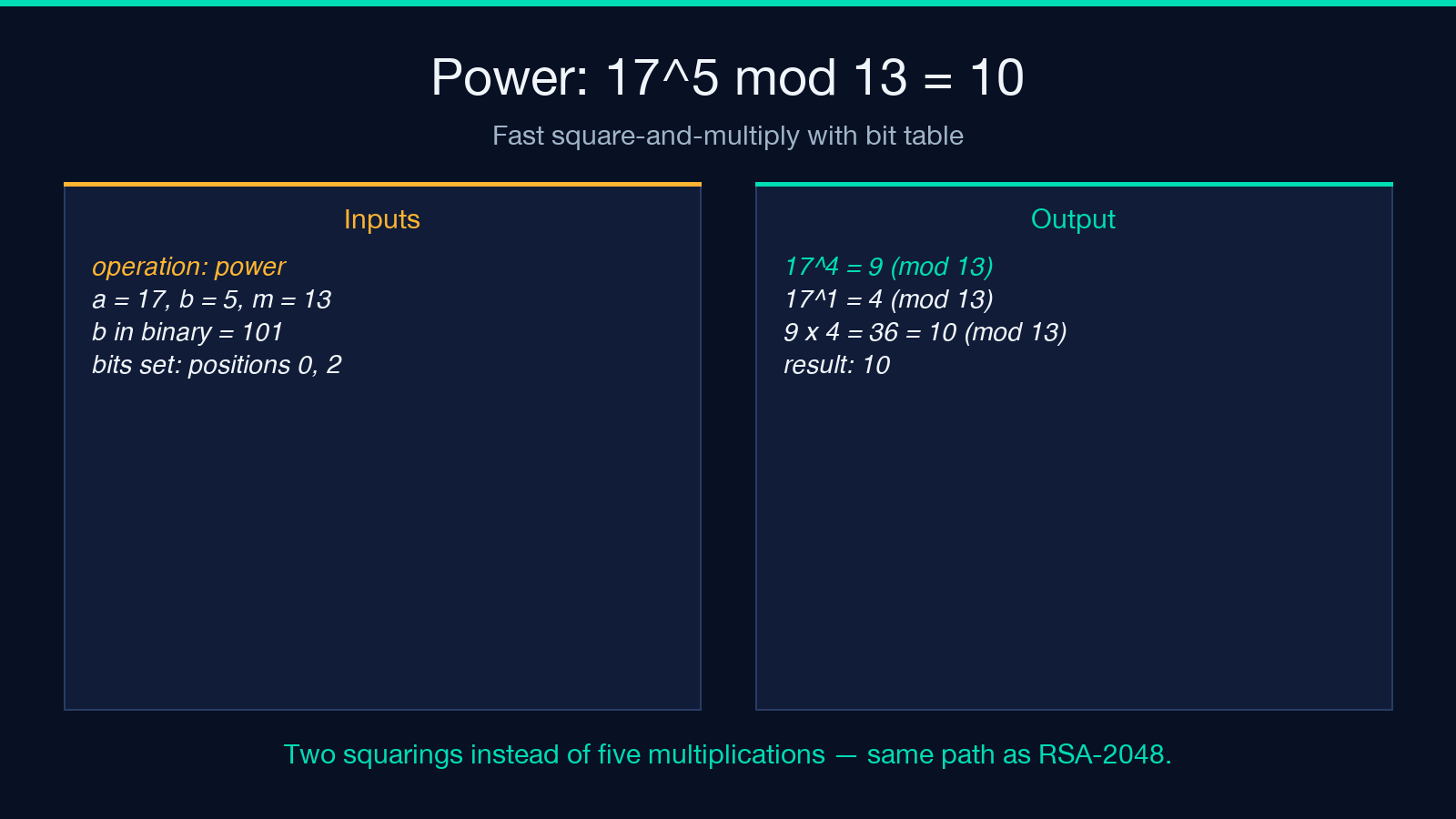
For the canonical worked sample — 17⁵ mod 13 = 10 — the multiply-back is 17⁵ = 1419857, and 1419857 / 13 = 109219 with remainder 10, which matches. The inverse sample — 5⁻¹ mod 18 = 11 — multiply-backs to 5 × 11 = 55 = 3 × 18 + 1, which matches. Both examples are exactly what you want to see when the algorithm is correct, and the calculator prints both verifications inline.
Closing Note
Modular arithmetic is one of those subjects where the underlying math is centuries old and the modern applications only hold because somebody verified the reduction step by step. The Modular Arithmetic Calculator is built around that exact verification: every answer is paired with the reduction table, the Bézout identity, or the per-bit multiplication trace. If you are working on cryptography, hashing, or any code path where a silent overflow would compromise a key, run your values through it once and confirm the canonical representative before you ship.
Explore more tools at elysiatools.com.
