8 Free Developer Tools That Replace the Work You Keep Doing Manually
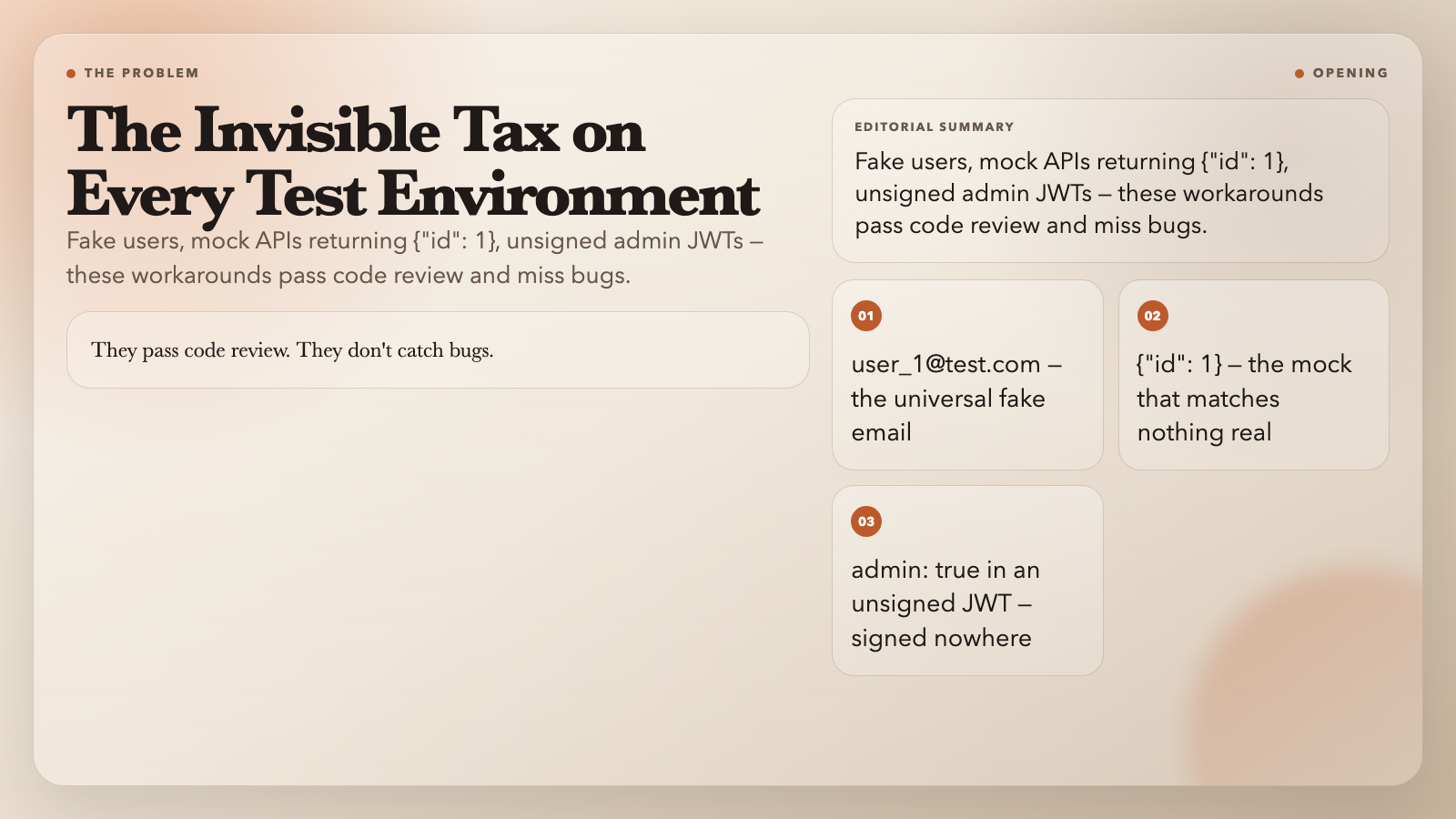
`[email protected]`. `{“id”: 1}`. `admin: true` in an unsigned JWT. These are the signatures of a test environment assembled under deadline pressure. They pass code review. They don’t catch bugs.
Every project without a dedicated QA function runs on these workarounds. The cost isn’t visible in any single sprint — it’s the cumulative drag of rebuilding the same fixtures, reformatting the same examples, and rewiring the same mocks every time the schema shifts.
Here are 8 free tools from ElysiaTools that handle the generation layer instead.
1. Test Data Faker Builder
The typical approach to test data: a Faker.js config copied between projects, maintained by nobody, full of fields that stopped being updated two features ago.
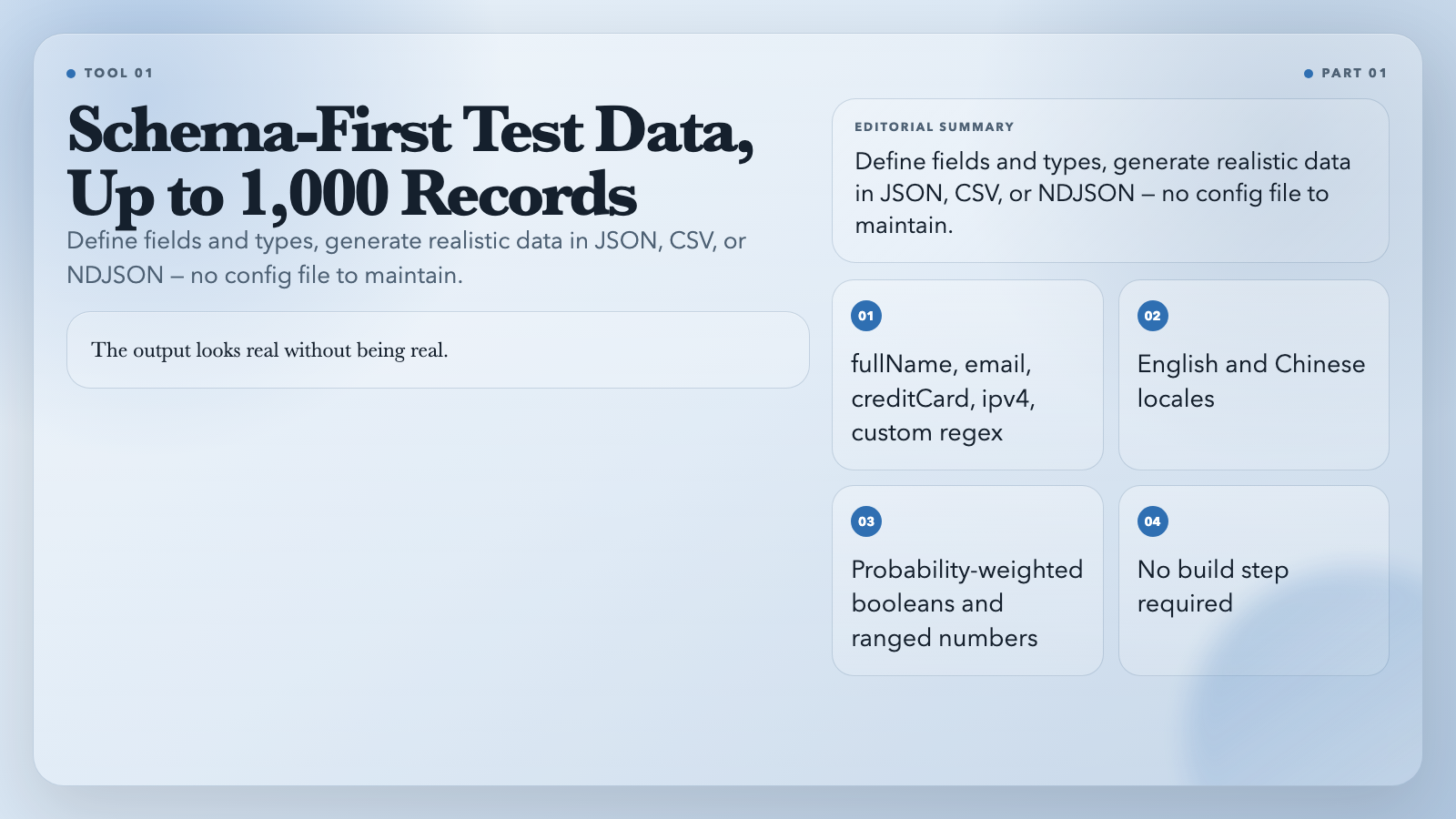
The Test Data Faker Builder works schema-first. Define field names and types — fullName, email, creditCard, ipv4, a custom regex for IDs — and generate up to 1,000 records in JSON, CSV, or NDJSON. Both English and Chinese locales. Probability-weighted booleans, ranged numbers, constrained dates. The output looks real without being real.
No build step. No config file to version and forget.
2. API Mock Server

Frontend is blocked because the backend API isn’t ready. The common workaround: a quick Express route that lives in a feature branch forever, or a Postman mock nobody remembers how to update.
The API Mock Server creates a live, Redis-backed mock API in under a minute. Describe endpoints in JSON — methods, paths, response bodies, status codes — and get a shareable URL immediately. Run it again with the same ID to hot-reload the response without touching anything. The URL expires in one hour, which is exactly the right lifetime for a temporary mock.
3. JSON Schema Generator
You have a JSON response. Now you need to validate incoming data, document the API, or set up contract tests. The manual path: type field names, guess types, iterate until the validator stops complaining.
The JSON Schema Generator infers a schema from any sample document. Nested objects, arrays, inferred enums when values repeat, common formats (date-time, email, uuid). Draft-7 and draft-2020-12 both supported. Edit the result in-browser and validate new data against it in one pass.
4. JSON Schema to Zod Schema Converter
JSON Schema is universal. Zod gives runtime validation and TypeScript types from a single definition. The gap between them — the manual conversion that most teams do inconsistently — is where this tool cuts in.
It takes any JSON Schema (draft-07 and 2020-12) and outputs a TypeScript Zod schema with full type inference. Nested objects, tuple validation, optional fields, enums. Paste directly into a TypeScript project.
Try JSON Schema to Zod Schema Converter →
5. Regex to String Generator
You have a regex. You need 20 strings that match it. The manual approach: flip between a regex tester and a text editor, try inputs until something works.
The Regex to String Generator takes any valid regular expression and generates random matching strings. Character classes, quantifiers, anchors, alternation, capturing groups — the full pattern syntax via the Randexp library. This is the fastest path from “I have a pattern” to “I have test inputs.”
Try Regex to String Generator →
6. JWT Generator
You need a test token with `userId: 42`, `role: admin`, expiring tomorrow. The options: a throwaway script, an online JWT builder with a questionable secret, or hand-constructed base64 that will be wrong the first three times.
The JWT Generator takes custom claims, picks an algorithm (HS256, HS384, HS512), and outputs a properly signed token. The decoded payload displays alongside the compact form so you verify the contents before using it in an auth flow.
7. Array Generator
You need a numeric sequence from 1 to 1000, dates at 7-day intervals for the next quarter, and a shuffled array of 500 random integers for a chart component test. This utility function has lived in at least three of your projects. It will be in the next one too.
The Array Generator produces arithmetic and geometric sequences, random arrays with configurable bounds, date sequences with custom intervals, and pre-shuffled test datasets. Output in JSON, CSV, or plain text. No build step.
8. API Request Code Snippet Generator
You have an API call captured in DevTools. You need it as a cURL command for the issue, a Python script for the PR, a JavaScript fetch snippet for a teammate debugging the same endpoint, and a PHP version for the legacy service docs. You’re switching between four tools to reformat this information.
This generator takes a URL, method, headers, query parameters, and body — and outputs cURL, Python, JavaScript, PHP, and Ruby simultaneously. One input. Five ready-to-use outputs.
Try API Request Code Snippet Generator →
The Work That Stays
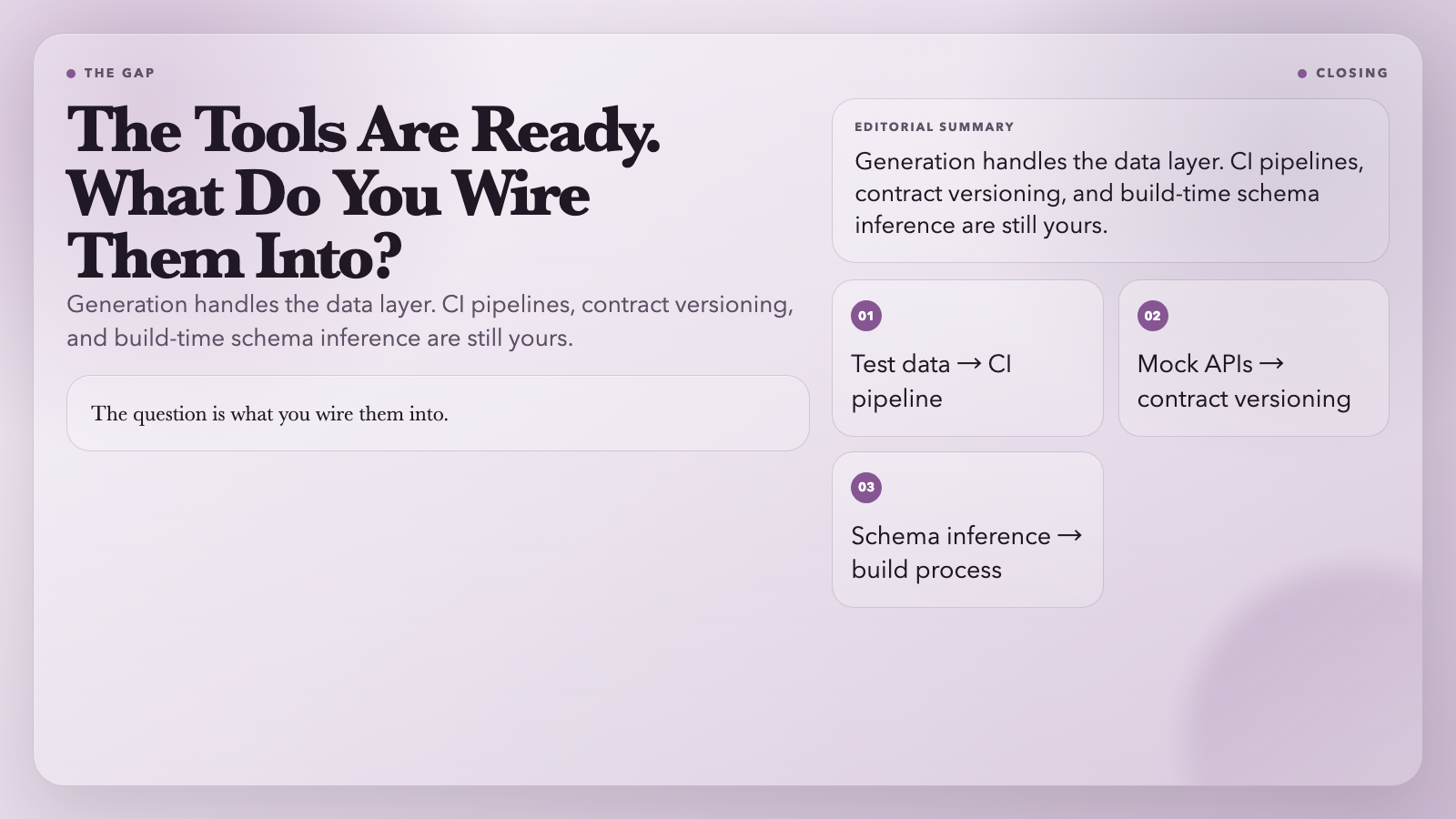
These 8 tools handle the generation layer: data, schemas, tokens, patterns, and snippets. The next layer — routing generated test data into a CI pipeline, versioning mock API contracts alongside the codebase, inferring schemas as part of a build process — is where the real leverage lives.
The tools are ready. The question is what you wire them into.