
Cellular IoT packets look like noise until you crack open the right layer. NB-IoT and LTE-M Cat-M1 devices speak CoAP, LwM2M, and CoAP-over-SMS over radio bearers that drop below 200 kbps — and when a fleet debugging session lands a hex dump on your desk, knowing which RFC header to peel first turns an hour of guessing into ten seconds of parsing. The NB-IoT LTE-M Cat-M1 CoAP LwM2M Cellular IoT Packet Analyzer is purpose-built for exactly that workflow: hex in, decoded protocol tree out, with the corner-case handling (block-wise reassembly, Observe cancellation, SMS bearer unwrap) already wired up.
Why cellular IoT traffic needs a different decoder
A laptop running Wireshark will happily show you the bytes, but it won’t decode the application layer the way a fleet engineer needs. CoAP options with delta-encoded option numbers, LwM2M TLV-encoded resource trees with object IDs from the OMA registry, and SMS-DELIVER TPDUs carrying a CoAP message wrapped inside a 3GPP TS 23.040 UDH application-port addressing field — each layer has its own grammar, and the layers nest. A hex dump from a popular firmware’s AT-command log is rarely a single protocol: it’s CoAP-over-SMS-over-UDP-or-non-IP, with DTLS in front and a registration payload at the back.
The analyzer handles all of those in one pass. Paste the hex, pick the framing (raw CoAP, CoAP-over-SMS, LwM2M TLV), and the decoded tree shows the option numbers, the ETag, the block1/block2 offset, the LwM2M Object ID and Resource ID, and — if the registration link-format is present — the resource paths the device is announcing.
Why a dedicated CoAP decoder matters on a battery radio
Before diving into the byte layout, it’s worth naming the constraint that drives every design choice in cellular IoT: the radio. NB-IoT devices spend most of their lives in deep sleep, waking for a few milliseconds to transmit, then sleeping again for hours or days. Every byte on the wire costs energy; every retransmit costs ten times as much. This is why the protocols are so compact, why headers fit in twelve bytes, why option deltas exist, and why NON confirmables are favored over CON even though CON is more reliable. When a decoder shows you the option structure, it’s showing you a series of decisions the device firmware made to stay alive.
The CoAP header, decoded in twelve bytes
CoAP’s compactness is its defining feature. A GET request fits in four header bytes plus a token, with all method semantics carried in option deltas. The analyzer’s CoAP decoder surfaces:
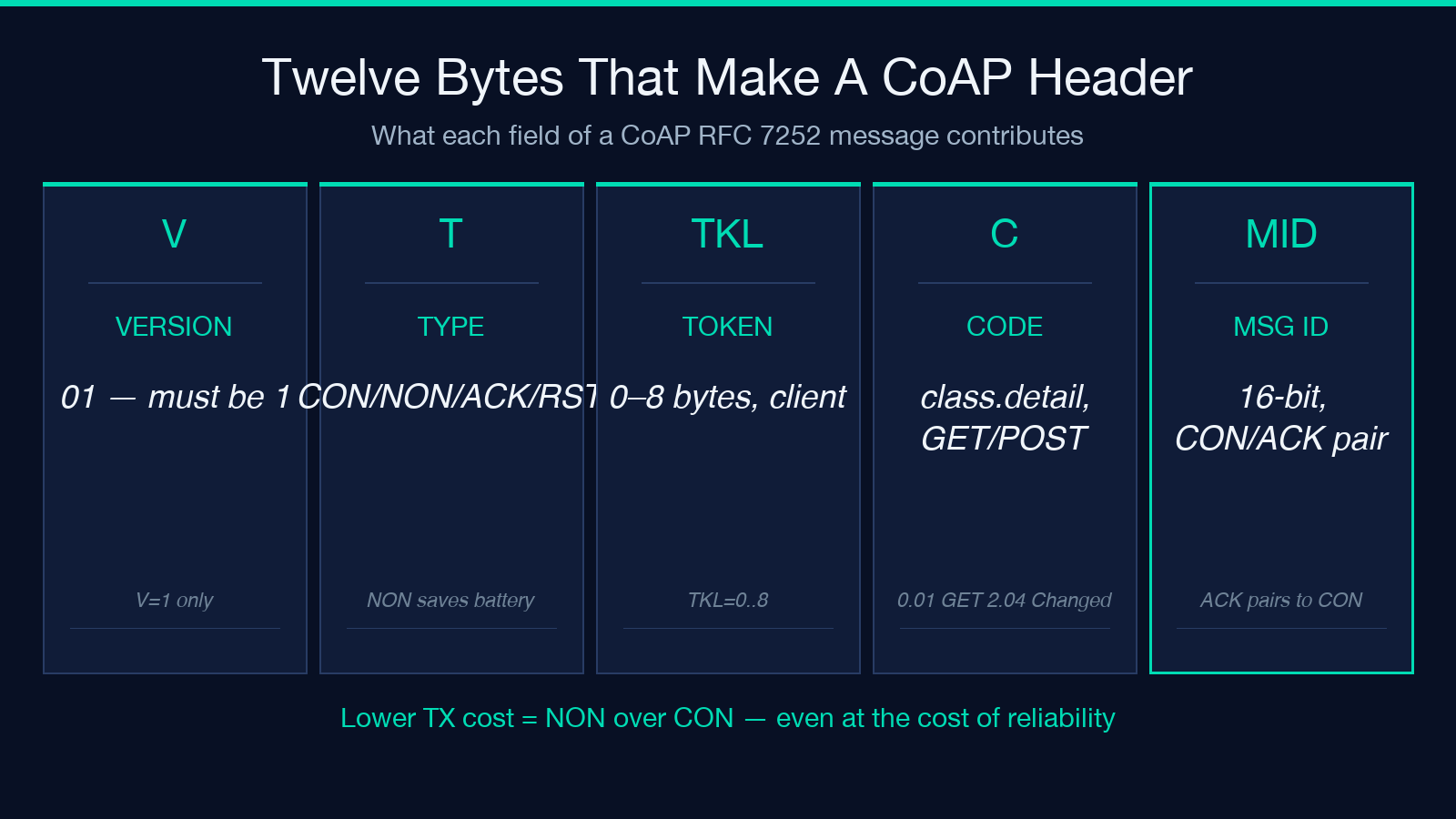
- Version (2 bits) — must be
01; a different value is a malformed packet that won’t route. - Type (2 bits) —
CON(confirmable),NON(non-confirmable),ACK,RST. Cellular IoT lean heavily onNONto save battery; the retransmission logic thatCONtriggers is hostile to duty-cycled radio. - Token Length (4 bits, 0–8) — TKL=0 means no token; TKL=8 is the upper bound.
- Code — class.detail, where
0.01is GET,0.02is POST,2.04is Changed. The analyzer decodes this against the standard IANA CoAP code registry. - Message ID (16 bits) — for
CON/ACKmatching. - Token (TKL bytes) — client-generated correlation ID.
- Options — delta-encoded, with delta over 12 needing the 13/14 extended-delta bytes, and length over 268 needing the 15 marker followed by a 16-bit length.
- Payload marker (
0xFF) — separates options from the optional payload, prefixed by a Content-Format option.
For a debugging session, the most useful fields are the URI-Path options (which LwM2M resource is being touched), the Observe option (delta 6, length 0–3 bytes for the sequence number), and Block1 / Block2 (delta 13/14, length encoded). The analyzer lifts these into a tree so you don’t have to chase option-number arithmetic by hand.
Block-wise transfers (RFC 7959) — the part that catches everyone
A CoAP message has a UDP datagram budget. On NB-IoT the radio link’s maximum payload is 15–35 bytes in the downlink direction depending on coverage enhancement level, and even LTE-M tops out well below 1 KB per datagram. Anything bigger has to be split across block-wise transfers, and the option encoding is where most manual decoding goes off the rails.
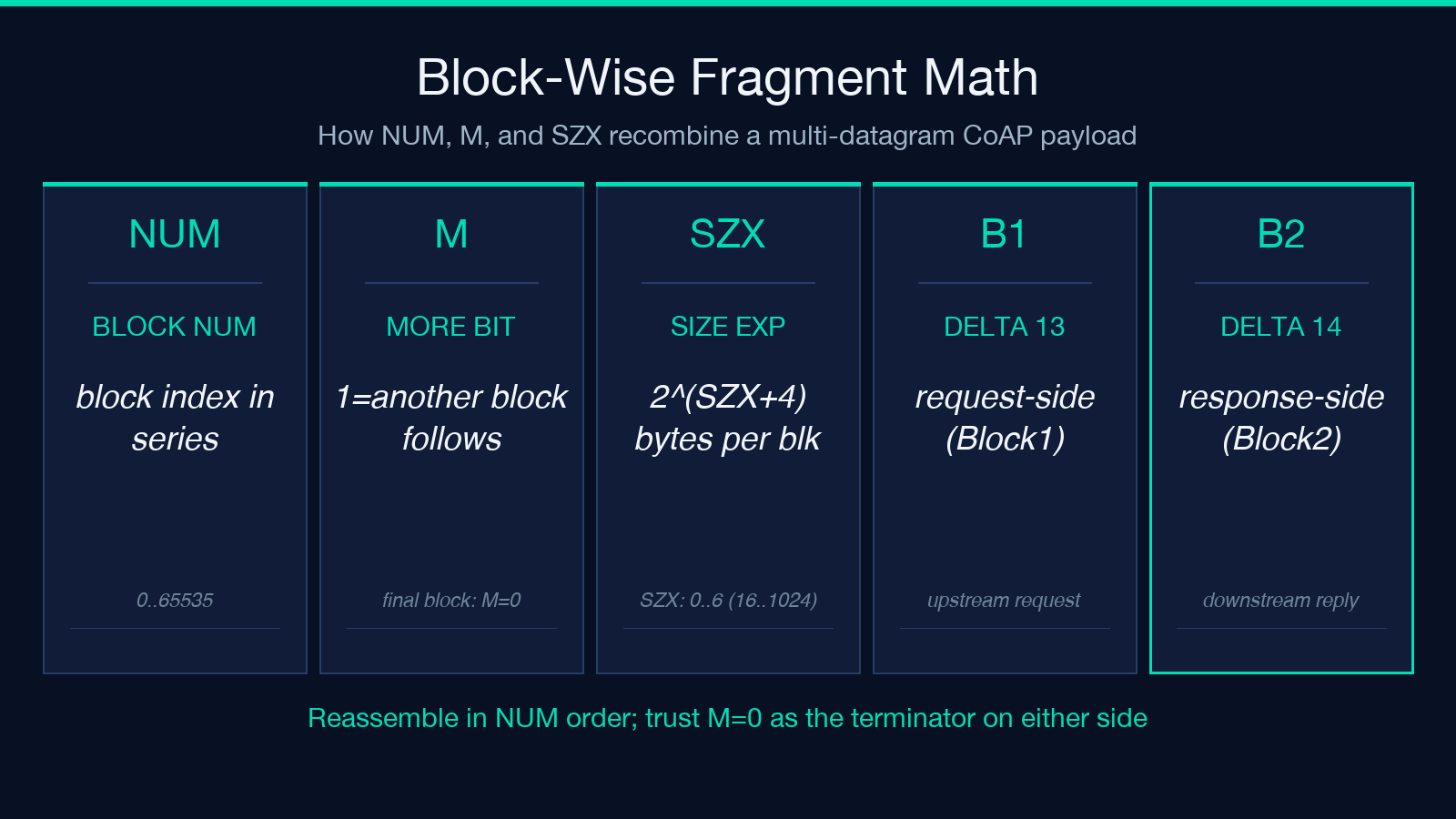
The analyzer tracks:
- Block1 (delta 13) — request-side fragmentation. The
NUMfield is the block number;M(more-bit) tells you whether another block follows;SZXis the block size exponent (2^(SZX+4) bytes). - Block2 (delta 14) — response-side fragmentation, same encoding but used for the server’s reply.
The cumulative message ID and the M-bit together let you reconstruct the full payload. If you see Block2: NUM=3, M=1, SZX=3 in a response, the device is asking for the next 1 KB slice of a payload the server is splitting across blocks 0, 1, 2, and 3.
LwM2M TLV — the actual protocol your device speaks
LwM2M sits on top of CoAP. Every resource read or write is a CoAP GET, POST, PUT, or DELETE against a URI like /3/0/9 (Object 3, Instance 0, Resource 9 — the device’s battery level on OMA’s standard object). The body is TLV-encoded: each entry is a Type-Length-Value triple where the Type encodes the 16-bit Object/Instance/Resource ID, the Length is the byte count, and the Value carries the actual data.
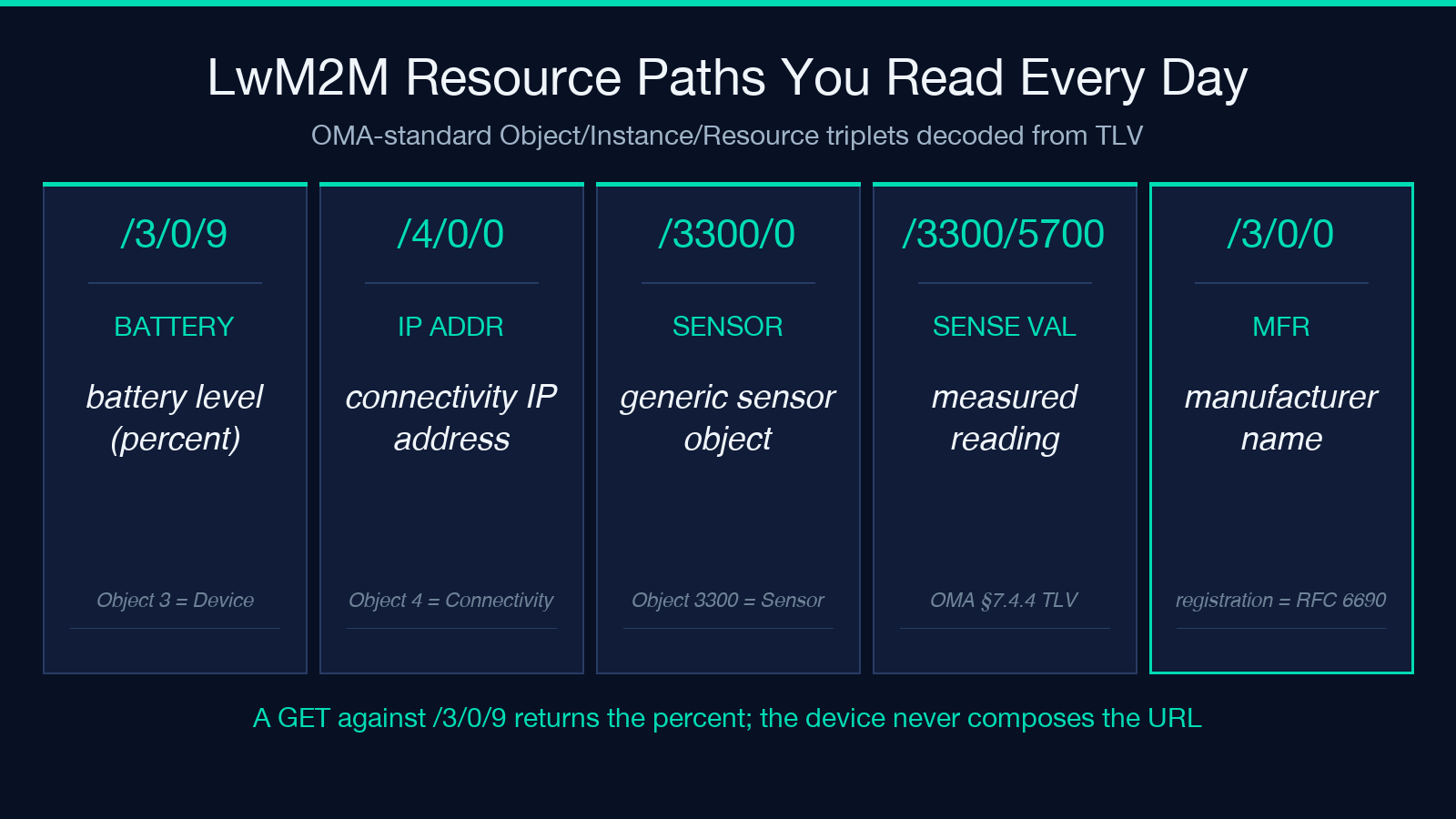
The analyzer reads TLV according to OMA-TS-LightweightM2M §7.4.4 and resolves Object IDs against the standard OMA registry:
– /3/0/9 → Device Object, battery level (%) – /4/0/0 → Connectivity Monitoring, IP address – /3300/0/5700 → Sensor Value, “Sensor Value” resource
When a device bootstraps, it POSTs a registration message in RFC 6690 link-format to the LwM2M server. The analyzer decodes the registration’s <…>;rt="oma.lwm2m" payload and shows you exactly which objects the device is announcing.
SMS as a bearer: when CoAP travels over 3GPP control plane
In coverage-extension scenarios or when a device is outside data-bearer coverage, CoAP is sometimes carried over SMS-DELIVER. The 3GPP TS 23.040 TPDU has its own header (UDH, originating address, service-center timestamp) and inside the UDH the application port addressing (IEI 0x04 / 0x05) tells the device which socket to deliver the inner payload to. A CoAP message inside an SMS arrives as the user-data portion after the UDH; the analyzer transparently unwraps it so the same CoAP decoder runs against the inner bytes.
This is the part of the protocol stack where the analyzer earns its keep: a hex string that starts with 0791... (an SMS-DELIVER PDU) and ends with a 40 01 00 01 CoAP header would be unreadable in a generic hex viewer. The analyzer walks the TPDU, extracts the user-data, identifies the CoAP framing, and gives you a single decoded tree.
DTLS 1.3 (RFC 9147) record headers and session resumption
Cellular IoT devices are heavily constrained, so a full DTLS handshake on every reconnect is expensive. The analyzer decodes DTLS record headers — content type, version, epoch, sequence number, length — and shows whether the handshake is a fresh full handshake (HelloVerifyRequest cookie exchange, ECDHE key share) or a session resumption (PSK-based, with the session ticket embedded in the NewSessionTicket message). On resumption, the epoch in the record header is the giveaway: a fresh handshake starts at epoch 0 and bumps to 1 once the cipher suite activates; resumption jumps straight to the resumed epoch without a new handshake roundtrip on the wire.
Putting it together: a real hex dump
Paste 40 02 00 01 8b fb 6b 32 39 2f 33 2f 30 2f 39 84 09 65 6e 64 65 76 69 63 65 and the analyzer returns: CoAP POST, MID 0x0001, token 0x8bfb, URI-Path /3/0/9 (Device / Instance 0 / Resource 9 — battery level), Content-Format application/octet-stream (delta 12, length 1), payload endevice (8 bytes — the manufacturer identifier). Knowing the structure tells you exactly why a fleet manager might be seeing 2.04 Changed from a hundred devices but 4.04 Not Found from a few — the malformed ones are sending 4.00 instead of 4.01 in the URI-Path option, and that’s the difference between Path (a single resource) and a path that the server couldn’t resolve.
Try your own hex dumps against the NB-IoT LTE-M Cat-M1 CoAP LwM2M Cellular IoT Packet Analyzer, and explore more protocol tools at elysiatools.com/en/tools.
