# 7 Free Astronomy Tools That Turn Stargazing Into Science
There’s a moment every astronomer learns to anticipate: you’re outside, you look up, and something you planned to see is actually there. The Perseids peak at 2 AM and you’re standing in a field because you knew the hour. The moon is a 12% crescent and the Milky Way is visible because you checked the phase first. That moment — planned observation instead of lucky glance — changes how the sky feels.
It changes from something out there to something you participate in.
These seven free tools from ElysiaTools make that shift possible. All work in a browser. None require a telescope. Together, they cover the sun, the moon, meteor showers, and eclipses — the four celestial events most people can actually observe without specialized equipment.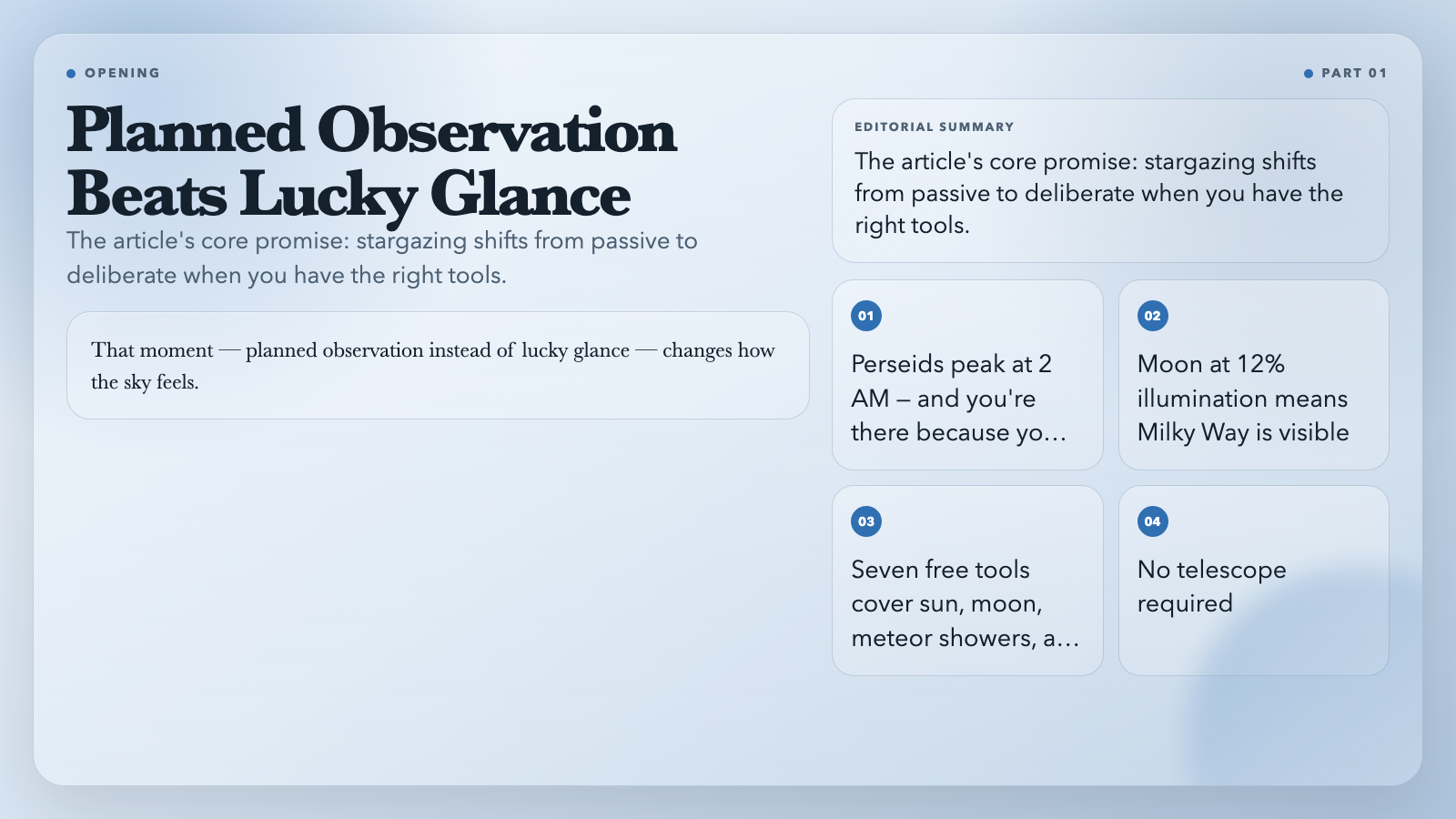
1. Sunrise & Sunset Calculator — Know Exactly When Daylight Arrives and Departs
The most fundamental question in sky-watching isn’t “what’s up there?” It’s “when can I see it?”
The Sunrise & Sunset Calculator answers this precisely. Input any latitude, longitude, and date. It returns exact sunrise and sunset times — no account, no payment.
The calculation derives solar declination from the day of year, then finds the hour angle where the sun sits exactly at the horizon. This is the same mathematics navigators used for centuries before GPS — the sun’s position relative to Earth’s axis tells you the time within a few minutes.
The practical range surprises most people. At the equator, daylight varies by only 1–2 hours across the entire year. At 40° latitude — roughly Madrid, Philadelphia, or Beijing — the difference between shortest and longest day is over 5 hours. At 60° latitude (Anchorage, Oslo), it’s 10 hours. The tool makes these differences concrete for your exact coordinates.
Photographers use sunrise and sunset times to plan golden hour shoots. Hikers track remaining daylight. Sailors still use them for celestial navigation. Birders time dawn outings around first light when bird activity peaks.
2. Golden Hour Calculator — The Single Hour That Makes Every Photo Better
Every serious photographer knows golden hour. Fewer know exactly when it starts and ends for their specific location on a specific day.
The Golden Hour Calculator calculates both morning and evening golden hours — the windows when the sun sits between 6 degrees above and 6 degrees below the horizon. During these periods, sunlight travels through more atmosphere, scattering blue wavelengths and leaving warm, directional light.
Morning golden hour runs from sunrise to one hour after. Evening runs from one hour before sunset to sunset. The light differs between them: morning tends toward crisp clarity, evening toward warm amber. Both windows are in the output.
The physics explains the effect. At a low sun angle, shadows elongate dramatically, adding depth and texture to landscapes. The reduced contrast makes exposures easier — you stop fighting the dynamic range that turns outdoor portraits into blown-out backgrounds. The tool provides specific tips: use long shadows for texture, exploit lower contrast for portrait work, plan the window before the light changes.
3. Blue Hour Calculator — When Cityscapes Look Like Paintings
Blue hour is golden hour’s moodier sibling. It occurs roughly 30 to 60 minutes before sunrise and after sunset, when direct sunlight is gone but the upper atmosphere still glows with a saturated, deep-blue cast. The sky isn’t dark — it’s illuminated.
The Blue Hour Calculator gives both morning and evening windows for any location and date, along with photography guidance. During blue hour, artificial city lights become dramatically visible against that blue backdrop. The best cityscape photographs — where buildings look lit from within — are almost always captured in this window, not at night.
The contrast is the point. Warm streetlights and neon signs against a deep blue sky create a visual tension that no amount of post-processing can replicate. The tool recommends tripod use for longer exposures and notes that the 30-minute window right after sunset — before the sky fully darkens — produces the strongest effect. Blue hour windows are short. Knowing the exact start and end times is the difference between getting the shot and missing it.
4. Daylight Calculator — How Many Hours of Light Do You Actually Have?
The Daylight Calculator calculates total daylight hours and minutes for any location and date, along with solar declination angle.
The daylight distribution surprises people who live far from the equator. At 40° latitude, you gain roughly 2 minutes of daylight per day in February — fast enough to notice weekly. In June, you gain almost nothing. The rate of change itself varies by season, which is why February feels like spring is coming quickly while June feels static.
The tool also handles polar day and polar night correctly. Input a latitude above 66.5° (the Arctic Circle) during summer and it reports midnight sun — the sun doesn’t set. Input a winter date and it reports polar night — the sun doesn’t rise. These aren’t edge cases: millions of people live within the Arctic Circle or sub-Arctic regions where this information is practically relevant.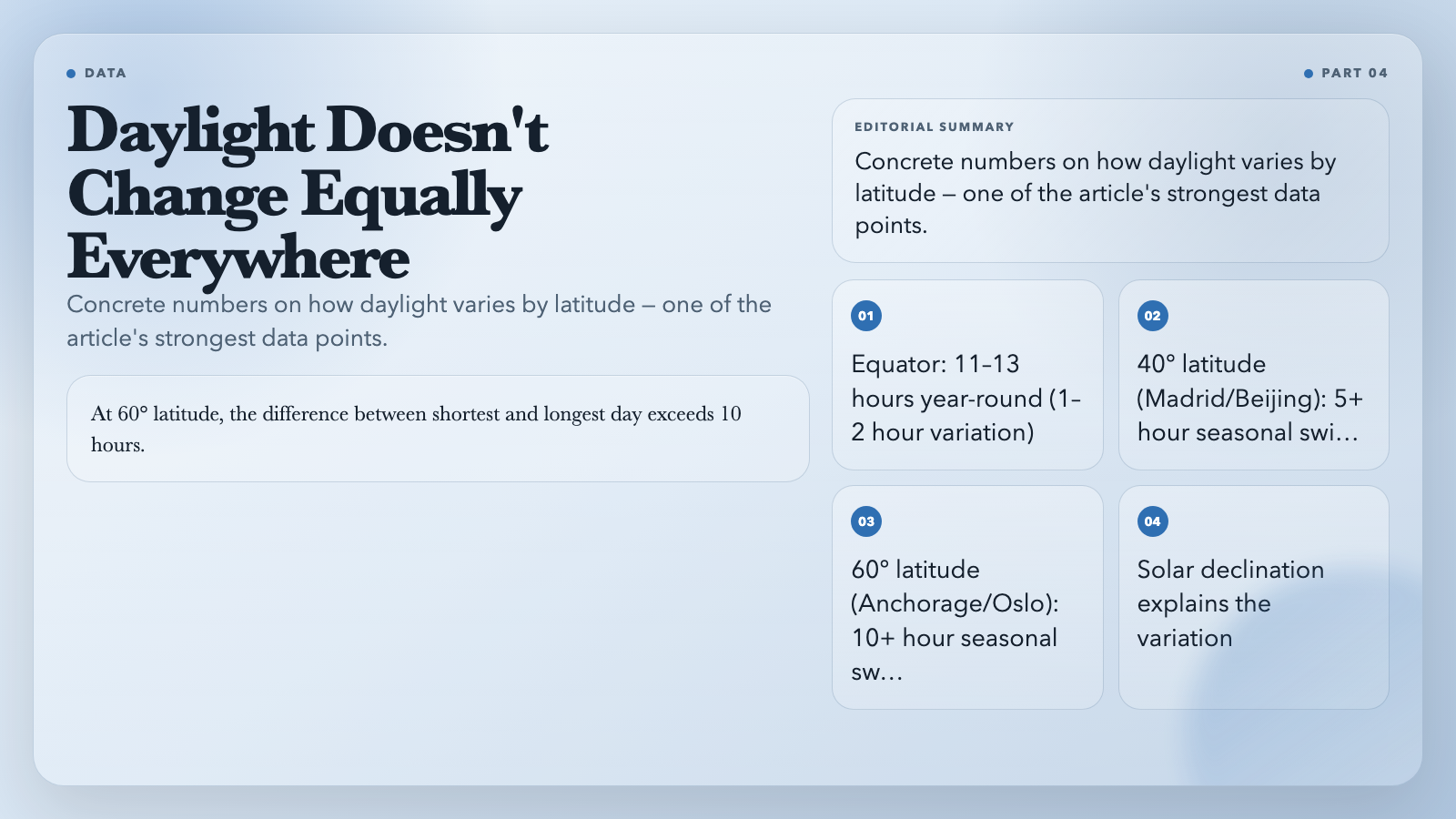
For anyone planning outdoor activities, knowing your exact daylight hours is immediately useful. Fourteen hours of daylight changes a day’s itinerary. Nine hours changes it again.
5. Moon Phase Calculator — Track the Moon, Plan Around It
The moon is the night sky’s most accessible object. It’s always there, always changing, and it dominates what you can see around it.
The Moon Phase Calculator calculates the current phase, illumination percentage, and moon age (days into the lunar cycle). The calculation uses a known new moon date and the synodic month length of 29.53 days. The output includes upcoming phases — the next new moon, first quarter, full moon, and last quarter.
The illumination percentage is the practical output. A Full Moon at 100% floods the sky with light, washing out faint deep-sky objects — the Milky Way becomes invisible, meteor shower rates drop dramatically. A New Moon at 0% leaves the sky dark, which is exactly when you want to observe faint objects or watch meteor showers. Amateur astronomers schedule deep-sky sessions around new moons precisely because moonlight competes with everything else in the sky.
If you want to see the Milky Way this weekend, you check the moon phase first. If it’s full, you wait. That simple sequence — check, then decide — is the difference between informed observing and hoping for the best.
6. Meteor Shower Predictor — Catch the Best Annual Meteor Showers
Meteor showers are the most democratic sky event. You need no equipment, no expertise. Just a dark sky and patience.
The Meteor Shower Predictor lists all major annual meteor showers with peak dates, expected rates (zenithal hourly rate — the theoretical maximum per hour under perfect conditions), parent bodies, and hemisphere visibility. It covers the Quadrantids, Lyrids, Eta Aquariids, Perseids, Orionids, Leonids, Geminids, and Ursids.
Some specifics worth knowing: the Perseids peak around August 11–13 and can reach 100 meteors per hour. The Geminids in mid-December are often the year’s best — bright meteors, reliable rates, and winter typically means stable, transparent skies. The Quadrantids in early January produce fireballs: unusually bright, long-lasting streaks that outlast the average meteor.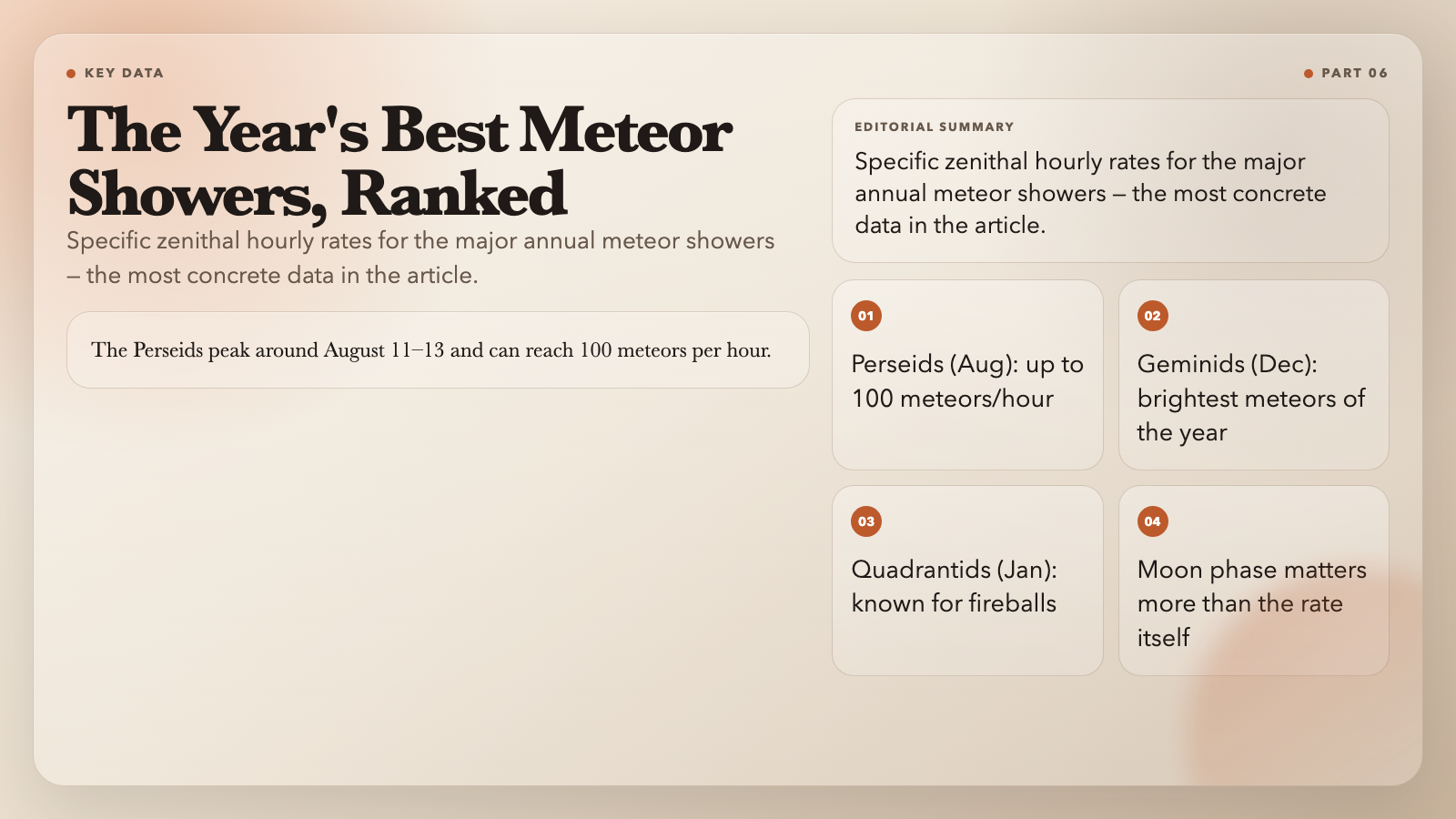
The tool’s viewing guidance is straightforward: find a dark location, let your eyes adapt for 20–30 minutes (this is real — your eyes don’t reach full night sensitivity instantly), face away from the moon, and be patient. Meteor showers aren’t fireworks that go off on demand. They’re a gradual accumulation of streaks that rewards persistence.
7. Solar Eclipse Calculator — Plan Years Ahead for Totality
Solar eclipses are rare in any specific location. Total solar eclipses — where the moon fully covers the sun and the corona blazes visible — might pass over your city once in several lifetimes. But they happen somewhere on Earth 2 to 5 times per year.
The Solar Eclipse Calculator returns all solar eclipses for a given year with type (total, annular, partial, or hybrid) and geographic visibility. It also shows the next upcoming eclipse regardless of year selected.
The distinction between types matters. During totality, the corona — the sun’s outer atmosphere, normally invisible against the sun’s brightness — becomes visible as a luminous ring. Temperature drops noticeably. Animals behave as if night is falling. Annular eclipses produce a “ring of fire” when the moon is too far away to fully cover the sun. Partial eclipses are exactly what they sound like.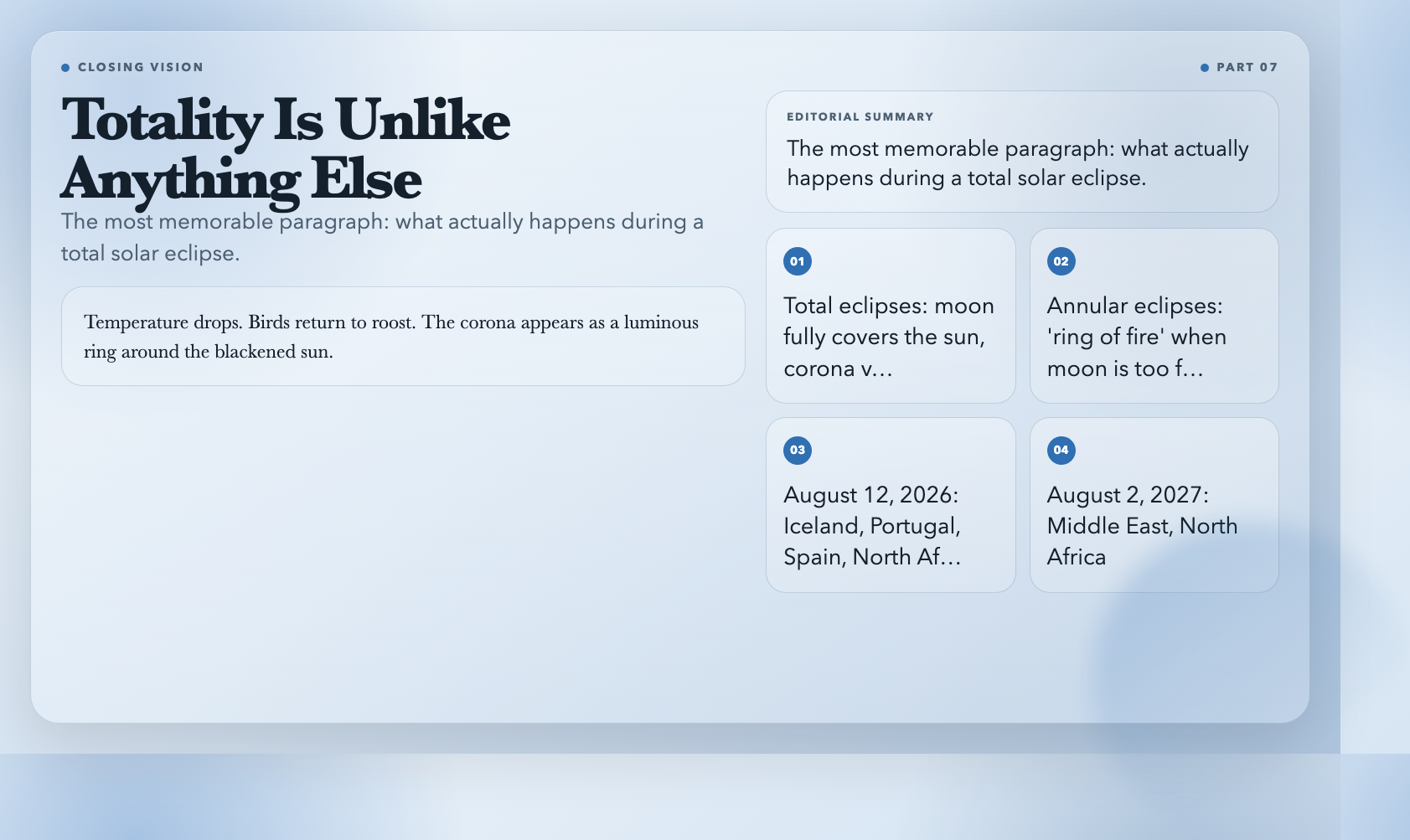
The August 12, 2026 total solar eclipse crossed Iceland, Portugal, Spain, and North Africa. The August 2, 2027 total solar eclipse was visible across the Middle East and North Africa. These events draw thousands of travelers because totality is unlike any ordinary experience — no photograph fully captures it, no description quite prepares you. The tool won’t tell you the weather forecast years in advance, but it tells you where to start planning.
The Sky Is Predictable. Your Stargazing Should Be Too.
These seven tools share a philosophy: the sky is knowable. The sun rises and sets at times you can calculate to the minute. The moon follows a 29.53-day cycle tracked since antiquity. Meteor showers arrive on the same dates each year because Earth orbits through the same debris trails. Eclipses are predictable decades out because orbital mechanics are solved mathematics.
What these tools change isn’t your knowledge of astronomy. It’s your relationship with looking up.
Instead of hoping you’ll catch something interesting, you know: tonight at 7:43 PM, blue hour begins in your city. The moon tonight is waxing gibbous at 73% illumination — too bright for the Milky Way, but ideal for moonlit landscape photography. The Perseid peak is in 12 days, and the moon will be a 12% crescent then, leaving the sky dark. August 12, totality crosses Spain.
The sky stops being something you glance at. It becomes something you plan around. And once you start planning, you start noticing — the moon’s phase on an evening walk, the sun’s angle changing week by week, the constellations shifting as the year progresses.
That’s the shift these tools make: from spectator to participant.
Try the Sunrise & Sunset Calculator with your coordinates. Watch tonight’s sunset. Compare what you see to what the tool predicted. That single data point is the beginning of a different relationship with the sky.