# 6 Free Health Calculators That Replace Your Bathroom Scale
In 1832, a Belgian mathematician built a formula to classify populations. That formula became BMI — and it’s still the most cited number in modern health assessments. Here’s the problem: it was never designed to measure individual health. It was built for census data.
Today, athletes get flagged as obese. Thin people with dangerous visceral fat pass with clean bills of health. And the bathroom scale — the most common proxy for health — tells you only one thing: how much you weigh relative to gravity.
The better question isn’t “what’s my BMI?” It’s what your body actually tells you when you ask the right metrics.
These six free calculators from ElysiaTools measure what your scale cannot.
The BMI Trap
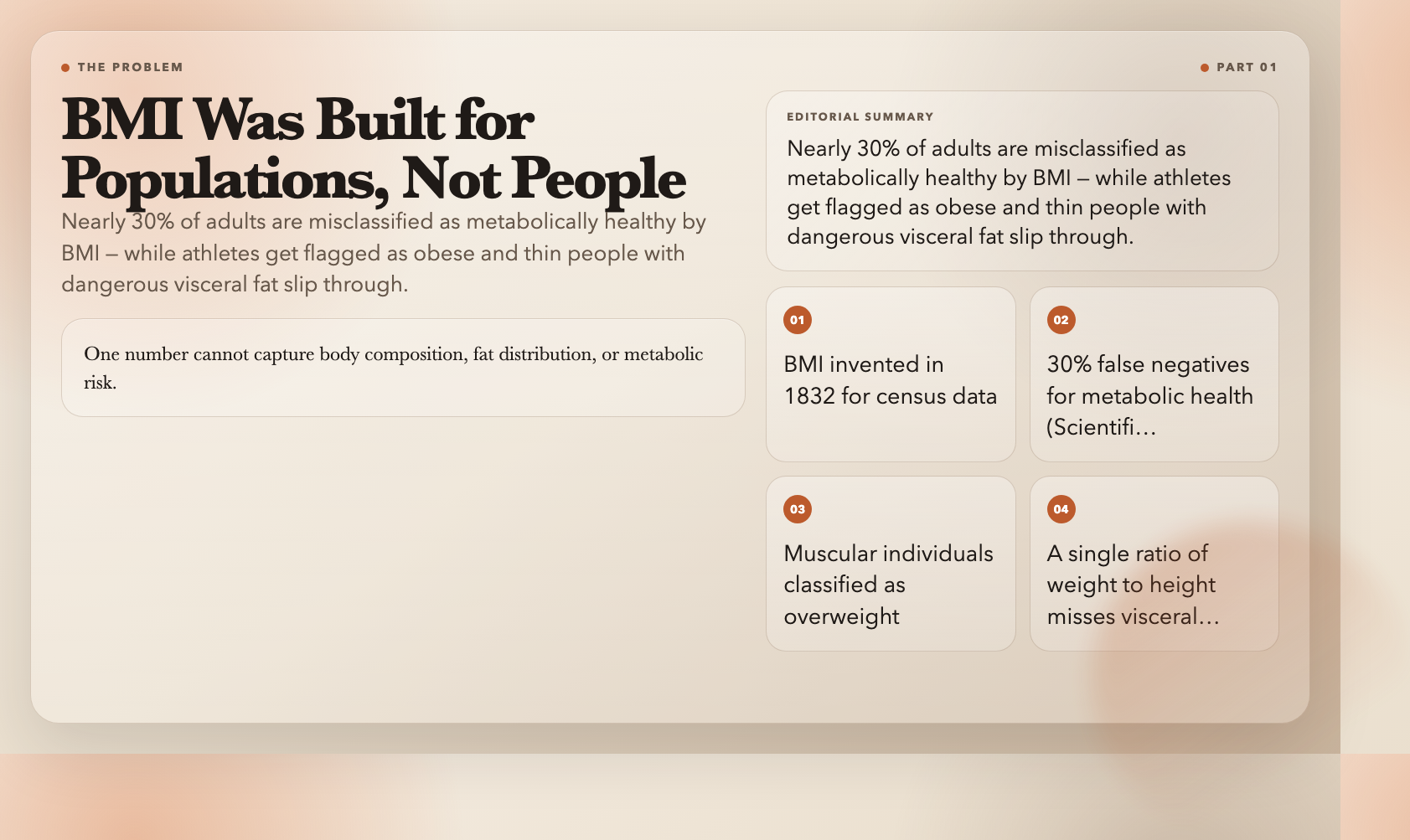
BMI classifies nearly 30% of adults as metabolically healthy when they have elevated visceral fat, according to research published in *Scientific Reports*. It also misclassifies muscular individuals as overweight. One number cannot capture body composition, fat distribution, or metabolic risk.
The BMI Calculator improves on the standard version by calculating your exact risk category, ideal weight range for your height, and age/gender-specific recommendations. The ideal weight range uses the BMI 18.5–24.9 window applied precisely to your measurements — so a 155cm person and a 190cm person get different healthy ranges, not the same chart.
This is a useful first check. Nothing more.
Your Resting Burn
Your Basal Metabolic Rate is the calories your body burns at complete rest. Not exercise. Not walking. Just staying alive — breathing, circulating blood, maintaining body temperature.
The BMR Calculator computes this from your weight, height, age, and gender using the Mifflin-St Jeor equation, the most accurate formula for general populations. A 35-year-old man, 80kg, 180cm burns roughly 1,793 calories per day doing absolutely nothing.
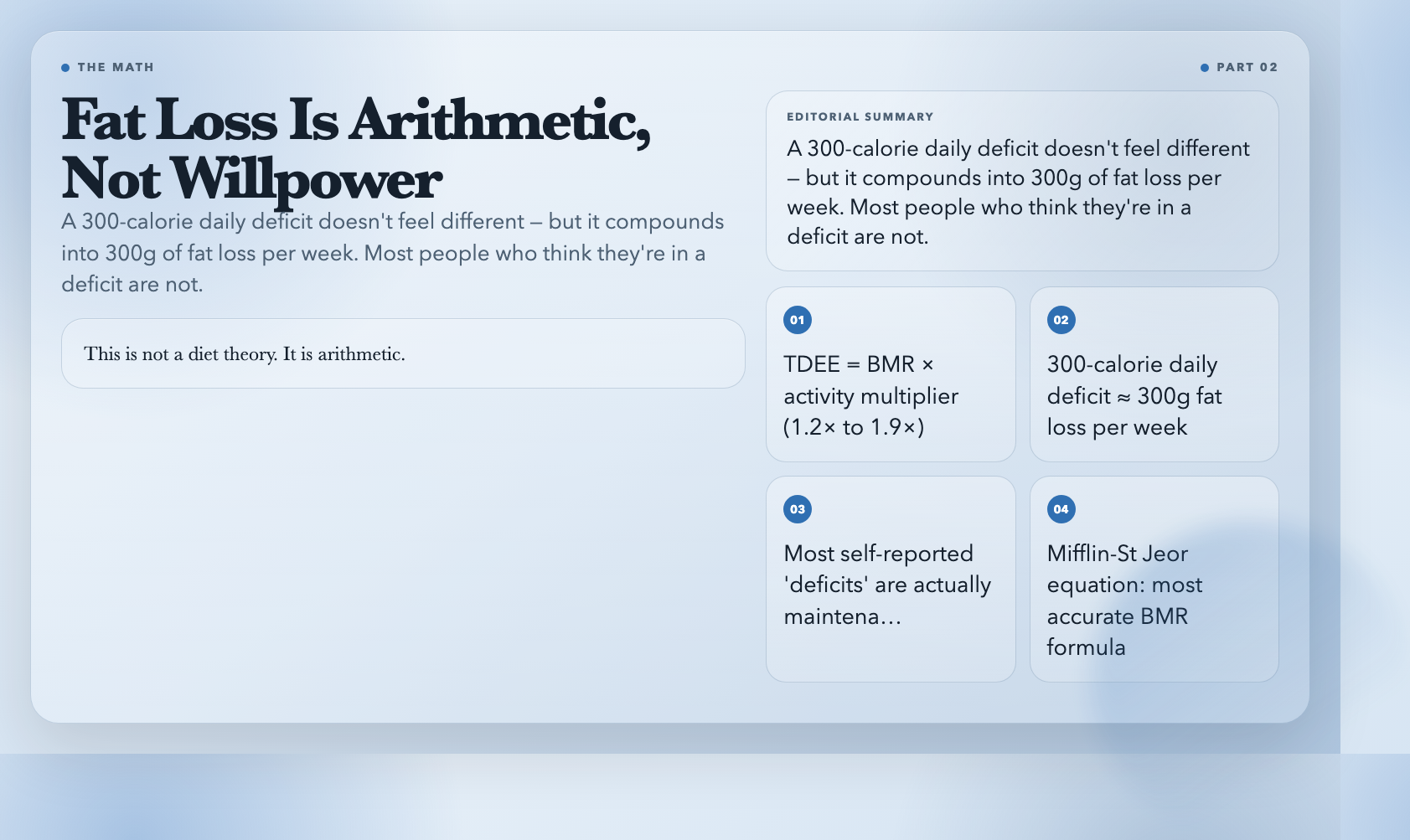
This number is the floor of your energy budget. If you eat below it consistently, you will lose weight. This is not a diet theory. It is arithmetic.
The Real Daily Number
BMR is the floor. TDEE — Total Daily Energy Expenditure — is what you actually burn.
The TDEE Calculator multiplies your BMR by an activity multiplier drawn from doubly-labeled water studies — the gold standard for measuring free-living energy expenditure:
| Activity | Multiplier |
|—|—|
| Sedentary | 1.2× |
| Light (1–3 workouts/week) | 1.375× |
| Moderate (3–5 workouts/week) | 1.55× |
| Hard (6–7 workouts/week) | 1.725× |
| Very hard (daily double sessions) | 1.9× |
The tool separates BMR calories from activity calories, so you can see exactly where your number comes from. If your TDEE is 2,500 and you’re eating 2,200, you’re in a 300-calorie daily deficit — which compounds to roughly 300 grams of fat loss per week. The math is simple. Most people who think they’re in a deficit are not. They are eating more than they burn.
The Metric Your Doctor Should Be Using
Two people at the same BMI can have completely different metabolic risk profiles. A person who carries 15kg in their hips and thighs has lower cardiovascular risk than someone with the same weight concentrated in their abdomen. BMI does not know the difference. Waist-to-height ratio does.
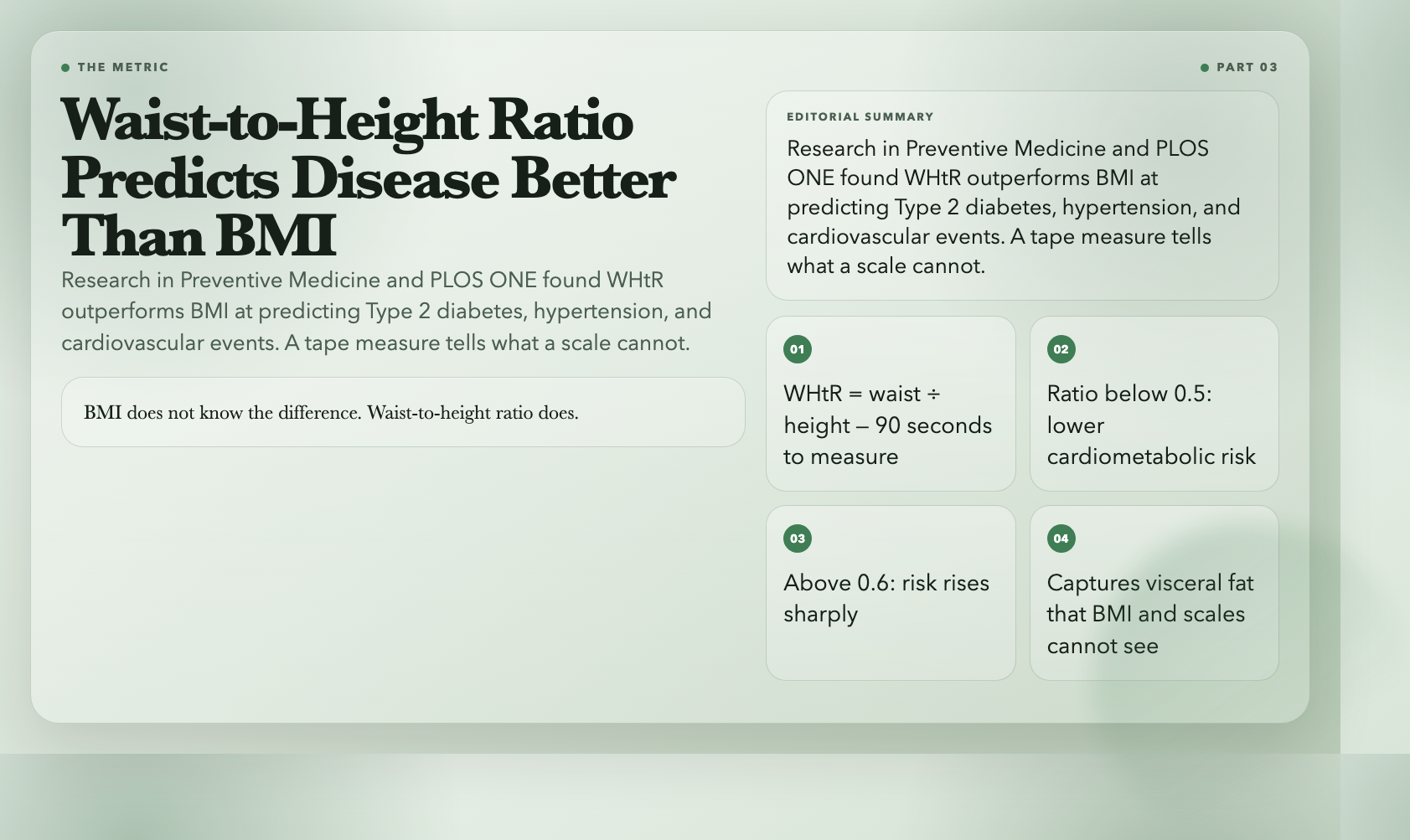
The Waist-to-Height Ratio Calculator computes waist ÷ height. Research in *Preventive Medicine* and *PLOS ONE* has found that WHtR outperforms BMI at predicting Type 2 diabetes, hypertension, and cardiovascular events. A ratio below 0.5 is associated with lower cardiometabolic risk. Above 0.6, risk rises sharply.
The tool returns your ratio, risk level, a list of health implications — cardiovascular risk, insulin resistance, fatty liver disease — and a specific recommendation. No scale required. A tape measure at your waist and a two-minute calculation tell you more about your metabolic health than a decade of stepping on a scale.
What The Scale Can’t See
The US Navy Body Fat Calculator estimates your body fat percentage using neck and waist measurements — no equipment beyond a tape measure. The formula was developed by the Department of Defense and validated against underwater weighing.
Consider two people at 85kg. One at 12% body fat has visible muscle definition and healthy metabolic markers. The other at 30% has a completely different health profile. Weight alone is nearly useless without this context.
Body fat percentage is how you track composition when the scale is stuck. Muscle weighs the same as fat — but it looks and functions differently. The number on the scale cannot tell this story. Body fat percentage can.
The Genetics You Need to Know
The Blood Type Calculator predicts possible child blood types from parents’ blood types and Rh factors, using standard ABO inheritance. It returns all possible combinations for a given parental pairing.
This has practical medical consequences that most people don’t learn until a problem surfaces. Rh incompatibility — when an Rh-negative mother carries an Rh-positive fetus — can cause fetal anemia and complications in subsequent pregnancies if left unscreened. The fix is simple: knowing the types. The prevention only works if people know their blood type in advance.
Basic genetic literacy. It should be more widely known.
Your Waist, This Week
You don’t need all six metrics on day one. You need one baseline.
Measure your waist at the navel, divide by your height, get your WHtR. Takes 90 seconds. That single number tells you more about your metabolic health than five years of stepping on a scale.
If the ratio is above 0.5, run your BMR next. Calculate what you’re actually burning. Everything in this list is free and runs in any browser. No account, no download.
The question is not whether these numbers matter. It’s whether you’re willing to look.