7 Free Health & Fitness Calculators You Need in 2026
Most people who start a fitness plan have a goal. What they don’t have is data.
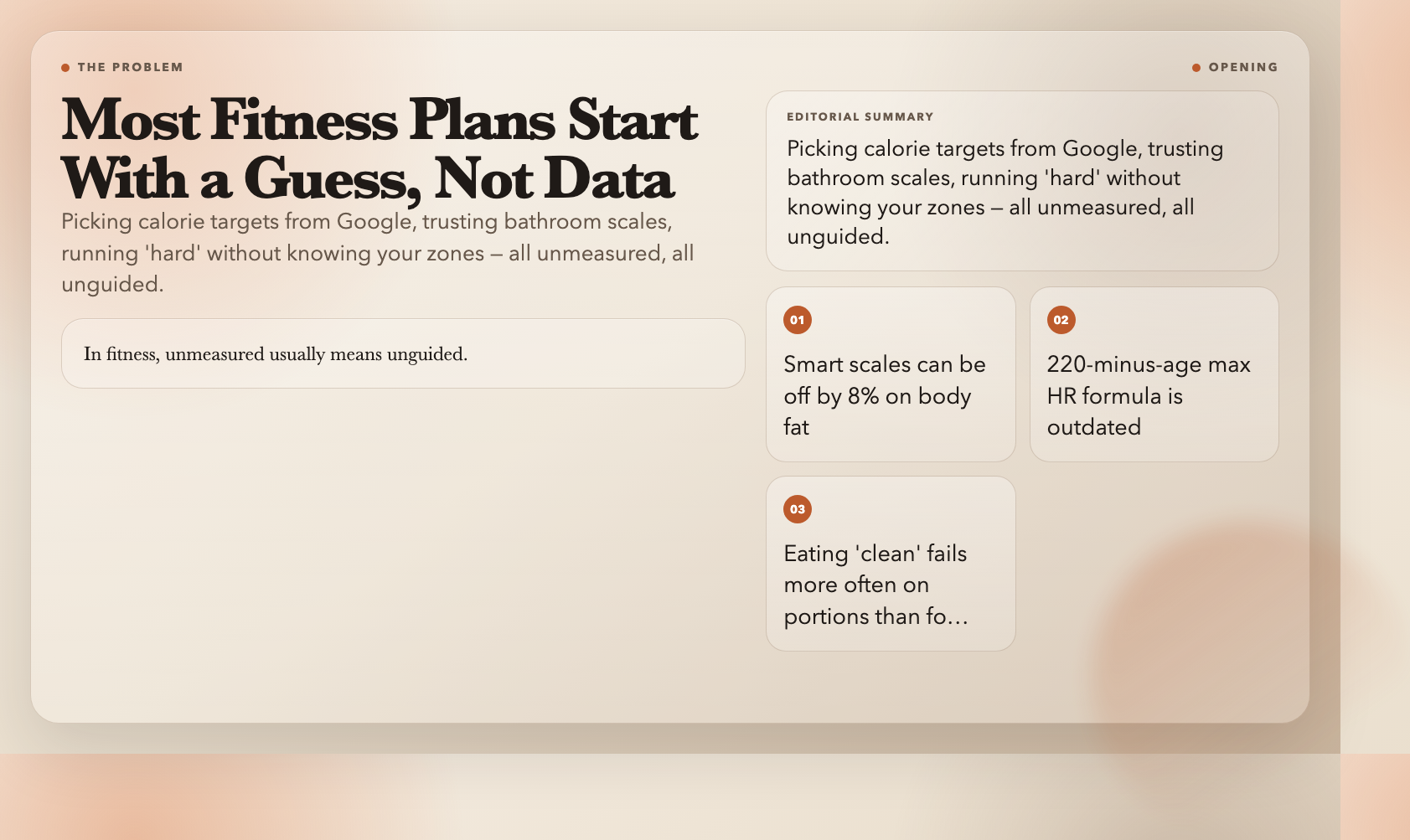
They pick a calorie number from a Google result that seemed reasonable. They buy a smart scale that shows body fat to two decimal places — a number that might be off by 8%. They run at a pace that “feels hard” and call it intervals. This isn’t stupid. It’s unmeasured. And in fitness, unmeasured usually means unguided.
There’s a better version of the starting point. It requires seven free tools and five minutes each. Here’s what to use and why.
#
1. BMI Calculator
Body Mass Index is the most cited health metric in the world — a fact that sometimes earns it more respect than it deserves.
The formula is simple: weight divided by height squared. Enter two numbers and get a category — Underweight, Normal, Overweight, or Obese — backed by decades of epidemiological research linking BMI to disease outcomes at population scale. It screens; it doesn’t diagnose. But as a first signal, it costs 30 seconds and zero equipment.
Plug in your weight, height, age, and gender. The tool returns your BMI, your ideal weight range for your height, and a plain-language health assessment. One important limitation: BMI doesn’t distinguish fat from muscle. A college football player can register as “obese” without coming close to a health problem. Use it as a weather forecast — useful context, not a final verdict.
Use it when: You want the fastest possible baseline before looking at anything more specific.
#
2. BMR Calculator
Your Basal Metabolic Rate is what your body burns at complete rest — keeping your heart beating, lungs functioning, and brain running. No movement, no digestion, no anything. Just existing.
BMR typically accounts for 60–75% of total daily calorie expenditure. The rest comes from movement and the thermic effect of food. If you eat below your BMR for too long, your body doesn’t negotiate with starvation — it downgrades non-essential functions. This is why crash diets fail over time.
The calculator uses the Mifflin-St Jeor Equation — the most accurate formula for most people — with options to switch to Harris-Benedict or Katch-McArdle if you already know your body fat percentage.
Use it when: You want to set a calorie target that starts from your body’s real floor, not a round number from the internet.
#
3. TDEE Calculator
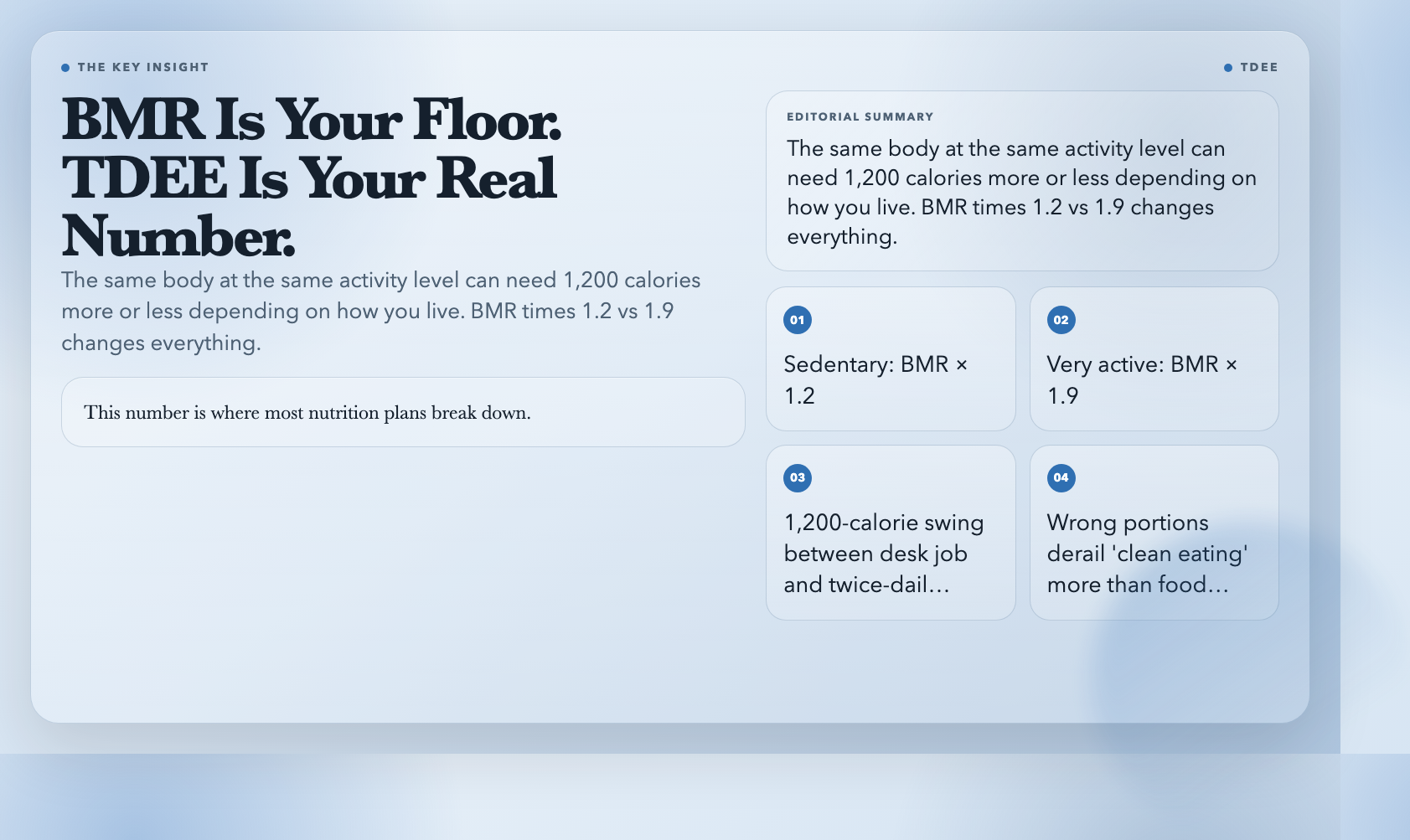
BMR is your floor. TDEE is your real number.
Total Daily Energy Expenditure multiplies your BMR by an activity factor. A sedentary person — desk job, no structured exercise — gets 1.2x. Someone training hard twice a day gets 1.9x. For a 30-year-old man at 175cm and 75kg, that multiplier changes daily calorie needs by roughly 1,200 calories. Same body, same food, opposite results.
This number is where most nutrition plans break down. People eat “clean” and see nothing because they were eating the wrong amount, not the wrong foods. TDEE tells you what “the right amount” actually is for your life — not an average, not a guess.
Use it when: You’re ready to eat with precision instead of portion intuition.
#
4. Body Fat Calculator (US Navy Method)
Two people can weigh the same and look entirely different. One carries 12% body fat; the other, 25%. The scale doesn’t know the difference.
The US Navy body fat formula was developed in the 1940s and remains the official fitness assessment method for US military personnel. It requires only a tape measure: neck and waist for men, neck, waist, and hips for women, plus height. The math — derived from underwater weighing studies on naval personnel — does the rest.
You get a body fat percentage, a gender-calibrated category (Essential Fat / Athletes / Fitness / Average / Obese), and estimated fat mass and lean mass. Consumer bioelectrical impedance scales can be off by 5–8%. This method won’t.
Use it when: You want to track body composition changes the bathroom scale will never show you.
Body Fat Calculator (US Navy) →
#
5. Target Heart Rate Calculator
Training at “a good pace” is not a strategy. It’s a guess.
Your heart rate is the only real-time objective measure of how hard your body is actually working. The classic maximum heart rate formula — 220 minus your age — came from a 1970s study with methodological problems, including subjects on beta blockers and with existing heart conditions. Modern research, including work by exercise physiologist Hirofumi Tanaka, puts the real formula closer to 208 minus 0.7 times your age.
This calculator gives you five training zones, each tied to a specific heart rate range and physiological benefit. Zone 2 (60–70% of max) builds your aerobic base and improves fat oxidation. Zone 4 (80–90%) raises your lactate threshold. Zone 5 is for short, maximum-intensity intervals. The Karvonen method — also available — factors in your resting heart rate for a personalized zone calculation.
Use it when: You want to train with measurable precision instead of effort intuition.
Target Heart Rate Calculator →
#
6. Macro Nutrient Calculator
Calories answer “how much.” Macros answer “what kind.”
Protein, carbohydrates, and fat make up everything you eat. Two people eating 2,000 calories a day can have radically different outcomes depending on their macro split. A 40/30/30 (balanced) vs. 5/25/70 (keto) changes body composition, energy levels, and performance at the same calorie count.
This tool takes your daily calorie target and goal (lose weight, maintain, or build muscle) and breaks it down to the gram level. Choose your diet type: Balanced, Low Carb, Keto, or High Protein. It also divides totals into per-meal amounts if you eat four times a day.
Use it when: You’re past calorie counting and want to understand what those numbers are doing inside your body.
#
7. Waist to Height Ratio Calculator
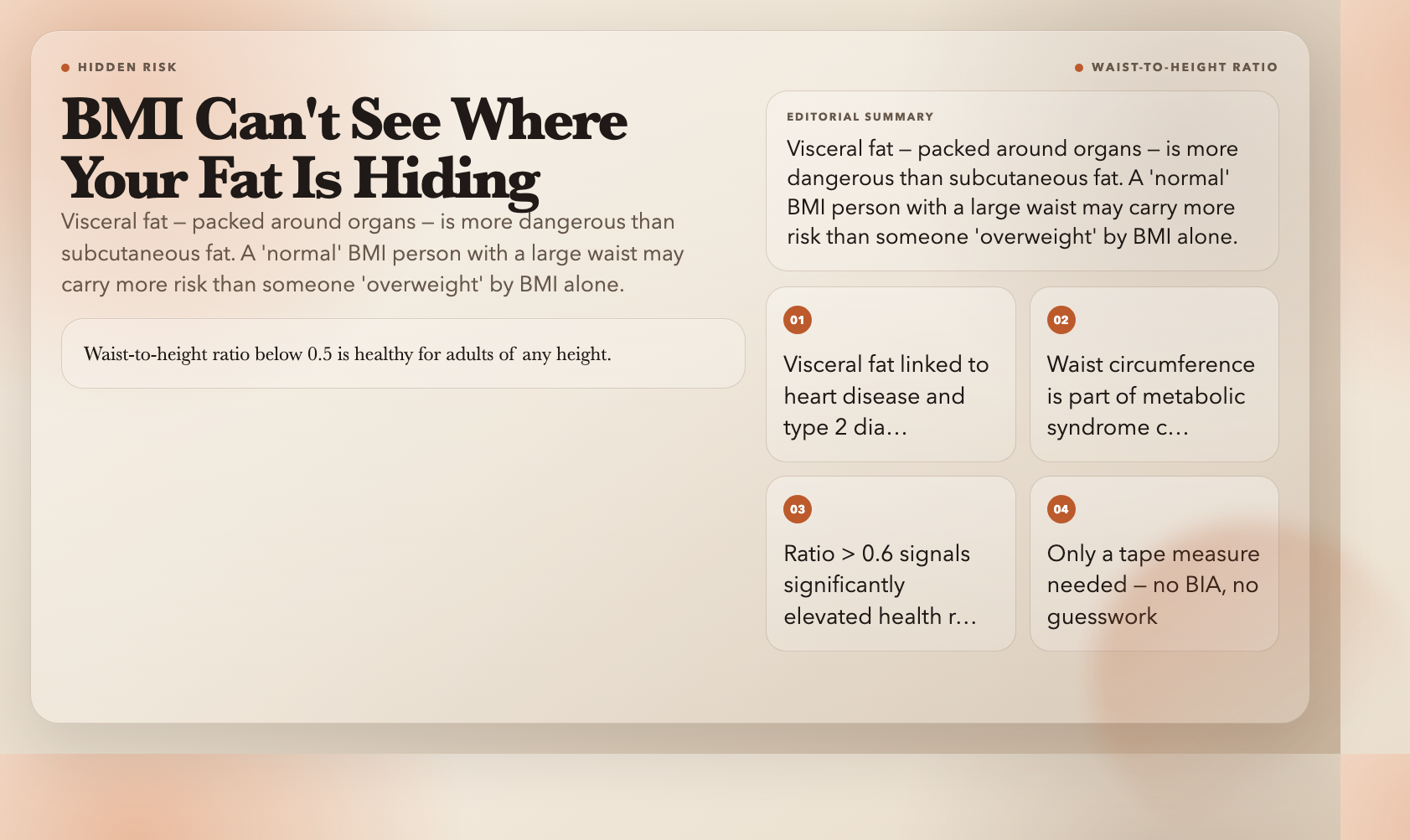
BMI has a meaningful blind spot: it doesn’t know where your fat is.
Visceral fat — packed around your organs — is more metabolically dangerous than subcutaneous fat (the kind under your skin). A person with “normal” BMI and a large waist carries higher health risks than someone with “overweight” BMI and a slim waist. Waist circumference is part of the metabolic syndrome diagnostic criteria that BMI alone misses.
The waist-to-height ratio is one of the simplest and most evidence-backed proxies for this risk. A ratio below 0.5 is healthy for adults of any height. A ratio above 0.6 signals significantly elevated risk. Research in *PLOS ONE* found it outperformed BMI as a predictor of heart disease and early death. You need a tape measure and 30 seconds.
Use it when: You want one number that captures your abdominal fat risk — no BIA, no guessing.
Waist to Height Ratio Calculator →
#
The Chain
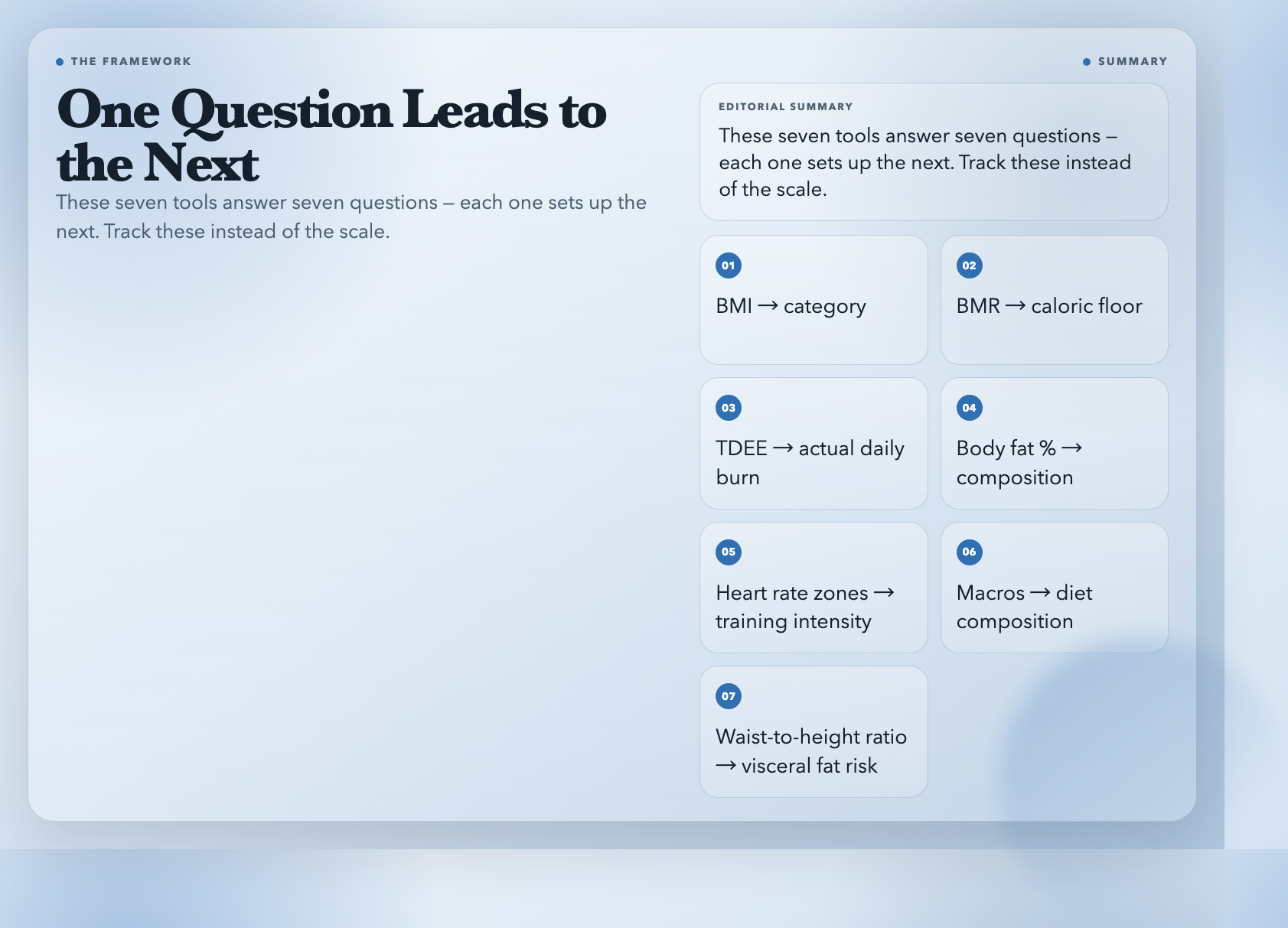
These seven tools answer seven questions, and each one sets up the next:
– BMI gives you a starting category.
– BMR tells you your caloric floor.
– TDEE tells you your actual daily burn.
– Body fat percentage shows what’s under the weight.
– Heart rate zones tell you how hard to train.
– Macros tell you what to eat.
– Waist-to-height ratio tells you whether the fat you’re carrying is the dangerous kind.
Most people who start a fitness plan track their weight. The people who change their body composition track these numbers instead.
If you don’t measure it, you can’t manage it. Five minutes, seven free tools. Start with BMI.