# Why Fireflies Don’t Decide to Sync. Neither Do Your Neurons. Here’s the Math.
Christiaan Huygens built some of the most precise clocks in 17th-century Europe. In 1665, he noticed something those clocks weren’t supposed to do: two pendulums hanging from the same wooden beam had synchronized. They swung in perfect unison, neither leading nor lagging. He moved one by hand. Within thirty minutes, they were locked again.
No one told them to. No central mechanism dictated the rhythm. The beam transmitted microscopic vibrations between the two clocks, and from that faint interaction, perfect order emerged. Huygens described it in a letter. Nobody followed up for a hundred years.
In 1975, Yoshiki Kuramoto wrote down a seven-line equation that explains exactly what Huygens observed — and why the same physics shows up in firefly swarms, neurons, power grids, and crowd applause. It remains one of the most beautiful models in all of applied mathematics.
What the Equation Actually Says
Here’s the setup: N oscillators. Each has a natural frequency — the rhythm it would swing at if it were completely alone. These frequencies aren’t identical. Some run fast, some run slow, scattered around a mean.
Now couple them. Add the simplest possible interaction: each oscillator gets nudged by the average phase of all the others.
“` dθᵢ/dt = ωᵢ + (K/N) Σⱼ sin(θⱼ – θᵢ) “`
In plain English:
– θᵢ is where oscillator i is in its cycle right now – ωᵢ is its preferred speed – K is coupling strength — how hard oscillators pull on each other – N is total oscillator count
The sine term does the work. Slow oscillators get sped up. Fast oscillators get slowed down. The coupling doesn’t prescribe a shared rhythm. It just nudges toward one.
Seven lines. Fifty years of papers. The model is that compact, and that rich.
The Order Parameter: Measuring Sync
How do you quantify whether a system is synchronized? Kuramoto introduced an elegant measure.
Take every oscillator’s phase, represent it as a point on a circle, then average those points as vectors. When oscillators are scattered randomly, the vectors cancel out and the sum approaches zero. When they lock together, the vectors align and the sum approaches one.
Kuramoto called this r. It ranges from 0 (total chaos) to 1 (perfect sync).
At a critical coupling strength Kc, the system undergoes a phase transition. Below Kc, oscillators drift independently and r stays near zero. Above Kc, r jumps up sharply. Oscillators that were ignoring each other suddenly lock step.
This is the same mathematics as ice melting into water, or a magnet losing its magnetism. Phase transitions are among the most studied phenomena in physics — and they emerge here from nothing more than oscillators nudging each other.
Real Synchronization Is Everywhere
Once you know what to look for, you find it in surprising places.
Fireflies in Southeast Asia synchronize by the tens of thousands. Thousands of male fireflies gather in mangrove trees and flash in unison, producing a light show visible from orbiting satellites. No lead firefly sets the tempo. Each firefly adjusts its flash timing based on what it sees around it. A global rhythm emerges from local rules.
Your neurons do this. When you focus attention, groups of neurons in your cortex start firing together. When you daydream, they drift apart. The transition looks like a Kuramoto phase transition — a sharp jump in synchrony as coupling crosses a threshold. Too much sync and you have a seizure. Too little and information doesn’t get processed. The brain sits near criticality, and some researchers argue this is where optimal information processing happens.
Crowd applause follows the same pattern. Start clapping and the room sounds chaotic — irregular claps from hundreds of hands. Then, without warning, the applause suddenly synchronizes. A unified wave of sound fills the room. Researchers have filmed this transition and measured the order parameter jumping exactly as the model predicts.
Power grids fight this. If generators fall into unwanted synchrony, they can trip and cause cascading blackouts. Engineers study Kuramoto dynamics specifically to stay below the critical coupling — maintaining stability without suppressing the synchronization that makes the grid work.
The Critical Point: Where Order Emerges
The model reveals something counterintuitive: you don’t need strong coupling to get synchronization. You need just enough.
With very weak coupling, oscillators drift independently. With very strong coupling, they lock instantly. But at the critical point, something interesting happens: a cluster of oscillators locks together while the rest continue running freely.
This partial synchrony is where interesting computation occurs. A network that’s too ordered can’t process new information. A network that’s too chaotic can’t maintain it. The sweet spot is criticality — where information gets encoded, transmitted, and transformed. Bird flocks, fish schools, and traffic jams all exhibit this behavior. None of them have a leader.
The Interactive Part
The visualization shows exactly this. Adjust the coupling strength slider and watch the order parameter change in real time.
Start with K = 0. The phase circle shows dots scattered randomly — each oscillator doing its own thing. r hovers near zero.
Slowly increase K. The dots begin clustering. r climbs.
At Kc, you witness the phase transition: a sharp jump in r as oscillators lock together. Increase K further and the cluster tightens until r approaches 1.
You can feel the transition. The model is simple enough to fit on a napkin. The dynamics are rich enough to occupy fifty years of research.
What Nobody Fully Understands Yet
The Kuramoto model explains how synchronization emerges from local rules. It doesn’t explain what synchronization is for.
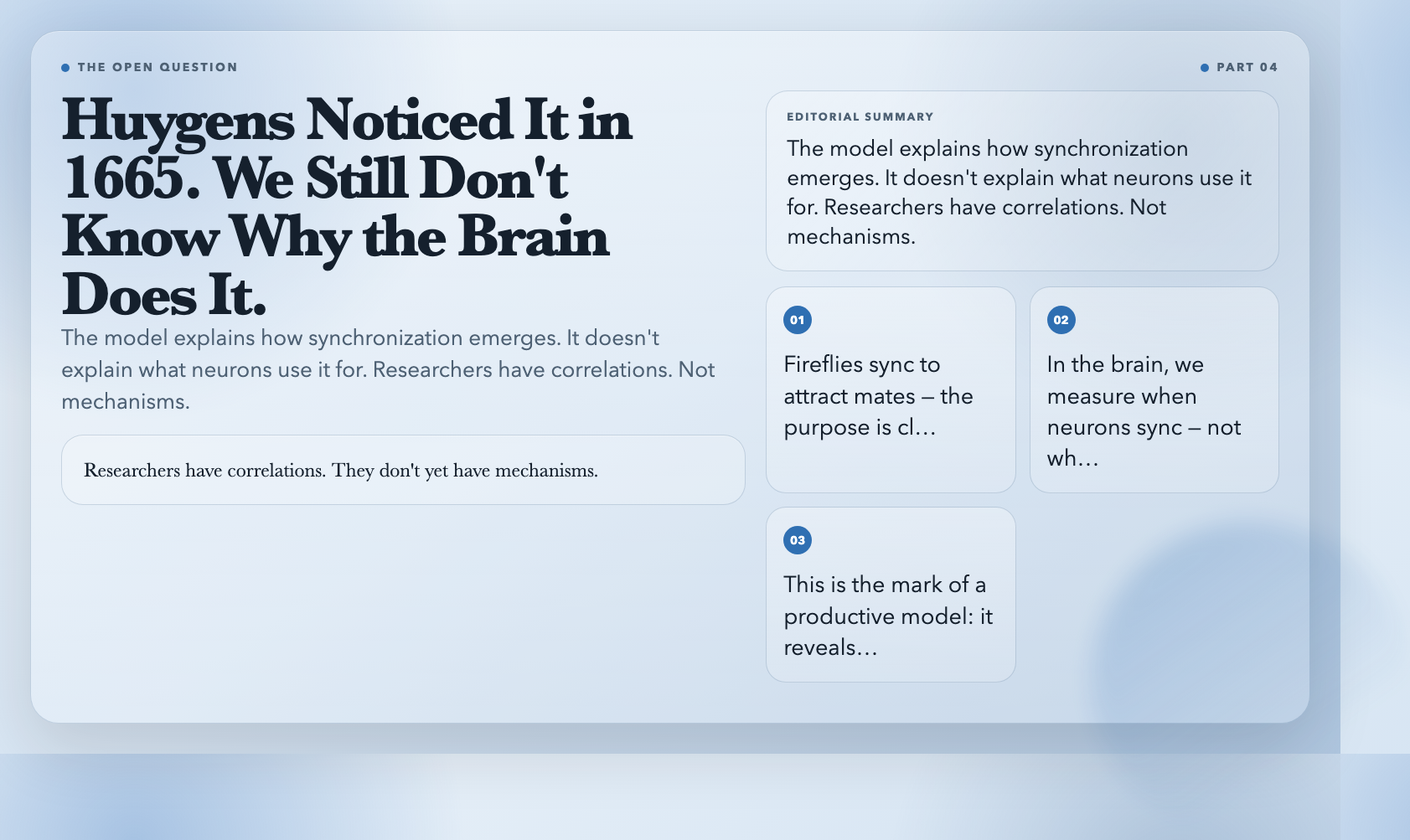
In fireflies, the answer is straightforward — they sync to attract mates. But in the brain, we can measure when neurons synchronize. We’re still working out what it means. Communication? Attention? Memory consolidation? Researchers have correlations. They don’t yet have mechanisms.
This is the mark of a productive model: it explains something real, and in explaining it, reveals how much more there is to discover. Huygens noticed his clocks syncing in 1665. Kuramoto explained it in 1975. We still don’t fully understand why the brain does it.
That feels about right for science.
—
The Kuramoto model was introduced by Yoshiki Kuramoto in 1975. The interactive visualization is available at elysiatools.com, where you can explore phase transitions, adjust coupling strength, and watch the order parameter evolve in real time.