8 Free Developer Tools That Replace Hours of Boilerplate Work
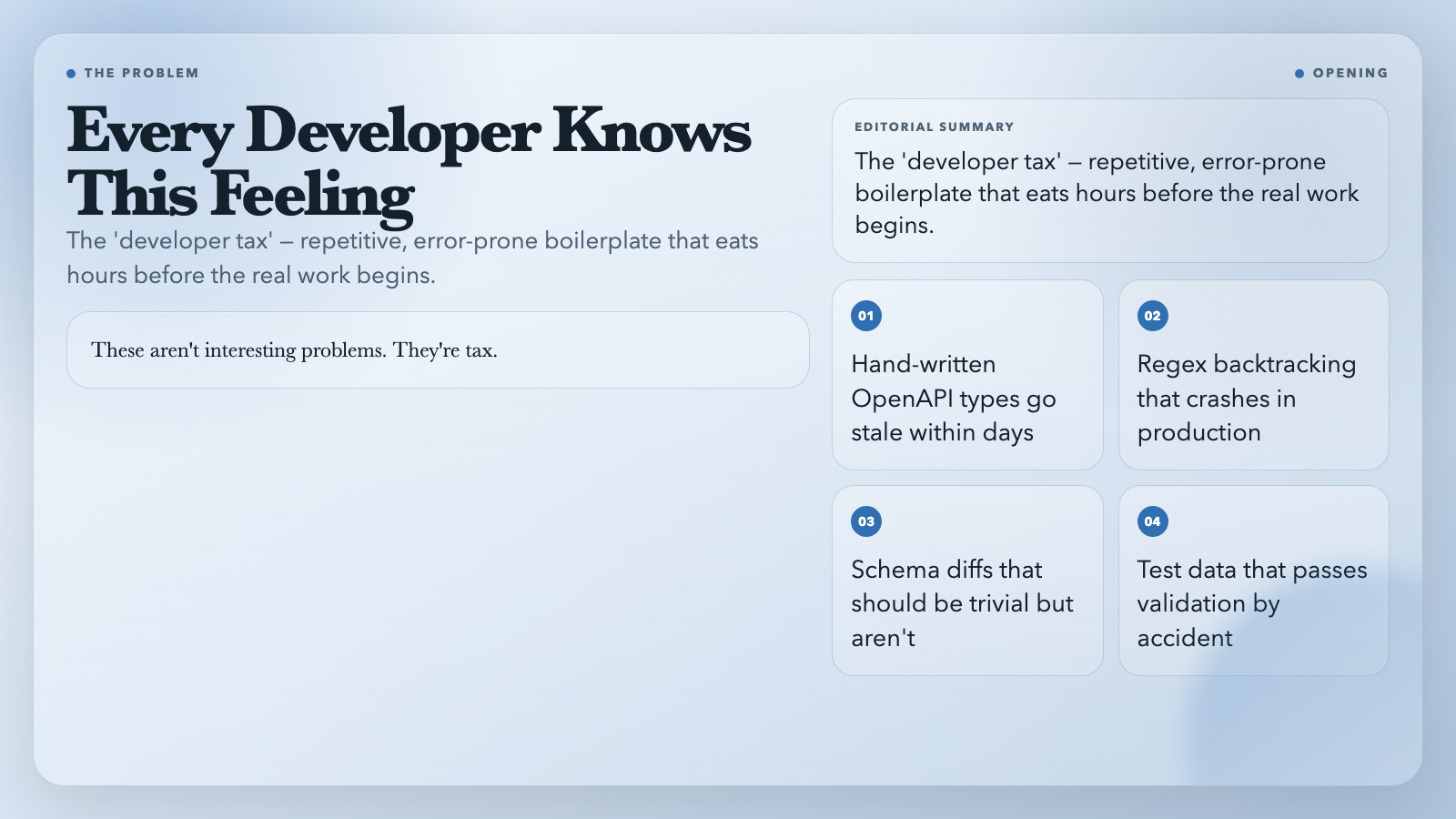
Every developer knows the feeling. You’re in the zone, ready to build something meaningful, and then reality hits: generate test users, write OpenAPI types by hand, figure out why your regex is catastrophically backtracking, diff two schemas that shouldn’t be different but clearly are.
These aren’t interesting problems. They’re tax — the toll you pay before getting to the actual work.
This list rounds up eight completely free developer utilities that eliminate the most common forms of tax. Each one does one thing well, runs in your browser with zero setup, and handles the edge cases you’d otherwise discover at 2 AM.
1. API Mock Server
Nothing kills a frontend sprint faster than a missing backend. You could spin up a Node Express app, wire up some routes, call it done. Or you could paste a URL, define your response templates with dynamic placeholders, and have a fully functional mock running in under two minutes.
The API Mock Server generates a Redis-backed mock API with a one-hour TTL, hot-reload support, and dynamic templated responses that handle request parameters, random delays, and conditional responses. You get a runnable endpoint you can hand to a frontend developer before the real backend even exists.
Use this when: you need to parallelize frontend and backend work, test error handling you can’t easily trigger on production, or simulate third-party API behavior during development.
2. JSON Schema Generator
The task sounds trivial: given a sample JSON object, produce the schema that describes it. In practice, the best schemas require domain knowledge — which fields are required, which can be null, what the numeric ranges actually are. You also need to validate new data against your schema as it evolves.
The JSON Schema Generator infers schemas from sample JSON, lets you overlay manual edits that persist across re-inference, and validates new data against the active schema. If you’ve ever fought with a misconfigured API contract mid-sprint, you know why this matters.
Use this when: you’re establishing API contracts, writing tests that need realistic payloads, or onboarding new team members who need to understand your data model.
3. Test Data Faker Builder
You need a thousand user records with realistic names, valid credit card numbers, properly formatted IDs, and email addresses that pass regex validation. You could write a script to generate this. Or you could configure fields, pick from faker categories, add regex constraints, and export a million rows as JSON or CSV in seconds.
The Test Data Faker Builder generates structured test data from a field-by-field configuration. Each field supports faker functions, custom regex patterns, conditional ranges, and batch export. This means the data isn’t just randomly shaped — it’s shaped correctly.
Use this when: you need to populate a staging database, run performance tests with realistic data shapes, or generate datasets for machine learning pipelines that require valid structured input.
4. Code Complexity Analyzer
Cyclomatic complexity tells you how many independent paths exist through a function. Cognitive complexity tells you how hard those paths are for a human to follow. If you’ve ever inherited a “simple utility” that required a flowchart to understand, you know the difference between these two metrics in practice.
The Code Complexity Analyzer measures both across JavaScript, TypeScript, Python, Java, and Go. It surfaces nesting depth, long methods, and files that are doing too many things at once. The output is structured enough to feed into CI pipelines — set a complexity threshold, fail the build if a PR exceeds it.
Use this when: reviewing pull requests, establishing complexity budgets for a codebase, or identifying which files need refactoring before adding new features.
5. Database Schema Diff
You’ve made changes to your local branch. Your colleague made changes to theirs. Both of you modified the users table. The question isn’t philosophical — it needs an answer right now: what actually changed, what’s at risk, and what’s the migration path?
The Database Schema Diff compares two SQL or JSON schemas and generates a change report: added columns, removed columns, type changes, and constraint modifications. It works across MySQL, PostgreSQL, and SQLite. The output is oriented around migrations — it tells you not just what changed, but what a migration script would need to do.
Use this when: reviewing database changes before deployment, auditing schema drift across environments, or writing migration scripts and wanting a first draft to build from.
6. Cron Expression Visualizer
Cron syntax is famously readable only by its author, and not even then after a week. /15 9-17 * 1-5 sounds reasonable until you realize it might not mean what you think. The problem isn’t the syntax — it’s that there’s no visual feedback loop while you’re writing it.
The Cron Expression Visualizer parses standard and Quartz cron expressions, validates the syntax, and displays the next N execution times on a visual timeline. It also renders multi-language human-readable labels so your whole team can verify what “every other Friday” actually translates to.
Use this when: configuring scheduled jobs, auditing existing cron jobs to confirm they’re set up correctly, or onboarding engineers who aren’t familiar with cron syntax.
7. OpenAPI to TypeScript Generator
You’ve got an OpenAPI spec. You’ve got a frontend that needs types for every request and response. Hand-coding the types from the spec is a day of tedious work that will be wrong in at least three places and out of sync by next week.
The OpenAPI to TypeScript Generator converts OpenAPI or Swagger JSON/YAML specs into TypeScript interfaces, request payload types, and response models. It supports flat and namespace output formats, configurable naming styles (PascalCase, camelCase, original), interface or type alias declarations, and optional operation-level types for every endpoint. Paste your spec, get clean generated types.
Use this when: bootstrapping a TypeScript API client, keeping frontend and backend types in sync without manual maintenance, or generating type-safe API bindings from a shared spec.
8. UUID Generator
Every programming language can generate UUIDs. But generating them by hand — specifying the version, getting the format right, handling namespace inputs for v5 — usually means opening a browser tab anyway.
The UUID Generator generates UUID v1 (time-based), v4 (random), and v5 (namespace-based SHA-1) in batches of up to 100 at a time. It handles all the parameter validation and presents clean, copy-pasteable output. For v5 generation, it supports DNS, URL, OID, and X500 namespaces with proper RFC 4122 compliance.
Use this when: seeding databases with test records, generating deterministic IDs for reproducible test fixtures, or creating unique identifiers in any environment where you don’t have a UUID library immediately available.
The Pattern
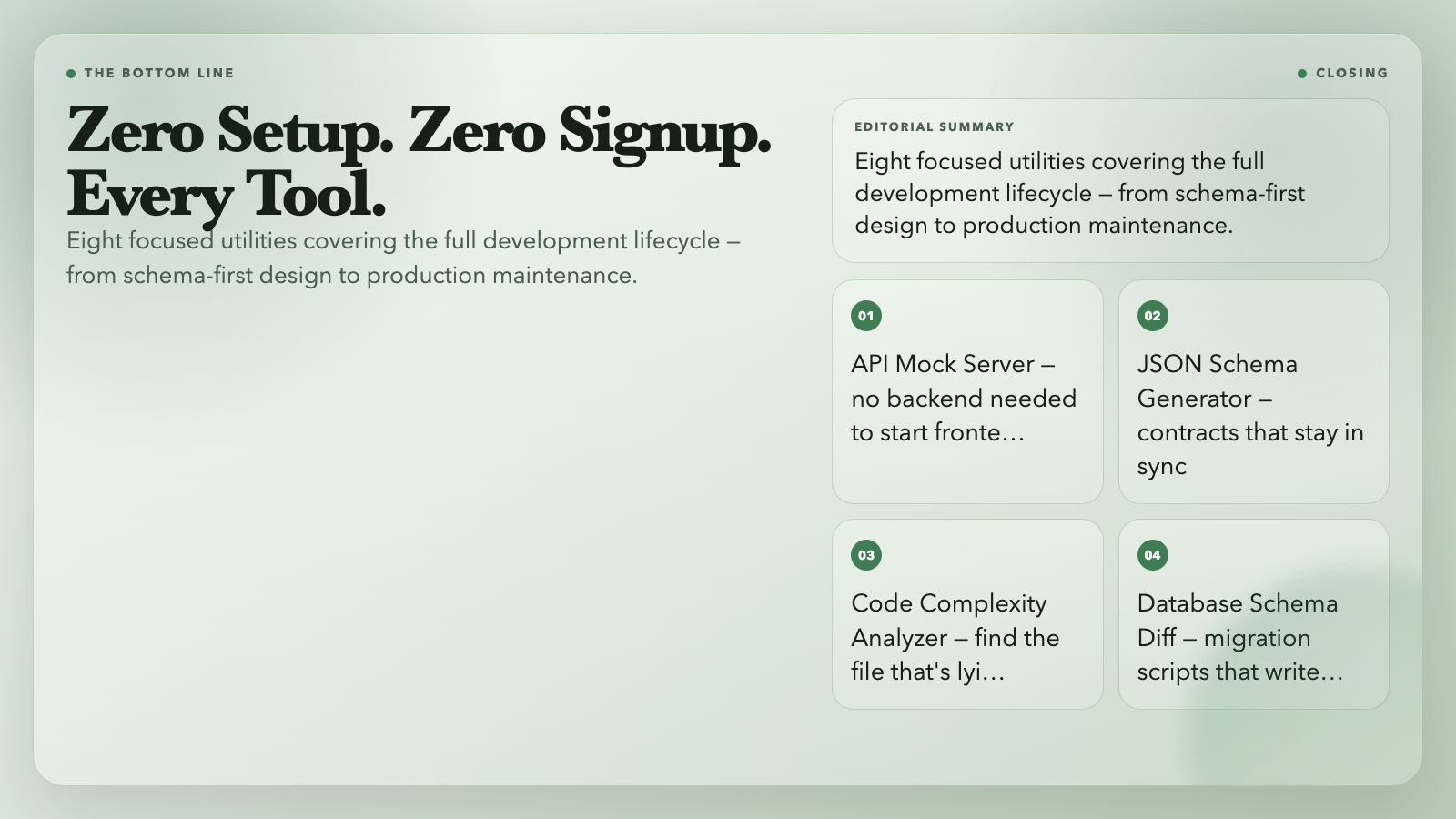
Every tool on this list follows the same logic: take a repetitive, error-prone task that every developer hits, solve it with a focused tool that requires zero setup. They’re not trying to be platforms — they’re utilities. You open the page, you solve the problem, you close the tab. That minimal friction is the entire product.
The collection spans the full development lifecycle — from schema-first design (JSON Schema Generator, OpenAPI to TypeScript) through development (API Mock Server, Code Complexity Analyzer) to deployment and maintenance (Database Schema Diff, Cron Expression Visualizer). Bookmark the ones that match where you are today. The others will find you when you need them.