8 Free Validation Tools That Would Have Saved Me Hours Last Week
Last Tuesday, I watched a payment form silently accept a credit card number for twenty minutes before the payment processor returned a cryptic error code. The number looked valid. It felt valid. But it wasn’t.
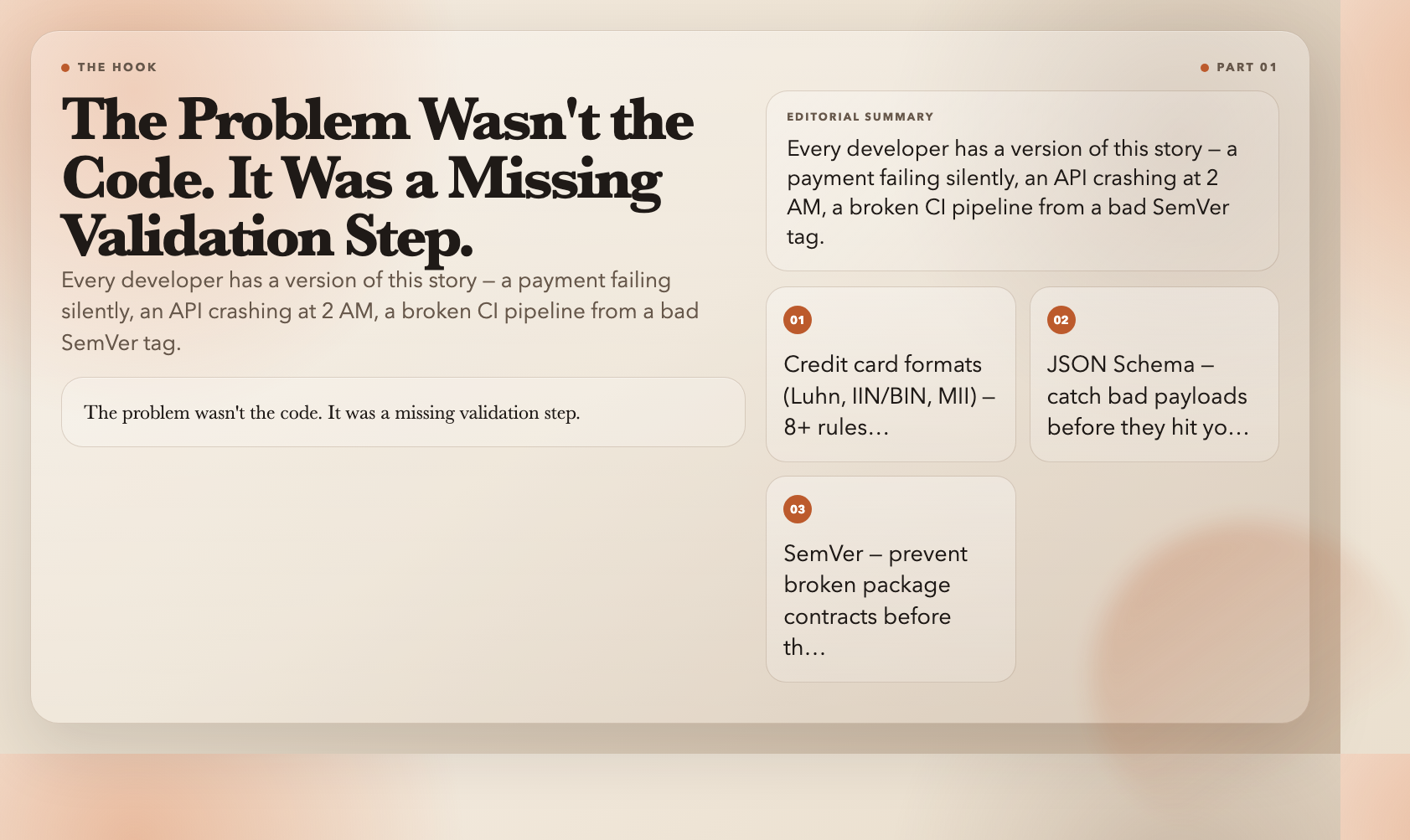
The problem wasn’t the code. It was a missing validation step.
Every developer has a version of this story. A malformed JSON schema crashed an API at 2 AM. A SemVer tag broke the CI pipeline. A EU VAT number passed a regex check but failed every compliance system downstream. Validation sounds boring until the moment it isn’t — and then it’s very, very not boring.
Here are eight free validation tools from ElysiaTools that I use daily.
 The kind of tools you set up once and forget. Until they prevent a spectacular production incident.
1. Credit Card Validator
Payment forms are deceptively complex. A card number isn’t just “numbers only” — it has a length constraint (13–19 digits), a Luhn checksum, an IIN/BIN range that identifies the issuer, and an MII digit that reveals the industry. Visa starts with 4. Amex starts with 34 or 37. UnionPay starts with 62. Each follows different rules.
The Credit Card Validator handles all of this in one shot. It parses the card number, identifies the brand (Visa, MasterCard, Amex, Discover, JCB, UnionPay, Diners Club, Maestro), runs the Luhn algorithm, and breaks down every component — MII, IIN/BIN, account number, check digit — into a readable report. For a developer building a payment form, this single pass replaces three or four separate validation functions.
In one project, a checkout flow was failing silently for UnionPay cards. The root cause: the team had only tested Visa and MasterCard formats. The Credit Card Validator would have caught the format mismatch in seconds.
2. JSON Schema Validator
If you’ve ever had an API accept malformed data and then fail downstream with an incomprehensible stack trace, you know why JSON Schema validation exists. JSON Schema is a vocabulary that describes what valid data looks like — which fields are required, what types are allowed, what the minimum and maximum values are, what string formats are acceptable.
The JSON Schema Validator on ElysiaTools uses the AJV library and supports drafts 4, 6, 7, 2019-09, and 2020-12. You paste your JSON data and your schema, pick a draft version, and it tells you exactly which validation rules failed, which path in the data triggered each failure, and what the constraint was. When validation passes, you get a clean confirmation. When it fails, you get actionable diagnostics instead of a 500 error.
This is the tool I use before shipping any public API. One bad payload shape can cascade into hours of debugging across multiple microservices.
3. SemVer Validator
Version numbers are a contract. When you publish 2.1.0 and then 2.1.1, every package manager in the world expects a patch-level change — backwards-compatible bug fixes only. When someone sees 3.0.0, they brace for potential breaking changes. SemVer exists so that these contracts are readable without reading a changelog.
The SemVer Validator checks whether a version string conforms to Semantic Versioning 2.0.0. It parses major, minor, and patch numbers, validates pre-release identifiers (alpha, beta, rc), checks build metadata, flags leading zeros (which SemVer forbids), and warns about potentially ambiguous pre-release identifier combinations. Input 1.01.0 and it immediately tells you the leading zero on the minor version violates the spec.
I use this in CI pipelines. If someone tags a release with v1.2 instead of v1.2.0, the SemVer Validator catches it before it reaches the npm registry.
4. EU VAT Validator
B2B commerce across the EU means dealing with VAT numbers. Germany’s is 9 digits. France’s is 11 alphanumeric characters. The Netherlands has a B in the middle (NL123456789B01). Ireland has three different valid formats. Each country has its own checksum algorithm. The format rules alone span multiple pages of documentation.
The EU VAT Validator supports all 27 EU member states, auto-detects the country from the country code prefix, validates the national identifier format, and runs country-specific checksum algorithms. It breaks down the VAT number into its components, reports the VAT type, and flags checksum mismatches.
For anyone building e-commerce platforms that sell to European businesses, this tool eliminates a whole class of compliance headaches. A billing system that accepts French VAT numbers in the wrong format will fail silently in the tax calculation step — the kind of bug that only surfaces during an audit.
5. ISBN Validator
Books have their own identification system. ISBN-10 uses a weighted checksum where the final digit can be X (representing 10). ISBN-13 starts with 978 or 979 and uses a completely different algorithm. The two formats are convertible — stripping the 978 prefix and recalculating the check digit transforms an ISBN-13 into an ISBN-10.
The ISBN Validator handles both formats, verifies checksums, breaks down the ISBN into its structural components (prefix, registration group, registrant, publication, check digit), converts between ISBN-10 and ISBN-13, and warns about structural issues even when the checksum technically passes.
For anyone building anything related to publishing, libraries, or academic databases, ISBN validation is non-negotiable. A single wrong digit in a book identifier cascades into wrong metadata, wrong associations, and hours of reconciliation work.
6. Color Code Validator
CSS color formats are everywhere in front-end development — and they have strict syntax rules. #FFF and #FFFFFF are both valid hex codes. #RGBA (8-character hex with alpha) is valid too. RGB values must be 0–255. HSL hue is 0–360°, saturation and lightness are 0–100%. Named colors must match exactly.
The Color Code Validator auto-detects the format (hex short, hex long, hex alpha, RGB, RGBA, HSL, HSLA, or named colors), validates syntax against format-specific rules, and converts between formats. It handles named color lookup for 25 standard CSS colors and flags invalid inputs with supported format examples.
This is surprisingly useful for design systems and theming engines, where color values flow through multiple formats and conversion steps. A value that starts as hsl(200, 80%, 50%) might end up as #33A0D9 in the compiled CSS — and each step needs to validate correctly or the theme breaks silently in production.
7. IP Address Validator
IP addresses show up in access control lists, server configs, network diagnostics, and security tooling. IPv4 addresses have four octets (0–255 each). IPv6 addresses are a different beast — they can be abbreviated with ::, have scope types (link-local, unique local, global), and CIDR notation adds prefix lengths. A typo in an octet can open a firewall hole to the wrong subnet.
The IP Address Validator handles IPv4 and IPv6 with full CIDR support. For IPv4 CIDR blocks like 192.168.1.0/24, it calculates the subnet mask, network address, broadcast address, available host count, first host, last host, IP class (A, B, C), and type (public, private, loopback, multicast). For IPv6, it expands and compresses addresses, identifies the scope, and validates the prefix.
This is the tool I reach for when writing network configuration tools or debugging access control rules. A misconfigured CIDR block in a security group was exposing an internal service to the public internet in one incident — the IP Address Validator would have caught the range issue before the config reached production.
8. Date & Time Validator
Dates are notoriously hard. Is 02/03/2024 February 3rd or March 2nd? It depends on locale. Then there’s leap year logic (2024 is one; 1900 wasn’t; 2000 was), month boundary validation (September has 30 days, not 31), ISO8601 parsing, Unix timestamps, RFC2822 formats, and timezone edge cases.
The Date & Time Validator auto-detects the input format from ISO8601, date-only, time-only, Unix timestamp, and RFC2822. It validates the date, reports whether it’s a leap year, calculates the day of week and day of year, converts to Unix timestamp and multiple output formats, and computes relative time (“3 days ago” vs “in 2 hours”).
For anyone building scheduling systems, analytics pipelines, or anything that touches timestamps from multiple sources, this tool surfaces ambiguity before it becomes a bug. An off-by-one error in a date calculation looks trivial in a test but compounds dramatically over time.
Why These Tools Exist in One Place
Most developers accumulate validation snippets over time — a Luhn function here, a date parser there, a regex for emails. But maintaining validation logic is its own burden. Formats change. New edge cases emerge. Snippets rot. A validation function written in 2020 might not handle a new card network that launched in 2024.
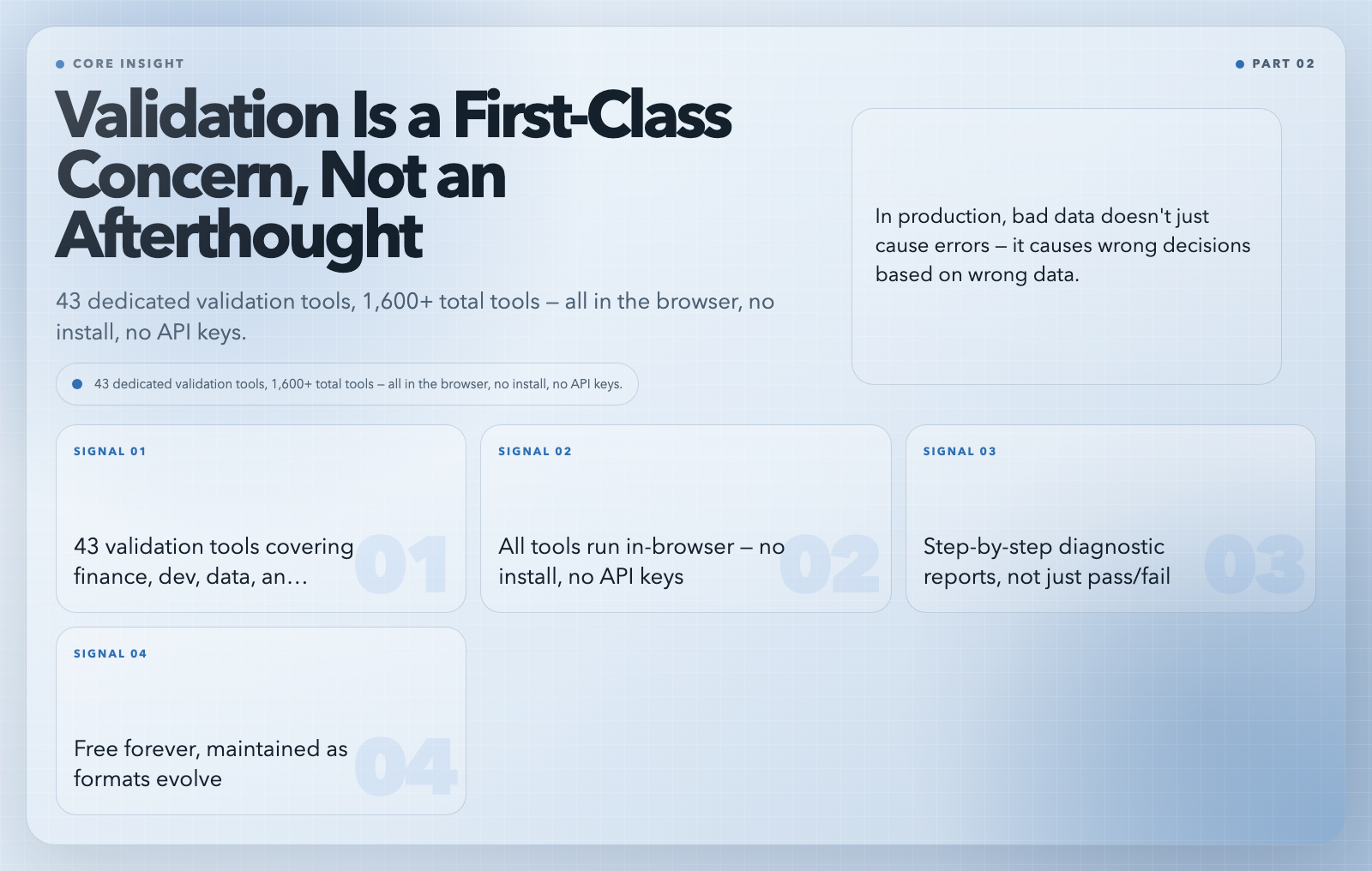
ElysiaTools centralizes 43 validation tools (and over 1,600 total tools) into a single, searchable catalog. All of them run in the browser with no installation, no API keys, and no account required. Every tool includes detailed output with step-by-step breakdowns — not just a boolean pass/fail, but a full report showing exactly what was checked and why.
The core insight: validation is a first-class concern, not an afterthought. The minutes you spend validating input at the boundary of your system can save hours of debugging when bad data hits your business logic. In production, bad data doesn’t just cause errors — it causes wrong decisions based on wrong data.
Bookmark ElysiaTools and pick the validation tool that matches your current pain point.
 Your future self — and your on-call rotation — will thank you.