The Mystery of How Nature Syncs Without a Conductor
In 1665, Christiaan Huygens — bedridden with illness — noticed something strange. Two pendulum clocks hanging on the same wall had somehow synchronized. Their swings, which should have drifted apart randomly, had locked into perfect unison.
Huygens had no explanation. There was no wire between them. No signal. No conductor.
Three hundred and fifty years later, a Japanese physicist named Yoshiki Kuramoto found the answer — and it changed how we understand everything from neurons to fireflies to the stock market.
The Setup Huygens Couldn’t Explain
Huygens assumed some mechanical connection existed. He was partially right: tiny vibrations traveled through the wooden beam. But that wasn’t the whole story. What he witnessed was a phenomenon that repeats across nature constantly, invisibly, without any central authority:
Fireflies in Southeast Asia blink together in perfect rhythm — thousands of them, no leader. Audience members at a concert start clapping in unison, drift apart, then sync again. The cells in your heart’s pacemaker fire together. Your neurons spike in synchronized waves during deep sleep, and the breakdown of this sync is linked to schizophrenia.
None of these systems have a conductor. And yet, order emerges.
The Kuramoto Model: One Equation That Explains Sync
In 1975, Kuramoto proposed a deceptively simple model. Take a group of oscillators — things that naturally cycle, like pendulums, neurons, or firefly light circuits. Each one has its own natural frequency, slightly different from the others due to random variation.
The equation for each oscillator:
dθᵢ/dt = ωᵢ + (K/N) Σⱼ sin(θⱼ - θᵢ)Here’s what it actually means:
– θᵢ — the phase of oscillator i (where it is in its cycle)
– ωᵢ — its natural frequency (how fast it wants to cycle on its own)
– K — coupling strength (how much oscillators influence each other)
– N — total number of oscillators
Each oscillator gets pulled slightly toward the average phase of all the others. Not commanded — nudged. These nudges, accumulated across many oscillators, are enough to create total synchronization.
The critical threshold is K_c = 2σ√(2/π), where σ is the spread of natural frequencies. Below this threshold, the system stays disordered. Above it, a phase transition occurs — synchronization emerges suddenly, like water turning to ice.
Watch the Phase Transition Happen
You can see this in real-time. Start with K=0 (no coupling) and the oscillators are completely chaotic — each doing its own thing. Gradually increase K.
At the critical point, something remarkable: the disorder doesn’t slowly dissolve. It collapses. Oscillators that were scattered across the phase circle suddenly clump together. The order parameter r — which measures synchronization from 0 (total chaos) to 1 (perfect sync) — shoots upward.
This is a phase transition, exactly like the transitions studied in statistical mechanics. Just as spins in a magnet flip into alignment at a critical temperature, oscillators flip into sync at a critical coupling strength. The mathematical structure is identical.
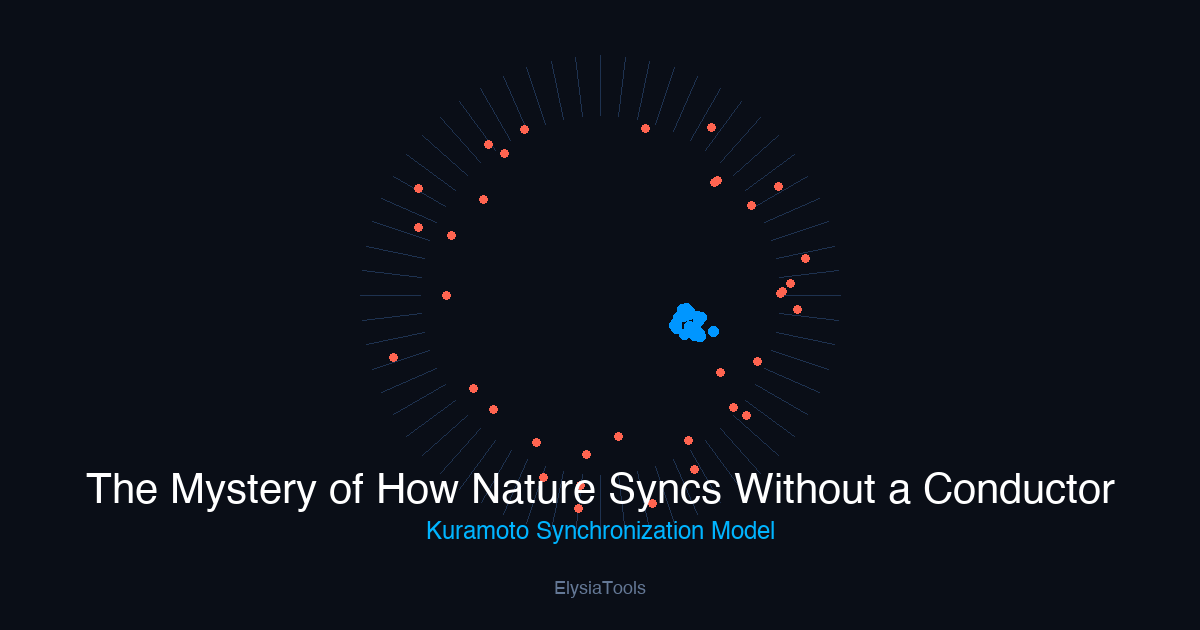
The visualization shows this beautifully. A “phase circle” displays each oscillator as a colored dot — blue for slow oscillators, red for fast ones. When synchronized, all dots cluster together. When chaotic, they’re scattered randomly. Alongside it, an order parameter plot shows r(t) over time, rising from noise to coherence as coupling increases.
Why This Matters Beyond Physics
The Kuramoto model is one of the most cited papers in nonlinear dynamics because synchronization appears everywhere:
Neuroscience: Your brain generates rhythmic activity — gamma waves (~40Hz) associated with consciousness, theta waves (~6Hz) involved in memory consolidation. When neurons synchronize, information integrates across brain regions. When synchronization breaks down, so does cognitive function. Schizophrenia, Parkinson’s, and epilepsy all involve synchronization disorders.
Power grids: Generators at power plants must stay synchronized to the same AC frequency — typically 50Hz or 60Hz depending on region. If they drift too far apart, cascading blackouts can result. The 2003 Northeast Blackout that affected 55 million people in the US and Canada was linked in part to synchronization failures triggered by a tree contact incident that went unnoticed.
Cardiac rhythm: Your heart’s pacemaker cells synchronize through electrochemical coupling. When synchronization degrades, you get arrhythmias. The Kuramoto model has been used to understand and predict cardiac fibrillation — a condition responsible for over 300,000 deaths annually in the US alone.
Finance: High-frequency traders quoting in and out of markets simultaneously can create synchronization-like effects in liquidity. Flash crashes share mathematical similarities with biological sync failures.
The Counterintuitive Part: Weak Coupling Wins
What makes Kuramoto’s insight so powerful is that the coupling doesn’t need to be strong. Even vanishingly weak coupling can eventually synchronize a large enough population of oscillators. The key is that the coupling is persistent and global — every oscillator influences every other one, even if only slightly.
This is why nature uses it. There’s no firefly commander sending signals to all the others. There’s no brain region issuing instructions to every neuron. The synchronization emerges because every element continuously adjusts based on what it senses from the whole system.
It’s distributed. It’s simple. And it’s everywhere.
Try It Yourself
The Kuramoto Synchronization Model at ElysiaTools lets you explore this directly. You can:
– Adjust coupling strength K with a slider and watch the phase transition happen in real-time
– Change the number of oscillators N and observe how population size affects the threshold
– Modify the frequency spread σ and see how diversity in the system makes synchronization harder
– Use presets to jump between No Coupling, Weak, Critical, Strong, and Full Sync regimes
The critical point preset is especially instructive — it sits right at the edge of synchronization, and you can watch the system tip back and forth between order and chaos as random fluctuations pass through.
The Deeper Implication
Huygens spent weeks trying to explain his clocks. He never quite succeeded in his lifetime. The mechanism — subtle vibrations traveling through wood — was too weak to observe directly with 17th-century tools.
Kuramoto’s gift was abstraction. By stripping away everything specific about pendulums, neurons, and fireflies, he found the skeleton underneath — and the same equation describes all of them.
What that suggests: synchronization isn’t a trick nature uses. It’s a fundamental property of coupled oscillating systems. Any system where elements cycle and influence each other will eventually either synchronize or fail to, depending on the ratio of coupling strength to frequency diversity.
Huygens’ clocks weren’t magic. They were one example of a law that governs neurons, fireflies, power grids, and markets alike. Now you can watch that law in action — in your browser, in real-time, without any of the guesswork Huygens had to work with.