# The Doppler Effect: Why an Ambulance Siren Drops in Pitch When It Passes You
An ambulance is driving straight at you at 80 kilometers per hour, siren screaming at 500 hertz. You hear it getting louder, the pitch high and urgent. The ambulance passes you, keeps going, and the same siren suddenly sounds lower — like the wail relaxed.
It didn’t. The siren is playing the exact same 500 Hz. Your position changed.
That’s the Doppler effect, and once you see the math, it explains a lot more than ambulance sirens.
—
The Core Mechanism
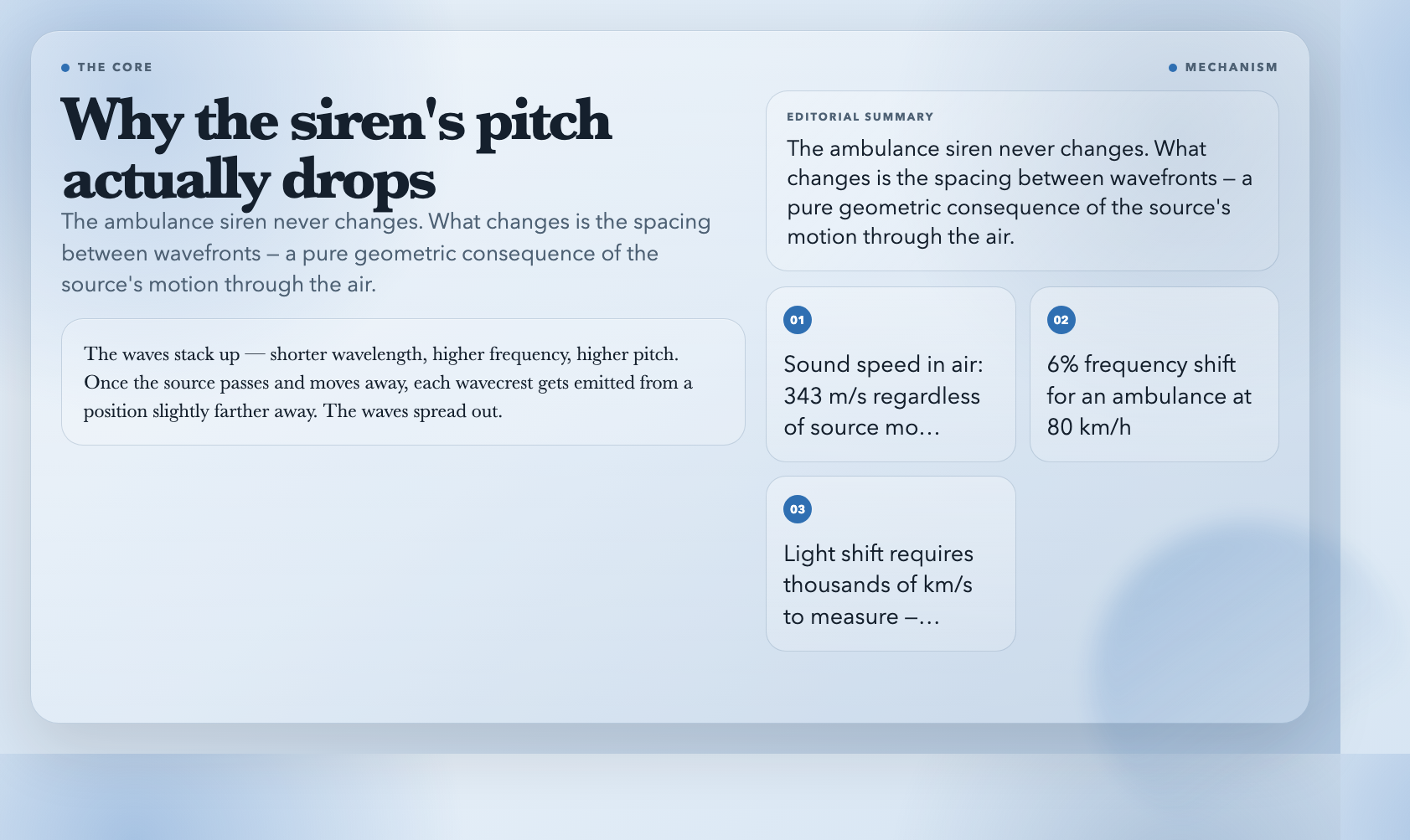
A wave source moving toward you compresses its own wavefronts ahead of it. Each new wavecrest gets emitted from a position slightly closer to you than the last. The waves stack up — shorter wavelength, higher frequency, higher pitch.
Once the source passes and moves away, each wavecrest gets emitted from a position slightly farther away. The waves spread out — longer wavelength, lower frequency, lower pitch.
The same mechanism works for light. A star moving toward us appears slightly bluer. A star moving away appears slightly redder. This is how Edwin Hubble discovered the universe is expanding in 1929 — virtually every galaxy is redshifted, and the more distant the galaxy, the more redshifted it is. The universe isn’t just expanding. It’s accelerating.
The formula for a moving source:
f’ = f₀ × v / (v ± vₛ)
The formula for a moving observer:
f’ = f₀ × (v ± vᵣ) / v
Where v is wave speed, vₛ is source velocity, vᵣ is receiver velocity. The ± is negative when approaching, positive when receding.
The key variable is the ratio vₛ/v — source velocity divided by wave speed. Sound in air travels at 343 m/s. An ambulance at 22 m/s gives a ratio of 0.064. The frequency shift is about 6%. For light, v is 300,000,000 m/s, so you’d need something moving at thousands of kilometers per second before the shift becomes measurable. That’s why astronomical redshift required some of the most precise instruments ever built.
—
Where You Actually Encounter It
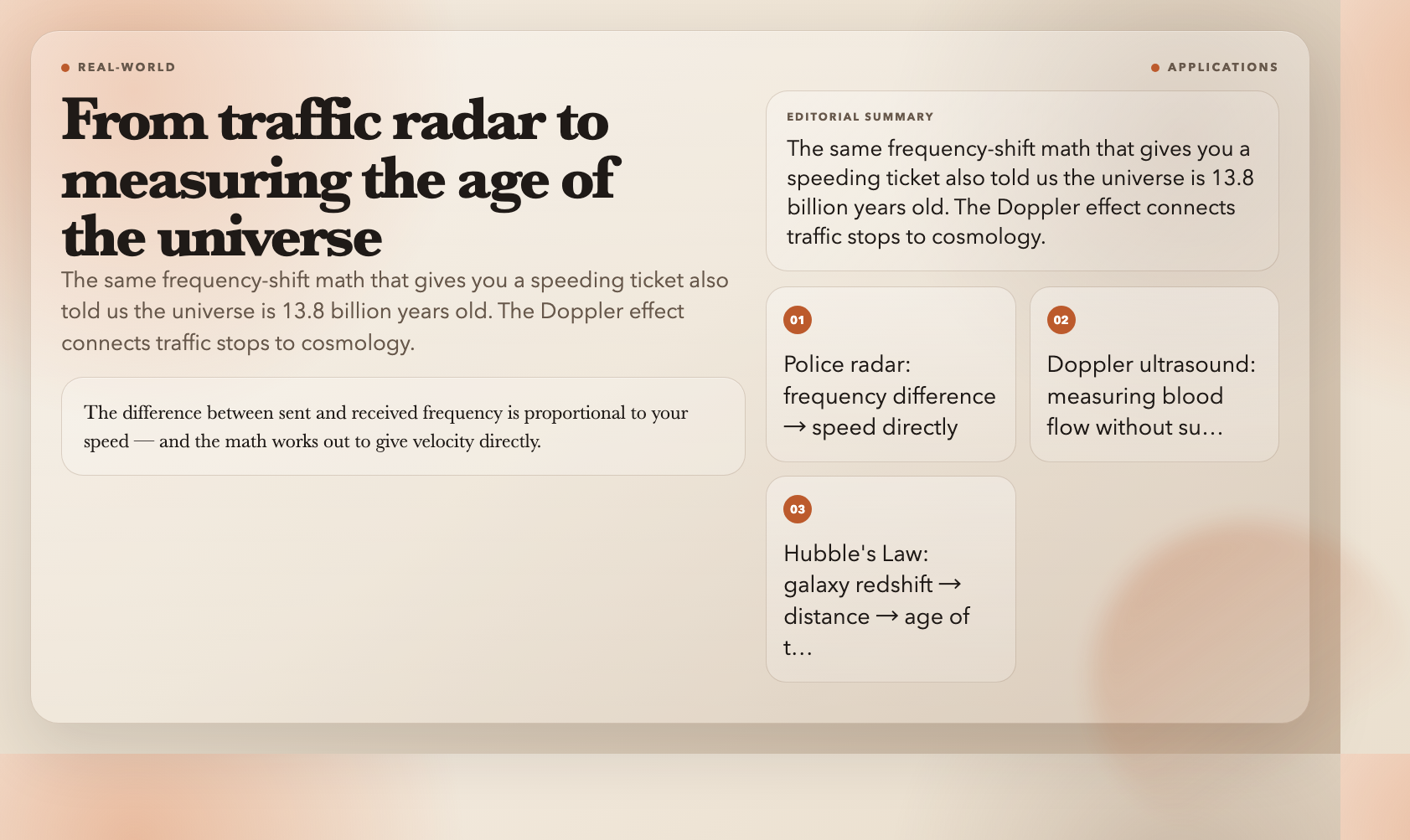
Police radar guns: The gun emits a radio wave at a fixed frequency. It bounces off your car and returns. If you’re moving toward the gun, the returned wave is compressed — higher frequency. The difference between sent and received frequency is proportional to your speed, and the math works out to give velocity directly. This is why radar works in fog, rain, and at night. It’s measuring frequency difference, not reflected images.
Doppler ultrasound in medicine: The same principle, but with sound waves bounced off red blood cells. The frequency shift tells you how fast blood is flowing through a vessel. It’s used to check for blood clots, evaluate heart valve function, and monitor fetal heartbeat. In the 1960s, this was revolutionary — you could now measure blood flow without surgery. Today it’s routine.
Weather radar: The NEXRAD network across the US rotates and pulses microwaves into storm systems. The return frequency tells you wind velocity inside rain clouds. The 2013 Moore, Oklahoma tornado was detected 16 minutes before touchdown by Doppler radar. Sixteen minutes is enough time to get to shelter.
Astronomy: Hubble found that galaxy redshift is proportional to distance. This gave us Hubble’s Law: v = H₀ × d. The constant H₀ — the Hubble constant — lets you calculate the age of the universe from how fast galaxies are moving away from us. Current best estimate: 13.8 billion years. The Doppler effect, applied to light from distant galaxies, is one of the most consequential measurements in the history of science.
Laser cooling: Atoms are cooled to nanokelvin temperatures using a counterintuitive application of the Doppler effect. Atoms moving toward a laser beam absorb photons that provide a tiny momentum kick opposite to their motion. Atoms moving away don’t absorb — the frequency is Doppler-shifted out of resonance. The net result: atoms are pushed to slow down in one direction. Repeat from six directions, and you get a trapped, cold cloud of atoms. This is how atomic clocks work. Atomic clocks are what GPS satellites use to keep your phone’s location accurate to within a few meters.
—
Why the Siren Drop Is Actually Strange When You Think About It
The Doppler effect seems intuitive because we hear it so often. But consider: the siren doesn’t change. The sound waves themselves don’t change their speed (speed of sound in air is constant regardless of source motion). What changes is the spacing between wavefronts — and that spacing is purely a geometric consequence of the source’s motion.
This is the same mechanism as light redshift. A distant galaxy emits light at specific frequencies — the absorption lines of hydrogen, helium, and other elements are at known wavelengths. When that light reaches us, those lines have shifted. Not because the galaxy is any different, but because space itself has stretched in the 13 billion years the light traveled.
Wait — that last point is where the Doppler effect and cosmology diverge slightly. Cosmological redshift isn’t the same as a Doppler shift. Doppler shifts come from objects moving through space. Cosmological redshift comes from space itself expanding while the light travels. The equations look similar at low velocities, but at cosmological scales they’re different things.
Most popular explanations conflate them. The siren example and the expanding universe example are both called “the Doppler effect” but the physics underneath is subtly different. The visualization shows you the classic Doppler case — source moving through a medium — which is what produces the siren pitch change and the radar gun reading.
—
The Visualization
The ElysiaTools Doppler Effect tool shows wavefronts propagating and compressing ahead of a moving source, stretching behind it. You can adjust source frequency, source velocity, observer velocity, and wave speed independently, then watch the frequency display update in real time.
The most useful mode is watching what happens when source velocity approaches wave speed. As vₛ/v approaches 1, the frequency ahead of the source approaches infinity — wavefronts pile up into a shock front. When vₛ exceeds v, you get a sonic boom: a cone of compressed wavefronts called the Mach cone. This is the same Mach cone you see in photos of jets breaking the sound barrier.
Set the speed below Mach 1, watch the wavefronts compress ahead and stretch behind. Then push the source speed above Mach 1 and watch the shock front form. The transition is visceral.
Try the Doppler Effect visualization free →
—
The One Thing to Remember
Moving source vs. moving observer produces the same frequency shift mathematically — but mechanically, they’re different. A source moving through a stationary medium compresses wavefronts ahead of it. A receiver moving into a stationary wave pattern meets those wavefronts more frequently without changing the wave itself.
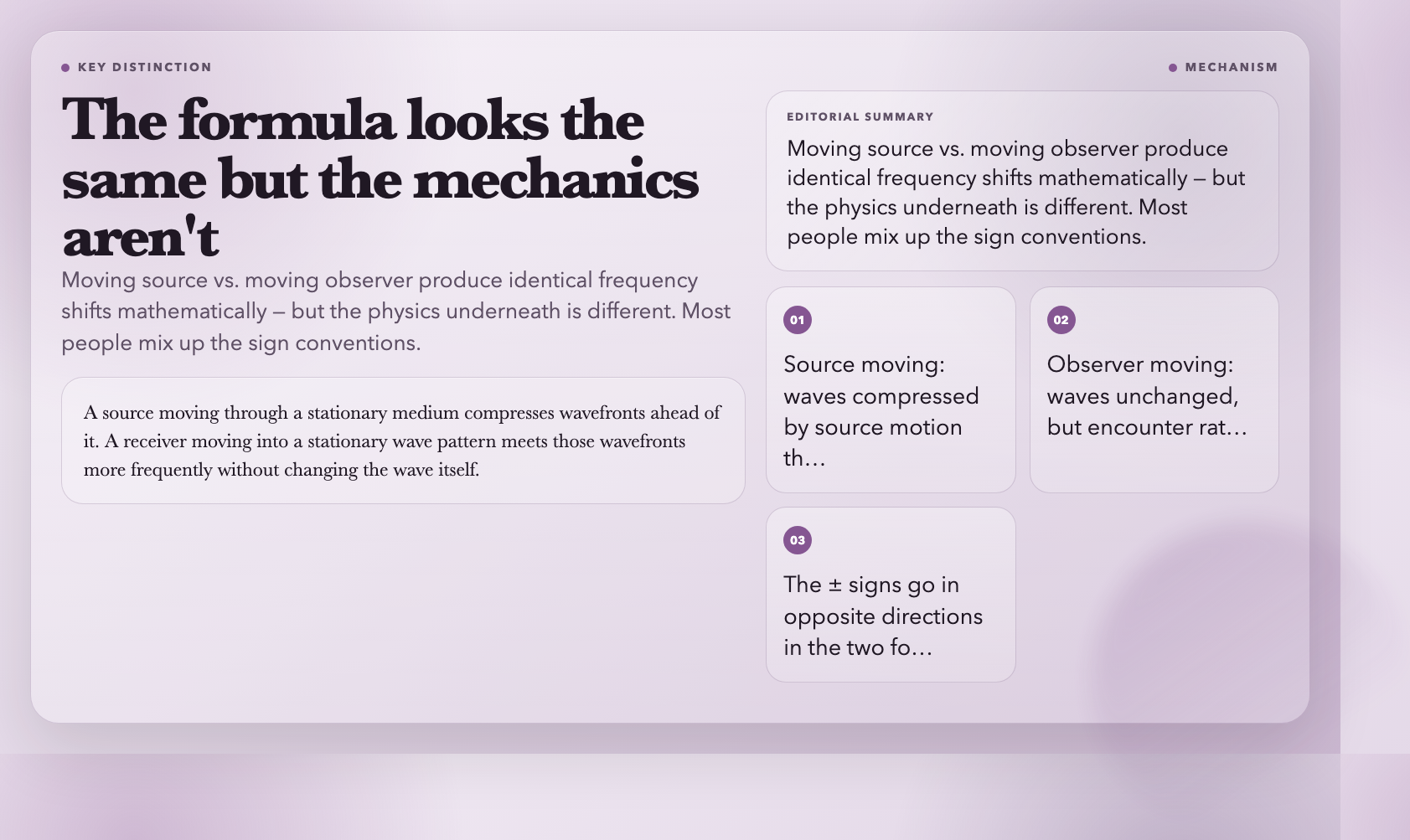
Both give you f’ = f₀ × (v ± vᵣ)/v or f’ = f₀ × v/(v ± vₛ). The ± signs go in opposite directions in the two formulas. Most people mix them up.
If you remember nothing else from this article, remember that distinction. It’s the difference between understanding the Doppler effect and just recognizing it.