# The Mathematical Reason Fireflies Synchronize — and Why It Matters More Than You Think
A bridge opens in London. Within hours, it is swaying so violently that engineers shut it down. Thousands of pedestrians had walked across it, falling into unconscious step, their collective lateral sway feeding energy into the bridge’s natural frequency. The coupling was mechanical. No one planned to synchronize. But the mathematics of synchronization made it inevitable.
This is the Kuramoto model, and it explains not just bridge wobbles but fireflies flashing in unison across riverbanks in Southeast Asia, neurons binding color and shape into coherent perception in your brain, and generators maintaining grid frequency across entire continents. In 1975, Yoshiki Kuramoto proved that any sufficiently large group of diverse oscillators, weakly coupled together, will spontaneously synchronize when coupling crosses a critical threshold. The transition is not gradual. It is sharp. And it happens not because anything plans it, but because mathematics demands it.
## The Model That Explains How Order Emerges From Chaos
The Kuramoto setup is almost insultingly simple. Take N oscillators. Each has a natural frequency, drawn from a Gaussian distribution — most are similar, some faster, some slower. Couple them weakly: each oscillator nudges its neighbors, pulling them toward its own phase. That is the entire model.
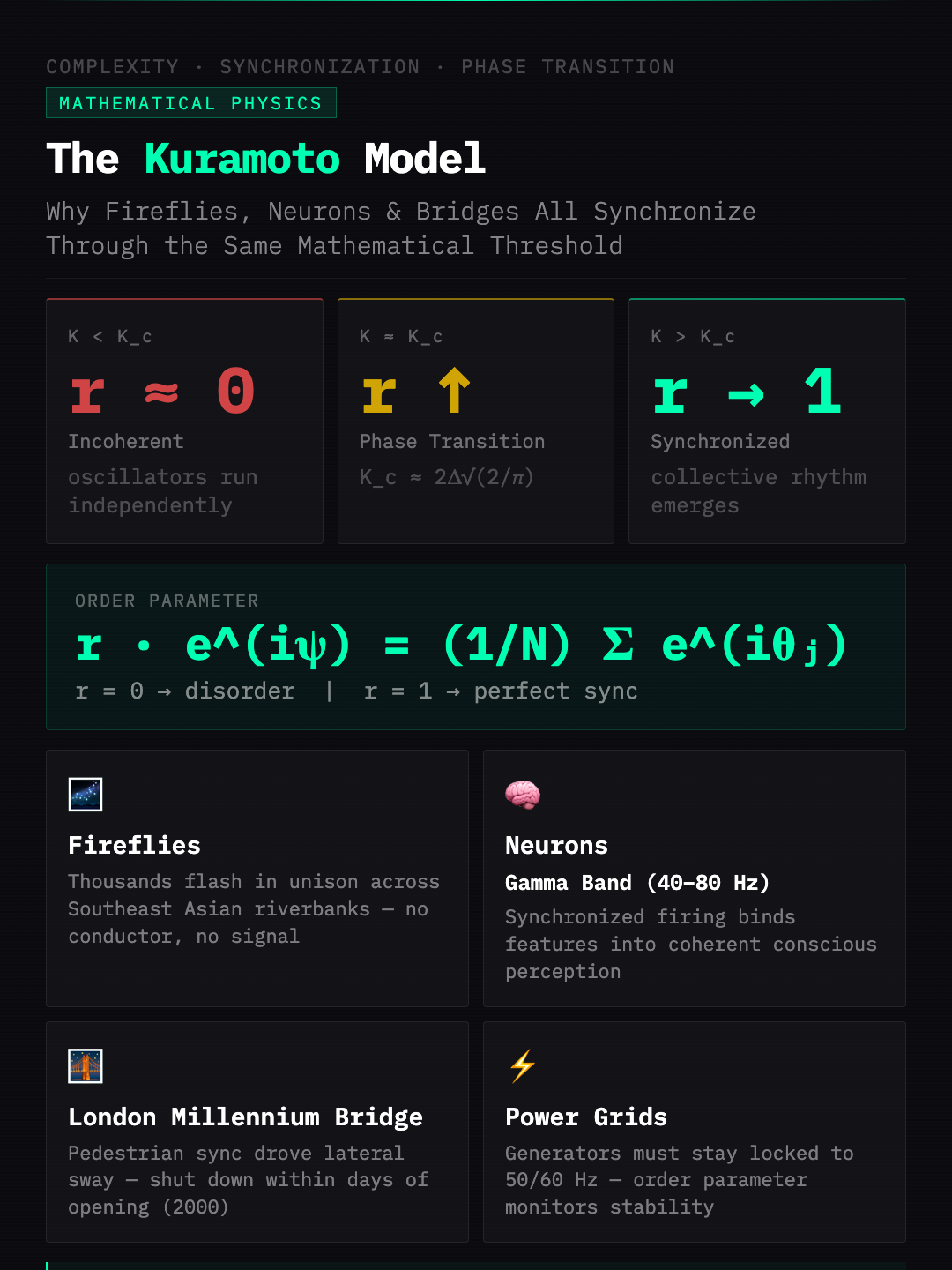
What emerges is not simple at all. Below a critical coupling strength K_c, oscillators march to their own drums. The order parameter r — a number between 0 and 1 measuring synchronization — sits near zero. Increase K past K_c, and r jumps. Oscillators scattered randomly around a circle begin to cluster. Incoherence collapses into rhythm.
Kuramoto derived the critical coupling exactly: K_c ≈ 2Δ√(2/π), where Δ is the spread of natural frequencies. Below K_c, no synchronization is possible. Above it, synchronization is inevitable. The sharpness of the transition makes this a genuine phase transition — the same mathematical structure as water freezing or a magnet losing its magnetization.
What sets the Kuramoto model apart is that it is tractable. Most collective systems resist analysis — too many degrees of freedom, too tangled interactions. Kuramoto found an approximation that captures essential dynamics without drowning in detail. You can make precise predictions and then verify them empirically.
## The Millennium Bridge: Synchronization as Disaster
In June 2000, London’s Millennium Bridge opened to the public. Within hours, it was swaying sideways. Within days, it was closed. Engineers spent months installing 37 viscous dampers before it reopened in 2002.
What went wrong? Thousands of pedestrians fell into unconscious step. Their lateral sway injected energy into the bridge’s natural frequency. Once enough people synchronized, the feedback loop drove the bridge into violent oscillations. The fix broke the phase locking — it pushed the system back below K_c.
The Millennium Bridge is a textbook Kuramoto failure. The analysis that explained the wobble — weak mechanical coupling, a critical mass of synchronized walkers, amplification through resonance — is exactly what Kuramoto had published decades earlier. The same mathematics that predicts fireflies flashing together predicts bridge collapse.
## Neurons and the Critical Brain
When you focus on a coffee cup — tracking its color, shape, motion, and location — groups of neurons across different cortical regions bind all that information into a coherent percept. Leading theories hold that synchronization does the binding. Neurons that prefer the same feature phase-lock their firing, creating a coordinated gamma-band rhythm (40-80 Hz) that labels all relevant signals as belonging to the same object.
In experiments, gamma-band synchronization rises as attention sharpens. When it breaks down, coherent perception fragments. Some neuroscientists argue the brain operates near the Kuramoto critical point — maximally responsive, maximally information-efficient — at the constant cost of vulnerability to phase collapse. The “critical brain hypothesis” remains one of the most active frameworks in the field.
## Power Grids, Cardiac Cells, and Universal Synchronization
Power grids are giant synchronized machines. Every generator must stay locked to the same frequency. If generators drift too far out of phase, cascading failures can black out entire regions. Grid operators monitor phase coherence constantly, using the Kuramoto order parameter to detect instability before it spreads.
When your heart beats, the sinoatrial node cells are synchronized. When that synchronization collapses into fibrillation, pumping stops. Cardiac arrhythmia is formally a Kuramoto order parameter collapse.
Synchronization also governs Josephson junctions in superconductors, laser oscillator arrays, circadian gene expression, and swarming robots. The same threshold. The same phase transition. The same mathematics appearing everywhere we look.
## The Fragility at the Edge of Synchronization
Here is the finding that makes the Kuramoto model genuinely unsettling: synchronized states are often fragile. A small perturbation near the critical point — a noise spike, a frequency shift, an external shock — can collapse a synchronized cluster back into disorder. The same mathematics that predicts synchronization predicts its sudden loss.
Markets that herd into a bubble are one bad headline away from panic. Neurons synchronized during deep focus dissolve with distraction. The Millennium Bridge needed dampers, not stronger materials, because the problem was proximity to K_c.
This fragility may be a feature. A brain sitting near criticality is maximally sensitive to new signals, maximally adaptable. The cost is constant vulnerability to phase collapse. Stability and sensitivity trade off, and the Kuramoto model quantifies exactly how.
## See the Phase Transition Happen
The sharpest way to understand the Kuramoto model is to watch the phase transition occur in real time. Start with K=0 — full disorder, r near zero. Slowly increase coupling. Watch r(t) jump at K_c.
The interactive Kuramoto Synchronization visualization on ElysiaTools lets you do exactly this in your browser. Adjust coupling strength K, oscillator count N, and frequency spread Δ. Watch the order parameter climb as the system transitions. Run presets — no coupling, weak coupling, critical point, full synchronization — and observe the phase transition fingerprint each time.
The world synchronizes. The next time you see fireflies pulsing together, a bridge swaying, or neurons firing in sync during a moment of focus, you are watching the mathematics of Kuramoto play out in physical reality. Now you know why.