Why a Spinning Top Doesn’t Fall Over — Even When It Should
Pick up a gyroscope. Tilt its axis. Watch what happens.
Instead of crashing to the table, the axis slowly traces a circle in the air — precessing around the vertical, as if the spinning top has found a clever loophole in gravity. This isn’t magic. It’s one of the most elegant consequences of angular momentum conservation in all of physics.
And once you understand it, you start seeing it everywhere: in the wobble of a bicycle wheel held by one hand, in the steady horizon of a airplane, in the slow gyration of Earth’s axis over 26,000 years.
The Counterintuitive Puzzle
When you hold a bicycle wheel by its axle and tilt it, gravity pulls down on the center of mass. A naive prediction: the wheel should fall, exactly like any other object. But because the wheel is spinning, it doesn’t. Instead, the torque from gravity causes the wheel’s axis to rotate sideways — perpendicular to both the spin direction and the pull of gravity.
This is the key insight: the torque doesn’t make the spinning object fall in the direction of the pull. It makes the axis of rotation precess around the vertical. The faster the wheel spins, the slower this precession. The relationship is precise:
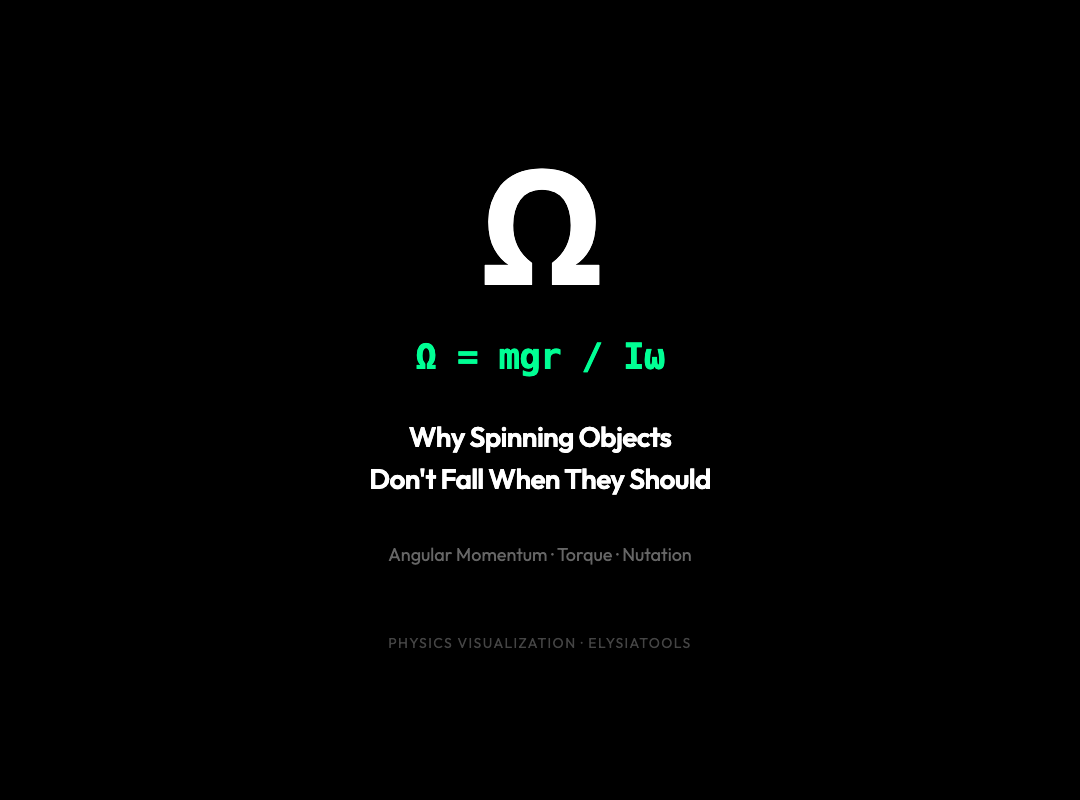
Ω = mgr / (Iω)
Where Ω is the precession rate, m is mass, g is gravity, r is the distance from pivot to center of mass, I is the moment of inertia, and ω is the spin rate.
Notice that ω is in the denominator. Spin twice as fast, precession slows by half. This inverse relationship is why small, fast-spinning objects precess slowly and appear stable, while slow, heavy objects precess rapidly and feel unstable.
The Real Physics: Torque and Angular Momentum
To understand why this happens, you need two concepts:
1. Angular momentum (L) — a vector pointing along the axis of rotation. For a spinning wheel, this vector points in the direction your thumb points when you curl your fingers in the spin direction.
2. Torque (τ) — the rotational equivalent of force. Gravity pulling on a tilted wheel creates a torque that is perpendicular to the angular momentum vector.
Here’s the critical part: a torque perpendicular to angular momentum doesn’t change the magnitude of angular momentum — it changes its direction. The axis of rotation slowly swings around, tracing the circle of precession, but the spin speed stays roughly constant.
Think of it like this: if you apply a force to a moving object in a direction perpendicular to its motion, you don’t slow it down — you change its direction. A spinning top works the same way, just in rotation.
Nutation: The Wobble Superimposed on the Circle
If you’ve ever carefully released a spinning top or gyroscope, you may have noticed something else: a small wobble or oscillation superimposed on the smooth precession circle. This is called nutation.
Nutation occurs when the gyroscope is released with an initial condition that doesn’t exactly match steady precession. When that happens, you get a brief, higher-frequency oscillation in the tilt angle riding on top of the slow precession. In well-made gyroscopes this nutation dies out quickly due to friction, leaving only the clean precession.
The nutation frequency is typically much higher than the precession frequency — which makes physical sense if you think about it: the restoring “wobble” is a faster, smaller-scale motion, while the precession is a slow, global reorientation.
Why This Matters Far Beyond Toys
The applications of gyroscopic precession touch several of the most important systems humans have ever built.
Navigation gyroscopes — Ships, aircraft, and spacecraft all use spinning gyroscopes as directional references. Because a spinning gyro resists changes to its orientation, it maintains a fixed reference direction even as the vehicle around it moves. This principle, first demonstrated comprehensively by Foucault in 1852, is why your smartphone can tell which way you’re facing.
The Earth’s precession — Perhaps the most dramatic example is right under our feet. Earth’s axis precesses in a slow circle with a period of approximately 26,000 years. This “precession of the equinoxes” is caused by the torque from the Sun and Moon on Earth’s equatorial bulge. The axis doesn’t point at the same star forever — Polaris will eventually cease to be the north star, just as it wasn’t always.
Bicycle stability — A bicycle is stable at speed partly because of gyroscopic effects. The spinning wheels act like gyroscopes, resisting tilts and helping the bike self-correct. Remove the gyroscopic effect (spin the wheel backwards, for instance) and the bike becomes noticeably harder to balance.
Everyday consequences — The effect shows up in power tools, where spinning drill bits cause reaction torques, in helicopter tail rotors that counter main rotor precession, and in the behavior of spinning projectiles in ballistics.
The Deeper Connection
What makes gyroscopic precession especially satisfying as a physics topic is that it connects cleanly to one of the deepest conservation laws in physics: conservation of angular momentum. This law states that the total angular momentum of a closed system remains constant unless an external torque acts on it.
When external torques do act (like gravity on a spinning top), the system responds in the most efficient way possible — redirecting the angular momentum vector rather than opposing the applied force. A non-spinning top tries to fall. A spinning top finds a way to redirect the falling tendency into circular precession.
This is why a more massive gyroscope (larger m or r) precesses faster — because the gravitational torque is larger. And why a faster-spinning gyroscope (larger ω) precesses slower — because its angular momentum is more resistant to redirection.
Try It Yourself
The best way to build intuition for precession is to interact with it directly. Adjust the spin rate, the tilt angle, the mass, and the radius in the visualization below and watch how the precession rate changes in real time.
Notice the inverse relationship between spin velocity and precession rate. Notice the wobble that appears and fades as nutation settles. Notice how changing the axle length (which changes r) immediately changes how aggressively the gyroscope precesses.
Physics you can feel, not just calculate, is physics you’ll never forget.
The Loophole in Plain Language
Gravity pulls down. The spinning object tries to fall. But angular momentum conservation gives it an escape route: it falls sideways instead of down, which becomes a circle, which is just falling sideways again — and so on, endlessly, as long as the spin holds.
That’s precession. One of the most beautiful loopholes in all of classical mechanics.
Visualization: Gyroscopic Precession — Interactive 3D Simulation
Tags: physics, angular-momentum, gyroscope, classical-mechanics, precession, nutation