# The Paycheck Gap That Starts the Moment You Become a Mother
Each child costs mothers 7% of their hourly wage. Fathers earn 6% more. Here’s the data—and what actually fixes it.
—
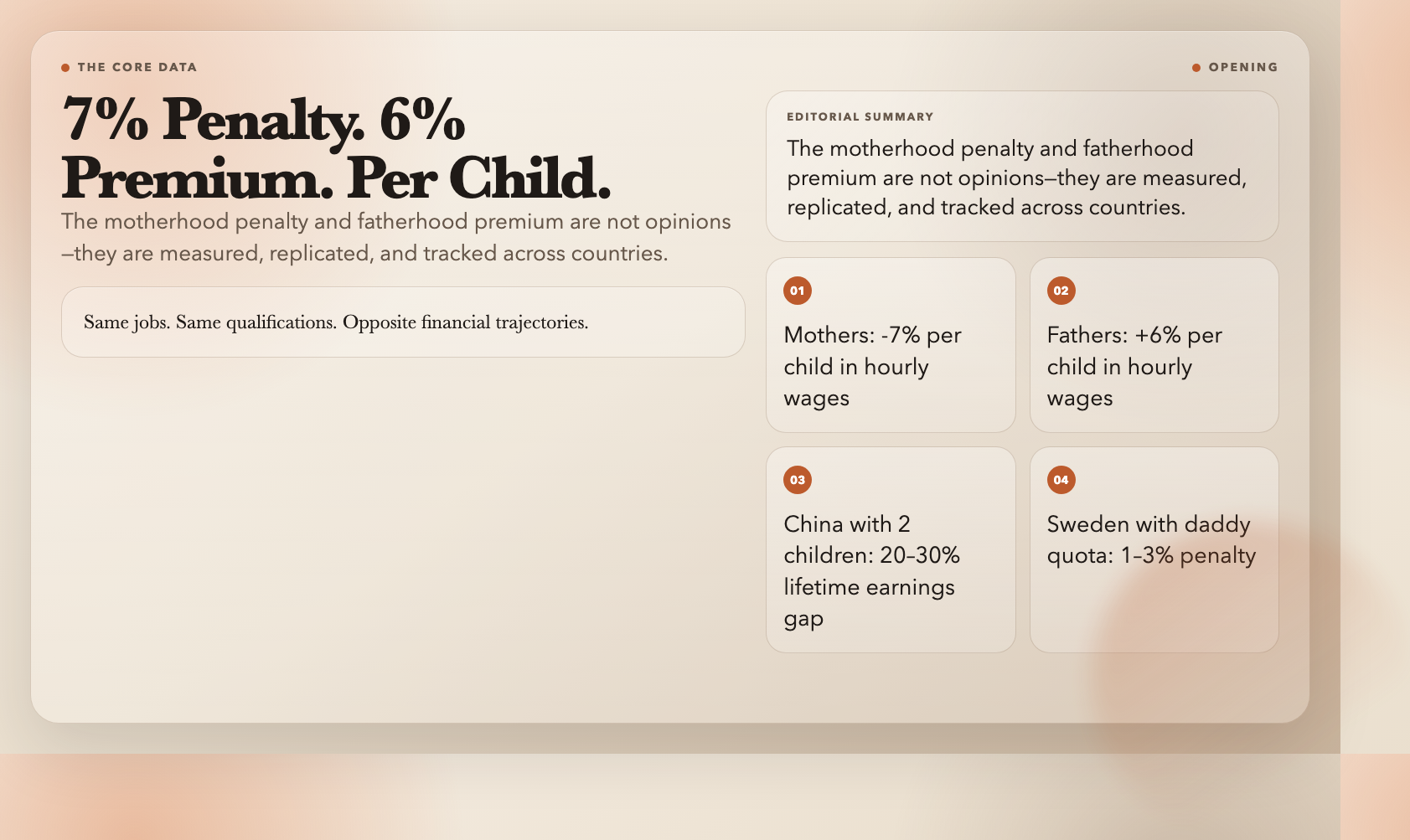
In 2002, Michelle Budig published a study that should have changed the gender pay gap debate forever: American mothers earned 7% less per child. Fathers earned 6% more. Same jobs. Same qualifications. Opposite financial trajectories.
Twenty-four years later, the 7% number hasn’t improved—it has simply migrated behind part-time adjustments and industry sorting, where it’s harder to see.
But the mechanism hasn’t changed. And neither have the solutions.
This article breaks down what research actually shows about the motherhood penalty, why it persists, and an interactive visualization where you can calculate your own exposure.
The Data: What the Research Shows
Budig’s findings have been replicated across countries and time periods:
– United States: 7% penalty per child for mothers; 6% premium per child for fathers.
– China: Two-child policy exposes women to double penalties—20–30% cumulative lifetime earnings gap.
– Germany: 6–8% per child, dropping near-zero in states with mandatory daddy quotas.
– Sweden: 1–3%—the lowest measured anywhere.
The variance isn’t random. It tracks almost perfectly onto one variable: how much parental leave fathers are legally required to take.
The Mechanisms: How the Penalty Works
1. Employers Discriminate Against Mothers—Directly
Correll and Benard ran a controlled experiment: identical resumes sent to real companies, with names signaling motherhood status. Mothers were rated as less competent and less committed. Fathers were rated *more* competent. Same credentials. Different children. Experimental proof.
2. “Greedy Work” Forces Women Into Lower-Paying Flexibility
Claudia Goldin (2023 Nobel in Economics) showed that much of the remaining gap comes from jobs that reward uninterrupted availability—and punish any absence. Women, carrying disproportionate childcare loads, self-select into flexible jobs. Those jobs pay less. The choice looks voluntary. It isn’t.
3. The Same Career Break Hits Women Harder
A six-month parental leave costs mothers promotions and advancement. Fathers taking the same six months face zero negative career impact—and sometimes earn a “family man” boost. Identical interruption. Asymmetric penalty.
4. The Opt-Out Pipeline
After children, women disproportionately leave high-paying, high-pressure roles for lower-paying, flexible ones. Rational, given who does the childcare. But calling it “choice” obscures the structural constraint underneath.
Hong’s Story: Watch Two Careers Diverge
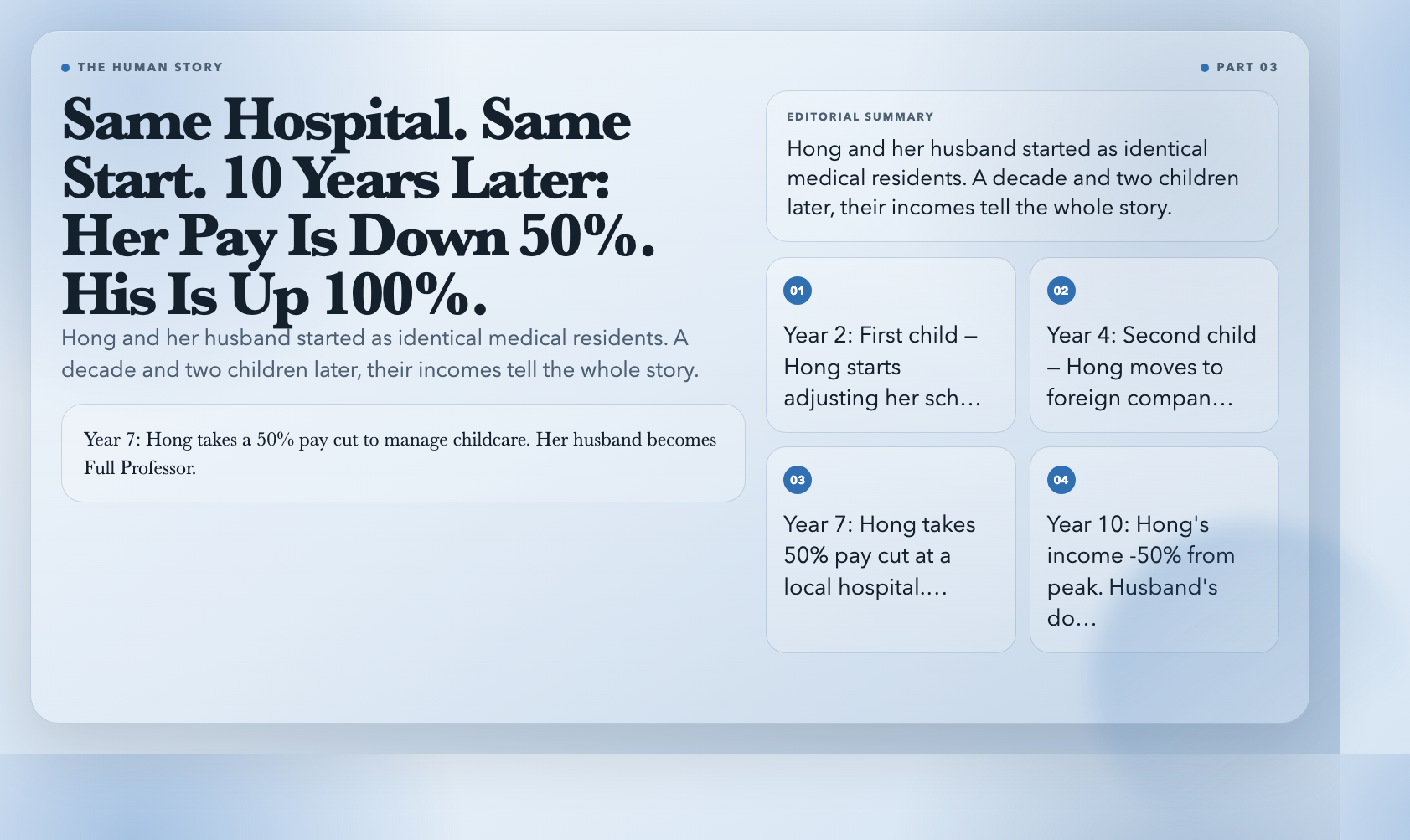
The Motherhood Penalty & Fatherhood Premium visualization includes an animated career simulation of a Shanghai physician.
Two residents start at the same top Shanghai hospital, identical salaries.
– Year 2: First child. Hong begins adjusting her schedule for school pickups.
– Year 4: Second child. Hong moves to a foreign company seeking flexibility—but takes more business trips. Her husband becomes Associate Professor.
– Year 7: Hong moves to a local hospital, accepting a 50% pay cut. Her husband becomes Full Professor.
– Year 10: Hong’s income is down 50% from peak. Her husband’s has doubled.
Run the simulation yourself. Watch two identical starting points diverge into two entirely different economic outcomes.
The Global Evidence: What Closes the Gap
The visualization compares eight countries. The pattern is unambiguous:
| Country | Penalty | Daddy Quota |
|———|———|————-|
| Sweden | 1–3% | 90 days mandatory |
| Norway | 2–4% | 15 weeks mandatory |
| Germany | 6–8% | 2 months mandatory |
| USA | 7–9% | None |
| China | 20–30% | Minimal |
| Japan | 15–20% | Minimal |
| South Korea | 20–25% | Minimal |
Mandatory paternal leave works because it does something cultural messaging cannot: it makes fatherhood equally career-disrupting. When the law requires men to be absent, employers stop associating parenthood with female employees. The motherhood penalty drops because fatherhood becomes equally costly to interrupt.
The Calculator: What It Means for You
Input your salary, children, gender, region—and the tool estimates your lifetime earnings impact.
For a 30-year-old Shanghai woman earning ¥500,000/year with two children: the estimated shortfall versus a child-free trajectory is ¥2–3 million.
That’s not a statistic. That’s a mortgage. Twenty years of retirement contributions. A child’s university fund.
What Actually Closes the Gap
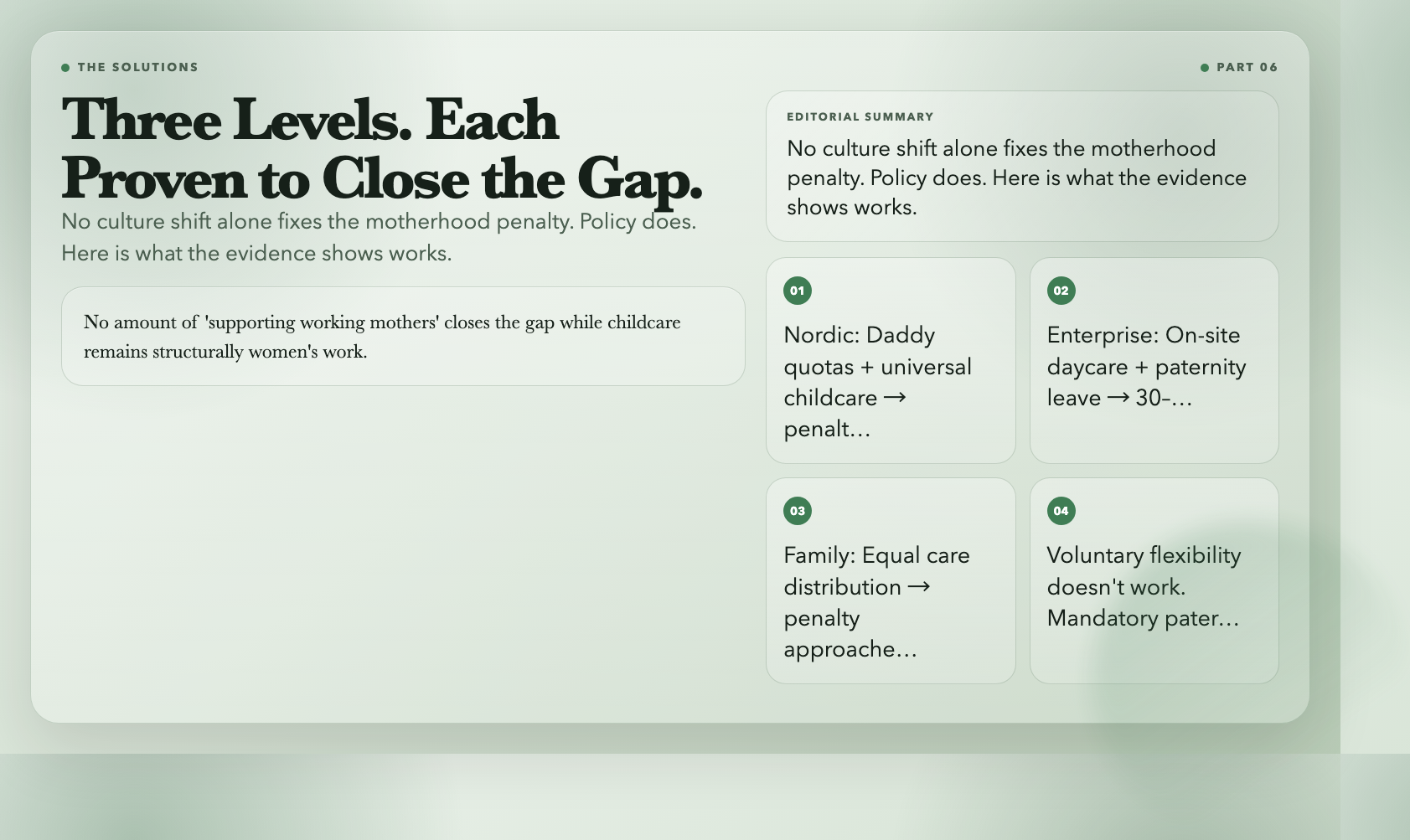
Three intervention levels show measurable results:
Nordic Model: Daddy quotas + universal childcare + legal right to part-time work. Penalty drops to 1–3%.
Enterprise Programs: On-site daycare + paid paternity leave + flexible scheduling. Pilots show 30–50% reduction.
Family Level: Equal care work distribution. Where fathers handle 50%+ of childcare, the penalty approaches zero.
No amount of “supporting working mothers” closes this gap while childcare remains structurally women’s work.
The Question No One in Power Is Asking
Sweden has 1–3% penalties. China has 20–30%. The difference isn’t culture. It’s whether governments force the issue with mandatory paternal leave.
The people with the power to mandate change rarely pay the price of inaction. That’s not a conspiracy—it’s an incentive structure. And incentive structures don’t change on their own.
So the real question isn’t whether we know how to close the gap. It’s whether we’re willing to hold the people who can close it accountable for not doing it.
—
*Explore the full interactive visualization at ElysiaTools—run the career simulation, compare global policies, and calculate your own potential impact.*