Why Simple Rules Create Infinite Complexity
Start with a line of cells. Each cell is either alive or dead. Now apply one rule: look at a cell and its two neighbors, read those three cells as a 3-bit binary number, and use that number to decide what this cell becomes next. Repeat.
That is the entire system. No physics engine. No global coordinator. No invisible hand directing the outcome.
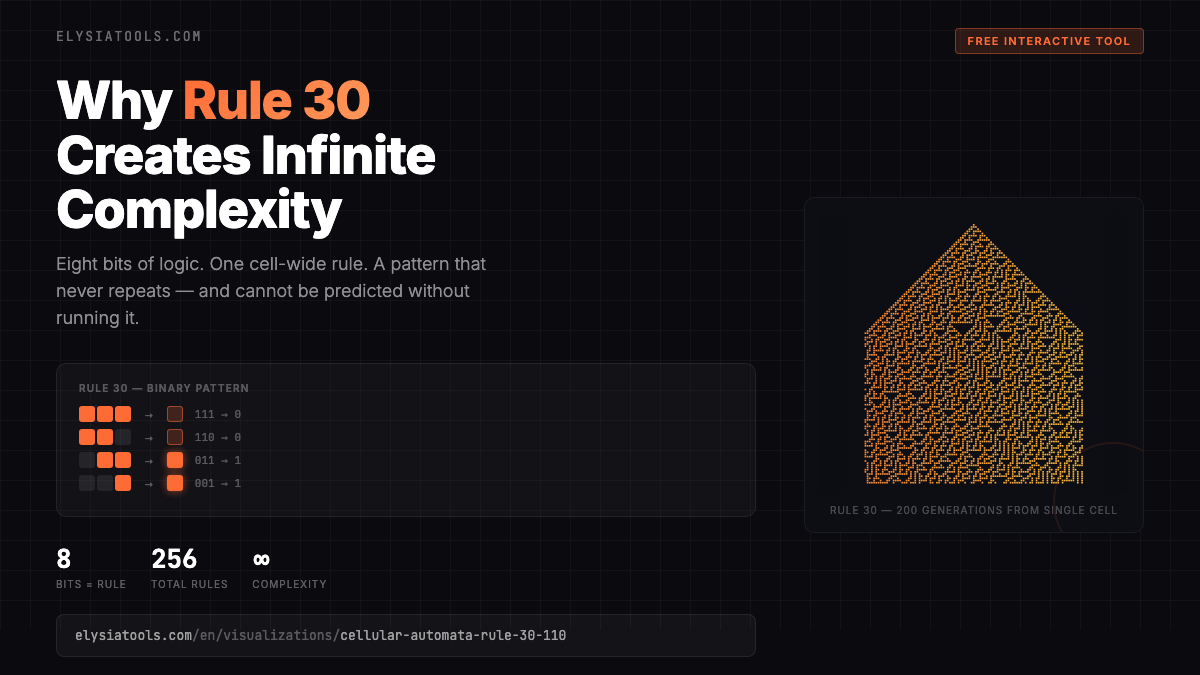
From this, one rule — Rule 30 — produces a pattern that looks deliberately designed: a perfect triangle of chaos with a regular crystalline edge. Run it long enough and the center never repeats. The pattern contains infinite variety, yet it was generated by eight bits of logic applied locally, millions of times over.
This is what Wolfram calls computational irreducibility — the inability to shortcut the process. The only way to know what Rule 30 does for 500 generations is to run it for 500 generations.
The Rule Behind the Pattern
The rule number is not arbitrary. A 1D cellular automaton has 8 possible neighborhood patterns (111 through 000). Each pattern maps to an output cell (alive or dead). Eight outputs, written as a binary number, give the rule its name.
Rule 30: 00011110 in binary. When the neighborhood is 111, the next cell is 0. When it is 110, the next cell is 0. When it is 100, the next cell is 1. And so on.
Neighborhood: 111 110 101 100 011 010 001 000
Rule 30: 0 0 0 1 1 1 1 0
Rule 30 is on the left edge of Wolfram’s four behavior classes. Class 1: settles to homogeneity. Class 2: produces stable or periodic structures. Class 3: chaotic. Class 4: complex localized structures that persist and interact.
Rule 30 is Class 3 — chaotic, unpredictable, irreversible.
Rule 110, just five binary positions to the right, is Class 4. It produces structures that move, collide, merge, and leave persistent marks. It is the only rule Wolfram identified as capable of universal computation — meaning you can build a computer out of Rule 110 cells.
The distance between those two rules is five binary positions. The behavioral gap between chaos and computation is five bits.
What Rule 30 Looks Like
With a single alive cell as the initial condition, Rule 30 produces a perfect triangular pattern: a left edge of repeating vertical stripes, a right edge of irregular chaos, and a center that remains structurally symmetric even as it evolves unpredictably.
The left edge is not random — it is a fixed 3-cell periodic pattern repeating forever. The right edge is not patterned — it resists compression, resists prediction, resists description beyond enumeration. And the interface between them, the boundary region, is where the interesting behavior lives.
Switch to a random initial condition and Rule 30 produces something indistinguishable from noise — until you look at the edges. The same left-edge structure appears regardless of initial condition. Run it from any starting pattern and the left margin converges to that same periodic behavior.
This is the signature of computational irreducibility: the system does not simplify. It cannot be summarized without running the full computation.
Why This Is Not Just a Math Curiosity
The theoretical implications are significant. Wolfram’s Principle of Computational Equivalence states that almost all processes that are not obviously simple will correspond to computations of equivalent sophistication. Rule 30 is one of the simplest possible systems that meets this threshold. If a rule this simple is computationally irreducible, then so is much of the natural world.
Real-world candidates: fluid turbulence, price formation in markets, the firing patterns of neurons, the evolution of ecosystems. None of these have shortcut descriptions. You cannot derive the outcome without simulating the process. This is not a failure of our models — it is a property of the systems themselves.
Stephen Wolfram has argued that this principle underpins fundamental physics: that the universe is a computational system executing simple local rules at scale, and that the apparent laws of physics are the compressed description of an irreducibly complex computation. Whether or not you accept this framing, the empirical observation stands: simple local rules produce globally irreducible behavior.
Rule 110: When Simple Rules Compute
Rule 110 sits on the boundary between chaos and order. Its pattern does not look like chaos — it looks structured. There are gliders (patterns that move across the grid), oscillators (patterns that cycle), and persistent structures that interact.
In 2004, Matthew Cook proved that Rule 110 is universal. This was significant because Rule 110 is defined by eight bits. Eight bits of information, applied locally and repeatedly, is enough to build a computer.
The gliders in Rule 110 move, collide, and interact. Collisions between gliders can be configured to implement logical operations. Configure the right collision sequence and you have an AND gate, an OR gate, a NOT gate. Build enough of those and you have a Turing machine.
The fact that these structures emerge spontaneously — that no one programs the gliders, no one designs the collisions — is the remarkable part. The computation is emergent. The computer builds itself.
The Practical Floor
Wolfram has spent decades building Mathematica and, more recently, Wolfram Language on the intuition that symbolic computation can describe the natural world. The company uses cellular automata as a modeling framework for everything from image processing algorithms to the theoretical foundations of physics.
Outside Wolfram’s shop: Rule 30’s one-way function behavior makes it interesting for cryptography. If running Rule 30 forward is easy but reversing it is hard (computationally speaking), it has pseudorandom generation properties. Rule 110’s computational universality makes it a theoretical substrate for questions about complexity, emergence, and the limits of prediction.
In biology, there is suggestive but incomplete work connecting cellular automata to developmental processes, pattern formation in organisms, and the emergent structure of neural networks. The analogy is not precise but the conceptual fit is real: local rules, global structure, irreducible complexity.
What You Can Actually Do With It
The interactive visualization lets you run Rule 30 and Rule 110, switch between initial conditions (single point, random, periodic pattern), adjust grid size and generation count, and step through one generation at a time or watch it run continuously.
With Rule 30, the most interesting experiment is boundary observation. Watch what happens to the left edge as generations increase. The edge is regular. The center is not. The distance between regular and irregular is a single row of cells.
With Rule 110, the most interesting experiment is increasing the grid size and letting it run. Start watching around generation 1000. You begin to see gliders. The larger the grid and the longer the run, the more glider collisions you observe.
This is the counterintuitive part: complexity does not decrease with scale. It increases.
The Edge Is Where Everything Interesting Lives
In 1984, Wolfram started systematically enumerating these rules. He expected to find a few interesting cases among 256 possibilities. What he found instead was that the interesting cases clustered in a narrow band — and that the behavior of that band could not be shortcut or summarized. The only way to know what these systems did was to run them.
This is the core of Wolfram’s challenge to traditional science: most systems in nature are not described by simple equations. They are described by processes. And processes, when they are complex enough, resist compression. The universe does not always offer a shorter path to its own behavior.
Rule 30 is eight bits. Rule 110 is eight bits. The difference between chaos and computation is five binary positions.
The implication is not that physics is a cellular automaton. It is that the gap between simple rules and irreducible complexity is smaller than intuition suggests — and that gap is everywhere you look.
Run Rule 30 and Rule 110 yourself at Cellular Automata Rule 30 / Rule 110 — switch between chaotic and computational behavior, adjust initial conditions, and watch complexity emerge from eight bits of logic.