Why Some Ideas Spread Like Wildfire and Others Die in Silence
In 1978, a sociologist named Mark Granovetter published a model that explained something peculiar: sometimes a small group of early adopters triggers a massive cascade. Other times, even a large initial push fizzles out completely. The difference, he showed, isn’t in how many people start — it’s in how willing each person is to act when they see others already acting.
That insight, now called Granovetter’s Threshold Model, governs everything from viral social media to protest movements, from product adoption to misinformation spread. There’s an interactive visualization at ElysiaTools where you can watch it play out in real time.
What the Model Actually Says
Granovetter’s core idea is deceptively simple: every person has a personal threshold — the fraction of their neighbors who must be active before they join in. Someone with a threshold of 0.1 needs only 10% of their friends doing something before they participate. Someone at 0.7 needs 70%.
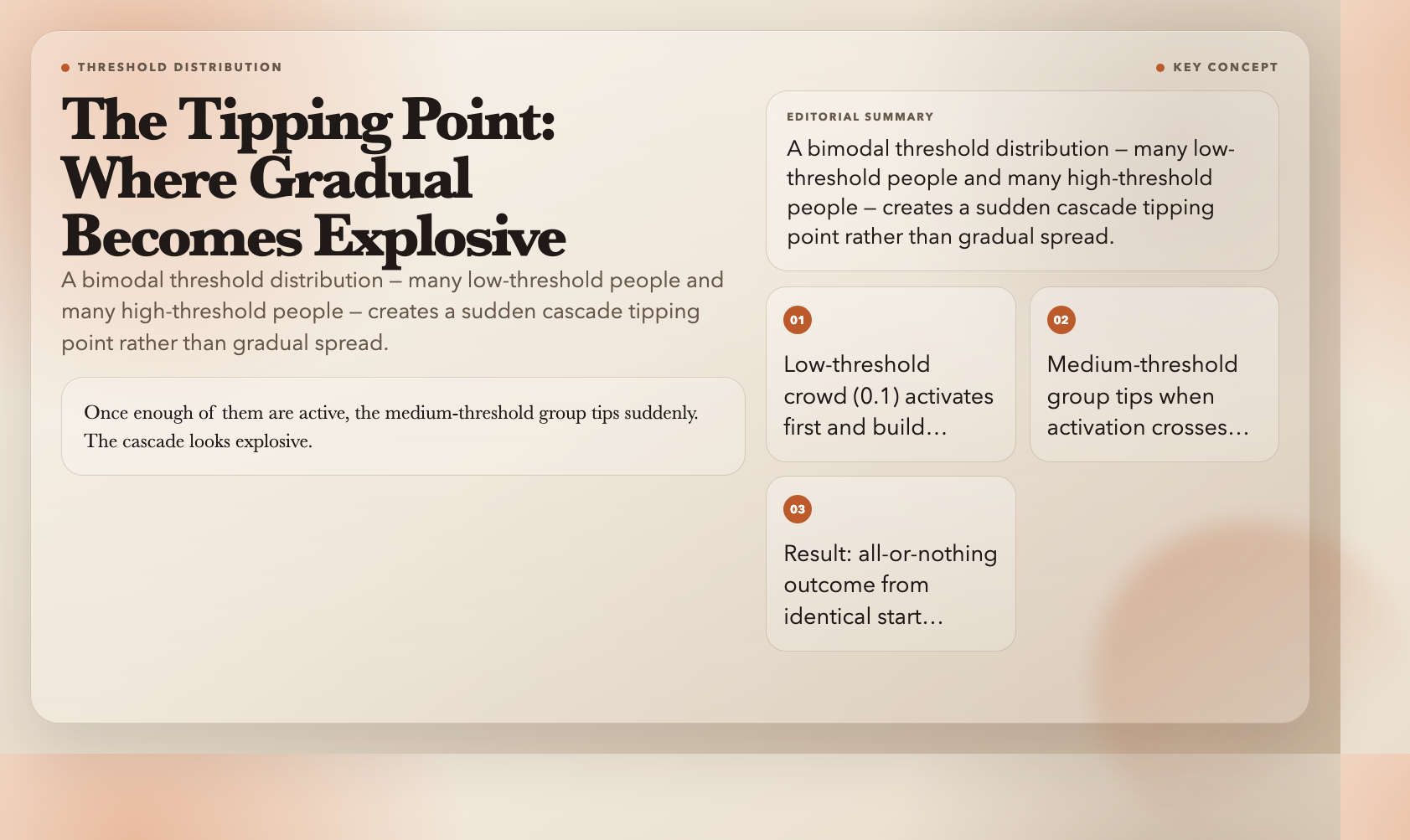
Unlike epidemic models, where infection probability is uniform and random, the threshold model is about heterogeneity. Small differences in how bold or cautious people are can produce wildly different collective outcomes — from total stagnation to full cascade. As Granovetter wrote in his landmark 1978 American Journal of Sociology paper, even a bimodal distribution of thresholds (many low, many high) creates a clear tipping point where cascades become sudden and explosive.
The Shape of the Threshold Distribution
Granovetter showed that the shape of the threshold distribution matters more than almost any other variable.
With a uniform distribution (everyone clustered around 0.5), propagation is gradual and predictable — like water soaking through sand.
With a bimodal distribution — many people at 0.1 and many at 0.9 — you get a sharp tipping point. The low-threshold crowd activates early and builds momentum. Once enough of them are active, the medium-threshold group tips suddenly. The cascade looks explosive.
With a power-law distribution, most people are easily influenced while only a stubborn few resist. The network lights up fast, then stalls as the holdouts remain inactive.
The unsettling implication: you cannot predict cascade outcomes by measuring the average threshold. You have to look at the distribution shape itself.
How Network Topology Reshapes the Spread
Granovetter’s original model assumed a well-mixed population. But real social networks have structure — and that structure amplifies or dampens cascades in ways that aren’t obvious.
Random networks (Erdős–Rényi) average out local fluctuations. Influence dissipates predictably.
Small-world networks (Watts-Strogatz) have shortcuts that let contagion jump between distant clusters. A spark that would die in one neighborhood hops to another, enabling cascades that would stall on a regular lattice.
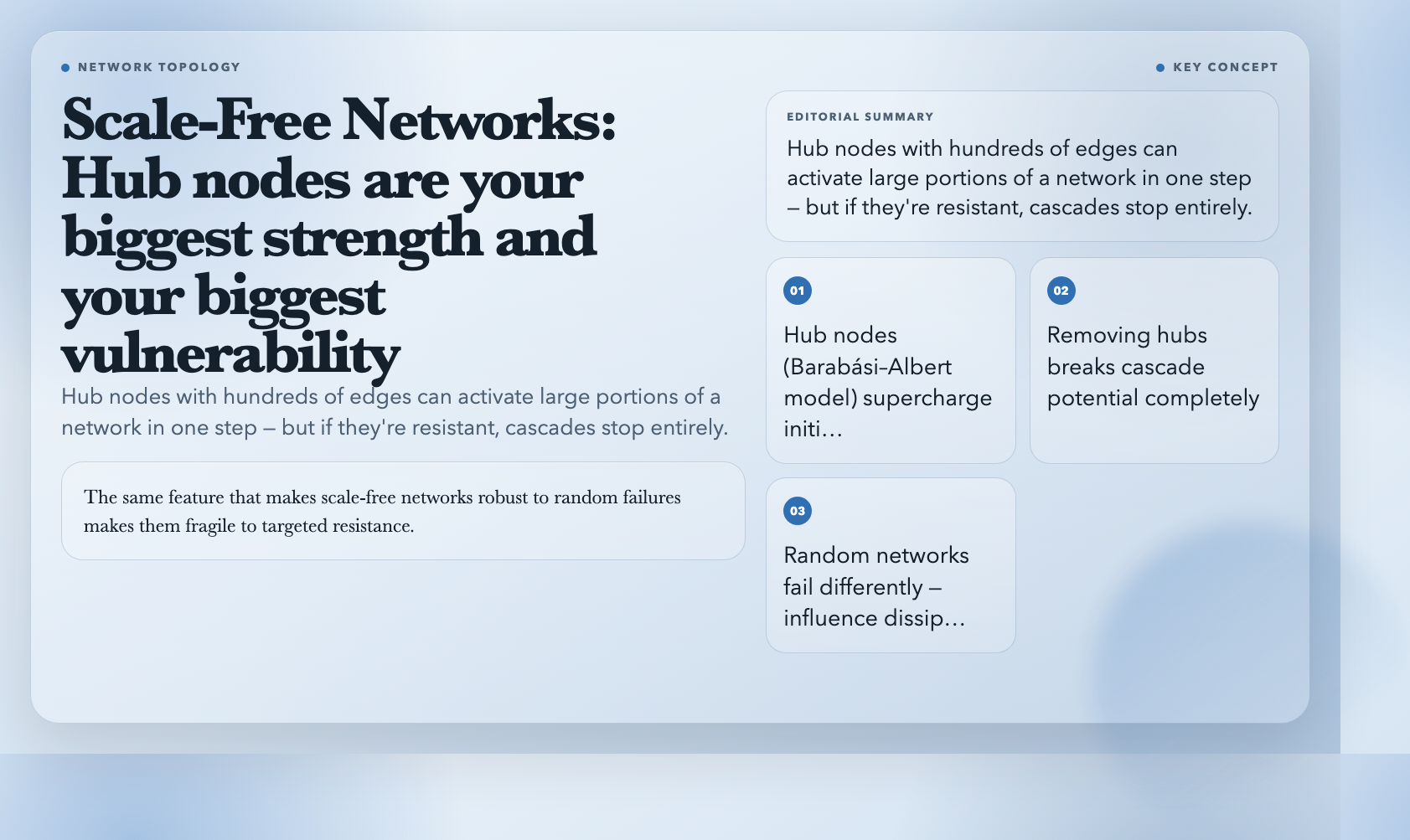
Scale-free networks (Barabási–Albert) have hub nodes — superconnectors with hundreds of edges. These hubs can activate large portions of the network in a single step. But this creates a strange vulnerability: if hubs are resistant, cascades stop entirely. The same feature that makes scale-free networks robust to random failures makes them fragile to targeted resistance.
This topology effect shows up in real-world cascades. The 2011 Egyptian Tahrir Square protests spread through tight-knit activist clusters before jumping across professional and family networks — a textbook small-world cascade path.
The Brutal Math of Initial Conditions
The model produces something deeply counterintuitive: path dependence. The same network with the same threshold distribution can produce completely different outcomes depending on how many seed nodes activate initially.
With 5% initial activation on a scale-free network, the contagion might sweep through 90% of nodes. Drop that to 3%, and it might stall at 40%. The difference of two or three early adopters — people, not parameters — determines whether an idea takes over or dies.
This is why grassroots movements are so unpredictable. A protest that gains 100 committed participants on Day 1 might become a national story. The same movement with 80 early participants might never make the news.
Sociologist Duncan Watts called this the structural explanation for social outcomes: not what people believe, but where they sit in a network determines what they end up doing.
The All-or-Nothing Trap
Granovetter’s 1978 paper noted that his model could predict either near-total adoption or near-total stagnation from identical parameters — depending on initial conditions that were effectively random. This cascade-or-stall dichotomy appears across domains:
–

Arab Spring (2010–2012): The same social media tools and grievances produced mass mobilization in Tunisia and Egypt, but minimal cascade in Saudi Arabia and Iran — despite similar demographics and economic pressures. The threshold distribution differed, even when we couldn’t measure it directly.
- Pokémon Go launch (2016): The game swept through some cities and stalled in others, even in demographically similar regions. The difference wasn’t the game — it was whether early adoption crossed local tipping points.
- COVID-19 early spread (2020): Regions with identical pre-pandemic profiles experienced radically different outbreak curves. Network topology and early seed events explain much of the variation that population density alone cannot.
The implication cuts against our narrative instincts: we celebrate viral movements as evidence of idea quality. Granovetter’s model suggests something humbler — virality often tells us about the network, not the idea.
Why This Matters Now More Than Ever
We live in an era of engineered virality. Algorithms amplify content. Bots simulate early adoption. Influencers function as seed nodes. These interventions don’t just accelerate existing cascades — they alter the effective threshold distribution of the entire network.
When an influencer posts, they’re lowering thresholds for their followers. When a platform promotes content, it’s artificially inflating the initial activation rate. These tools shift the odds without guaranteeing cascade — but they change the physics of spread.
The uncomfortable truth: influence is less about idea quality and more about finding the right threshold distribution to exploit.
See It for Yourself
If you want visceral intuition for this model, spend 20 minutes with the Network Contagion simulator on ElysiaTools. Choose a network topology, set a threshold distribution, dial in the initial activation ratio. Then watch.
Try this: set up a power-law network with low thresholds. Run it three times. Three seemingly identical simulations will produce three different cascade curves — not because parameters changed, but because random node positioning varies between runs.
That variance is the point. Granovetter’s model tells us social systems are sensitive to initial conditions in ways that look random but aren’t. The randomness is real. The structure beneath it is also real. Both matter.
The Question Worth Asking

Granovetter’s model makes one thing unavoidable: a cascade tells you about the network, not the idea.
Viral spread gets treated as social proof. The model treats it as weather — a local atmospheric condition, not a verdict on the thing that spread. The same idea, launched into a network with unfavorable thresholds, produces nothing. Launch it into a network that’s primed, and it explodes. Same idea, different physics, completely different outcome.
This doesn’t mean ideas don’t matter. It means virality can’t be the only evidence we use to evaluate them.
So here’s what to do next time something goes viral: don’t ask “why is this spreading?” Ask instead: “what network conditions made this viral — and what would the same idea look like in a network that wasn’t?” The second question is harder to answer. It’s also the only one that actually matters.
—
Explore the full interactive simulation at ElysiaTools — Network Contagion.