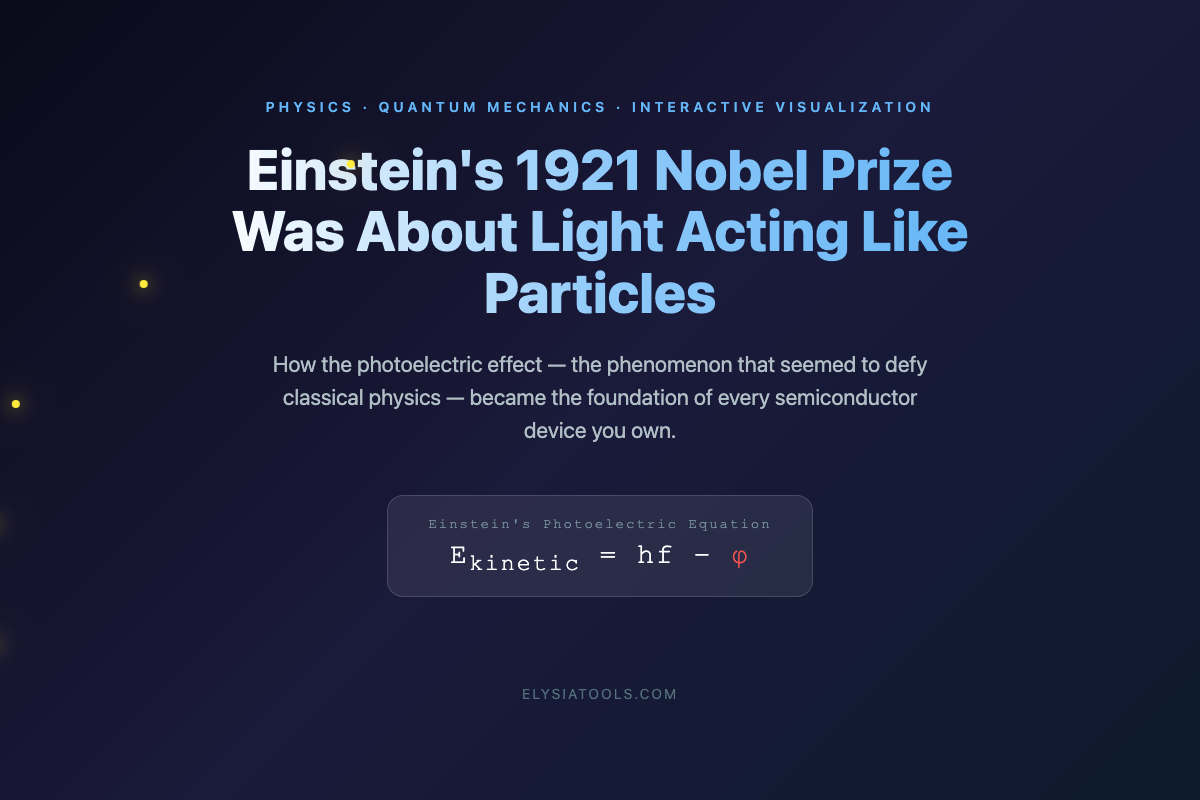
Einstein‘s 1921 Nobel Prize Was About Light Acting Like Particles
In 1887, Heinrich Hertz noticed something odd in his lab. When he shone ultraviolet light on his metal electrodes, sparks jumped more easily. He didn’t understand it. Within a few years, physicists had mapped the effect precisely: certain metals eject electrons when light hits them. Classical wave theory predicted the electrons’ energy should depend on light brightness. The data showed it depended on light color instead.
Einstein’s explanation earned him the Nobel Prize in Physics in 1921. Not for relativity — for the photoelectric effect.
The Experiment That Broke Classical Physics
Here’s what the data actually shows:
Threshold frequency: Shine red light on sodium. Nothing. Shine yellow light. Nothing. Shine ultraviolet. Electrons fly off instantly. The metal doesn’t care about brightness — it cares about frequency.
Instant response: Electrons emit in less than a nanosecond after light hits. Classical theory predicted a delay while the metal “charged up.” No delay observed.
Energy by frequency: Plot electron kinetic energy against light frequency. You get a straight line. The slope is Planck’s constant. The intercept is the metal’s work function — the energy cost to kick out an electron.
An interactive photoelectric effect visualization lets you test this yourself: adjust light frequency and intensity, pick different metals, and watch the electron energy change.
The Equation That Changed Everything
Einstein’s quantum explanation: E_kinetic = hf – φ
– h is Planck’s constant (6.626 × 10⁻³⁴ J·s)
– f is light frequency
– φ is the work function (metal-specific energy barrier)
Each photon transfers all its energy to exactly one electron. If hf > φ, the electron escapes with kinetic energy equal to the surplus. If hf ≤ φ, nothing. No partial credit. No accumulation. All-or-nothing quantum transactions.
This is why solar cells work. Why photodiodes detect light in cameras. Why automatic doors sense your presence. Every photon-to-electron conversion in every semiconductor device on Earth runs on Einstein’s 1905 insight.
What You Can Explore in the Visualization
The photoelectric effect tool shows:
– Frequency response: Drag the frequency slider and watch electron emission start or stop at the threshold
– Intensity effects: Increase brightness — more electrons escape, but each electron has the same energy
– Metal comparison: Different elements have different work functions. Cesium needs less energy than tungsten
– Einstein’s equation: Real-time display of E_kinetic = hf – φ as you adjust parameters
The gap between classical prediction and quantum reality becomes visceral when you can manipulate the parameters yourself.
Why This Still Matters
The photoelectric effect was the first clean experimental demonstration that light comes in discrete packets. Not theoretical — measurable electron energies that don’t match wave theory predictions.
Millikan spent years trying to disprove Einstein’s hypothesis. His 1916 data confirmed the quantum equation to within 0.5%. He reportedly hated every minute of it because the whole idea seemed so wrong-headed.
Einstein didn’t fully trust quantum mechanics later in his career. He found entangled particles philosophically uncomfortable. But his photoelectric paper is one of the foundational documents of quantum theory. Every solar panel, every digital camera, every fiber optic receiver runs on the principle he described.
Run the frequency slider down through visible light into infrared. Nothing. Drop into ultraviolet. Electrons appear. The metal doesn’t care about your intuitions about waves. It only cares about photon energy.
The Takeaway
Classical physics couldn’t explain why dim blue light ejects electrons while bright red light doesn’t — no matter how intense. Einstein could. His explanation was counterintuitive enough that Millikan spent years trying to disprove it. The data kept confirming quantum mechanics.
Every solar panel converts this effect into electricity. Every camera sensor. Every fiber optic receiver. The physics that seemed impossibly strange in 1905 became the foundation of every semiconductor device built since.
Run the frequency slider in the photoelectric effect visualization from infrared upward. Watch where the electrons start. That’s the threshold. That’s where classical physics breaks.
Every solar panel, every camera sensor, every fiber optic receiver runs on this quantum logic. Einstein’s equation — E = hf – φ — describes the fundamental operation of every semiconductor device you’ve ever touched.
Now ask yourself: what would Millikan have done with an interactive visualization like this?
Explore the Photoelectric Effect visualization and 230+ interactive science tools at ElysiaTools.