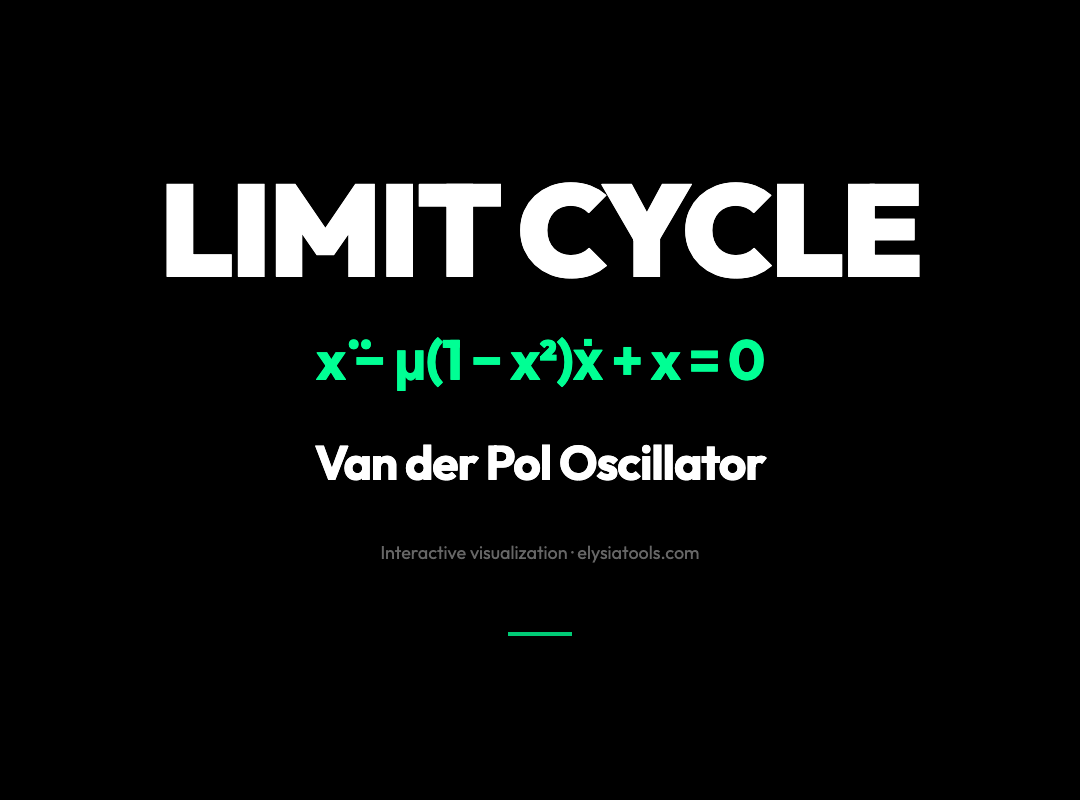
Why Your Heart Doesn’t Need a Clock to Keep Time
In 1926, a Dutch engineer wired up a vacuum tube circuit and watched it pulse on an oscilloscope. Nothing was pushing it. No external signal, no clock, no drive. The circuit just… oscillated. Forever.
Classical physics said this was impossible. Every oscillating system loses energy to damping and grinds to a halt. This one didn’t.
Balthasar van der Pol captured the behavior in a single line:
ẍ − μ(1 − x²)ẋ + x = 0
The middle term does something counterintuitive. When the displacement |x| exceeds 1, it turns positive and bleeds energy away. When |x| drops below 1, it turns negative and shoves energy back in. The system runs its own energy economy.
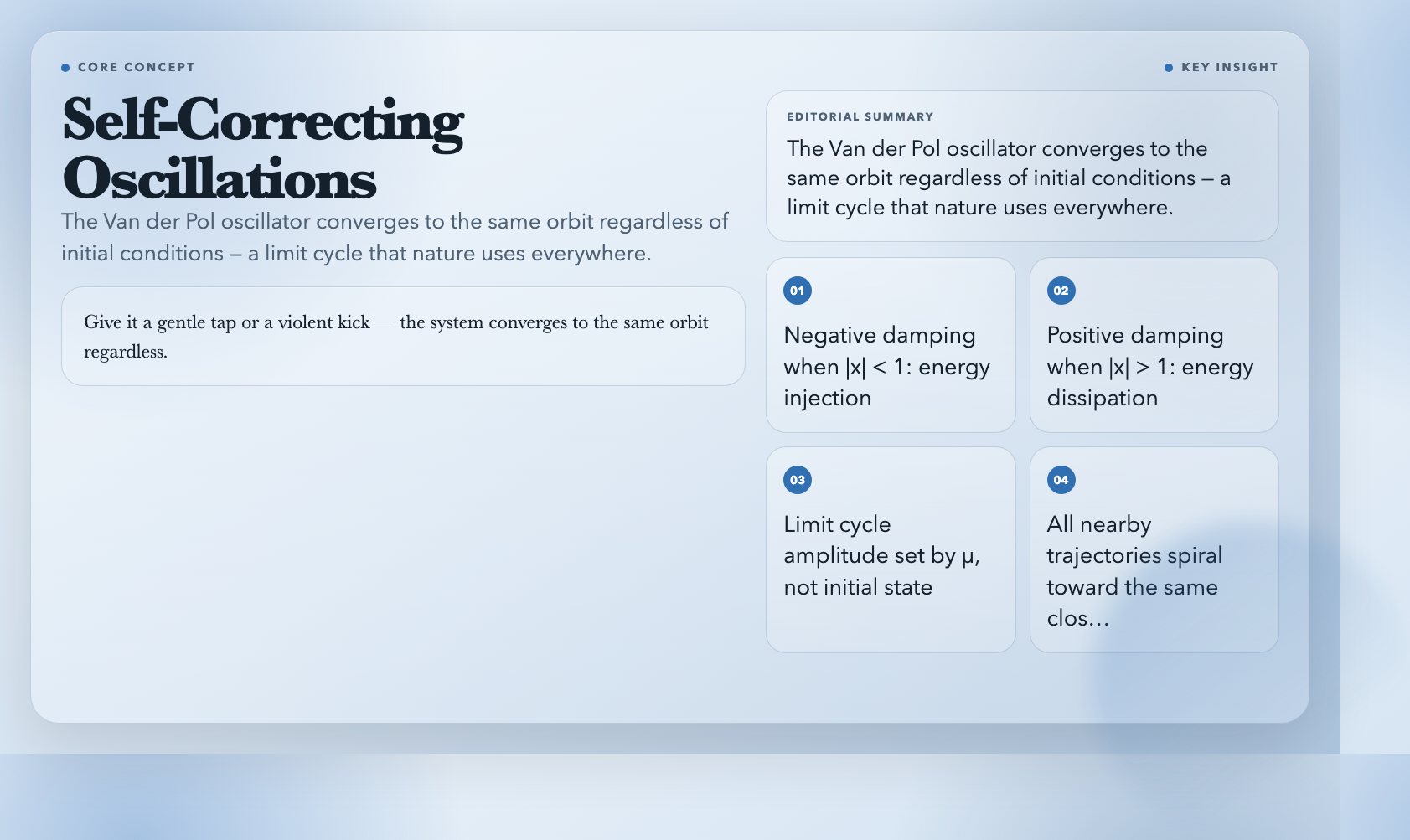
Most oscillation equations produce amplitudes that depend entirely on how hard you start them. Van der Pol’s equation doesn’t. Give it a gentle tap or a violent kick — the system converges to the same orbit regardless. Van der Pol called that orbit a limit cycle: an isolated closed path in phase space that attracts all nearby trajectories.
He found this working at Philips Research Laboratory in the 1920s, studying triode oscillators that linear theory couldn’t explain. He also coined the term “relaxation oscillations” for what happens at high μ: the system lingers near one extreme, then snaps hard to the other, over and over.
Once you know about limit cycles, they surface everywhere.
Cardiac pacemaker cells. The sinoatrial node doesn’t wait for a clock pulse. It generates self-sustaining rhythmic discharges through the same feedback mechanism — nonlinear damping that balances energy injection against energy loss. Cardiologists use Van der Pol variants because they match real cardiac dynamics.
Neural spiking. The FitzHugh-Nagumo model, which neuroscientists use to model neuron firing, behaves as a two-dimensional Van der Pol system. A neuron at rest suddenly spikes, then refractorily relaxes. The spike-relax cycle is a limit cycle.
Lasers. Below threshold, a laser is silent. Above threshold, the output stabilizes to a constant intensity — another limit cycle where stimulated emission and absorption reach equilibrium.
Power grids. Generator synchronization across a grid follows limit cycle dynamics. Engineers model grid stability using coupled Van der Pol equations.
Brake squeal. The high-pitched oscillation your brakes make is a self-excited friction oscillation — same math.
#
The μ Dial
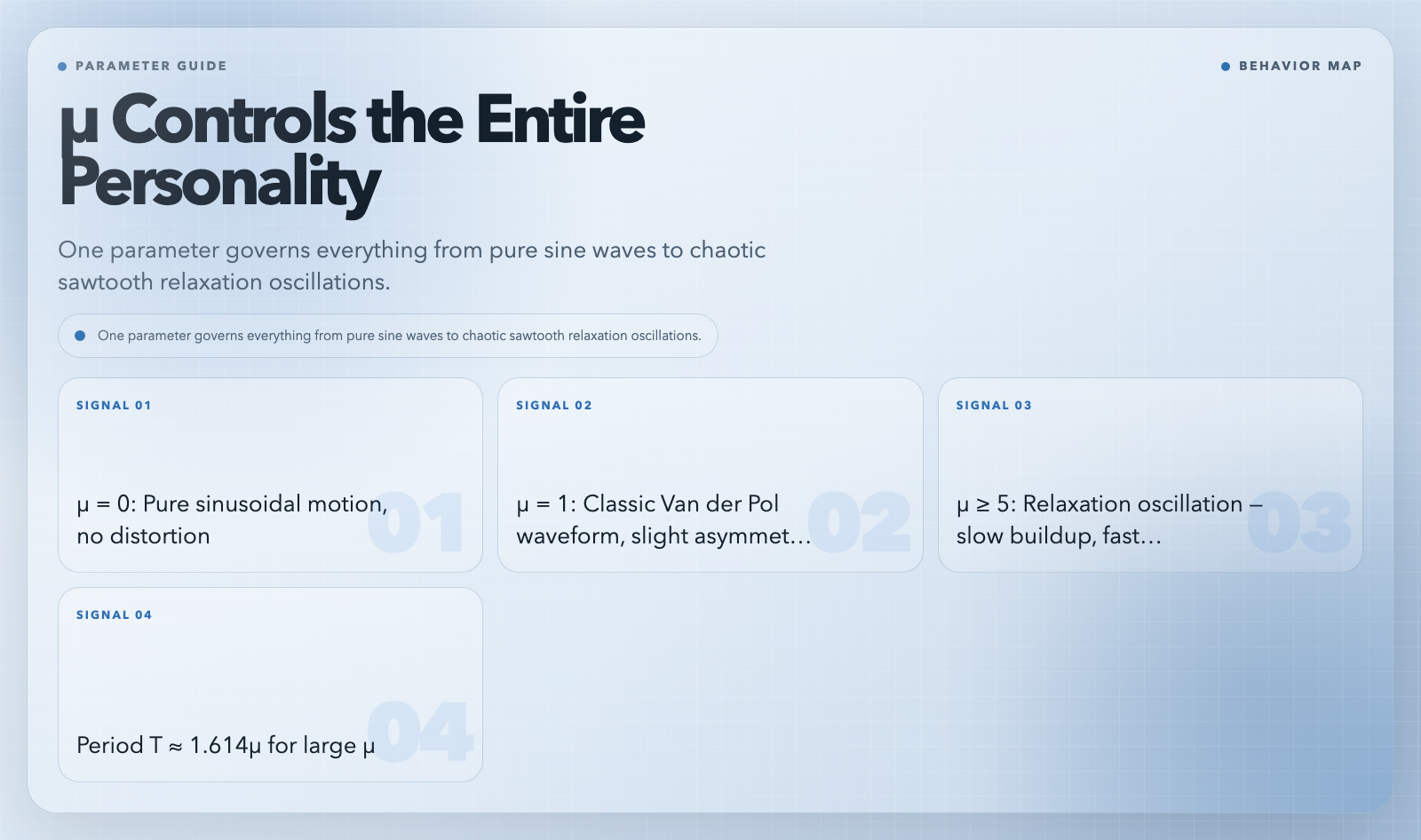
μ controls the system’s personality from pure sine wave to sawtooth-like relaxation oscillator:
μ = 0: simple harmonic oscillation, sinusoidal forever.
μ = 1: slight asymmetry, the classic Van der Pol waveform.
μ ≥ 5: relaxation oscillation — long slow buildup, sharp snap to the opposite extreme, repeat. Period ≈ 1.614μ.
In 1927, van der Pol and Van der Mark observed something else: driven at certain frequencies, the circuit produced irregular, unpredictable output. Deterministic equations producing chaos. Thirteen years before chaos had a name.
#
The Forced System
Add an external force:
ẍ − μ(1 − x²)ẋ + x = A cos(ωt)
The oscillator locks to the driving frequency. As you increase A or change ω, the system undergoes period-doubling bifurcations: the response period doubles (T → 2T → 4T → 8T), then cascades into chaos. This period-doubling route to chaos is now a textbook pathway.
#
Why This Matters
The Van der Pol oscillator makes a simple but profound claim: stability requires activity, not stillness. A system that actively balances energy injection against dissipation doesn’t grind to a halt — it locks into a self-sustaining rhythm.
Your heart does this. Neurons do this. Lasers and power grids do this. Van der Pol found the mechanism in a vacuum tube in 1926. Biologists found it in cardiac tissue. Physicists found it in lasers. Engineers keep finding it in new places.
One equation. Ninety-nine years. And the list of places it shows up keeps growing.
Explore the math: Van der Pol Oscillator — drag μ from 0 to 10 and watch a sine wave transform into a relaxation oscillator in real time.