The Bar That Proved Markets Can Coordinate Without a Planner
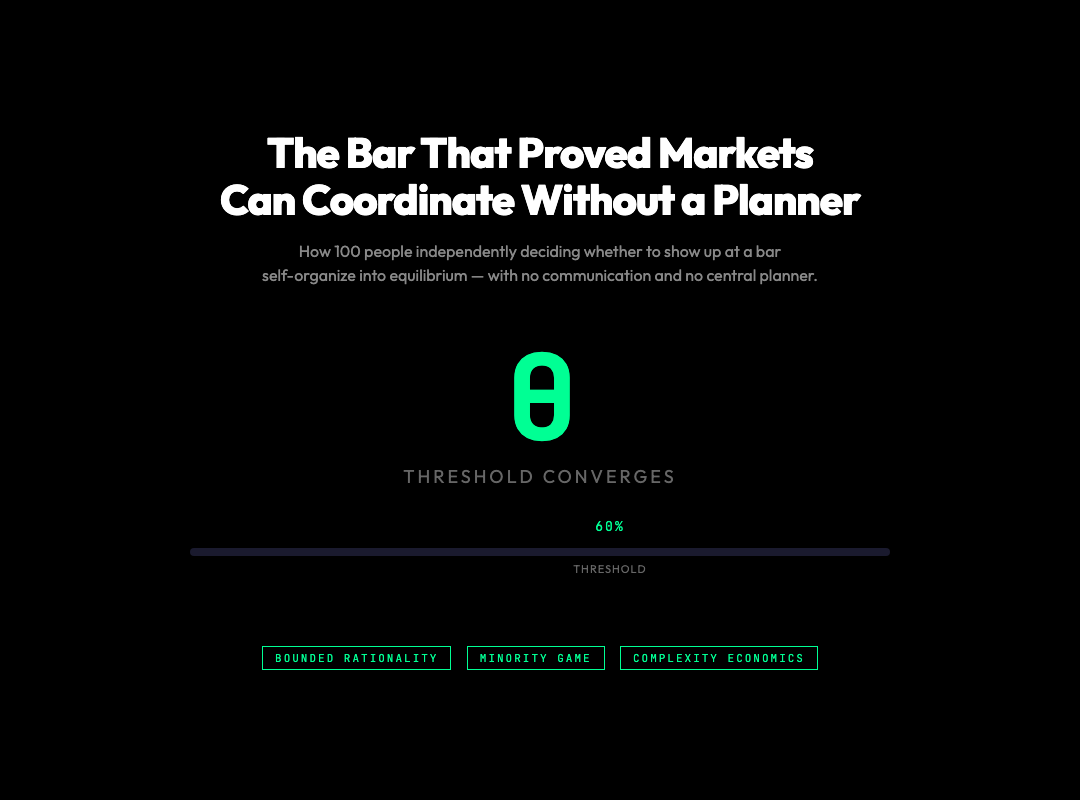
In 1994, a small Irish bar in Santa Fe, New Mexico became one of the most cited thought experiments in economics and complexity theory. W. Brian Arthur — then a newly appointed professor at the Santa Fe Institute — asked a question that would eventually upend how economists think about markets, rationality, and emergence.
The setup was deceptively simple.
Every Thursday night, N people independently decide whether to go to El Farol, a bar with limited seating. If fewer than θ people attend, the bar is pleasant — good music, enough space, an enjoyable evening. But if more than θ show up, it’s overcrowded and miserable. Each person wants to go only if they expect attendance to be below the threshold.
The problem: everyone makes the same calculation with the same information. There’s no central planner, no announcement, no way to coordinate. And here’s the twist — if you try to reason your way to the “right” answer using classical game theory, you hit an infinite regress. You think about what others think. They think about what you think. Around and around.
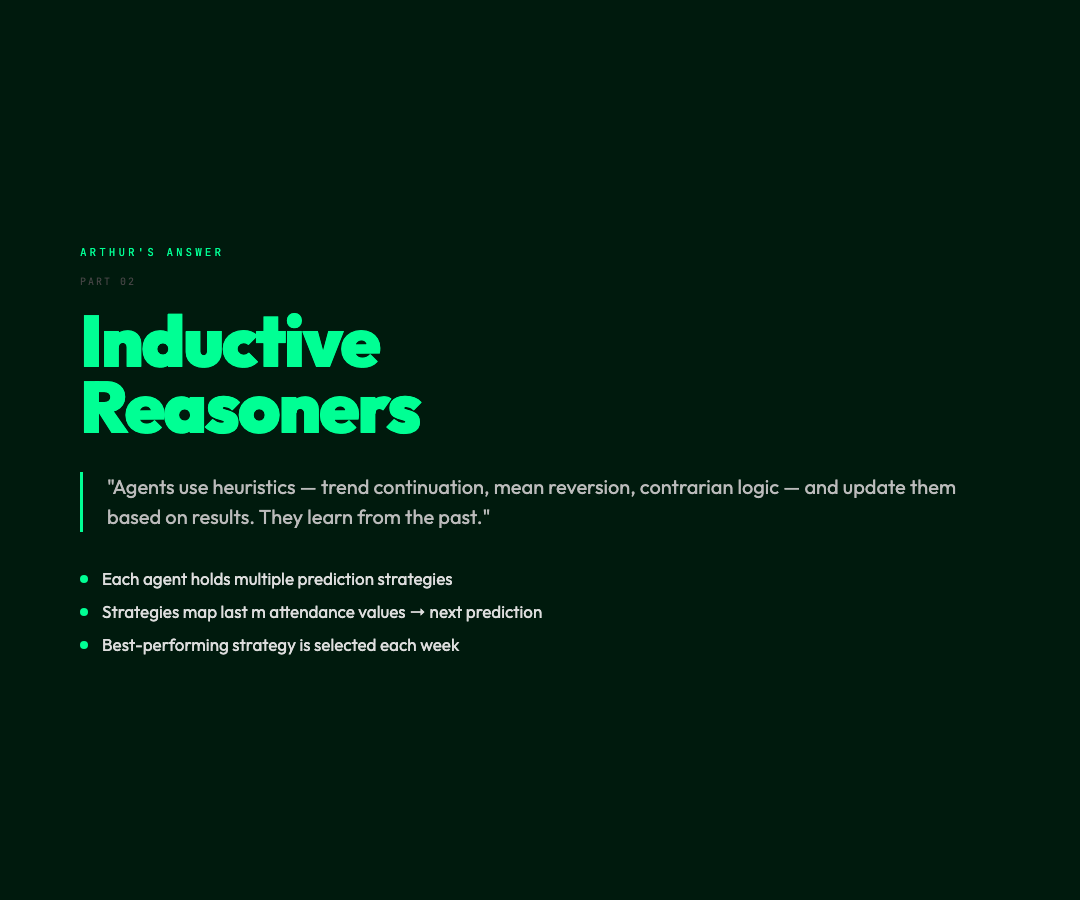
Arthur’s insight was to model the agents not as perfect deductive reasoners — which is what standard economics assumed — but as inductive reasoners. Each agent develops a set of strategies based on historical attendance patterns and picks the one that has performed best. They learn from the past. They adapt. They compete.
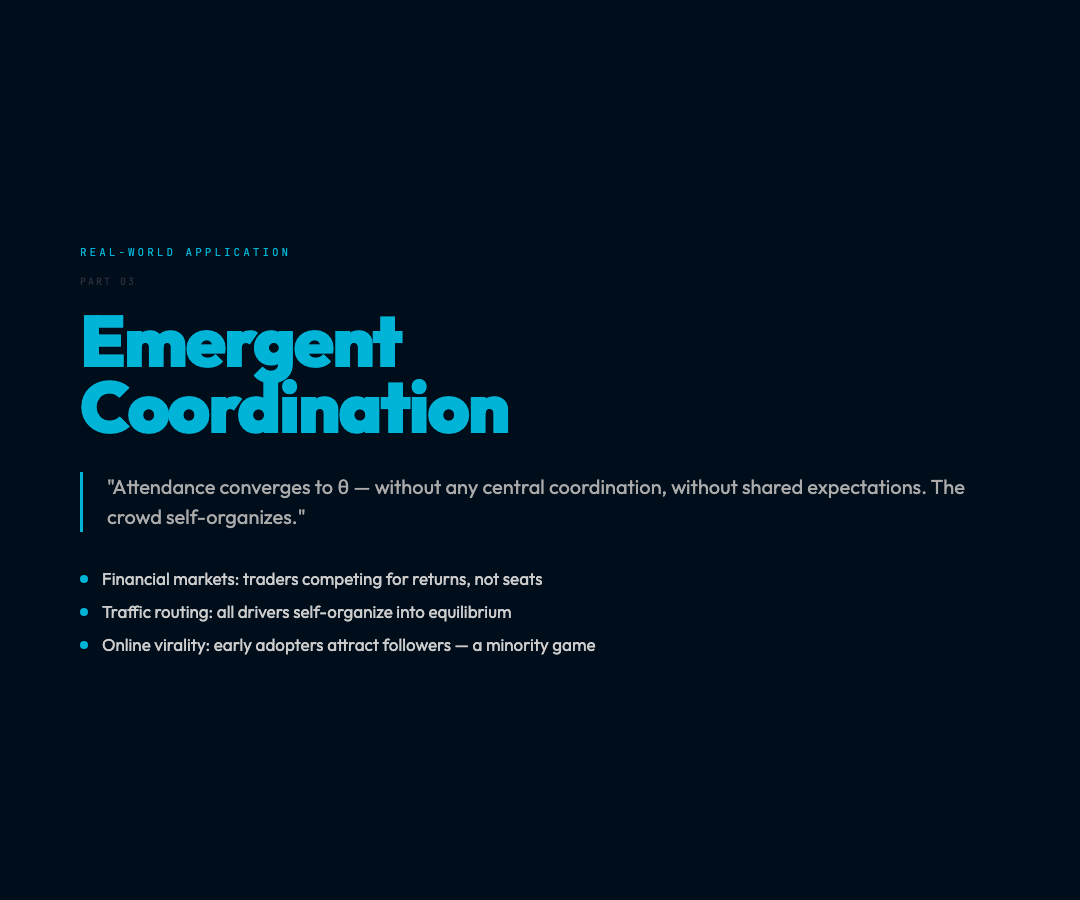
The result was striking: even without any communication or central coordination, mean attendance converges to the threshold θ. The crowd self-organizes. Not perfectly, not every week — but statistically, the system finds an equilibrium that no individual planned.
This became known as the El Farol Minority Game, and it did something rare in academic literature: it was simple enough to teach, general enough to apply everywhere, and strange enough to make you question what you thought you knew about markets.
Why Standard Economics Gets It Wrong
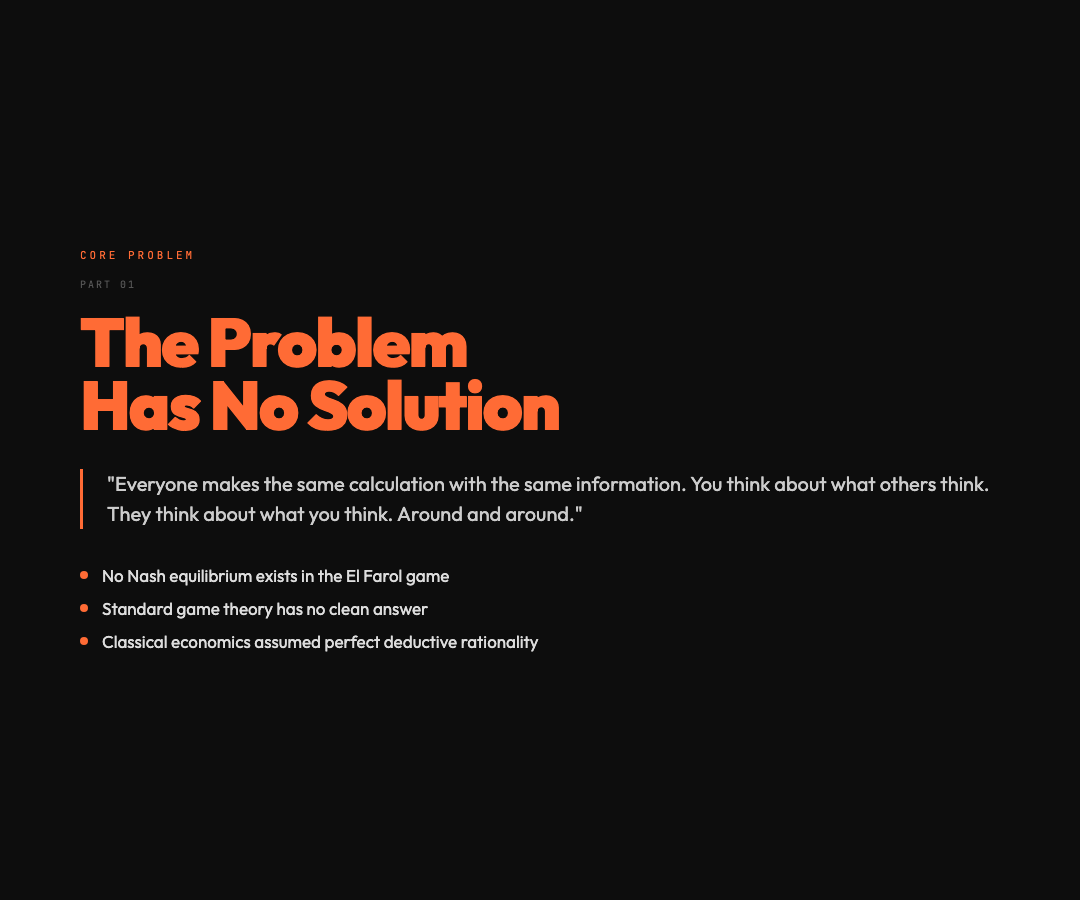
Classical game theory predicts that rational agents, faced with the El Farol problem, should fall into a Nash equilibrium — a stable state where no individual can do better by unilaterally changing their strategy.
The problem is that no such equilibrium exists in this game.
Try to solve it formally. You need to know what others will do to decide what you should do. But they’re solving the same problem. The recursion never bottoms out. Classical game theory has no clean answer — and that silence is the point.
What Arthur proposed instead was a behavioral model: agents don’t have perfect information, and they don’t reason backwards from perfect rationality. They use heuristics. They look at attendance history. They form predictions. They pick strategies and update them based on results. It’s messy, adaptive, and deeply human.
This is bounded rationality — a term coined by Herbert Simon in the 1950s, but one that mainstream economics largely sidestepped. The El Farol Minority Game made it impossible to sidestep anymore.
How the Simulation Works
The visualization at ElysiaTools implements the game with five key parameters you can adjust:
- Agents (N): How many people are making the decision each week
- Threshold (θ): The attendance level that separates a good night from a bad one
- Memory (m): How many past weeks of attendance each agent remembers
- Strategies per Agent: How many prediction strategies each agent holds
- Decision Noise (ε): How often agents make a random choice instead of following their best strategy
Each agent holds multiple strategies. A strategy is essentially a function that takes the last m attendance values and outputs a prediction for next week’s attendance. Each week, the agent uses the strategy that has performed best historically (lowest cumulative prediction error). With some probability (ε), the agent ignores their best strategy and picks randomly — this prevents the system from locking into stable but suboptimal patterns.
The key emergent behavior: attendance hovers around θ, even though no agent is trying to achieve that outcome. Every agent is just trying to predict whether the bar will be below or above the threshold, and they’re all using variations of the same basic prediction toolkit — trend continuation, mean reversion, contrarian logic, cyclical patterns.
What the Minority Game Tells Us About Markets
The most direct application is financial markets. Every trading day, investors decide whether to buy or sell an asset. If too many buy, prices rise and returns suffer. If too many sell, prices fall. Each trader is essentially playing a minority game — trying to be on the winning side of a crowd.
This connection was developed extensively after Arthur’s original paper. Traders in the real world don’t have perfect models of the market. They use historical price patterns, moving averages, momentum indicators — all heuristics, not rational deductions. And just like in the El Farol Minority Game, these heuristics compete in a crowded space, and the system self-organizes around aggregate statistics that no individual controls.
The minority game framework also applies to:
- Traffic routing: Each driver picks a route based on expected congestion. If too many take the “fast” route, it becomes slow. The system converges to a statistical equilibrium.
- Auction design: Bidders use historical auction outcomes to calibrate their strategies. The outcome depends on the mix of strategies in the pool.
- Online content virality: Whether a post “goes viral” depends on how many people are already engaging with it — a minority game dynamic where early adopters signal quality and attract followers.
In each case, the mechanism is the same: many agents making independent decisions based on local information, adapting over time, and producing emergent coordination without any central planner.
The Deeper Lesson
The El Farol Minority Game is often taught as a model of market dynamics. But its deepest lesson is about the nature of economic equilibrium itself.
Standard economics treated equilibrium as the result of rational agents solving a coordination problem through price signals. The minority game suggests equilibrium might be something more humble: the statistical fingerprint of many agents, each using simple rules, each trying to do their best with incomplete information.
W. Brian Arthur went on to become one of the founding figures of complexity economics. The El Farol bar, and the minority game it spawned, remain one of the cleanest demonstrations of his central claim: that the most interesting economic phenomena — markets, cities, technologies — don’t emerge from perfect rationality. They emerge from adaptive agents bumping into each other, learning, and converging on patterns that no one designed.
The next time you’re deciding whether to show up somewhere — a restaurant, a concert, a meeting — and you wonder how everyone else is making the same calculation, you’re playing the El Farol Minority Game. And the remarkable thing is that it usually works out.
Try it yourself: El Farol Minority Game — adjust the parameters, watch attendance converge, and explore how bounded rationality produces emergent coordination.