The Gallery of Shapes That Prove Chaos Has a Hidden Order
In 1961, a meteorologist named Edward Lorenz was running a weather simulation. He wanted to replay a sequence — so he typed in the numbers from a printout and started the program again. The numbers looked the same. But the weather pattern that emerged was nothing like the one he’d seen before. It diverged, spiraled, folded into something irreducible. He’d stumbled into what we now call chaos.
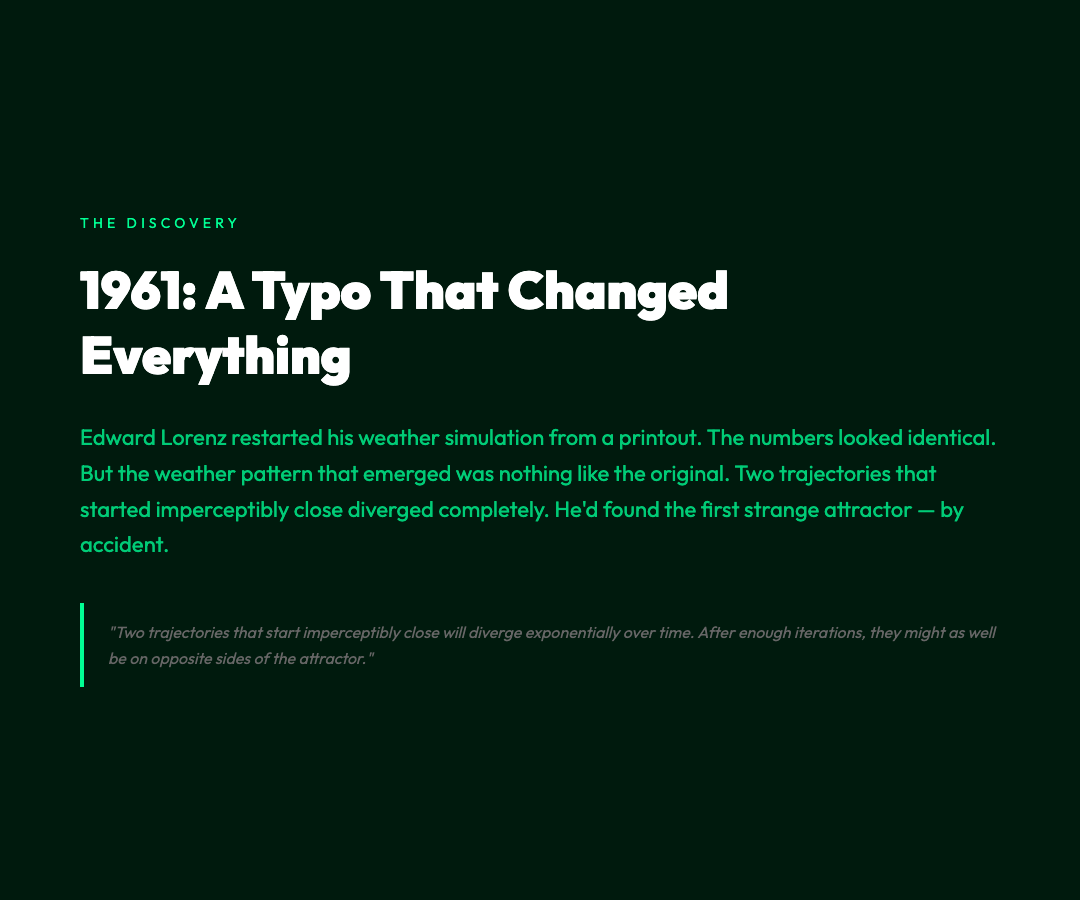
What Lorenz had found — later named the Lorenz attractor — was not random noise. It was a shape. A structure so precise that every trajectory, no matter where it started, would eventually settle into the same intricate orbit. It was the first strange attractor ever described.
That discovery opened a window into a universe of shapes that mathematics had hidden for centuries. And today, you can explore them interactively at Strange Attractors Gallery.
What Is a Strange Attractor, Really?
A strange attractor is the set of states that a dynamical system settles into over time. The word “attractor” is apt — these shapes pull systems toward them, the way a drain pulls water into a vortex. But unlike the simple attractors you learned about in school (a fixed point, a pendulum’s back-and-forth), strange attractors have a fractal structure. Their geometry is infinitely detailed: zoom in, and you find more structure. Zoom in again, and more still.
More importantly, strange attractors exhibit sensitive dependence on initial conditions. This is the famous butterfly effect — not the pop-culture version where a butterfly flaps its wings and causes a tornado, but the mathematical reality: two trajectories that start imperceptibly close will diverge exponentially over time. After enough iterations, they might as well be on opposite sides of the attractor.
This combination — fractal geometry plus exponential divergence — is what makes them strange. The trajectories never cross (that would violate the mathematical rules of deterministic systems), yet they never repeat either. They are caught in an eternal dance, trapped in a bounded region of space but never settling into a fixed pattern.
Why Lyapunov Exponents Tell You Everything
How do you measure chaos? The standard tool is the Lyapunov exponent, named after the Russian mathematician Aleksandr Lyapunov.
The intuition is simple: take two points very close together. Watch how the distance between them grows (or shrinks) as the system evolves. If the distance grows exponentially — if |δx(t)| ≈ |δx(0)| · e^(λt) — then λ is positive, and you have chaos. A positive Lyapunov exponent is the mathematical signature of a strange attractor.
Most strange attractors have a characteristic Lyapunov spectrum. The Lorenz attractor, for instance, has one positive exponent (λ₁ ≈ 0.9056), one near zero (λ₂ = 0), and one negative (λ₃ ≈ −14.5723). The sum is negative, meaning volumes in phase space contract even as trajectories within that volume diverge. The system is simultaneously expanding in one direction and collapsing in another — a kind of perpetual folding.
This is why strange attractors look the way they do: the stretching and folding process, repeated over and over, creates the fractal filamentary structure. It’s the same mechanism that gives bread its layered texture when you fold and stretch dough — the Baker’s map from chaos theory.
Seven Attractors, Seven Universes
The Lorenz attractor was just the beginning. In the decades that followed, mathematicians and physicists discovered dozens more — each with its own personality, its own geometry, its own story.

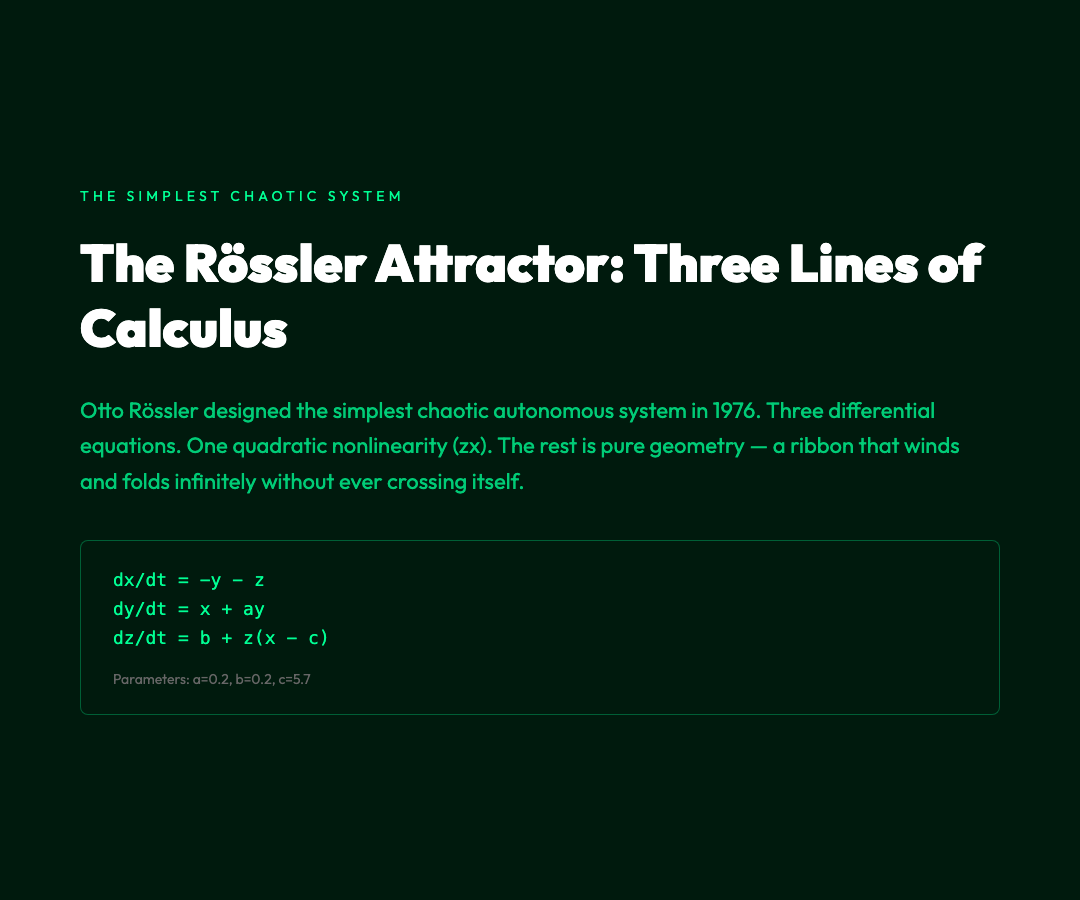
The Rössler Attractor (1976): Otto Rössler designed this as the simplest possible chaotic system. Its equations are almost trivial — just three lines of calculus — yet they produce a attractor that winds around like a folded ribbon. As you adjust the c parameter upward, it follows the classic period-doubling route to chaos, exactly as Feigenbaum predicted. You can watch the transition happen in real time in the interactive visualization.
The Halvorsen Attractor: This one has a three-fold symmetry that makes it visually striking — rotating it 120 degrees around the (1,1,1) axis leaves it looking the same. With the default parameter a=1.89, it produces a beautiful, almost ornamental shape.
The Clifford Attractor: Unlike the continuous-flow attractors above, the Clifford is a discrete 2D map. You iterate the equations: x’ = sin(a·y) + c·cos(a·x), y’ = sin(b·x) + d·cos(b·y). With just four parameters, you get an extraordinary diversity of fractal shapes — spirals, galaxies, nets. Each parameter choice is a different universe.
The Aizawa Attractor: A 3D system with elegant topology — a bowl shape with a distinctive spiral structure winding around the vertical axis. Its default parameters produce something that looks almost biological, like a chambered nautilus shell rendered in pure mathematics.
The Thomas Attractor: Thomas discovered this in 1999 while studying the simplest possible chaotic flow with only sin() nonlinearities. With b=0.208186, it produces a cyclically symmetric attractor with three-fold symmetry. As you decrease b, it transitions from fixed point to limit cycle to chaos.
The Dadras-Momeni Attractor: This one can produce both two-scroll and four-scroll chaotic attractors, depending on parameters. It has multiple equilibria — unusual among chaotic systems — which gives it a rich repertoire of behaviors.
The Sprott Attractor (Case A): Julian Sprott ran an exhaustive computer search in 1994 for the simplest possible chaotic flow. This is what he found: dx/dt = y, dy/dt = −x + yz, dz/dt = a − y². With just one quadratic nonlinearity and a single parameter (a=2.07), this is one of the simplest chaotic systems known. Sprott’s search enumerated 19 distinct simple chaotic systems (Case A through S), proving that chaos is not rare or pathological — it lurks in the simplest possible equations.
Why It Matters
The implications of strange attractors reach far beyond mathematics.
In cryptography, their sensitive dependence on initial conditions makes them natural candidates for encryption. A tiny change in the key (initial conditions) produces an entirely different output trajectory. Several chaos-based image encryption algorithms have been proposed, exploiting the fact that chaotic sequences are deterministic yet appear random.
In engineering and control, understanding strange attractors means knowing when to prevent chaos (unwanted vibrations in mechanical systems, cardiac arrhythmias) and when to exploit it (chaotic mixing in chemical reactors, chaotic advection for improved blending). The OGY method, developed in 1990, showed that tiny perturbations could stabilize an otherwise chaotic system — a result that transformed control theory.
In biology, strange attractors appear in cardiac dynamics (ventricular fibrillation corresponds to chaotic electrical activity), neural networks (epileptic seizures can be modeled as transitions into chaotic regimes), and population ecology. The famous logistic map — simple enough to be taught in introductory courses — produces period-doubling cascades and chaos as you increase the growth rate parameter.
In physics and chemistry, strange attractors show up in laser dynamics, Belousov-Zhabotinsky chemical reactions, fluid turbulence, the three-body problem in celestial mechanics, and plasma physics. Each physical system maps to a characteristic attractor topology.
Explore the Gallery
The Strange Attractors Gallery on ElysiaTools lets you interact with all seven systems in real time. You can adjust parameters, change the trail length, toggle auto-rotation, and observe how each system transitions between periodic and chaotic behavior. You can see the Rössler attractor wind up, watch the Halvorsen’s symmetry reveal itself, and explore the Clifford’s parameter space to find shapes no one has named yet.
What makes this kind of visualization valuable isn’t just the beauty — though the beauty is genuine. It’s that you can develop intuition for how chaotic systems behave. You can see, concretely, what it means for trajectories to diverge while remaining bounded. You can watch bifurcation happen as you turn a dial. That is something no textbook equation can quite replicate.
Lorenz didn’t set out to discover chaos. He was running a weather model. But the shape he found — that delicate, infinite butterfly drawn by deterministic equations — turned out to be one of the most important mathematical objects of the twentieth century. And it turns out you don’t need a supercomputer to explore it. You just need a browser.