The Mysterious Curve Generated by a Rolling Circle
You roll a wheel. You attach a pen to its rim. You roll the wheel along a piece of paper. The curve that emerges — a cycloid — has tormented and delighted mathematicians for five centuries.
It looks simple. It isn’t.
The Curve That Started a War
In 1696, Johann Bernoulli posed a challenge to the world’s mathematicians: What curve does a particle follow when sliding from point A to point B in the shortest possible time? Gravity only. No friction. The answer wasn’t a straight line, wasn’t a parabola — it was a cycloid.
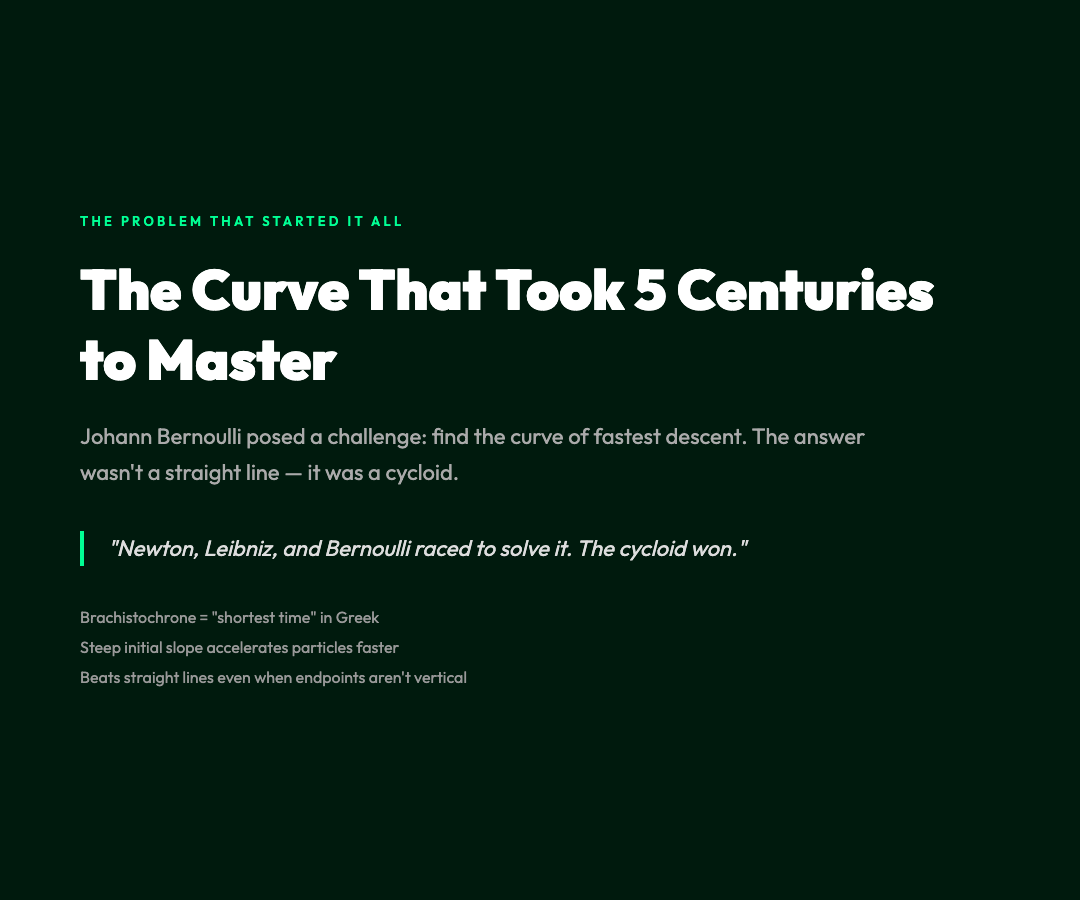
This launched what mathematicians call the “brachistochrone controversy.” Isaac Newton, Gottfried Leibniz, and Bernoulli himself all raced to solve it. Newton reportedly solved it in a single evening and published anonymously, but Bernoulli reportedly recognized his “claw” in the solution. The drama was real.
The cycloid won. A particle sliding along an inverted cycloid curve reaches the bottom faster than along any other curve — even beating a straight line when the endpoints aren’t vertically aligned. This is counterintuitive: gravity pulls straight down, so shouldn’t the shortest path be a diagonal? No. The cycloid’s initial steep slope accelerates the particle faster, compensating for the longer path.
This property — brachistochrone means “shortest time” in Greek — makes the cycloid not just mathematically interesting but practically powerful.
Three Curves from One Setup
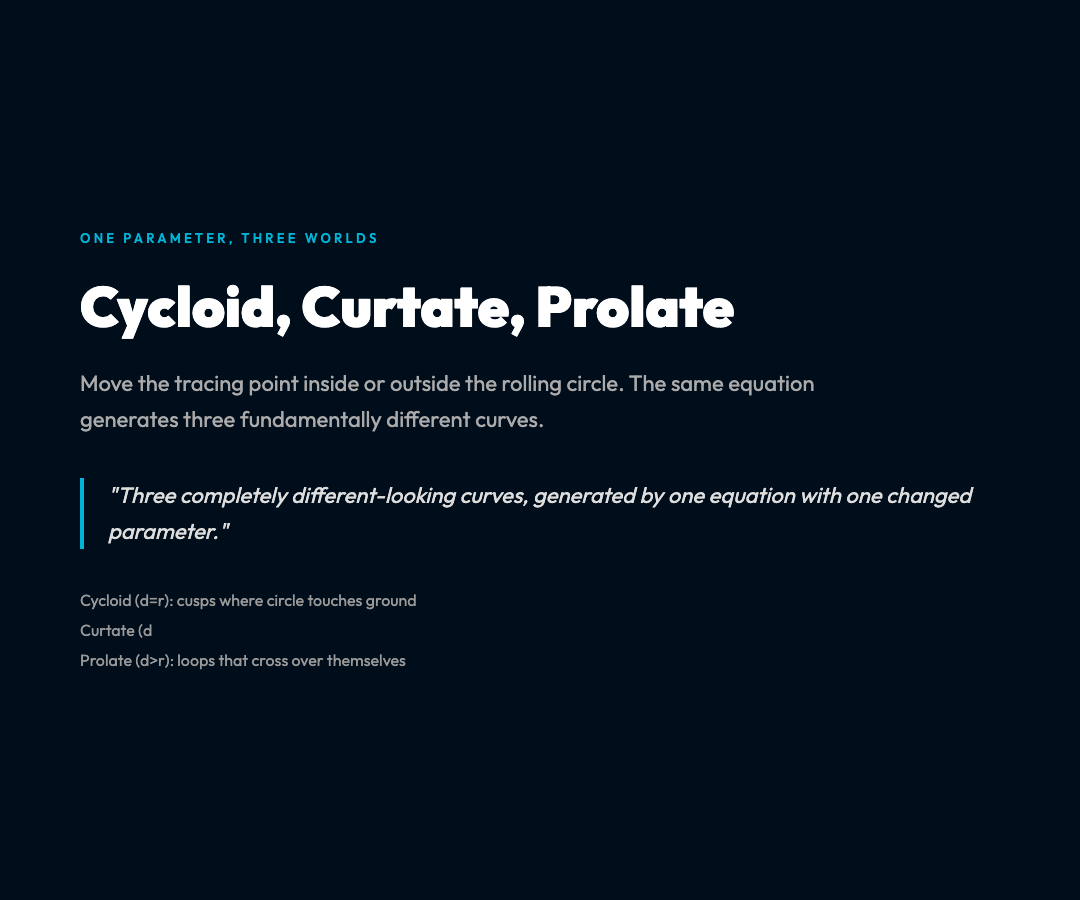
Here’s what makes the cycloid family remarkable: change one parameter, get a fundamentally different curve.
The cycloid (d = r): The tracing point sits exactly on the rim of the rolling circle. The curve touches the ground at cusps — sharp points where the circle meets the surface. This is the classic cycloid, the one that won the brachistochrone problem.
The curtate cycloid (d < r): Move the tracing point inward, toward the center of the circle. The curve becomes wavy and graceful — it never touches the ground, hovering above with elegant loops. Picture a wheel with a pen attached inside the rim, tracing the inside of the circle’s path.
The prolate cycloid (d > r): Move the pen outward, past the rim. Now the curve forms loops that cross over themselves. The wheel’s spoke extends beyond the wheel itself, and the pen traces loops that dip below the ground line — mathematically impossible for a physical wheel, but perfectly valid as a parametric curve.
Three completely different-looking curves, generated by one equation with one changed parameter:
x = r(t - sin t)
y = r(1 - cos t)
Where r is the rolling circle’s radius, d is the distance from center to tracing point, and t is the angle of rotation.
Where Cycloids Hide in the Real World
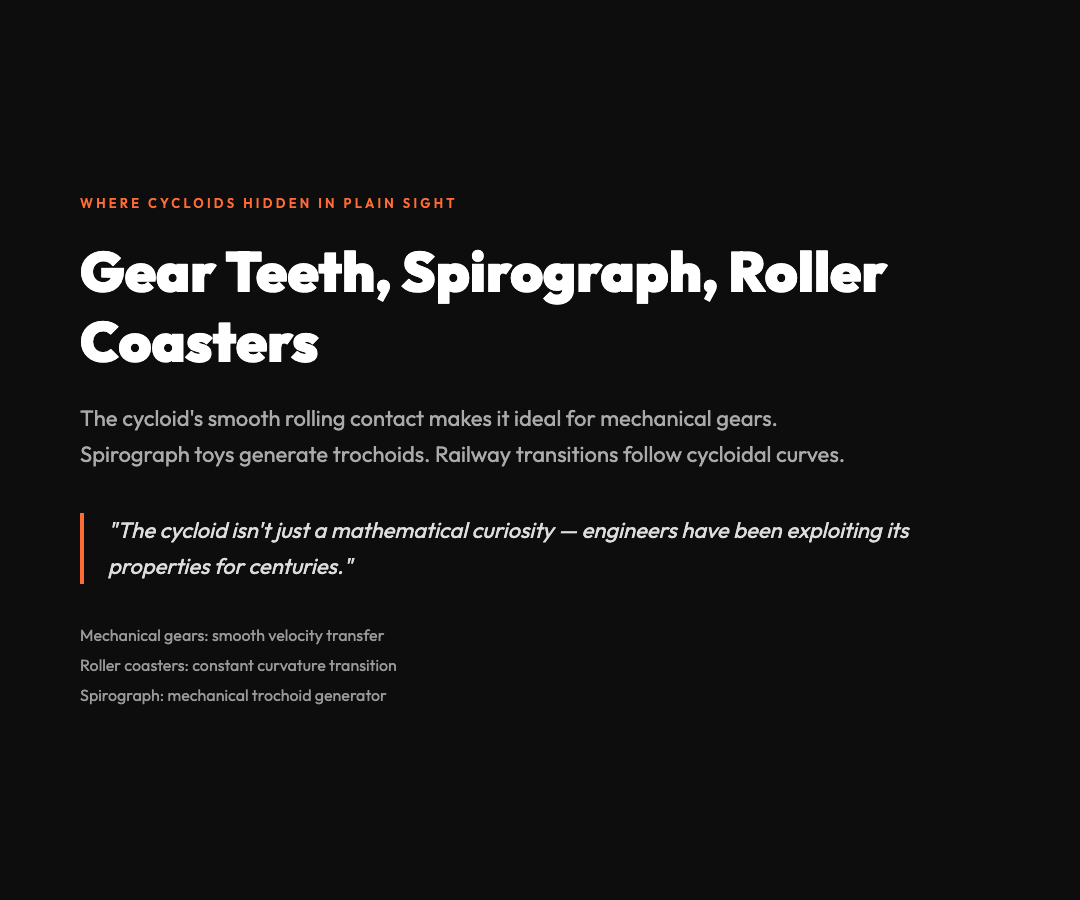
The cycloid isn’t just a mathematical curiosity — engineers have been exploiting its properties for centuries.
Gear teeth: Modern mechanical gears often use cycloidal curves for their teeth profiles. The shape allows smooth contact between gear teeth — constant angular velocity transfer without the jarring “thump” that square-toothed gears produce. The cycloid’s rolling contact is inherently smoother than other curves.
Architecture: The cycloid appears in arches and vaulted structures. The Brachistochrone problem’s solution — the inverted cycloid — gives the optimal curve for minimizing stress concentrations in arch construction. Less material, more strength.
Spirograph: That childhood art toy? It’s a mechanical trochoid generator. Rolling a smaller circle inside or outside a larger one, with a pen through a hole, produces hypotrochoids and epitrochoids — the beautiful looping patterns that look like flowers or mandalas. These are all relatives of the cycloid.
Railway tracks and roller coasters: The cycloid’s smooth acceleration profile makes it a natural shape for transitions in railway curves and roller coaster drops. A train entering a curve following a cycloidal transition experiences constant curvature change — no sudden jolt to the passengers.
Why This Visualization Matters
You can read about cycloids, or you can watch one form in real time. The Cycloid & Trochoid visualization on ElysiaTools lets you adjust the radius, move the tracing point from inside to outside the circle, and watch how the curve responds.
Some things you can explore:
- Watch how the cycloid’s cusps form at the moment the circle touches the ground
- See why curtate and prolate cycloids look so different despite coming from nearly identical setups
- Observe how changing the radius scales the curve — bigger wheel, bigger loops
- Reset and trace multiple curves simultaneously to compare
The mathematical elegance of the cycloid is best appreciated when you see it emerge in real time: the circle rolling, the point tracing, the curve growing one elegant arc at a time.
The Deeper Pattern
The cycloid connects to a theme that runs through much of mathematics: curves that seem simple often encode deep complexity. The cycloid’s equation is elementary — two lines of parametric math, no calculus required. But its properties — brachistochrone, applications in mechanical engineering, relationship to gear design — reveal layer after layer of hidden structure.
This is the cycloid’s lesson: don’t judge a curve by its generation mechanism. The path of a rolling wheel’s point seems like a party trick. Five centuries of mathematical attention suggests otherwise.
Try the Cycloid & Trochoid visualization and watch one of mathematics’ most prolific curves emerge, one rotation at a time.