Why Planets Don’t Fall Into the Sun — And What Happens When They Almost Do
There is a moment, every year, when the Earth is moving fastest in its orbit around the Sun. Not because anything pushes it. Because of geometry — the same geometry that Johannes Kepler spent decades untangling in the early 1600s, and that Isaac Newton later explained with a single inverse-square law.
The Orbital Simulation at ElysiaTools lets you watch this happen in real time. You can add planets, adjust their speeds, and flip on multi-body mode to watch gravity become unpredictable. It’s one of the cleanest interactive demonstrations of classical mechanics on the web.
But the most surprising thing about orbital mechanics isn’t the math. It’s how close the answer sits to something that should clearly be wrong.
The Intuition That Should Fail
Your gut tells you: things orbit because they’re moving sideways fast enough that gravity keeps pulling them around. That’s approximately right, but it papers over a deeper puzzle.
Gravity pulls straight inward. Every moment, Earth is falling toward the Sun. But it’s also moving sideways at about 30 kilometers per second. Gravity bends that sideways motion into a curve. The curve closes. You get an ellipse.
The intuition that “should” fail is this: shouldn’t the planet spiral in? Gravity is constantly pulling it inward, and there’s no friction in space. The planet should be losing energy, drifting closer, eventually crashing. Right?
It doesn’t. Because in a stable two-body system, gravity is a conservative force. It conserves mechanical energy. The planet speeds up as it falls toward the Sun (converting gravitational potential energy into kinetic energy) and slows down as it climbs away. The total energy — kinetic plus potential — stays exactly constant.
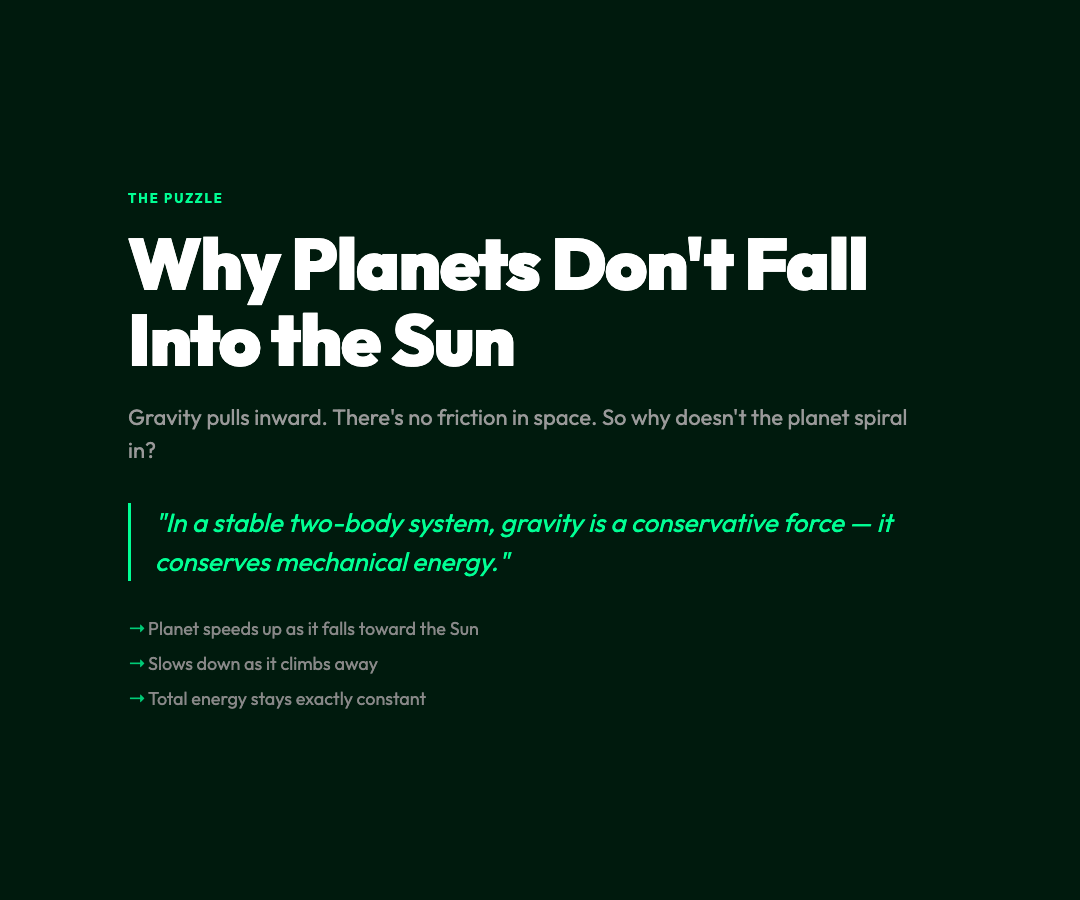
This is what the simulation’s energy chart shows. Watch it in two-body mode: the total energy line is flat. The planet speeds up and slows down, but never gains or loses energy overall.
Kepler’s Three Laws (and Why They Took 30 Years)
Kepler didn’t start with the idea that orbits are ellipses. He started with Mars — trying to explain Tycho Brahe’s decades of precise observations. He tried circles. He tried ovals. He spent years before landing on the ellipse, and even then it took him further years to articulate the full picture.
The three laws emerged in this order:
First Law: Planets move in ellipses, with the Sun at one focus. Not circles. This was the shock. Copernicus had assumed circles because circles were “perfect.” Kepler threw that out.
Second Law: A line from the planet to the Sun sweeps out equal areas in equal times. This is what gives you the speeding-up and slowing-down. When the planet is close to the Sun, it has to cover more angular distance per unit time to sweep the same area — so it moves faster. When it’s far out, it moves slowly. The simulation’s area-chart is a direct visualization of this.
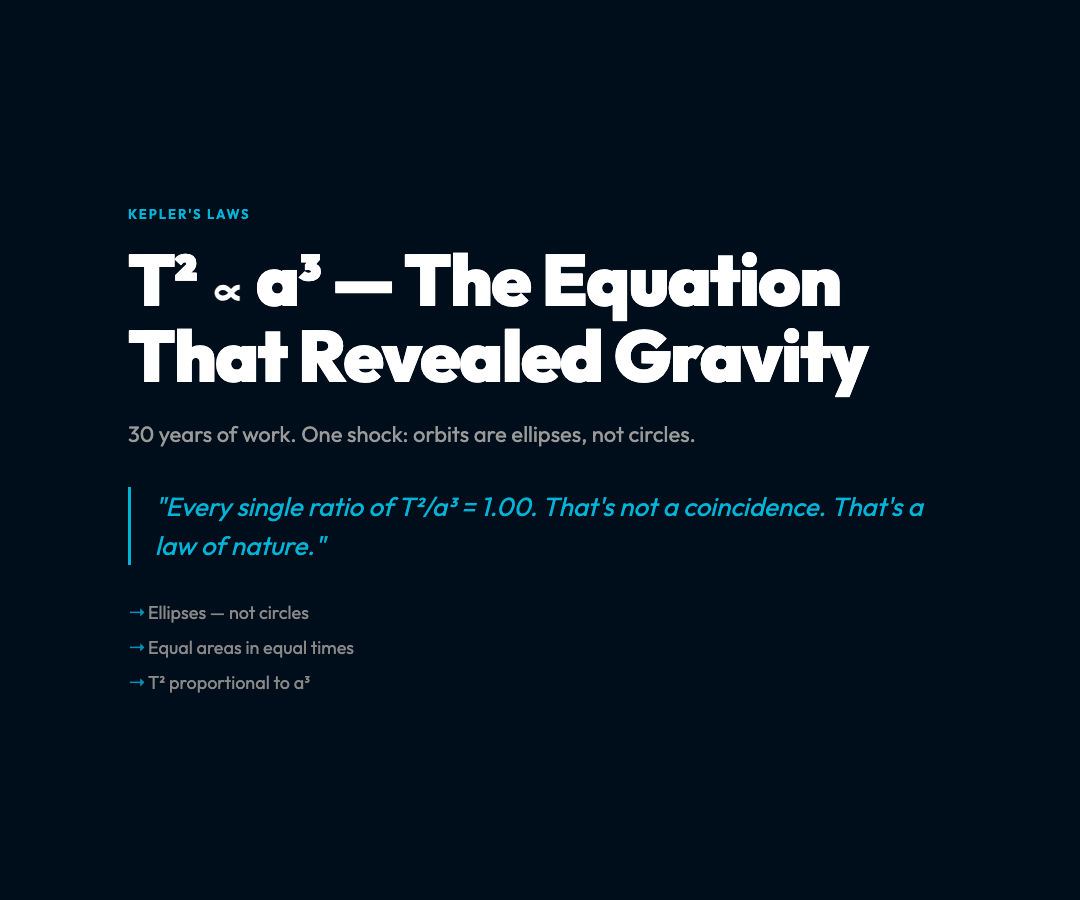
Third Law: The square of the orbital period is proportional to the cube of the semi-major axis. T² ∝ a³. This is the one that Newton later used to infer that gravity falls off as 1/r². If you know how the period depends on distance, you know how the force depends on distance.
Kepler’s third law for the planets in our solar system:
| Planet | Semi-major Axis (AU) | Orbital Period (years) | T² / a³ | |——–|———————|————————|———| | Mercury | 0.387 | 0.241 | 1.00 | | Venus | 0.723 | 0.615 | 1.00 | | Earth | 1.000 | 1.000 | 1.00 | | Mars | 1.524 | 1.881 | 1.00 | | Jupiter | 5.203 | 11.86 | 1.00 |
Every single one ratios to 1.00. That’s not a coincidence. That’s a law of nature.
Newton’s Synthesis
Newton looked at Kepler’s third law and asked: what kind of force produces this relationship?
If gravity is a force F pulling the planet toward the Sun, and the planet maintains a roughly circular orbit at distance r with speed v, then centripetal force requires:
F = mv²/r
For circular motion, v = 2πr / T, so:
F = m (4π²r) / (T²r) = m (4π²) / (T²)
From Kepler’s third law, T² ∝ r³, which means 1/T² ∝ 1/r³. Substituting:
F ∝ m / r²
Gravity falls off as the inverse square of distance. And it works both ways — the Sun pulls on the planet, but the planet also pulls on the Sun with equal and opposite force.
This is the leap: Kepler described what planets do. Newton explained why — with a force law that applies universally, to apples falling from trees and moons orbiting planets and the whole solar system holding together.
The gravitational constant G that appears in Newton’s formula F = GmM/r² wasn’t measured until Henry Cavendish in 1798, 71 years after Newton’s Principia. But the structure of the law — inverse square — was extractable from Kepler’s arithmetic alone.
The Vis-viva Equation: Energy in an Ellipse
Circular orbits are a special case. Most orbits — including Earth’s — are slightly elliptical. For an elliptical orbit, there’s a useful relationship between speed and distance at any point:
v² = GM (2/r − 1/a)
Where a is the semi-major axis (the orbit’s “size”), r is the current distance, and GM is the Sun’s standard gravitational parameter.
At perihelion (closest approach), r is small, so the 2/r term dominates — maximum speed. At aphelion (farthest point), r is large — minimum speed. The semi-major axis a determines the total energy of the orbit: a larger orbit means more total energy (less negative, if you account for the sign convention).
This equation is the energy conservation law for elliptical orbits, and it’s what the simulation computes internally at every time step.
Multi-body Chaos: Where the Clean Math Breaks Down
Everything above describes a two-body system — one planet, one star. The math is exact, the orbits are stable, and energy is conserved perfectly.
Add a second planet, and everything changes.
The planets tug on each other. Their orbits don’t close exactly — they precess. Small perturbations accumulate. Over long timescales, the system can become genuinely chaotic — not random, but unpredictable in practice because tiny differences in initial conditions lead to completely different outcomes.

This is what the simulation’s multi-body mode shows. Set two planets at similar distances, give them slightly different starting angles, and run it. The interaction isn’t dramatic at first. Then, over time, one planet gets flung outward or spirals inward. The system that looked stable turns out to be living on borrowed time.
Our own solar system has this problem. Astronomers have long studied whether the planets are stable over billions of years — whether Mercury might eventually get flung out or crash into Venus. The honest answer, confirmed by modern numerical simulations: we don’t know for certain. Mercury has a small but nonzero probability of instability over the next few billion years. The solar system is, in a precise mathematical sense, chaotic.
What the Simulation Actually Shows
The Orbital Simulation is worth spending time with. A few things to try:
Start with default settings and watch the energy chart. Confirm that total energy is flat in two-body mode. This is the cleanest demonstration of energy conservation in mechanics.
Adjust the velocity multiplier for a single planet. Set it below 1.0 and watch the orbit become more elliptical — the planet falls closer to the star before swinging back out. Set it above 1.0 and the orbit becomes more circular, eventually approaching escape velocity if you push it far enough.
Enable multi-body mode and watch the distance charts. Even with two planets at different orbital distances, the gravitational interaction shows up as oscillation in each planet’s distance from the star. The oscillation grows over time if the planets are close enough in mass and distance.
Enable chaos mode and reset — small changes in starting conditions produce dramatically different outcomes over long simulation times.
The Deeper Point
Orbital mechanics is a rare thing in science: a phenomenon where the math is exact, the predictions are precise, and the underlying physics is beautifully simple. F = GmM/r². That’s it. From that single expression, you derive Kepler’s laws, the vis-viva equation, escape velocity, the lot.
But the solar system is also a reminder that “simple laws” doesn’t mean “simple behavior.” Three bodies, interacting gravitationally, produce chaos that no amount of cleverness can fully predict. The laws are deterministic. The outcomes are not foreseeable over long horizons without numerical simulation.
The gap between a simple law and complex behavior is where much of modern physics lives — in turbulence, in ecosystems, in markets, in brains. Planets orbiting a star is the cleanest possible version of this gap. It’s worth understanding on its own terms, and it’s worth using as a baseline for everything else.