Why Your Perfume Bottle and an Airplane Use the Same Trick
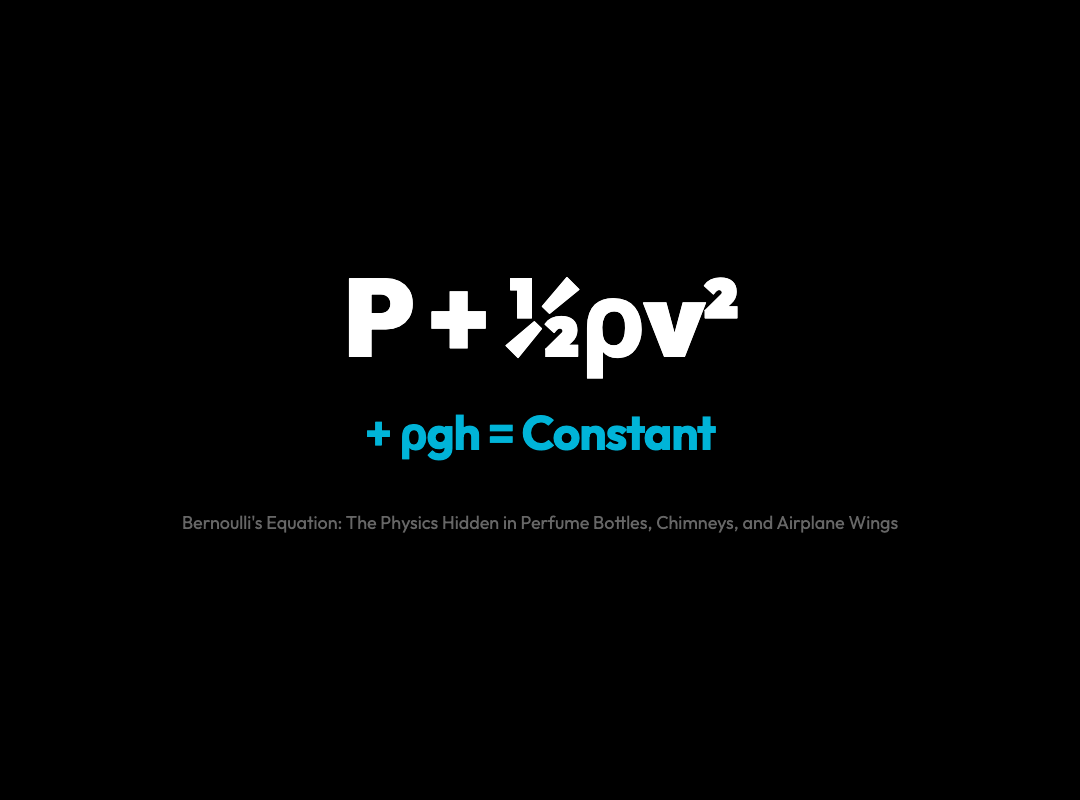
In 1738, Daniel Bernoulli published an equation that would eventually appear on cocktail napkins, physics cheat sheets, and the walls of every engineering classroom. The form is simple: P + ½ρv² + ρgh = constant. Pressure plus kinetic energy plus potential energy equals a constant along a streamline.
Most textbooks introduce it as an explanation for airplane lift. That’s technically correct, but it misses something important: Bernoulli’s principle is hiding in dozens of everyday objects, from the inhaler your doctor prescribed to thechimney on your roof. The same tradeoff between pressure and velocity that keeps a 737 airborne is also the reason a perfume atomizer works.
This piece is about that deeper point — and about an interactive visualization that lets you see it happen in real time.
The Core Tradeoff: Speed Costs Pressure
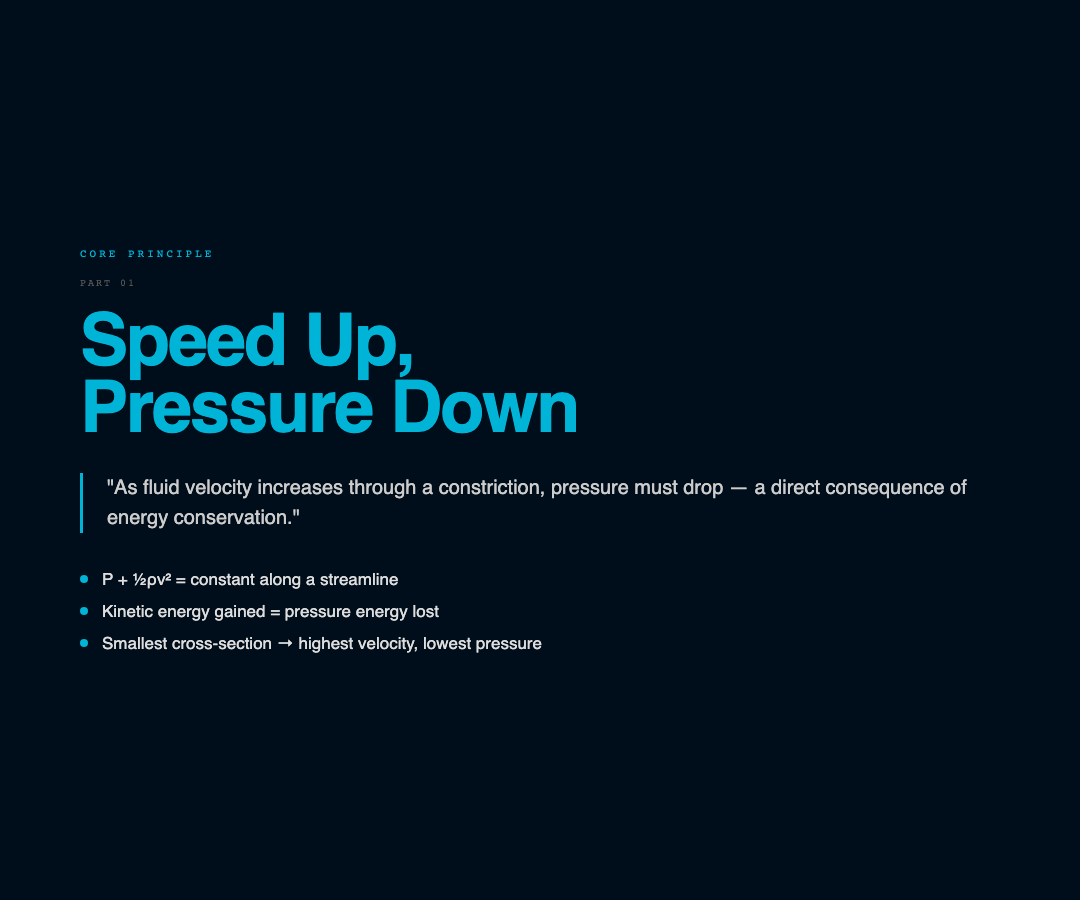
Before applications, the mechanism. Bernoulli’s equation describes energy conservation in fluid flow. For a horizontal pipe where elevation change is negligible, it simplifies to:
P + ½ρv² = constant
As fluid velocity (v) increases through a constriction, the pressure (P) must drop. This is the Venturi effect: a narrow section accelerates flow, and the accelerated fluid exerts less sideways push on the pipe walls — lower pressure.
The counterintuitive part is that the pressure drop is not caused by friction or turbulence. It is a direct consequence of converting pressure energy into kinetic energy. Faster flow means more kinetic energy per unit volume, which means less available as pressure.
This has a clean geometric prediction: in a Venturi tube, pressure is lowest where the cross-section is smallest and velocity is highest.
The Three Everyday Consequences Nobody Tells You About
1. The Perfume Atomizer
Squeeze the bulb of a perfume spray and air rushes through a narrow nozzle at high speed. Bernoulli’s principle says that high-speed air has lower pressure than the surrounding atmosphere. The pressure difference draws liquid perfume up a tiny tube and into the airstream, where it atomizes into droplets. No pump, no compressed gas — just a pressure gradient created by moving air.

2. The Chimney Draft
Wind blowing across the top of a chimney creates a zone of lower pressure relative to the room inside. This pressure difference pulls combustion gases up and out of the building. The taller the chimney and the stronger the wind, the stronger the draft. This is also why architectural drawings show chimneys taller than surrounding rooflines — the pressure drop at the tip needs enough height to overcome the buoyancy of the hot column inside.
3. The Inhaler
Medical nebulizers and asthma inhalers work on the same principle. A high-speed air stream passes over a narrow tube, creating a pressure drop that draws liquid medication upward. The liquid is then sheared into aerosol droplets small enough to reach the lower airways. The dose you receive is controlled by the geometry of the nozzle and the flow rate of the driving air — not by any mechanical pump.
All three share the same abstract structure: a constriction, a speed increase, a pressure drop, and a consequence that follows.
What the Visualization Shows
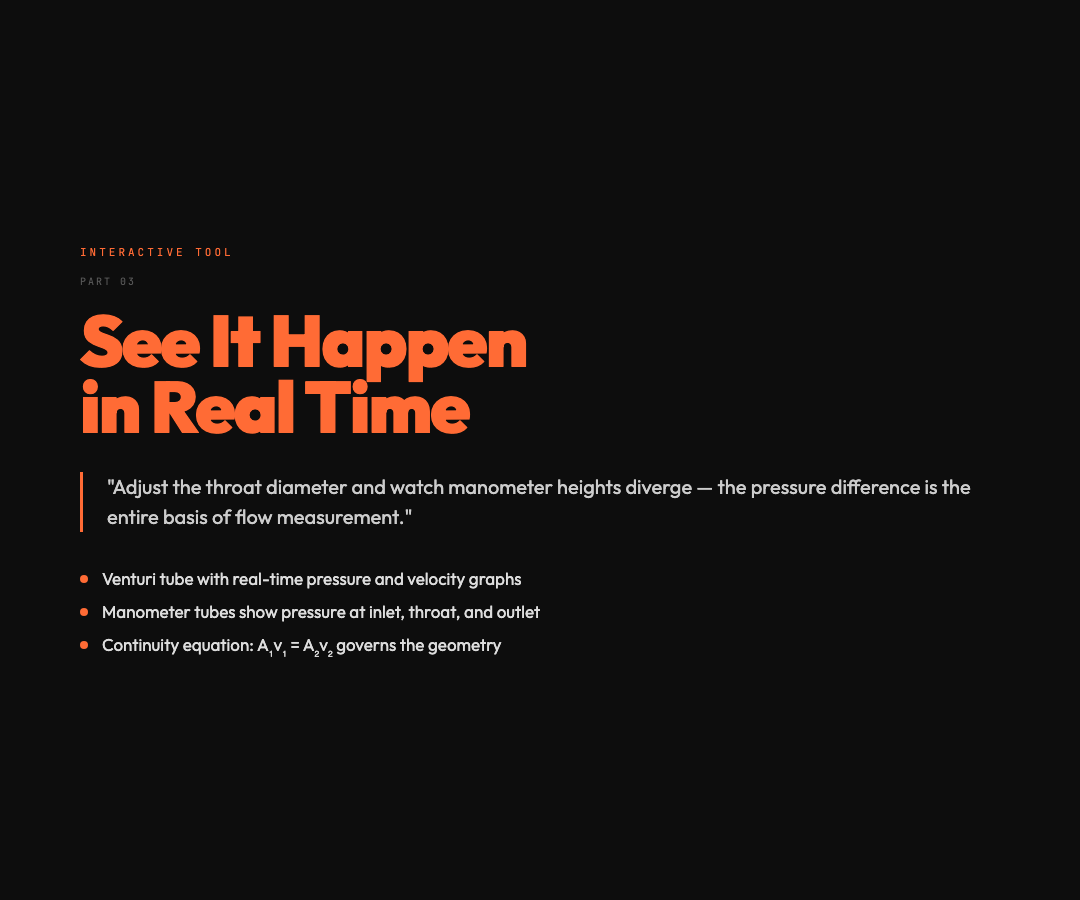
The Bernoulli equation visualization at ElysiaTools models a Venturi tube — a pipe that narrows and then expands back to its original diameter. You control:
– Inlet pressure and velocity – Throat diameter (the constriction) – Fluid type (water or air)
The display shows three synchronized views: a cross-section of the tube with color-coded pressure, a graph of pressure along the tube length, and a graph of velocity along the tube length. As you tighten the constriction, you watch the throat pressure drop in real time and the throat velocity climb proportionally.
The continuity equation (A₁v₁ = A₂v₂) governs the velocity change: cross-sectional area and velocity are inversely related. A halving of diameter quadruples the velocity (since area scales with diameter squared). Bernoulli’s equation then gives the corresponding pressure drop.
You can also toggle manometer tubes — straight vertical pipes connected to the tube at three points. The fluid in each manometer rises to a height proportional to the local pressure. This is how engineers actually measure pressure in industrial Venturi flow meters: the height difference directly reads out the pressure difference, from which the flow rate follows.
The Equation Behind the Lift Claim
Back to airplanes, briefly. An airplane wing is shaped so that air travels faster over the curved upper surface than the flatter lower surface. Faster flow on top means lower pressure above the wing. The pressure difference between top and bottom is the net upward force — lift.
The same principle applies to a rotating baseball: the ball’s spin deflects nearby air, speeding up one side and slowing the other, creating a pressure asymmetry that curves the trajectory. This is the Magnus effect, a Bernoulli relative.
These are not different physics. They are the same equation applied to different geometries. The Venturi tube makes the tradeoff visible and quantifiable because the geometry is controlled. Wings and spinning balls introduce turbulence, boundary layer separation, and three-dimensional flow effects that complicate the picture. But the core mechanism — speed up, pressure drop — remains the same.
The Limitation That Makes It Honest
Bernoulli’s equation assumes inviscid (frictionless) flow, incompressible fluid, steady state, and energy conservation along a single streamline. Real fluids have viscosity. Real flows can become turbulent. Real wings stall at high angles of attack. The equation is a model, not a physical law — it describes what would happen in an idealized world where energy is perfectly conserved.
The visualization lets you explore where the model holds and where it starts to break down. High velocities approach compressible flow regimes; very narrow constrictions introduce turbulent losses; sudden expansions cause pressure recovery to be incomplete. These are not failures of the physics — they are the boundaries where the assumptions stop holding, and they are worth understanding precisely because the idealized case is so clean.
The Takeaway
One equation, three centuries old, explains perfume bottles, chimneys, inhalers, wings, and spinning balls. The common thread is a pressure-velocity tradeoff that is almost too clean to be true. It becomes less mysterious once you see it happen in a controlled geometry, which is what the Venturi tube visualization provides.
Try adjusting the throat diameter slowly from wide open to nearly closed. Watch the manometer heights diverge. That gap you see — that pressure difference — is the entire basis of a huge fraction of the engineered world.
Explore the interactive Bernoulli equation visualization at ElysiaTools.