The Experiment That Proves You’re Not Watching Reality
When observation doesn’t just measure — it creates
Walk up to a beach on a moonless night and throw pebbles at a wall with two gaps in it. You know what happens: each pebble goes through one hole or the other, and on the ground beyond the wall you get two clusters of marks — one behind each gap.
Now replace the pebbles with light. You get the same result: two bright regions on the other side.
But replace the light with electrons — one at a time — and something deeply strange happens. Even though each electron arrives at the detector as a single, indivisible dot, over time the accumulated dots on the screen form a pattern of alternating bright and dark bands. That’s an interference pattern. It only appears when something wave-like passes through both slits simultaneously.
This is the double slit experiment. Richard Feynman called it “a phenomenon which is impossible, absolutely impossible, to explain in any classical way, and which has in it the heart of quantum mechanics.”
The Interactive Setup
The Double Slit Quantum Trajectory visualization lets you run this experiment yourself — electrons one at a time, a particle detector you can toggle on and off, and a live probability distribution building up on the screen.
The three key components:
– Electron gun: Fires single electrons at configurable energy levels (de Broglie wavelength from 2 pm for protons to 150 pm for slow electrons) – Double slit barrier: Configurable slit separation (d) and slit width (a) – Path detector: Toggleable sensor that measures which slit each electron passes through
Without the detector enabled, you watch the interference pattern slowly emerge as hundreds of electrons accumulate. With the detector on, you can definitively say which slit each electron went through — and the interference pattern vanishes, replaced by two classical clusters.
The Central Mystery: Measurement as Creation
Here’s what makes this hard to accept. When the path detector is off:
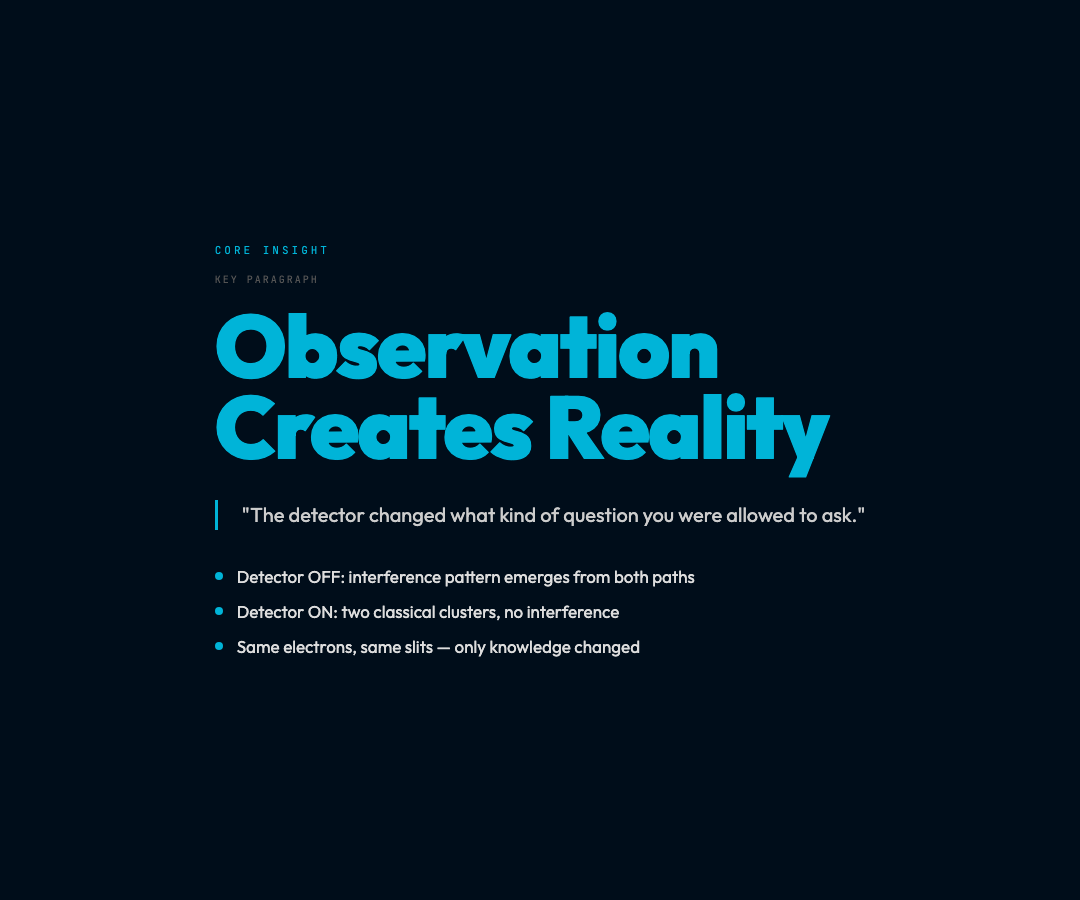
– Each electron goes through both slits (as a wave) – The electron’s probability amplitude splits, passes through both slits, and interferes with itself – The result on screen: interference bands
When the path detector is on:
– Each electron goes through exactly one slit (as a particle) – The wave function “collapses” at the moment of measurement – No interference is possible because there is only ever one path – The result on screen: two classical clusters
The detector didn’t disturb the electrons. The detector didn’t change the slits. The detector changed what kind of question you were allowed to ask. And the universe answered accordingly.
This is the measurement problem in its purest form. In quantum mechanics, the answer you get depends on the question you choose to ask — not just on the physical setup of the system.
The Math: de Broglie Wavelength
Every particle has a wavelength:
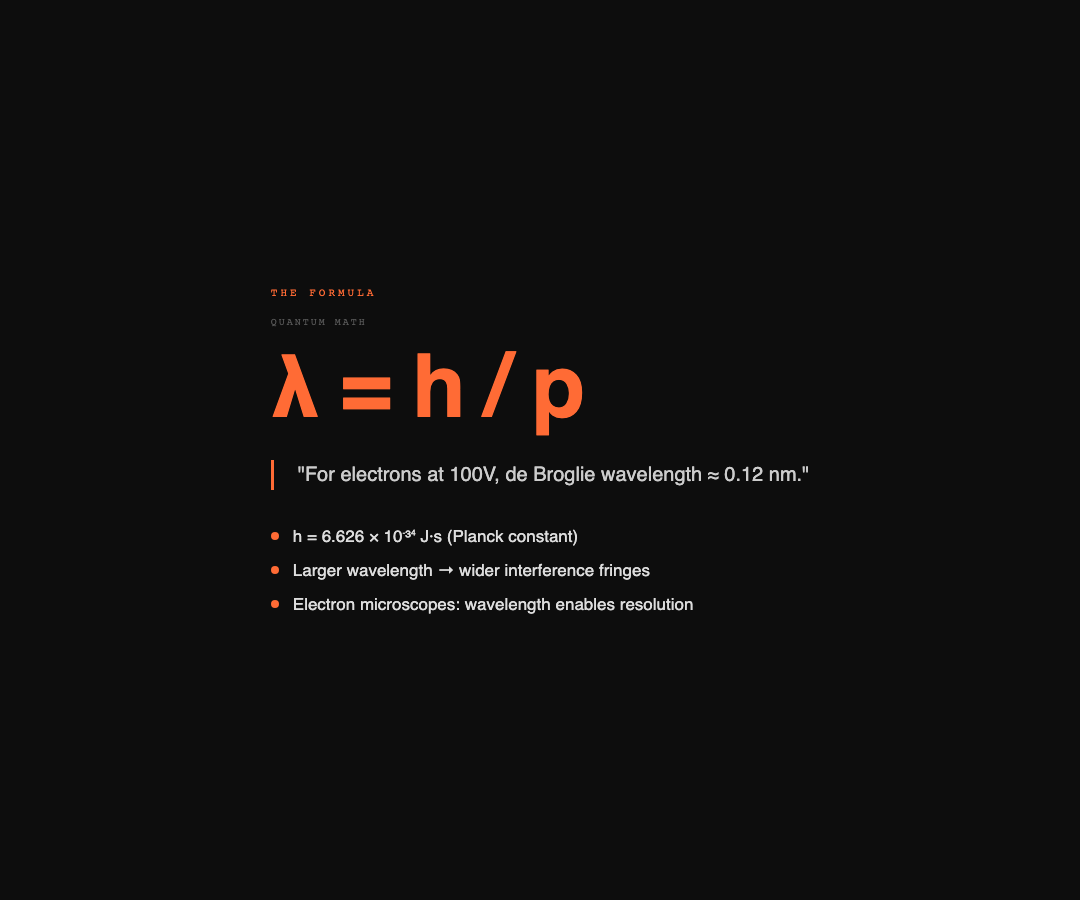
λ = h / p
Where h is Planck’s constant (6.626 × 10⁻³⁴ J·s) and p is momentum. For an electron accelerated through 100V, the de Broglie wavelength is about 0.12 nm — comparable to the spacing between atoms in a crystal. This is why electron microscopes can see structures far smaller than optical microscopes: the probe’s wavelength sets the resolution limit.
In the visualization, you can switch between preset particles (electron at 50 pm, slow electron at 150 pm, proton at 2 pm) and watch how the interference pattern spacing changes. Larger wavelength (slower particle) means wider pattern fringes on the screen. This is a direct test of wave-particle duality you can run in your browser.
What “Trajectory” Means in Quantum Mechanics
The visualization’s name — “Quantum Trajectory” — deserves clarification. Classical trajectories are deterministic: given initial position and momentum, you can compute where a particle will be at any future time.
Quantum trajectories are something different. In the Bohmian interpretation of quantum mechanics, particles have definite positions at all times and follow definite paths guided by the quantum wave function. The trajectories you see in the visualization are calculated from the wave function — they show what the electron’s path would look like if it had one, given the boundary conditions of the experiment.
This is not the only interpretation. The Copenhagen interpretation says the question “what path did the electron take?” is not physically meaningful until a measurement is made. Both interpretations make identical predictions for observable results — they differ on what “reality” consists of when no one is looking.
Why This Matters Beyond the Physics Lab
The quantum interference principle underlies two transformative technologies:
Electron microscopy — By using electron waves instead of visible light, electron microscopes achieve resolution down to the atomic scale (~0.05 nm). This is only possible because the de Broglie wavelength of accelerated electrons is orders of magnitude smaller than optical wavelengths. Every electron microscope is a practical application of double slit physics.
Quantum computing — Quantum computers process information using quantum bits (qubits) that can exist in superposition states. The entire computational advantage comes from interference: carefully preparing quantum states so that wrong answers cancel out and right answers amplify. A quantum algorithm is, at its core, a procedure for engineering interference patterns in qubit state space.
The Question No One Can Answer Satisfactorily
Flip the detector on and off. Watch the screen. The interference pattern appears and disappears.
The detector didn’t change the physical environment. The electrons were the same, the slits were the same, the screen was the same. Only knowledge changed — only what you chose to measure.
This is why Feynman also said: “If you think you understand quantum mechanics, you don’t understand quantum mechanics.”
The double slit experiment is the clearest window we have into the fact that quantum reality does not simply exist — it responds to our questions. What that says about the nature of reality remains, after a century, an open question.
Run the double slit experiment with different particle types and detector settings. Watch what accumulates on the screen. Then ask yourself: what was the electron doing when no one was watching?