The 1678 Insight That Still Explains Light, Sound, and Water in One Diagram
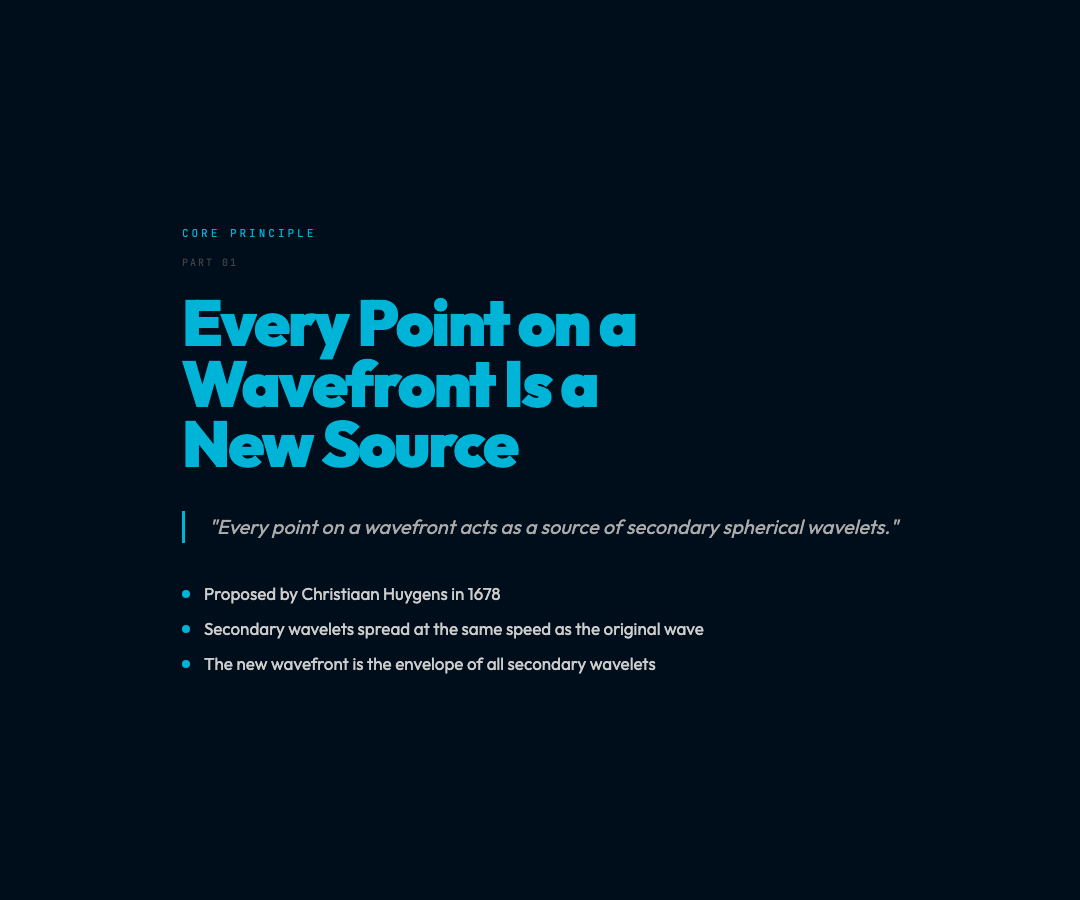
In 1678, Christiaan Huygens proposed an idea so simple it sounds like a party trick: every point on a wavefront is itself the source of a new spherical wave. That’s it. And yet from that single notion, you get a unified picture of why light bends around corners, why echoes work, and why your voice carries farther on foggy nights.
The interactive visualization at Huygens’ Principle on ElysiaTools lets you watch this idea animate in real time — toggling planar versus circular wavefronts, adjusting point density, and observing how the envelope of all those secondary wavelets traces the new wavefront. It’s one of those rare tools that makes an abstract principle tangible.
The Core Idea in Plain Language
Imagine a pebble dropped into still water. The circular ripples spreading outward — that’s your wavefront, the leading edge of the disturbance. Huygens’ bold claim was that you don’t need to think of the whole ripple as one thing. Instead, treat every single point along that ripple as a tiny new pebble, each generating its own circular wave. The new ripple that emerges — the one you’ll see a moment later — is simply the envelope, the outer boundary, of all those overlapping circles.
The math is straightforward. For a planar wavefront, each point generates a secondary wavelet described by:
r = v × t
where r is the radius of each secondary sphere, v is wave speed, and t is elapsed time. The new wavefront is the surface tangent to all these spheres — a geometric construction that yields exactly what you observe physically.
For a circular wavefront (from a point source), the same principle applies but the secondary wavelets are also circular, and their envelope produces the next circular wavefront — maintaining the curvature but expanding outward.
Why Planar vs. Circular Matters
The two fundamental wavefront types behave differently under Huygens’ construction:
Planar wavefronts — imagine a line of synchronized oscillators — generate secondary wavelets whose envelope remains planar as the wave propagates. This models light from a distant source arriving at Earth as essentially flat wavefronts. The geometry is elegant: parallel lines stay parallel.
Circular wavefronts — from a point source like a pebble or a spark — generate expanding circles whose envelope is another circle. The curvature gradually decreases as the radius grows large, which is why circular ripples look straighter as they move outward from the source.
The ElysiaTools visualization lets you switch between these modes and watch how the secondary wavelets (shown as faint circles emanating from each point on the primary wavefront) interfere constructively at the envelope and cancel elsewhere.
Three Phenomena, One Principle
Here is where Huygens’ idea earns its reputation as one of physics‘ most economical explanations.
Diffraction: When Waves Bend Around Corners
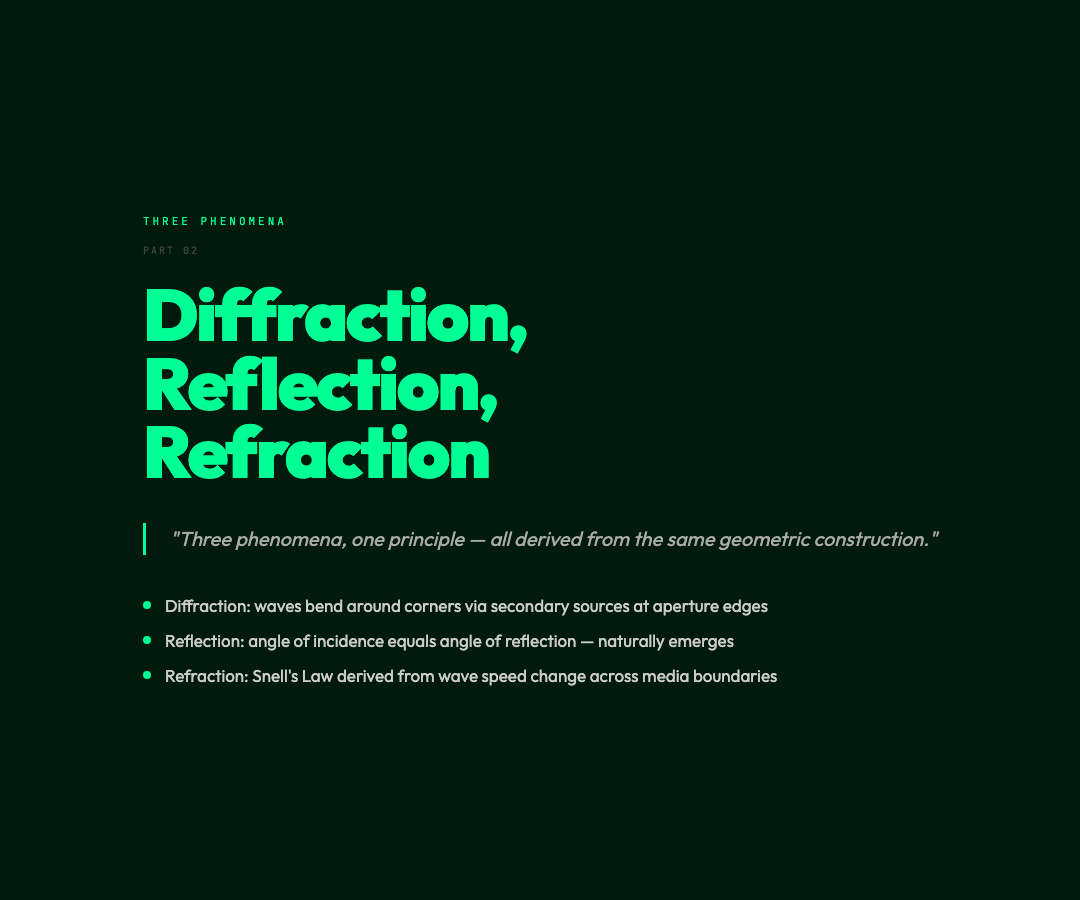
When a wave encounters an obstacle with a small opening, Huygens’ principle explains why the wave spreads out beyond the opening rather than casting a sharp shadow. Every point in the aperture becomes a point source of secondary wavelets, and these propagate outward into the region that would otherwise be shadowed. The smaller the opening relative to the wavelength, the more pronounced the diffraction.
This is why radio waves can reach around buildings and why sound bends around doorways. The visualization shows this clearly in planar mode: as the wave passes through a gap, the secondary wavelets originating at the gap edges fan out, tracing a circular new wavefront beyond the obstacle.
Reflection: The Law of Angles
When a planar wavefront strikes a flat surface, each point on the wavefront hits the surface at a different time. Apply Huygens’ construction: each point becomes a secondary source, and the reflected wavefront emerges as the envelope of all these reflections. The geometry forces the angle of incidence to equal the angle of reflection — a result that drops out naturally, not as an assumption.
Refraction: Why Straws Look Bent in Water
When a wave crosses from one medium to another — light entering water, or sound crossing a temperature gradient — its speed changes. Under Huygens’ construction, the points where the wavefront first enters the new medium slow down immediately, while the rest of the wavefront continues at the original speed. The envelope tilts, producing a bent wavefront and the phenomenon we call refraction, governed by Snell’s Law:
sin(θ₁)/sin(θ₂) = v₁/v₂
Huygens derived this from his principle, not the other way around.
What the Visualization Reveals
The ElysiaTools Huygens’ Principle tool is revealing precisely because it separates each component of the principle visually:

– The original wavefront (blue, default on) shows the incoming wave – The secondary wavelets (red/orange arcs) show each point source in isolation – The envelope (dashed red line) shows the resulting new wavefront
Toggle these independently and you can see exactly how the envelope forms — watching the tangent line or curve emerge from the interference of many individual circular arcs. This is the geometric heart of the principle, and most textbooks show a static diagram. Watching it animate is different in kind.
Adjusting the number of points reveals why the construction requires dense sampling: with too few points, the envelope is polygonal and inaccurate. As you increase the density, the envelope smooths into a true curve — a nice visual argument for why calculus (rather than discrete geometry) is the natural language of wave physics.
Why This Still Matters
Huygens’ principle was later superseded in its details by Fresnel’s refinement (which added phase and amplitude considerations), and again by the full Maxwellian electromagnetic account of light. But as a geometric intuition for wave behavior, it remains unmatched in its explanatory power.
In signal processing, the principle underlies the Huygens-Fresnel principle used in acoustic modeling, antenna design, and seismic imaging. In optics, it justifies the use of wavefront reconstruction in holography. In oceanography, it explains how ocean swells propagate across thousands of kilometers.
The French mathematician Jacques Hadamard reportedly called it one of the most beautiful examples of a physical intuition that precedes its rigorous justification. That feels right. You don’t need the math to believe it — the visualization makes you feel it first.
A Simple Idea That Refuses to Be Old
What strikes me most about Huygens’ principle is how it models scientific thinking at its best: an observation so clear it seems obvious only in retrospect. Every point on a wavefront acts as a new source. Once you accept that, diffraction, reflection, refraction, and interference all follow as corollaries.
The ElysiaTools visualization doesn’t just demonstrate this — it lets you play with it. Change the wave speed, watch the secondary wavelets expand faster or slower. Toggle the envelope on and off to see what the new wavefront would be without it. The principle becomes immediate and empirical rather than something you take on faith from a textbook diagram.
It’s also a reminder that many of the most powerful ideas in physics are, at their core, geometric. The world is full of points doing simple things, and the emergent patterns — waves, fields, forces — are the envelope of all those individual contributions.