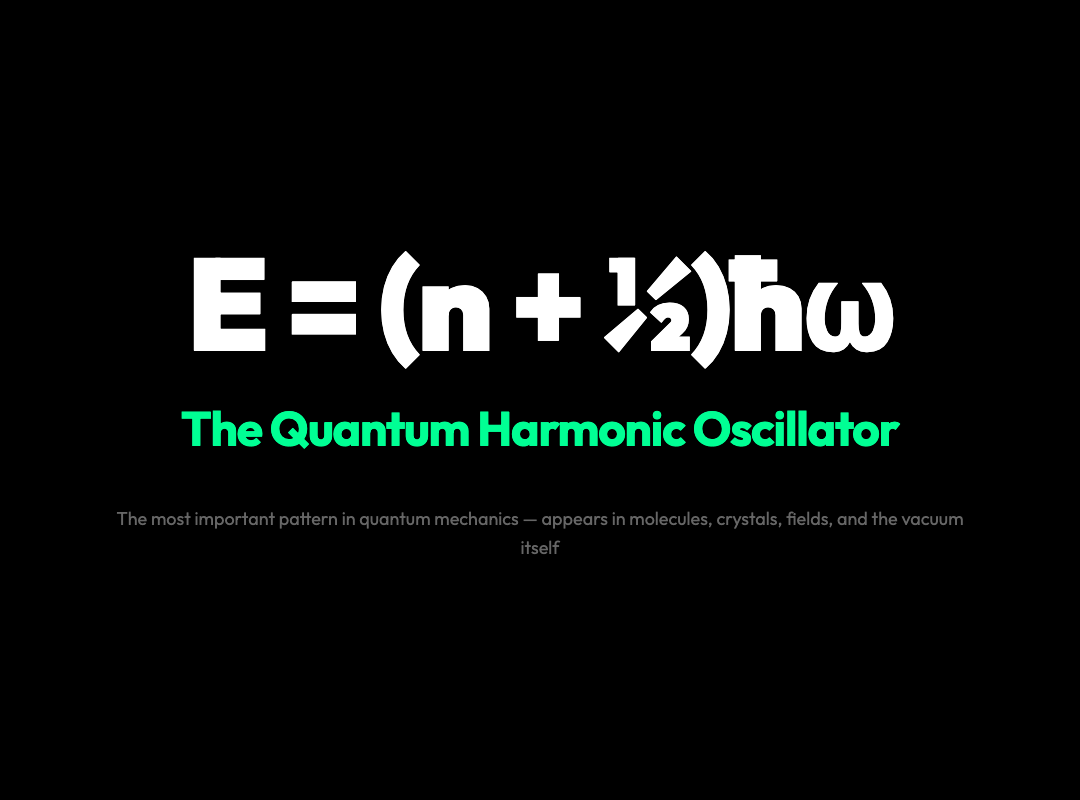
The Oscillator That Rules the Universe: Why Every Quantum System Eventually Becomes a Harmonic Pendulum
In the spring of 1926, Werner Heisenberg and Erwin Schrödinger published competing formulations of quantum mechanics. Heisenberg’s matrix mechanics was algebraic and abstract. Schrödinger’s wave mechanics had something else: pictures. You could see the electron doing something.
But both men were immediately confronted with a problem that neither formulation could avoid. Almost every real quantum system — a molecule vibrating, a crystal lattice shaking, a light wave bouncing between mirrors — eventually reduces to the same simple mathematical structure. Two walls. A particle between them. And a force that pulls harder the further you push.
This is the quantum harmonic oscillator, and it is arguably the most important system in all of quantum physics.
Why the Harmonic Oscillator Shows Up Everywhere
The quantum harmonic oscillator isn’t a single physical system. It’s a pattern that nature keeps rediscovering.
The mathematics starts with a potential energy shaped like a parabola: V(x) = ½mω²x². In plain English: the further the particle strays from the center, the more energy it accumulates, and the more aggressively it gets pushed back. It’s a spring. Every spring.
This shape appears because of a fundamental principle called Taylor expansion: almost any potential energy curve, near its minimum, looks like a parabola. The bottom of any stable potential well is approximately quadratic. Molecules vibrate. Crystals vibrate. The vacuum itself — according to quantum field theory — is filled with oscillating fields that, when quantized, become harmonic oscillators.
This means the harmonic oscillator isn’t an approximation of reality. It is the local truth of almost every physical system near equilibrium. You can’t escape it, which is exactly why it’s so useful to study.
The Equation That Makes physicists Cry (in a Good Way)
The time-independent Schrödinger equation for the harmonic oscillator gives:
Hψ = Eψ
Where the Hamiltonian operator is:
H = -(ħ²/2m) · d²/dx² + ½mω²x²
Two terms: kinetic energy (the derivative squared) plus potential energy (the parabola). Solving this equation yields wave functions that are among the most beautiful in all of physics.
The energy levels fall on a perfectly equally spaced ladder:
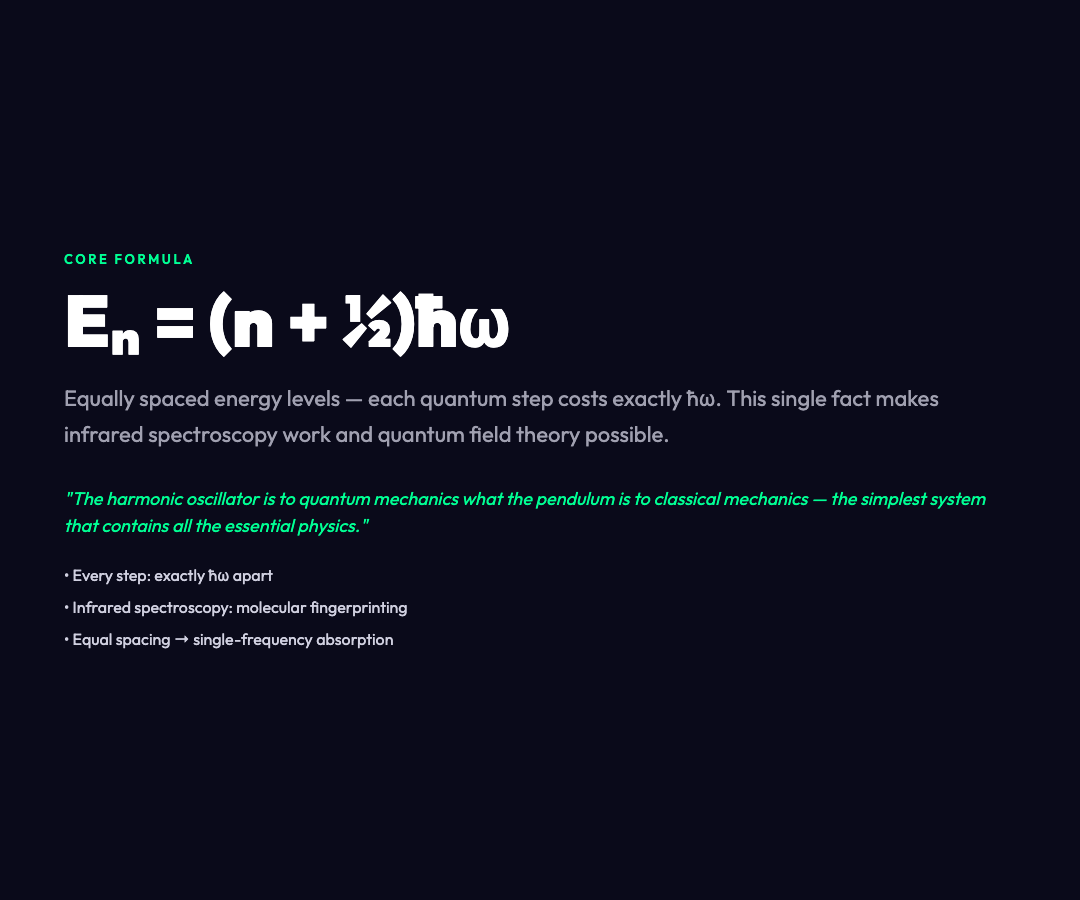
Eₙ = (n + ½)ħω
n = 0, 1, 2, 3… Each step is exactly ħω apart. This is unique. In the hydrogen atom, energy levels get closer together as you go up. In the harmonic oscillator, they are perfectly evenly spaced. That even spacing has an extraordinary consequence: a single frequency ω can absorb or emit energy in exactly one quantum at a time.
For a molecule, this means infrared spectroscopy works the way it does. For a crystal, it explains phonons. For quantum field theory, it means the vacuum can be thought of as a collection of harmonic oscillators, each mode of the field contributing ½ħω of zero-point energy — even in complete darkness.
The Zero-Point Energy: The Universe’s Minimum Price
The ground state (n = 0) has energy E₀ = ½ħω. Not zero.
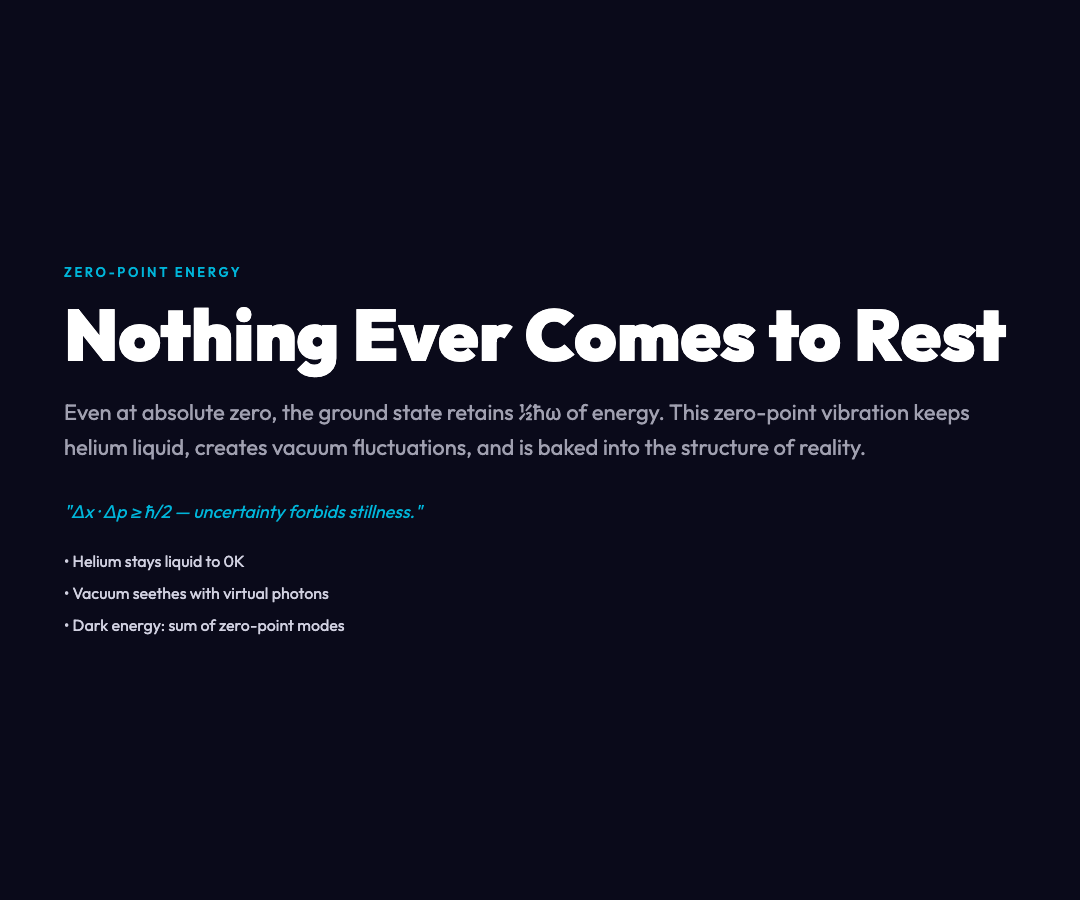
This is zero-point energy: the minimum energy a quantum system must have, even at absolute zero. You can’t cool a molecule to perfect stillness. The uncertainty principle won’t allow it.
Δx · Δp ≥ ħ/2
If a particle had exactly zero kinetic energy, you’d know its position perfectly. The uncertainty principle forbids this. The particle must always retain some irreducible motion.
- Zero-point energy is not a theoretical curiosity. It explains:
- Why helium remains liquid at atmospheric pressure all the way down to absolute zero
- Why helium-3 doesn’t freeze no matter how cold you go (nuclear spin statistics also play a role)
- Why the ground state of the electromagnetic field is not nothing — it’s a seething sea of virtual photons
- Why quantum field theory predicts dark energy as a kind of宏观 zero-point energy of the vacuum
The Wave Functions: Hermite Polynomials Meet Gaussian Envelopes
The stationary states of the harmonic oscillator are products of Hermite polynomials and a Gaussian envelope:
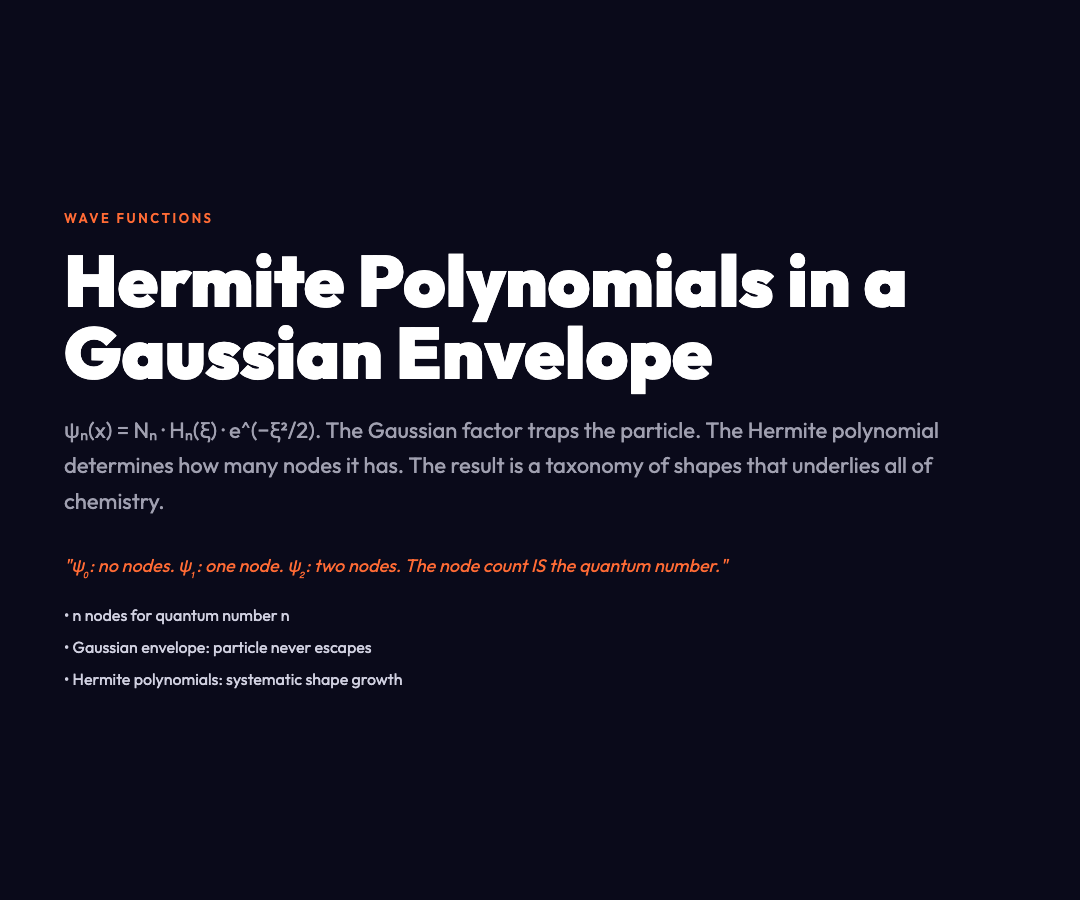
ψₙ(x) = Nₙ · Hₙ(ξ) · e^(-ξ²/2)
Where ξ = √(mω/ħ) · x is a dimensionless coordinate and Hₙ is the nth Hermite polynomial.
The Gaussian factor e^(-ξ²/2) is crucial. It ensures the wave function decays smoothly at large distances — the particle can never escape to infinity, unlike in the hydrogen atom where the electron has a finite escape energy. In the harmonic oscillator, the walls are infinitely high: there is no escape.
Each state has exactly n nodes — points where ψ = 0. The ground state (n = 0) has no nodes. The first excited state (n = 1) has one node at the center. The second has two, symmetric around the center. The pattern grows systematically.
Why Equal Spacing Changes Everything
The equidistant energy levels of the harmonic oscillator produce something remarkable: when you drive the system with light or any oscillating field, it absorbs energy only at one specific frequency.
For a molecule, this means infrared light of frequency ω can push the molecule from n = 0 to n = 1, or from n = 1 to n = 2, but nothing else. The absorption spectrum is a series of sharp lines at exactly ħω, 2ħω, 3ħω… — though due to anharmonicity (the actual potential is not perfectly parabolic), real molecular vibrations show slight departures from equal spacing that reveal molecular structure.
This is the physical basis of infrared spectroscopy: identifying molecules by the frequencies of light they absorb. Every molecule has a unique vibrational fingerprint, and that fingerprint is, at its core, a harmonic oscillator spectrum.
The Classical Limit: When Quantum Becomes Newton
At high quantum numbers (n → ∞), the quantum harmonic oscillator converges toward its classical counterpart.
In classical physics, a harmonic oscillator spends most of its time at the turning points — where velocity is lowest and the particle lingers. In quantum mechanics, the probability density for large n concentrates near the classical turning points. The correspondence principle is satisfied: quantum mechanics reduces to classical mechanics in the appropriate limit.
This is deeply satisfying: the same equation governs both regimes, just expressed differently.
Quantum Field Theory’s Hidden Foundation
Here is where the harmonic oscillator becomes truly extraordinary.
In quantum field theory, every point in space is assigned a harmonic oscillator — not a particle, but a field value that can vary. The electromagnetic field at each point in space is one of these oscillators. The electron field is another. Vacuum, in this picture, is not empty. It is each of these oscillators sitting in their ground state, contributing ½ħω of energy per mode.
When you hear that quantum field theory predicts dark energy from vacuum fluctuations, this is the mechanism: a sum over all possible field modes, each contributing a tiny zero-point energy. The calculation gives a vacuum energy density that is enormous — too enormous by many orders of magnitude. This discrepancy (the cosmological constant problem) remains one of the deepest unsolved problems in theoretical physics.
Try It Yourself
The Quantum Harmonic Oscillator interactive visualization on ElysiaTools lets you:
- Select any quantum number n from 0 to your chosen maximum and watch the corresponding wave function and probability density
- See the real part of the wave function oscillate in time, revealing the phase structure Hermite polynomials encode
- Compare the quantum probability distribution with the classical velocity distribution for the same energy
- Observe how many nodes each state has and how they grow systematically with n
- Watch superposition states interfere, producing beats and oscillations that have no classical counterpart
The visualization shows both the stationary states and their time evolution — the latter reveals that while the energy eigenstates are static in shape, their phase rotates at frequency ω, and superpositions produce probability densities that slosh back and forth at difference frequencies.
The Oscillator That Never Stops
The quantum harmonic oscillator is a system that earns its status as the foundation of quantum physics. Its clean mathematics, its universal appearance across atomic, molecular, condensed matter, and field physics, and its beautiful wave functions make it the clearest demonstration of how quantum mechanics differs from classical mechanics.
And its most profound lesson is this: in the quantum world, nothing ever truly comes to rest. Even in the lowest possible energy state, the system retains an irreducible restlessness — a zero-point vibration that is not a limitation of measurement, but a fundamental feature of reality itself.
The universe, at its roots, is always humming.