The Invisible Waves That Connect the Modern World
In the summer of 1865, James Clerk Maxwell published a set of eight equations that would, within two decades, predict something no one had ever seen. The equations described how electric and magnetic fields interact — how charges create fields, how changing fields induce currents, how fields propagate through space. And buried in the mathematics was a startling conclusion: disturbances in these fields should travel at exactly the speed of light. Light itself, Maxwell realized, must be an electromagnetic wave.
No one had proven this yet. The technology to generate and detect these waves did not exist. Maxwell died in 1879 without seeing his prediction confirmed. It would fall to Heinrich Hertz, fifteen years later, to build the first radio wave transmitter in a Karlsruhe laboratory — a pair of metal spheres separated by a gap, charged and discharged in rapid succession. Across the room, a loop of wire with a tiny gap showed sparks when the spheres fired. Hertz had detected electromagnetic radiation propagating through air.
Everything wireless — every radio, every WiFi router, every mobile phone, every satellite link — traces its lineage to that Karlsruhe laboratory. And every one of those systems obeys the same underlying mathematics Maxwell first wrote down.
What an Electromagnetic Wave Actually Is
An electromagnetic wave is a self-propagating disturbance in the fabric of electric and magnetic fields. Unlike sound waves or ocean waves, which require a medium to travel through, EM waves need nothing. They move through vacuum as easily as through air or glass.
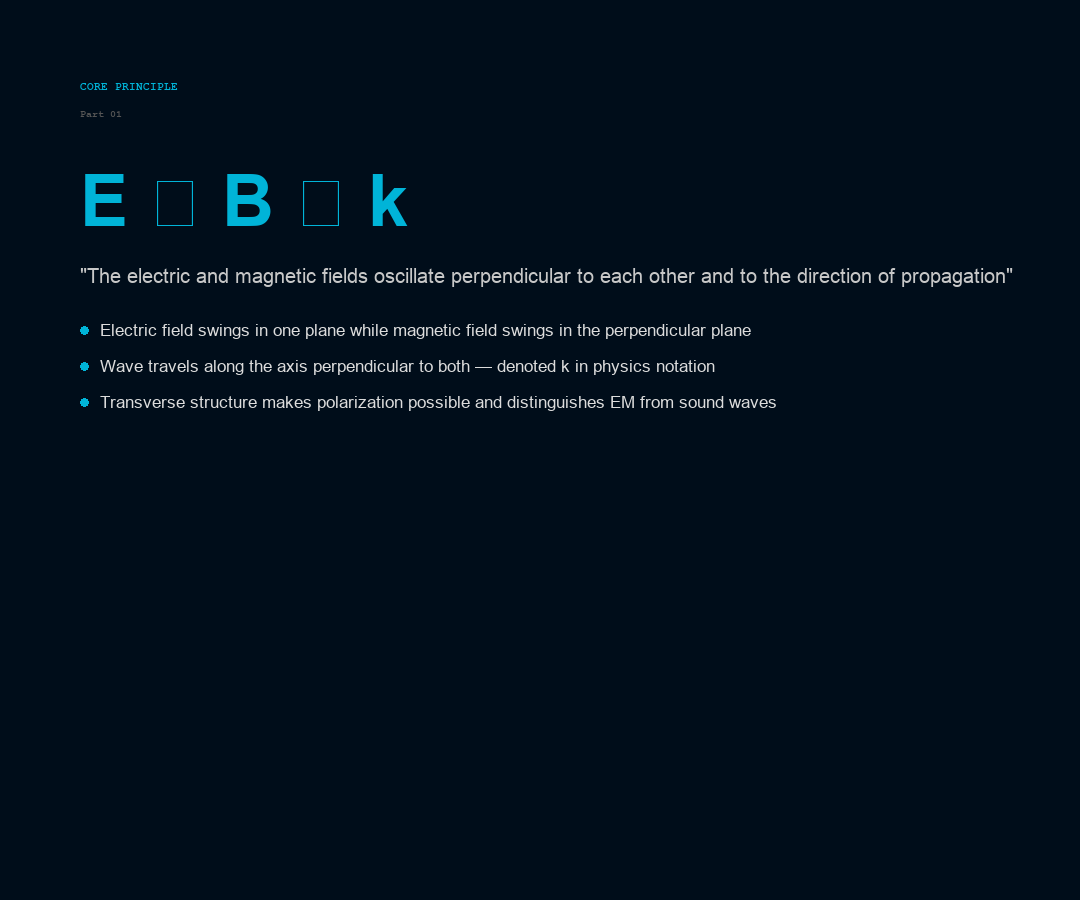
The structure of a single wave is elegant and strict. The electric field E oscillates in one direction — say, vertically. The magnetic field B oscillates perpendicular to that — horizontally. The wave itself travels in a direction perpendicular to both, like a arrow pointing forward out of a spinning coin. Physicists call this “transverse” structure: the oscillations are sideways to the direction of travel.
E and B are locked together. They reach their maximum strength at the same instant and cross zero at the same moment. Their amplitudes are not independent — at any point in space, E = cB, where c is the speed of light. This fixed relationship is not a coincidence; it is built into Maxwell’s equations.
The energy the wave carries flows along the direction of propagation, given by the Poynting vector S = E × H. H is the magnetic field strength (closely related to B), and the cross product direction gives the direction of energy flow. Point any device that receives radio signals at the sky, and you are pointing in the direction energy is arriving from.
The Wave Equation That Emerged from Maxwell’s Mathematics
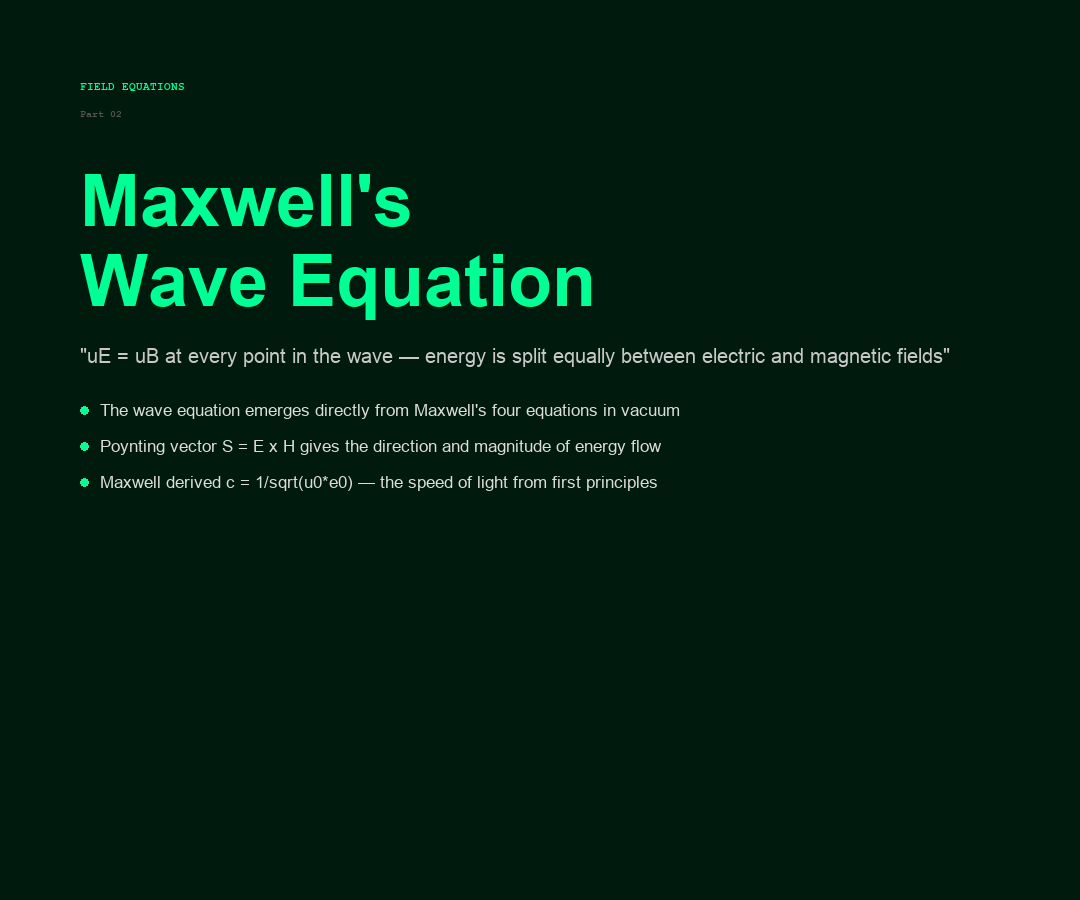
Maxwell’s four equations — Gauss’s law for electricity, Gauss’s law for magnetism, Faraday’s law, and the Ampère-Maxwell law — can be combined to yield a wave equation. In vacuum, with no charges (ρ = 0) and no currents (J = 0):
∇²E = μ₀ε₀ · ∂²E/∂t²
The left side is the Laplacian of the electric field — the way the field varies from point to point in space. The right side is the second derivative of the field with respect to time, multiplied by the product of two fundamental constants: μ₀, the permeability of free space, and ε₀, the permittivity of free space.
Any equation of this form describes a wave traveling at speed v = 1/√(μ₀ε₀). When Maxwell plugged in the measured values of these constants, he got v ≈ 3 × 10⁸ meters per second — exactly the known speed of light.
This was not adjusted or fitted. The constants μ₀ and ε₀ come from measurements of magnets and capacitors, made independently of anything optical. Their product, when inverted and square-rooted, gives the speed of light. Maxwell wrote: “This velocity is so nearly that of light, that it seems we have strong reason to conclude that light itself is an electromagnetic disturbance.”
Why Transverse Matters
Sound waves are longitudinal: air molecules compress and expand in the same direction the wave travels. You can hear sound through air because air molecules push against each other. Remove the air, and sound cannot travel — this is why there is no sound on the Moon, despite what movie sound designers suggest.
EM waves have no such requirement. The oscillations are perpendicular to the direction of propagation, not parallel. A vertically polarized radio wave — one whose electric field swings up and down — still travels horizontally. The field itself is a property of space, not a vibration of matter in space.
This transverse structure is why polarization works. A polarized sunglasses filter blocks light whose electric field oscillates in one direction while passing light oscillating perpendicular to it. The filter does not block the light wave — it absorbs the electric field component oscillating at its own molecular orientation. The result is reduced glare. The same principle, applied with deliberate precision, underlies LCD displays, 3D cinema, and fiber optic communication.
Energy Density: Equal Shares for E and B
EM waves carry energy in two containers simultaneously. The energy density of the electric field is u_E = ½ε₀E². The energy density of the magnetic field is u_B = B²/(2μ₀). Because E = cB and c = 1/√(μ₀ε₀), these two expressions are equal at every instant. The wave carries equal energy in its electric and magnetic components.
The total energy density is u = u_E + u_B = ε₀E². This energy is not static — it moves with the wave. At any surface perpendicular to the propagation direction, the power crossing per unit area is given by the magnitude of the Poynting vector: |S| = |E × H| = E·H = u·c. The energy density u, moving at speed c, gives the power flux.
This has practical consequences. The Sun delivers roughly 1,000 W/m² to Earth’s upper atmosphere. This energy arrives as EM radiation — visible light, infrared, ultraviolet — propagating from 150 million kilometers away. Solar panels convert some of this power to electricity. The Poynting vector describes exactly how much power is available per unit area at any distance from a radiating source.
The Spectrum: One Wave Type, Many Sizes
What we call “light” is only a narrow slice of the electromagnetic spectrum — wavelengths from about 400 to 700 naneters, small enough to interact with the molecules in our retinas. But the physics of EM waves does not change across the spectrum. Radio waves, microwaves, infrared, visible light, ultraviolet, X-rays, and gamma rays are all the same phenomenon, differing only in frequency and wavelength.
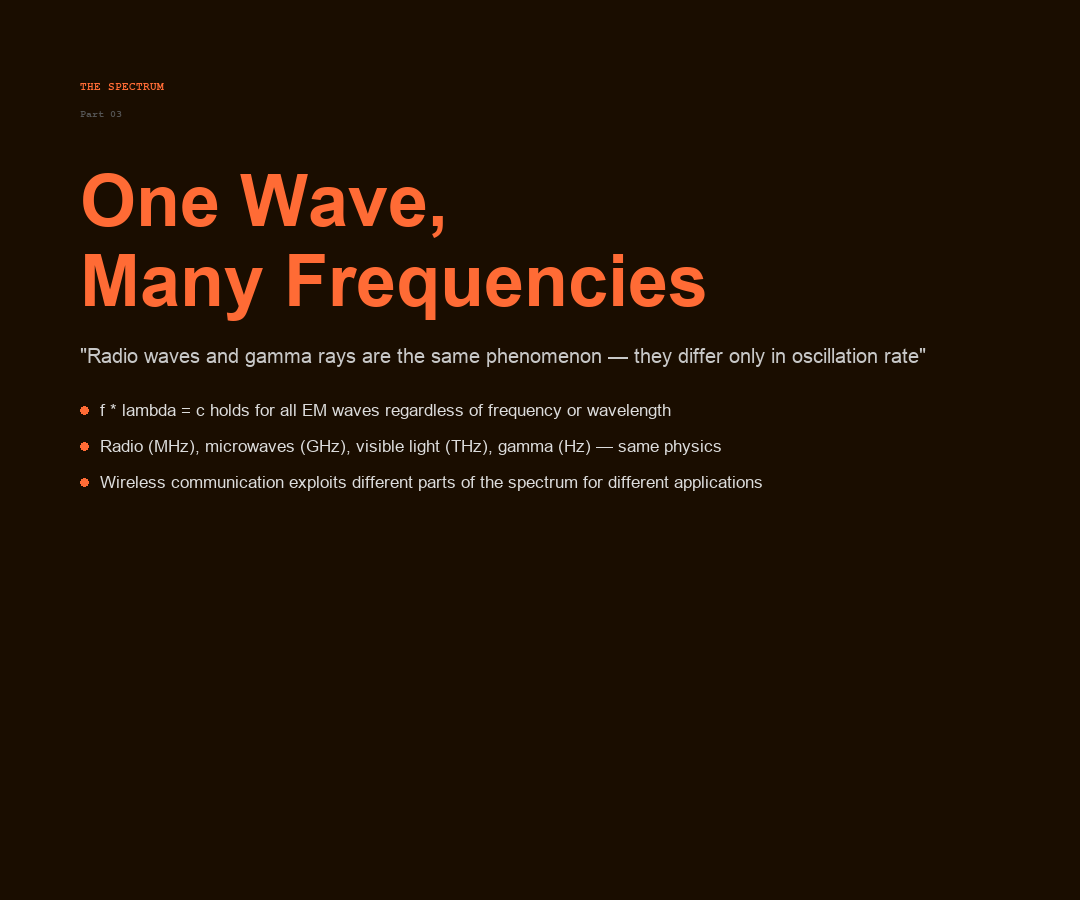
Radio waves can have wavelengths of meters to kilometers. AM radio operates at frequencies around 1 MHz, giving wavelengths of hundreds of meters — why these waves diffract around buildings and travel long distances. WiFi uses 2.4 GHz or 5 GHz, giving wavelengths of 12.5 cm and 6 cm, respectively. These higher frequencies do not diffract around obstacles as well, which is why WiFi signal weakens through walls.
Visible light, at 400–700 THz (10¹² Hz), has wavelengths shorter than a micron. X-rays, at 10¹⁸–10²⁰ Hz, have wavelengths comparable to atomic spacings — which is why they are useful for imaging crystal structures and medical diagnoses. Gamma rays, emitted in nuclear processes, can have frequencies above 10²⁰ Hz.
All travel at the same speed in vacuum. The frequency-wavelength relationship fλ = c holds for all of them.
The Orthogonality Trick: Why E ⊥ B ⊥ k
The relationship between the electric field, magnetic field, and propagation direction in an EM wave is not an accident — it is forced by Maxwell’s equations. Take Faraday’s law, which says a changing magnetic field induces an electric field. Take the Ampère-Maxwell law, which says a changing electric field induces a magnetic field.
Combine these in vacuum, and you get a feedback loop: a changing E creates a B, which changing B creates an E, which changing E creates a B, and so on. The wave propagates because each field creates the other in a staggered sequence. The orthogonality emerges because any component of E along the propagation direction would, when differentiated with respect to time, fail to satisfy both Maxwell’s equations simultaneously. Only transverse oscillations survive.
This orthogonality is what makes polarization possible as a concept. If E could oscillate in any direction with equal ease, polarizers would have nothing to work with. The strict perpendicularity of E, B, and the propagation direction (conventionally written as k) is a geometric constraint imposed by the field equations themselves.
Hertz’s Experiment and the Birth of Wireless
Heinrich Hertz’s 1887 experiment was deliberately modest. He was not trying to invent radio — he was trying to confirm Maxwell’s theory. His transmitter was two brass rods, each ending in a sphere, separated by a small gap. A high-voltage induction coil sent rapid pulses across the gap. Each pulse sent a burst of EM radiation outward.
His receiver was a loop of wire with a small gap — no bigger than the thickness of a book. When the transmitter sparked, tiny sparks appeared across the receiver gap, visible only in a darkened room. Hertz had detected radiation propagating through the laboratory air.
He then mapped the standing wave patterns in his laboratory, measuring the wavelength and inferring the frequency. Multiplying the two gave a speed — approximately 3 × 10⁸ m/s, matching the predicted speed of light. Maxwell was confirmed.
Hertz himself seemed unimpressed by the practical implications. When asked about the significance of his result, he reportedly said: “It is of no use whatsoever […] merely an experiment that proves Maestro Maxwell was correct.” His student asked him what practical value radio might have. He replied: “Nothing, I think.”
Within a decade, Guglielmo Marconi was transmitting radio signals across the Atlantic. Within a century, the electromagnetic spectrum was the world’s most valuable commercial resource, worth more per unit of bandwidth than almost any other asset.
Why the Speed in Vacuum Is a Universal Constant
The speed of light in vacuum, c = 299,792,458 m/s, is the fastest speed at which information or matter can travel. This is not an engineering limitation — it is a property of spacetime itself. Massive objects require infinite energy to reach c; massless objects cannot travel at any other speed.
This has consequences for cosmology. When light leaves a distant galaxy and travels toward Earth, it does not slow down regardless of how far it travels or how long it takes. The expansion of the universe stretches the wavelength (redshift) but does not slow the photons. They arrive at exactly c.
For EM waves in material, the speed is slower: v = c/n, where n is the refractive index of the material. Light travels at roughly 0.67c in glass and 0.67c in water. This reduction arises because the oscillating electric field of the wave polarizes the atoms of the material, and those induced dipoles create their own fields that partially cancel the original. The net effect is a slower wave front.
None of this changes the fact that in vacuum, the speed is exactly c for all observers regardless of their motion. This invariance of c is the foundation of Einstein’s special relativity — the recognition that Maxwell’s equations implicitly contain the constancy of the speed of light, which led Einstein to rethink the structure of space and time.
The Visualization
The ElysiaTools Electromagnetic Wave Propagation visualization renders the transverse wave structure in three dimensions. You can toggle the electric field, magnetic field, and Poynting vector independently, watching how they relate to each other at every point in the wave. The rotation angle control lets you view the wave from any perspective — above to see the E-B plane, from the side to see the propagation direction, or any angle in between.
The 3D view makes the orthogonality tangible: E always vibrates in its own plane while B vibrates in the perpendicular plane, and the wave moves forward along the axis perpendicular to both. The Poynting vector arrow shows the instantaneous direction of energy flow — always aligned with the propagation direction, never with either field direction.
The spectrum display maps real-world EM wave frequencies onto the same visualization, letting you see how FM radio (88–108 MHz), microwave (2.4 GHz), and visible light (500 THz) differ in oscillation rate — not in fundamental physics, only in the speed at which the fields flip back and forth.
The Unchanging Framework
What makes Maxwell’s equations remarkable is their durability. Written before the electron was discovered, before quantum mechanics, before relativity, they remain exactly correct in their domain — classical electrodynamics at human scales. Every time you make a phone call, transmit a file over WiFi, or receive a satellite signal, Maxwell’s equations are being solved, implicitly, by the hardware in your devices.
The wave equation ∇²E = μ₀ε₀ · ∂²E/∂t² is as true today as it was in 1865. The orthogonality of E, B, and propagation direction has not relaxed. The Poynting vector still points exactly where energy flows. The spectrum still spans the same infinite range of frequencies.
Maxwell gave physics an unexpected gift: a set of equations so structurally complete that they predict their own consequences before those consequences are observable. Hertz confirmed the radio waves. Einstein extracted the constancy of c and built relativity. Quantum mechanics later revealed that the electromagnetic field itself is quantized — photons are the quantum excitations of the EM field — but the wave equation remains exactly correct for describing the classical behavior of light.
The invisible waves connecting your devices to the internet, to satellites, to each other, are still governed by the same mathematics Maxwell wrote in 1865. That is a rare thing in any science: a framework so complete that its predictions require no revision, only exploitation.