Why Tiny Particles Can’t Sit Still: The Random Walk That Proved Atoms Exist
In 1827, botanist Robert Brown peered through his microscope at a drop of water containing pollen grains and saw something he couldn’t explain. The pollen particles weren’t settling or flowing — they were jittering, twitching, dancing in small random hops. Every time he looked, the motion was different. The direction changed. The speed varied. There was no pattern, no external push, no reason Brown could identify.
Brown spent years trying to figure out what was moving the particles. He considered evaporation, surface tension, light, even “life.” None of it fit. He had no way to know that what he was watching — what would become one of the most famous observations in physics — was the visible signature of something he had no way to see: individual molecules crashing into the pollen grain from all sides, too small and too numerous to ever be observed directly.
The Puzzle Nobody Could Solve
For most of the nineteenth century, Brown’s observation sat as a curiosity. Some scientists thought it was evidence of vital forces — some mystical life energy driving the motion. Others suspected it was an artifact of the microscope. Nobody had a clean theoretical account of what was actually happening at the molecular level.

The breakthrough came in 1905. In the same year Albert Einstein published his paper on special relativity, he also published a paper on Brownian motion — and it changed everything.
Einstein‘s argument was deceptively simple. If liquids are made of molecules, and those molecules are in thermal motion, then invisible molecular collisions should occasionally nudge a suspended particle in one direction or another. Each individual kick is too small to see. But over time, the cumulative effect of trillions of collisions produces the jittery motion Brown observed.
What Einstein added was a quantitative prediction. He showed that the average squared displacement of a Brownian particle should grow linearly with time:
where D is the diffusion coefficient. This was not just a qualitative story — it was a number. And in 1908, Jean Perrin measured it experimentally and confirmed Einstein’s prediction exactly.
Colloids: The Sweet Spot Where Brownian Motion Is Visible
Not all particles suspended in a liquid are small enough to show Brownian motion. If a particle is too large, molecular collisions are balanced from all sides and the particle sits still. If a particle is too small, individual molecular impacts wash out and you see smooth diffusion at the molecular scale.
Colloidal particles sit in the Goldilocks zone. With diameters typically between 1 nanometer and 1 micrometer, they are large enough to scatter light (making them visible under a microscope) but small enough that molecular collisions from the surrounding solvent produce measurable random displacement.
This is why Brownian motion is so intimately associated with colloid science. The colloids give us the experimental window into molecular motion that direct molecular observation cannot provide.
The Stokes-Einstein Relation: Connecting Viscosity, Temperature, and Diffusion
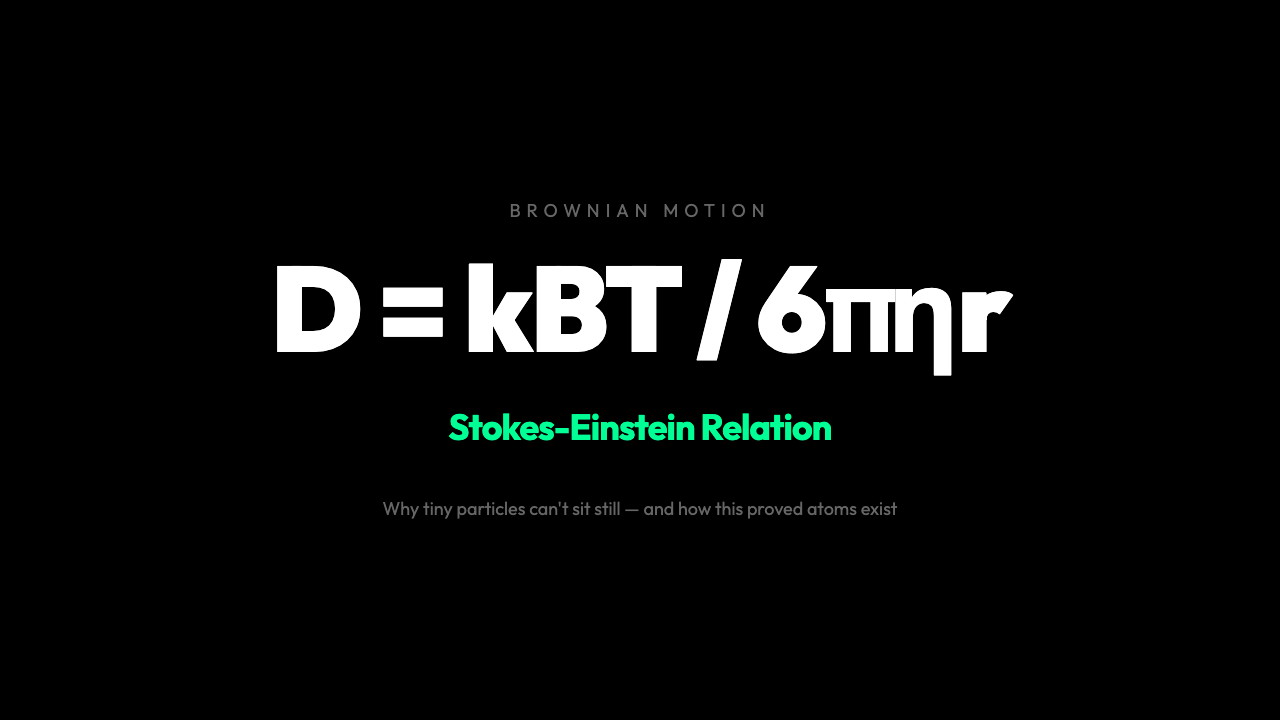
Einstein’s 1905 paper gave us the framework, but the most elegant connection in Brownian motion theory is the Stokes-Einstein relation, which links the diffusion coefficient D to the properties of the particle and the solvent:

D = kBT / (6πηr)
where: – kB is Boltzmann’s constant (1.38 × 10⁻²³ J/K) – T is absolute temperature – η is the viscosity of the solvent – r is the particle radius
This equation is remarkable. It says: if you know the temperature, the solvent viscosity, and the particle size, you can predict the diffusion coefficient — and therefore the rate of Brownian jittering — without knowing anything about the molecular details of the collisions.
The physics underneath is a balance. Higher temperature means faster molecular motion and more energetic collisions, so D increases. Higher viscosity means the solvent molecules are more sluggish and transfer momentum less efficiently, so D decreases. Larger particles have more inertia and more surface area to feel the collisions, but also more mass to accelerate, so D decreases with radius.
Mean Squared Displacement: Measuring What You Can’t See
The most important measurable quantity in Brownian motion experiments is the mean squared displacement (MSD). If you track a single colloidal particle over time and measure how far it moves from its starting point, the squared displacement (x²) grows linearly with time — but with random fluctuations around the trend line.
The theoretical prediction:
The slope of
What makes this powerful is that you never see individual molecular collisions. You only track the colloidal particle’s path. But because the colloidal particle is a statistical probe — feeling the average effect of ~10²⁰ solvent molecules at once — its measurable motion encodes the properties of the molecular world you cannot see.
Real-World Applications
Brownian motion is not just a historical footnote. It is a working tool across science and engineering.
Drug delivery. Nanoparticles in the bloodstream undergo Brownian motion. Understanding their diffusive behavior is essential for designing drug carriers that reach target tissues without being cleared too quickly.
Atmospheric science. Aerosol particles in the atmosphere — dust, smoke, cloud condensation nuclei — are colloidal in size and exhibit Brownian motion. This affects how aerosols scatter sunlight, form clouds, and transport pollutants.
Ink and printing. The behavior of pigment particles in liquid ink is dominated by Brownian motion. If the particles aggregate too quickly, inkjet nozzles clog. If they don’t disperse adequately, color quality suffers.
Materials science. Colloidal suspensions are used to synthesize nanostructured materials. Controlling Brownian motion — through viscosity, temperature, or surface chemistry — determines whether particles assemble into ordered crystals or disordered gels.
Brownian Motion and the Existence of Atoms
It is worth pausing on what this chain of reasoning accomplished. Brown saw jittering pollen in 1827. Einstein wrote down a formula in 1905. Perrin tested it in 1908 and confirmed it to within a few percent.

That confirmation was not just a validation of Einstein’s theory. It was direct experimental evidence that liquids are made of molecules, that molecules are in thermal motion, and that the macroscopic properties of matter — viscosity, temperature, diffusion — emerge from the statistical behavior of enormous numbers of invisible molecular collisions.
Brown never knew what he was looking at. He had found the first visible proof of the molecular structure of matter, and he couldn’t see the molecules at all.
Explore the Simulation
The simulation visualizes colloidal Brownian motion with configurable particle size, temperature, and solvent viscosity. You can observe individual particle trajectories, watch the displacement distribution evolve toward a Gaussian, and measure how mean squared displacement grows with time. Try changing the medium from water to glycerol and watch the motion slow dramatically — the viscosity changes everything.