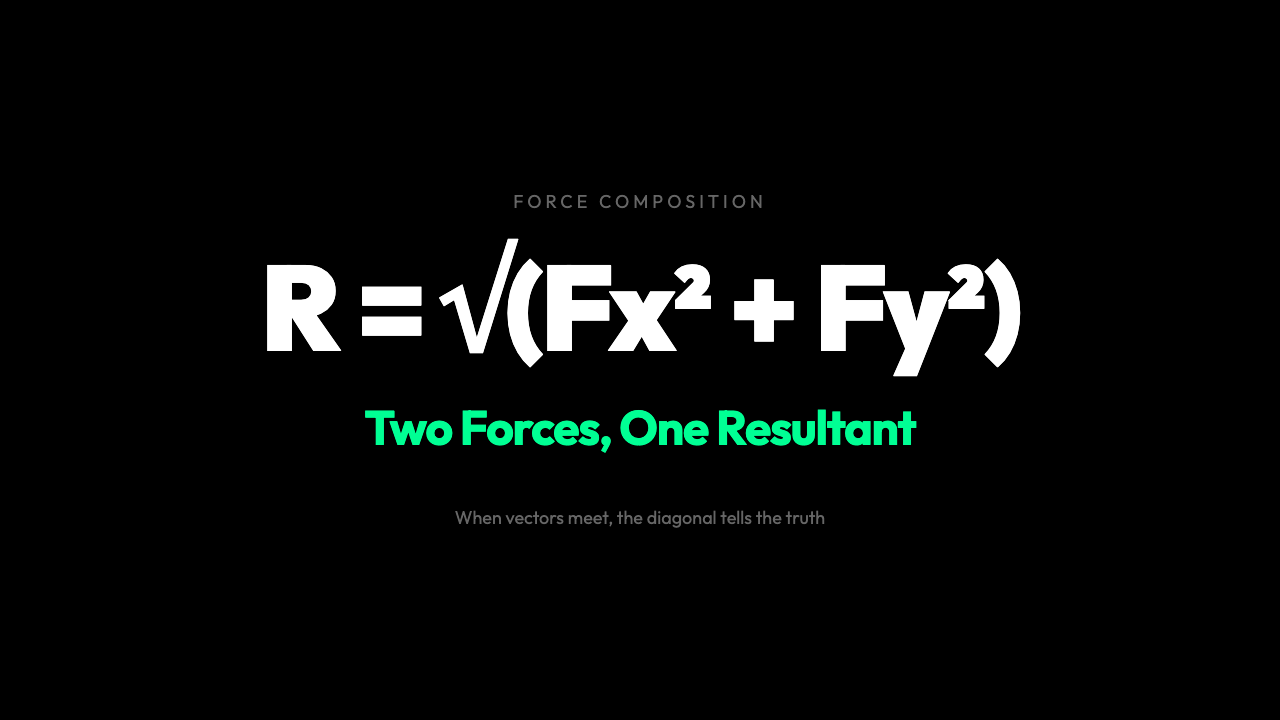
Why Two Forces Can Do What One Never Could: The Physics of Force Composition
A cargo ship sits motionless in still water. Two tugboats pull at different angles — one eastward at 50 kilonewtons, another northeastward at 60 kilonewtons. The ship moves not toward either tugboat, but along a path that belongs to neither. This is not magic. It is vector addition, and it is the reason engineers spend hours calculating where things will actually end up.
Force composition is the process of finding the resultant — the single force that produces exactly the same mechanical effect as two or more forces acting together. It is one of the first things you learn in statics, and one of the last things you ever fully internalize.
The Two Methods
The Parallelogram Rule
Draw both force vectors from a common origin. Complete the parallelogram. The diagonal running from that origin to the opposite corner is the resultant.
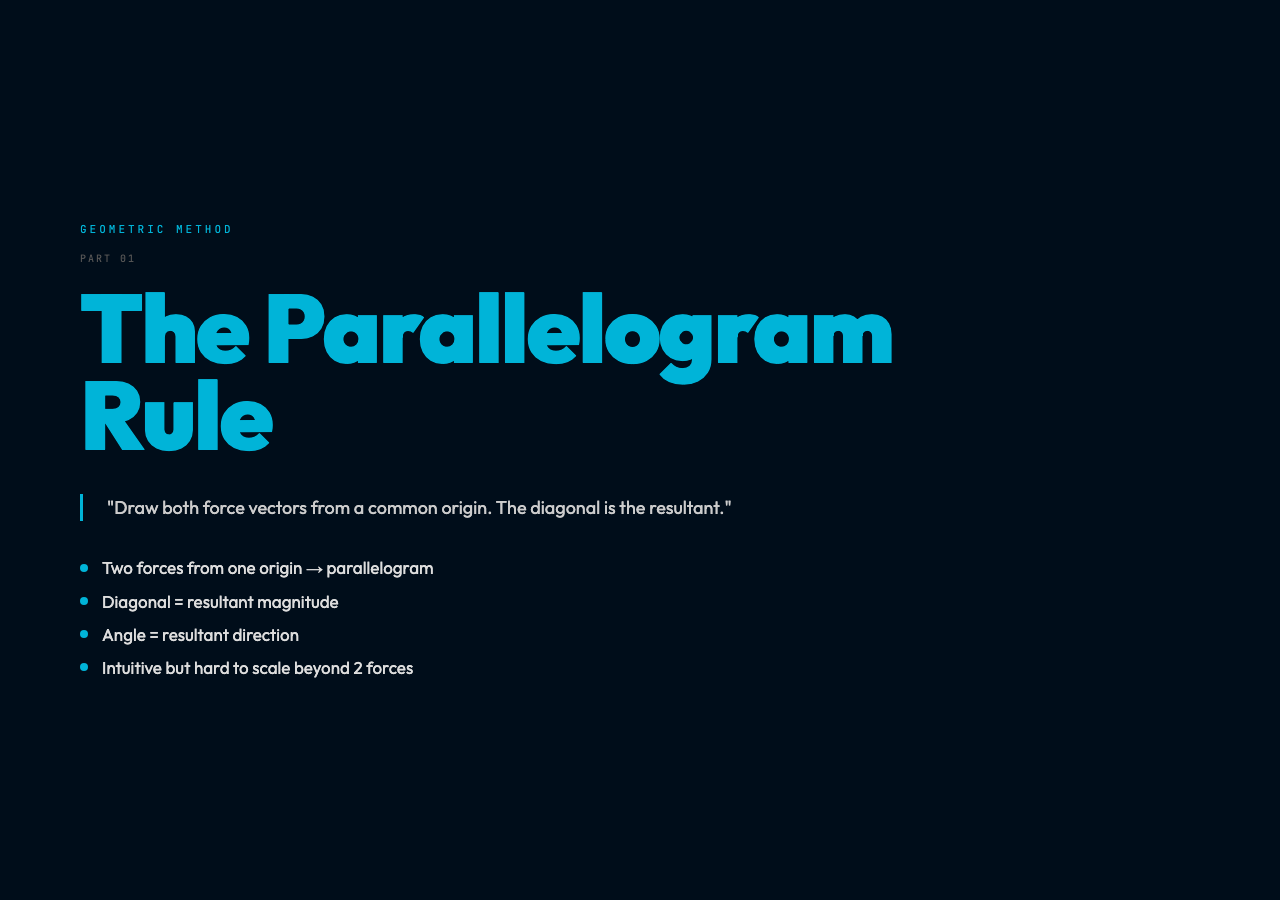
This is the geometric picture, and it is intuitive: you can literally see the forces pushing against each other and the diagonal representing their combined push. The diagonal length is the resultant’s magnitude. The angle it makes with the horizontal is the resultant’s direction.
The Component Method
The parallelogram is the picture. The component method is the calculation.
Any force F at angle θ can be decomposed into: – Fx = F · cos(θ) — the horizontal push – Fy = F · sin(θ) — the vertical push
Once both forces are broken into their x- and y-components, addition becomes trivial: – Rx = F1x + F2x – Ry = F1y + F2y
Then the resultant magnitude is: – R = √(Rx² + Ry²)
And its direction: – θ = atan2(Ry, Rx)
The component method scales cleanly to any number of forces. The parallelogram rule starts to get unwieldy after two.
Why It Matters
In the cargo ship example, knowing the resultant tells you: 1. Which direction the ship will actually move 2. How hard it will accelerate (F = ma) 3. Whether the tugs are working with or against each other

When two forces point in nearly opposite directions, they partially cancel. When they point perpendicular to each other, they complement perfectly — the resultant is larger than either force alone.
This is why structural engineers sum all the forces acting on a bridge joint before deciding how thick a member needs to be. It is why the tension in a rope changes depending on the angle it makes with the load. Force composition is not a classroom abstraction — it is the calculation that tells you whether something holds or collapses.
The Interactive Simulation
The Force Composition tool lets you drag two force vectors around a canvas and watch the resultant update in real time. You can toggle between the parallelogram view, the triangle view, and the components view. The numbers — F1x, F1y, F2x, F2y, and the final R and θ — update continuously as you drag.

The default setup shows F1 = 50 N at 0° and F2 = 50 N at 60°. Working through the components: – F1x = 50 · cos(0°) = 50.0 N – F1y = 50 · sin(0°) = 0.0 N – F2x = 50 · cos(60°) = 25.0 N – F2y = 50 · sin(60°) = 43.3 N – Rx = 50.0 + 25.0 = 75.0 N – Ry = 0.0 + 43.3 = 43.3 N – R = √(75² + 43.3²) ≈ 86.6 N
The interactive visualization makes this concrete: the parallelogram’s diagonal is exactly that length, and the angle display reads approximately 30°.
The Deeper Point
What is subtle about force composition is that it is not averaging. The resultant is not “somewhere between” the two forces. It is the vector sum — direction and magnitude — of what both forces together actually do to the object.
Change one angle by 10 degrees and the resultant direction shifts by a disproportionate amount, especially when the forces are nearly perpendicular. This sensitivity is why engineers do not eyeball force directions on critical structures.
The next time you see a crane lifting a load on a diagonal cable, you are watching force composition in the real world — the cable’s tension resolved into vertical lift and horizontal pull, added together, and that load moving along the path of their combined effort.