
Why Painters Mixed Colors Long Before Screens Existed: The Physics of Subtractive Color Mixing
Walk into any art studio and you’ll find jars of cyan, magenta, and yellow pigment on the shelf. Walk into any print shop and the same three colors sit in the ink wells. That’s not a coincidence. It’s the physics of subtractive color mixing — a system that governed how humans made color for centuries before anyone heard of RGB pixels.
The Core Idea: Light You Don’t See
When light hits a painted surface, something very different happens than when light hits a screen. A monitor emits light directly — that’s additive color. A painted surface does the opposite: it absorbs (subtracts) parts of the white light that hits it and reflects the rest. What your eye sees is the reflected remainder.
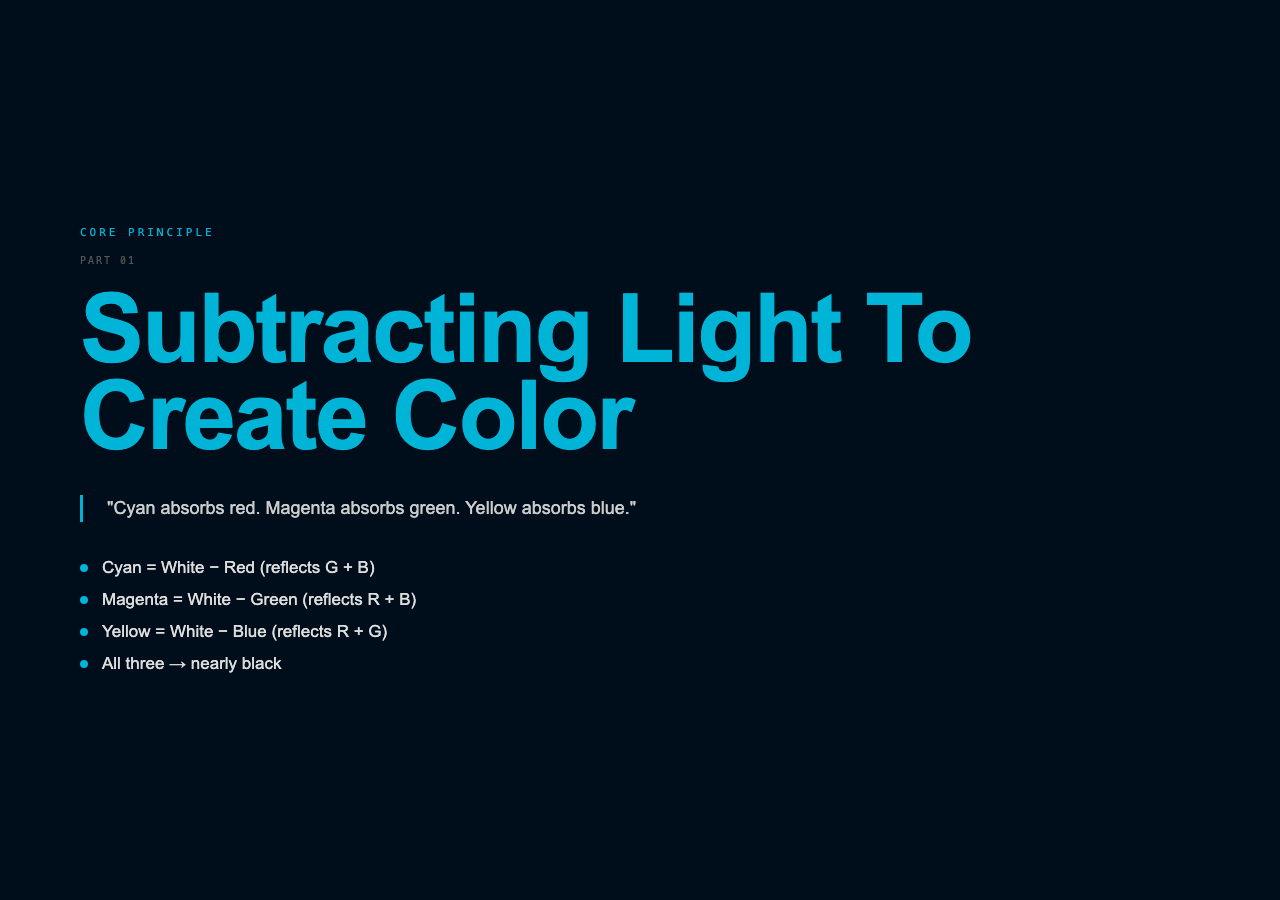
Cyan pigment absorbs red light. Magenta absorbs green. Yellow absorbs blue. Mix all three, and nearly all light gets absorbed — leaving near-black. This is why printer cartridges and paint tins have always centered on CMY: these three colors can recombine into the widest range of hues through subtraction alone.
The math is elegant. Each pigment removes one of the three RGB components from white light: – Cyan = White − Red (reflects G + B) – Magenta = White − Green (reflects R + B) – Yellow = White − Blue (reflects R + G)
Add black (K) to deepen shadows and you have CMYK — the standard four-color printing system still used today.
Why This Matters More Than RGB
RGB dominates screens because screens emit light. The world outside your window, though, mostly reflects it. Every physical object you see that isn’t a light source follows subtractive rules. The sky looks blue because air molecules subtract red. A leaf looks green because chlorophyll subtracts red and blue. The redness of a ripe tomato? That’s the tomato subtracting cyan and magenta.
Once you see the world through subtractive physics, you notice it everywhere. Warm golden hour light isn’t adding orange to the scene — it’s subtracting blue from the white sky. Shadows aren’t darker versions of the object — they’re the object receiving light with certain wavelengths already filtered out by the atmosphere.
The CMY Mixing Grid: Seeing It Interactive
The simulation gives you a CMY mixing grid — three sliders controlling cyan, magenta, and yellow values from 0% to 100%. Each slider removes its complementary color channel from white. Watch what happens as you move a slider: the center square shifts from pure white toward the pigment’s complementary color, then toward the pigment’s own hue.
Push all three sliders to maximum and you get black — all light absorbed, nothing reflected. Push cyan and magenta to 100%, yellow to 0%, and you get blue — cyan absorbs red, magenta absorbs green, only blue remains.
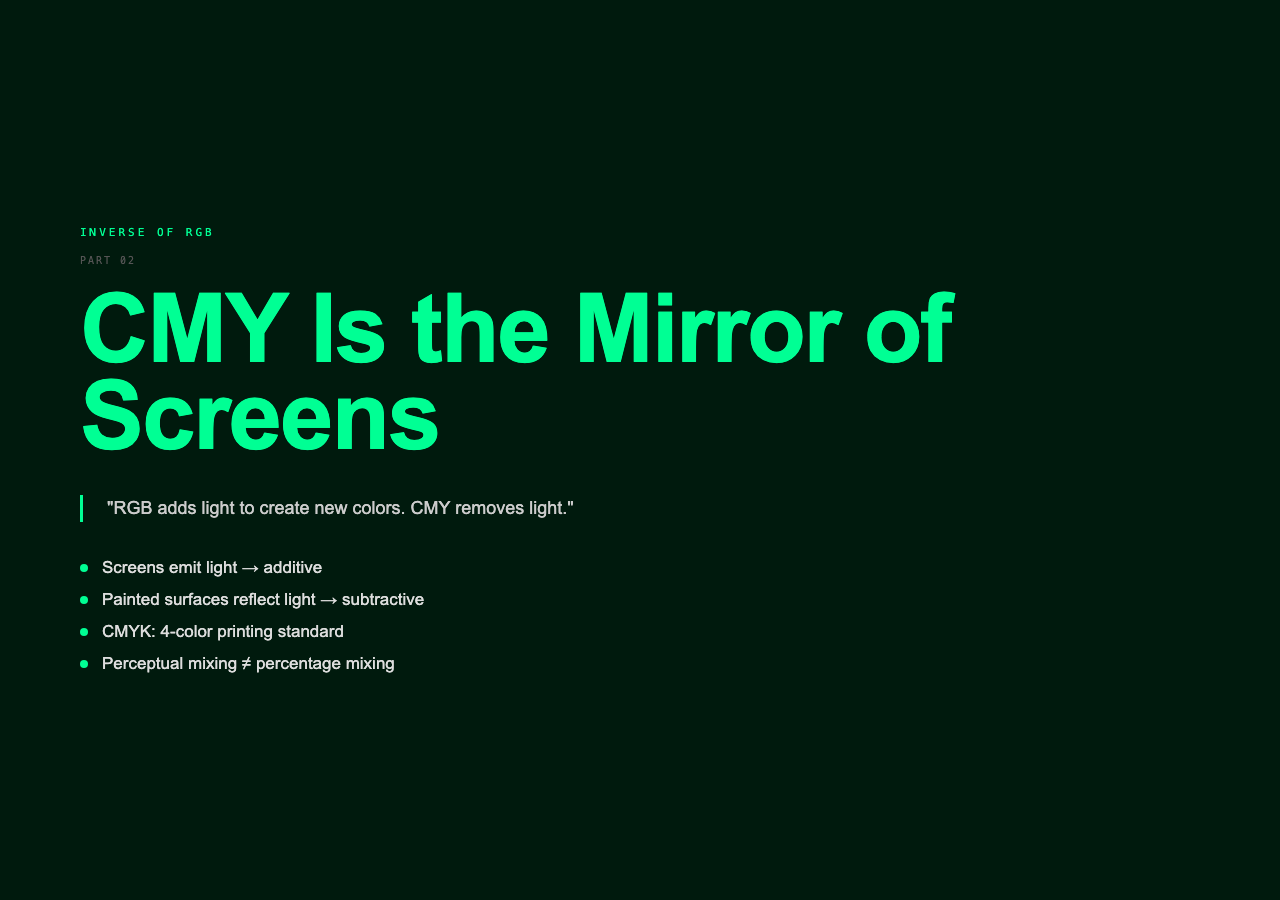
This is the inverse of how RGB monitors work. On an RGB screen, red + green = yellow (adding red and green light). In CMY pigment, red is absorbed, so red + green on a CMY mix means you have cyan (absorbs red) + yellow (absorbs blue) — leaving only green.
The asymmetry is clarifying: RGB adds light to create new colors. CMY removes light to create new colors. Same goal, opposite mechanism.
Why Painters Figured This Out Centuries Before Physicists Named It
Artists knew empirically what CMY describes before the terminology existed. Renaissance painters layered transparent glazes to build up shadows and depth — each glaze absorbing certain wavelengths, letting others pass through. The result was luminous color that opaque pigments alone couldn’t produce. They were doing subtractive mixing without the name.

The formal model came later, from artists like James Clerk Maxwell (yes, the same Maxwell of electromagnetic fame), who demonstrated in 1861 that any spectral color could be reproduced by mixing just three colored lights. That was additive mixing. Subtractive — how pigments actually work — took longer to formalize, but the empirical knowledge was ancient.
This is a pattern in physics: practitioners often develop working knowledge long before the theory arrives. Painters, dyers, and ceramicists were subtractive color mixers for millennia. The physics caught up.
What the Interactive Graph Reveals
The interactive simulation’s real value is showing how the three sliders interact non-linearly. Move cyan from 0% to 50%, then from 50% to 100%. The color change isn’t proportional — the eye perceives the first 50% differently than the second.
This is why color management is hard. Perceptual color spaces (Lab, Lch) exist precisely because percentage mixing in CMYK doesn’t match human perception. A printing profile’s job is to translate between what the slider says and what the eye sees.
The simulation isolates the CMY mechanism cleanly — no gamma correction, no display profile, no perceptual interpretation. Just: given these three absorption levels, what color does the surface reflect? The answer follows from physics directly.
The Takeaway
Subtractive color mixing is the physics behind every painted wall, printed photograph, and dyed fabric in the world. Screens are the anomaly — they add light. The natural state of color in the physical world is subtractive.
Understanding CMY isn’t just knowing a printing system. It’s understanding why the physical world looks the way it does — why shadows have color, why leaves change in autumn, why the sky is blue. The RGB world on your screen is a narrow exception. The CMY world outside your window is the rule.