Why Heat Spreads the Way It Does: The Mathematics Behind Every Thermal Process
A coffee cup cools faster in the first minute than in the tenth. A metal spoon left in soup grows warm almost instantly, while the soup itself takes minutes to reach the same temperature. Every kitchen, every engine, every climate system runs on the same law — and once you see the equation behind it, these everyday patterns stop being surprises and start being inevitable.
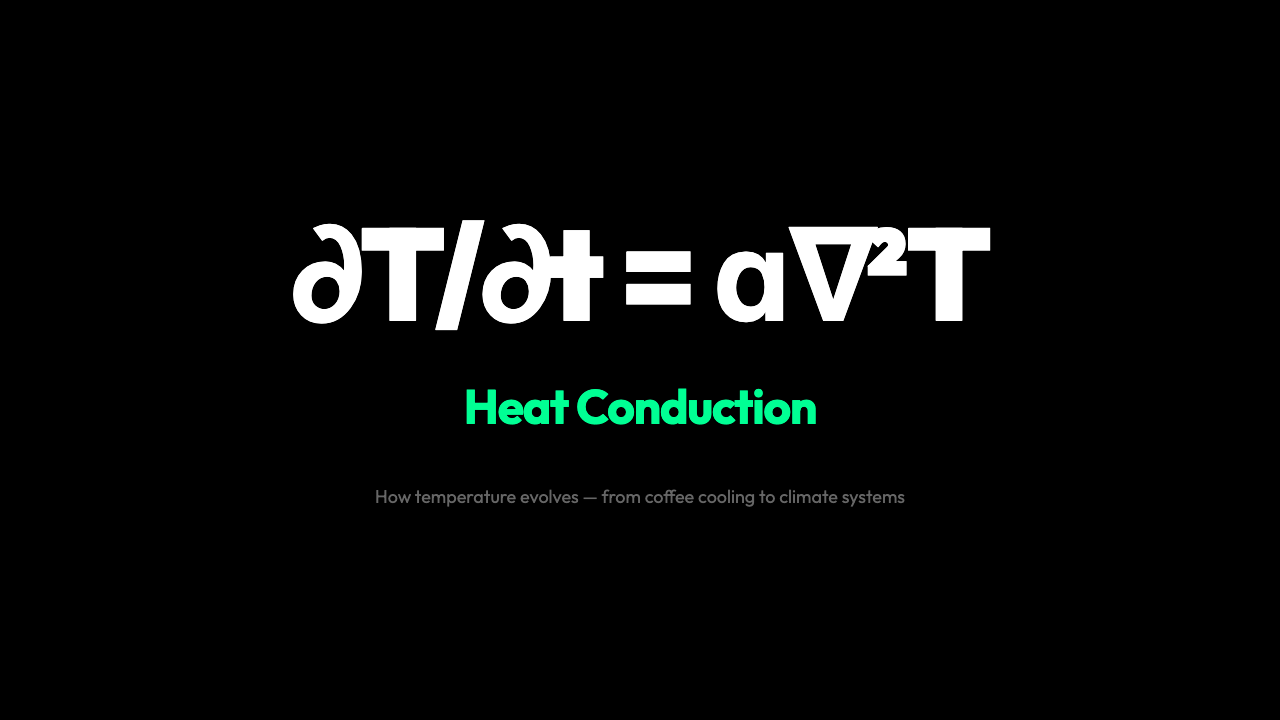
That equation is the heat equation: ∂T/∂t = α∇²T. It describes how temperature T changes over time t, driven by the Laplacian ∇²T (the local “curvature” of temperature), scaled by the material’s thermal diffusivity α. In plain English: heat diffuses from warm regions into cooler ones, and the rate depends on the material.
What the Simulation Shows
Open the interactive simulation and set a 1D rod with both ends held at fixed temperature — say, 0°C — while the center starts at 100°C. Watch what happens.

Within seconds, the peak begins to flatten. Within minutes, the rod settles into a straight line. The mathematics is straightforward: the heat equation tells us that wherever temperature has positive curvature (a peak), heat flows outward. Wherever it has negative curvature (a valley), heat flows inward. The initial hot center is a peak, so it loses heat in both directions until the rod is isothermal.
The same logic extends to 2D plates. A circular hot spot in the center of a cool plate doesn’t just shrink — it spreads sideways, diffusing radially outward until the entire plate reaches equilibrium. The heat doesn’t “travel” so much as it disperses, like ink diffusing through water.
Why α Matters
Thermal diffusivity α controls the speed. It combines three material properties: how well the material conducts heat (thermal conductivity k), how thermally “responsive” it is (specific heat capacity c), and how dense it is (density ρ). Specifically, α = k / (ρc).

Metals have high α — copper ≈ 1.1 × 10⁻⁴ m²/s. This is why a copper pan heats evenly and quickly: thermal energy diffuses through it rapidly. Wood has low α ≈ 10⁻⁷ m²/s — roughly a thousand times smaller. This is why wooden cutting boards feel cooler to the touch even at the same temperature: less heat flows from your hand into the wood per unit time.
In the simulation, α is set to 50 (in arbitrary grid units), which makes the diffusion clearly visible on human timescales. Real materials at human scale behave identically in principle — just faster or slower depending on their α.
The Boundary Conditions Are the Story
The heat equation itself is universal. What makes every thermal problem distinct are the boundary conditions — how the system interacts with its surroundings.

In the simulation’s “fixed temperature” mode, the boundaries are held at constant temperature, simulating contact with a large thermal reservoir. In “insulated” mode, no heat crosses the boundary — simulating a perfectly insulated rod. These two conditions produce dramatically different long-term behaviors: fixed-temperature systems always settle to a linear temperature profile, while insulated systems conserve total heat and reach a uniform temperature.
Real systems are rarely perfectly either extreme. A cast-iron skillet has one surface exposed to a burner (roughly fixed temperature) and the other surface exposed to air (somewhere between insulated and fixed, depending on airflow). Understanding which boundary condition applies tells you more about a thermal system’s behavior than knowing the exact equation.
Fourier’s Insight, Still Unmatched
This entire framework traces back to Joseph Fourier, who in 1807 proposed that the rate of heat flow is proportional to the temperature gradient — a relationship now known as Fourier’s law: q = -k ∇T. The negative sign is important: heat flows downhill, from warm to cool, opposite the temperature gradient direction.
From this single proportionality, the heat equation follows mathematically. And from the heat equation, you can derive the behavior of everything from cooling curves to heat exchangers to the thermal regulation of the human body. The fact that such a wide range of phenomena flows from one simple law is a reminder that physics is less about memorizing facts than about finding the compact description from which the facts follow inevitably.
Why You Feel This Every Day
The reason this matters outside the textbook: every time you touch a surface and judge it “warm” or “cool,” you’re sensing the rate at which heat is flowing between your skin and the object — governed by α and the temperature gradient. A metal chair feels colder than a wooden one at the same temperature not because it is colder, but because it pulls heat from your body faster (higher α). The stone floor feels warmer than the rug in summer not because it holds more heat, but because your foot loses heat to it more slowly.
The heat equation is not just an engineering tool. It is a description of a world that is always, everywhere, settling toward thermal equilibrium — and whose details are written in diffusivity, gradients, and boundary conditions.
Run the simulation. Start with a sharp temperature peak and watch it flatten. What you are watching is not an approximation or a model — it is the exact same mathematics that describes how your coffee cools, how your house loses heat in winter, and how the Earth’s crust releases geological heat over millennia.