Why Two Charges Determine Everything Between Them: Coulomb’s Law in One Equation
There is a moment every physics student remembers — the discovery that the same equation that governs planetary orbits also governs what happens when you rub a balloon against your hair. The inverse-square relationship, the product of two quantities, the proportionality constant: all of it appears in both places. But gravity only attracts. Charge interaction splits the universe in two.
That split is what Coulomb’s law captures in a single line:
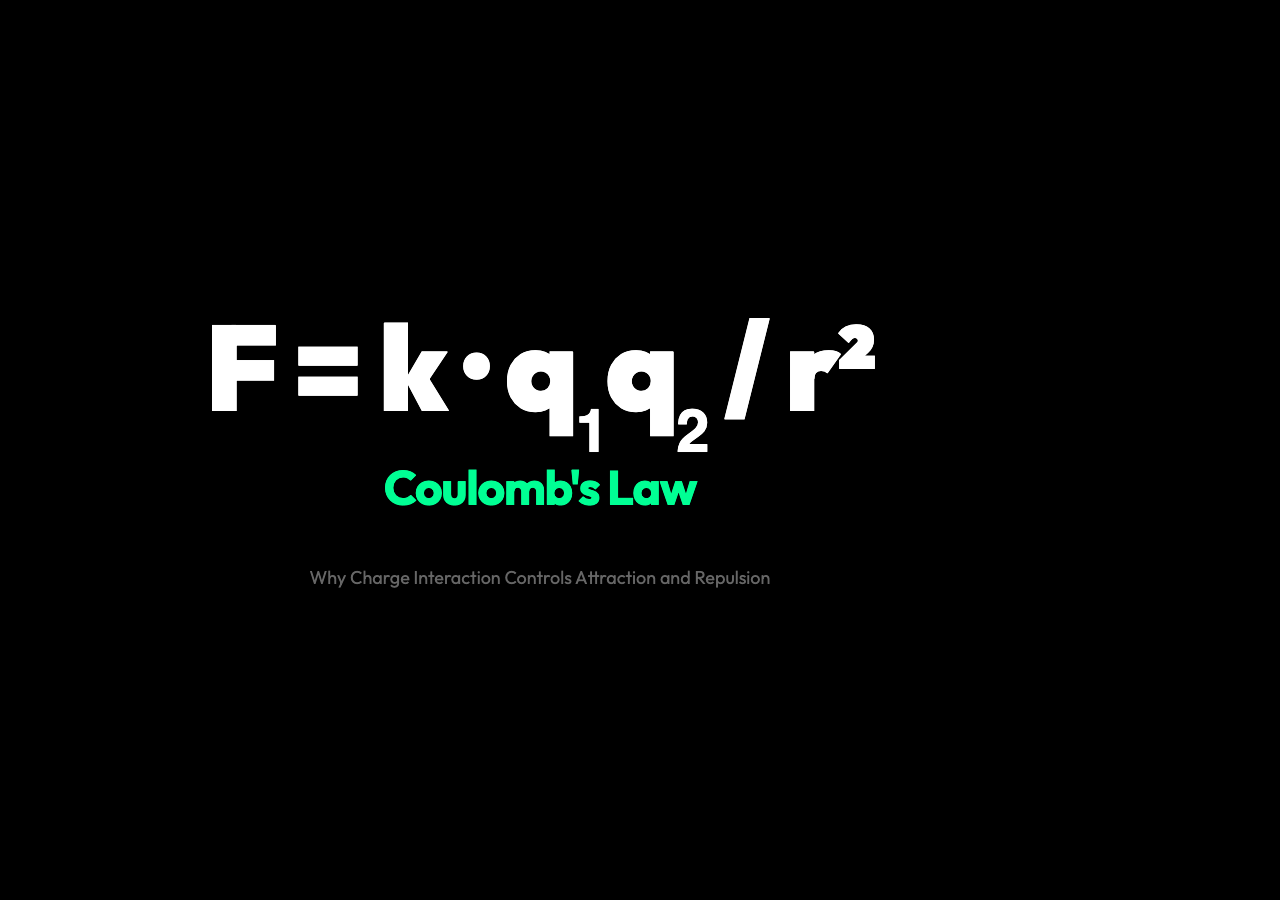
F = k · q₁q₂ / r²
Three scenarios, one law. Positive times positive gives repulsion. Negative times negative gives repulsion. Positive times negative gives attraction. The distance term does the rest.
The Visualization
Open the charge interaction simulation and the first thing you see is two objects — one fixed, one free to move. Set the charge magnitude slider to 5. Watch the force vector arrow. Now flip the sign of one charge from positive to negative. The arrow reverses direction. The magnitudes stay the same. Change the distance: the force scales with the square of the separation. The math does exactly what the physics says.
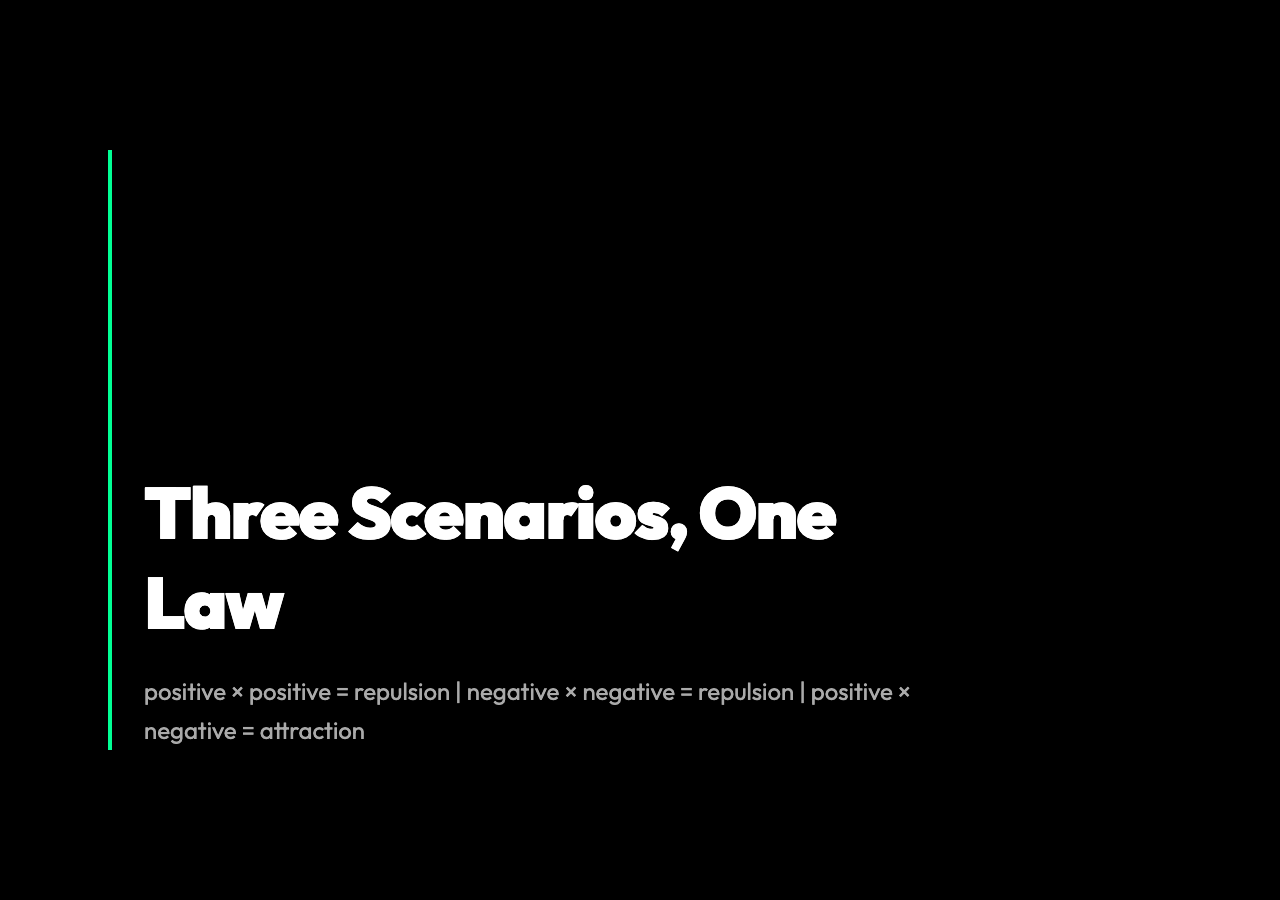
The simulation runs four scene types. Positive-positive — both charges push apart. Negative-negative — the same repulsion. Positive-negative — opposite charges pull toward each other. Negative-positive — the same attraction. Each scene is a different arrangement of the same fundamental rule.
This is the key thing the visualization makes viscerally obvious: the law is symmetric in charge sign product. The universe decides attraction or repulsion based on whether the two charges share a sign or have opposite signs.
Why This Matters Beyond the Textbook
Coulomb’s law isn’t just an academic exercise. It explains:
- Why atoms stay together: The electromagnetic force between nucleus and electrons is what holds every atom together. No Coulomb attraction, no chemistry.
- Why matter feels solid: At close range, electron clouds repel each other. This repulsion is why you can’t walk through walls — it’s not magic, it’s charge.
- Why lightning strikes: Separated charge in clouds builds enormous potential. When the electric field exceeds air’s breakdown threshold, charge rushes to equalize. That rush is lightning.
The law also explains a counterintuitive feature of electrostatics: force drops off with the square of distance, but charge buildup doesn’t. You can separate charge until the force at the gap equals the binding force holding electrons in place. At that point, the material breaks down conductively.
The Force Equation Deconstructed
The equation F = k · q₁q₂ / r² has three moving parts:
q₁q₂ — charge product sign: When both charges are positive or both negative, q₁q₂ > 0, and the force is positive (repulsive). When one is positive and one negative, q₁q₂ < 0, and the force is negative (attractive). The sign of the product determines direction.
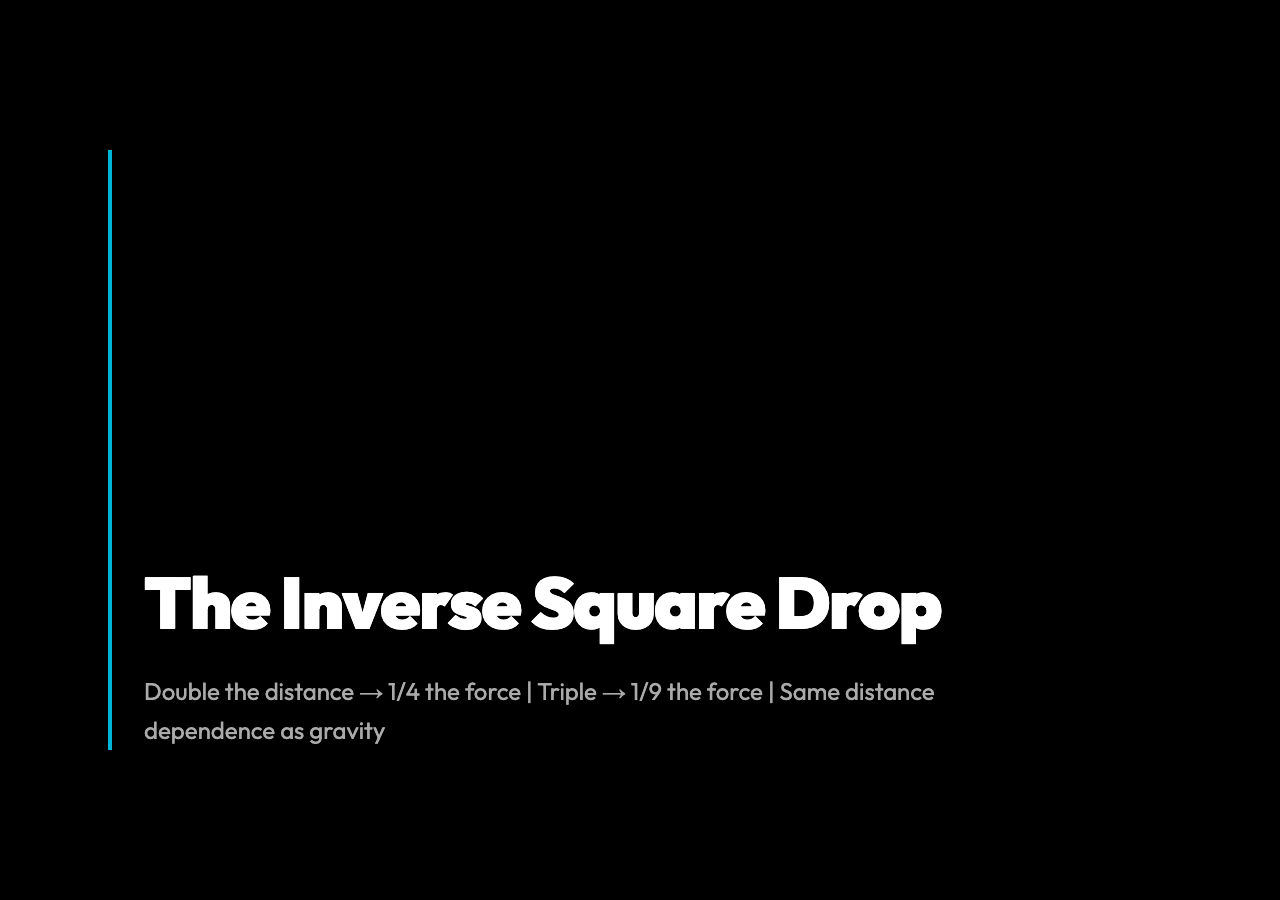
r² — inverse square distance: Double the separation and the force becomes one quarter. Triple it, one ninth. This is the same distance dependence as gravity — but gravity only attracts.
k — Coulomb’s constant: In the real world, k ≈ 8.99 × 10⁹ N·m²/C². In the simulation, k = 1000 (scaled for relative units). The constant sets the overall strength of the electromagnetic interaction.
Three Scenarios, One Law
The simulation labels each scene type explicitly:
- positive-positive: Maximum positive product. Force pushes charges apart.
- negative-negative: Maximum positive product. Force pushes charges apart.
- positive-negative: Minimum (negative) product. Force pulls charges together.
- negative-positive: Minimum (negative) product. Force pulls charges together.
What looks like four different cases reduces to two: same-sign repulsion, opposite-sign attraction. The law is simpler than the menu makes it appear.
What the Simulation Can’t Show
The simulation is classical electrostatics. It omits relativistic effects, quantum mechanical tunnelling, and the magnetic component of moving charges. It assumes point charges — no extended charge distributions. The inverse-square law holds for point charges and spherical charge distributions, but breaks down near irregularly shaped conductors.
These limitations are the same ones any first-physics treatment of Coulomb’s law has. They are not bugs — they are the precise conditions under which the equation holds exactly.
The Takeaway
Coulomb’s law is one equation. F = k · q₁q₂ / r². It covers attraction, repulsion, force scaling with charge magnitude, and force scaling with distance squared. The only thing it doesn’t tell you is which direction — that comes from the sign of q₁q₂.
Every static electrical phenomenon you see — the snap of a door handle, the stick of a balloon to a wall, the snap of lightning — is an instance of this equation playing out at a particular scale with particular boundary conditions. The law is clean. The universe is the rest.