In 1913, a French physicist named Georges Sagnac mounted a light source on a rotating disc and split a single beam into two beams traveling in opposite directions around the perimeter. When he recombined them, the interference pattern had shifted — the two beams had traveled different distances despite the path length being identical in either direction. The result was immediately contradictory to classical intuition: two beams of light, each covering the same geometric distance, arrived at different times simply because the platform they traveled on was spinning.
Sagnac was trying to prove the existence of the aether — the hypothetical medium thought to carry light waves. He expected his result to confirm it. Instead, the experiment confirmed something far more durable: that rotating reference frames have a measurable preferred state, detectable by light itself. General relativity would later explain why. But the effect carries his name regardless of what he originally hoped to find.
The Core Idea: Light Still Takes Different Times Around a Circle
Imagine you are standing on a rotating platform with two flashlights and a light detector. You shine one flashlight clockwise around the perimeter and one counterclockwise. The platform rotates as the light travels. By the time each beam returns to you, you’ve moved — so the counterclockwise beam has slightly less catching up to do, and the clockwise beam has slightly more.
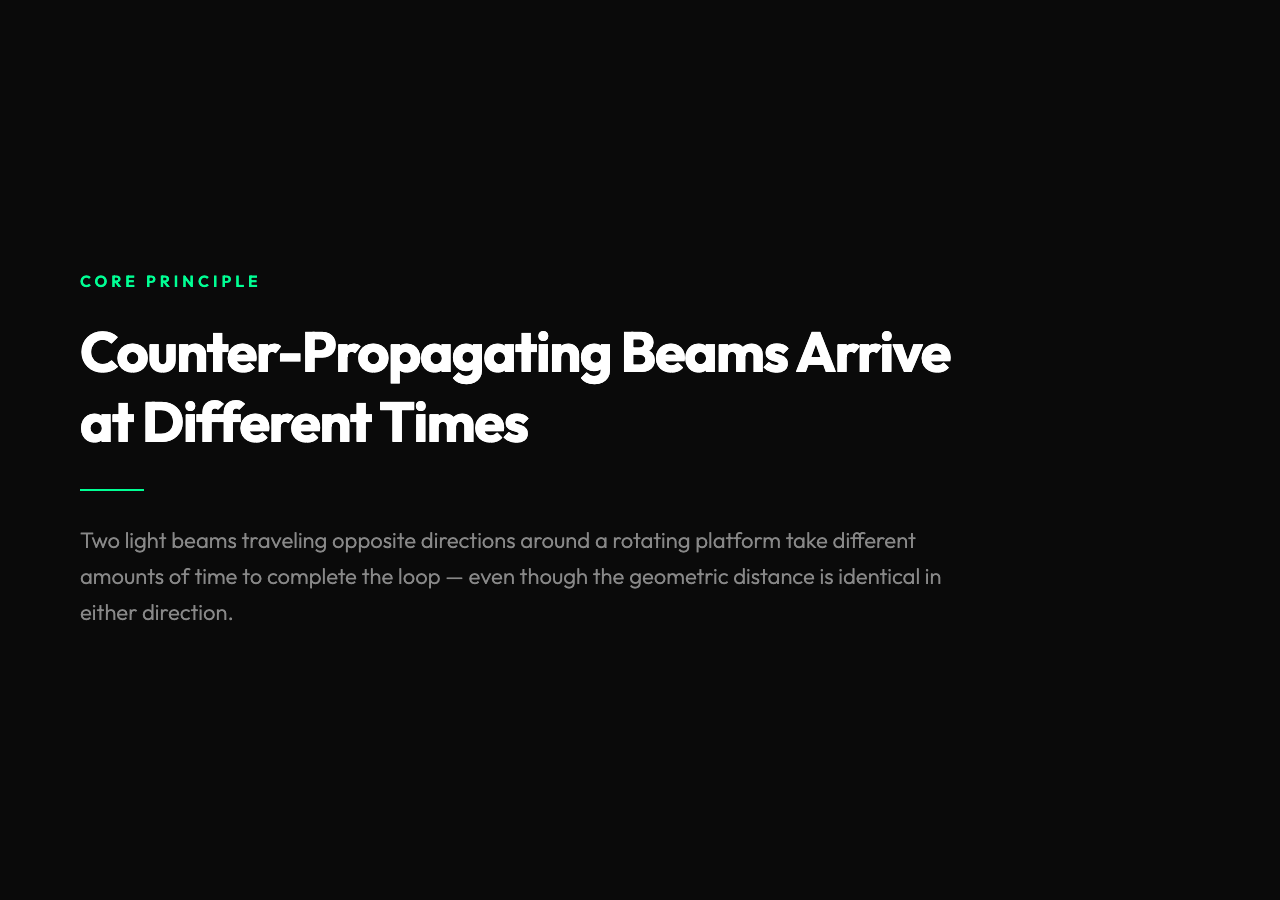
This is the Sagnac effect in its most mechanical form. The critical quantity is the time difference between the two beams:
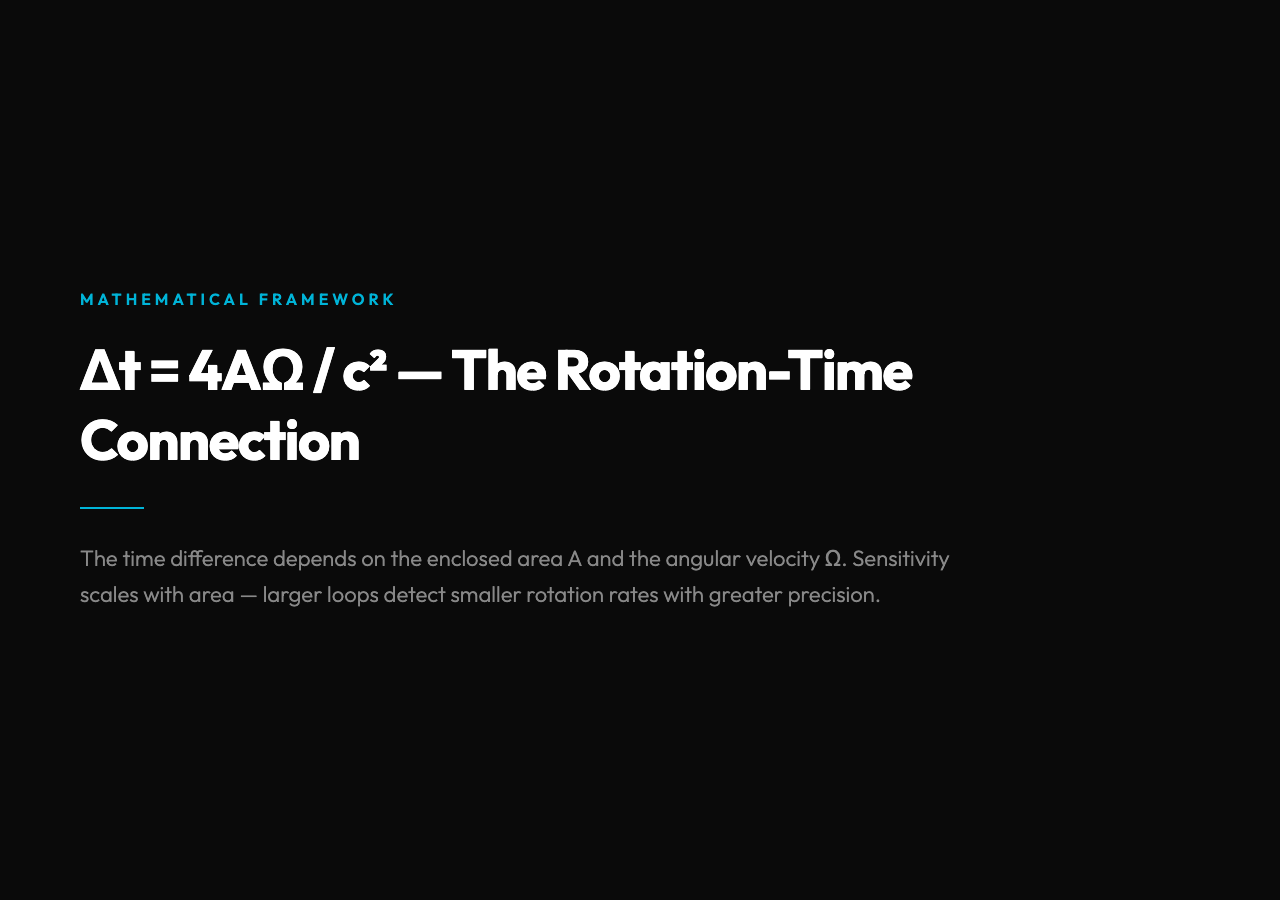
Delta t = 4AOmega/c^2
where A is the area enclosed by the light path, Ω is the angular velocity of rotation, and c is the speed of light. The phase shift is then:
Deltaphi = 4pi d · v/lambda c
where d is the path length, v is the velocity of the rotating platform, and λ is the wavelength of the light used.
What makes these equations remarkable is the c² in the denominator. Even for large areas and high rotation rates, the time differences are tiny — typically nanoseconds. Yet modern instruments detect them reliably. The Sagnac effect is not a large effect; it is a precise one.
Why Rotation Creates a Preferred Frame
Special relativity tells us that the speed of light is constant in all inertial frames. But a rotating platform is not an inertial frame — it is accelerating toward the center at every moment. When you travel around a circle at constant angular velocity, your velocity vector is constantly changing direction, which means you are accelerating even if your speed stays the same.
This acceleration defines a preferred state: rotation. The two counter-propagating light beams experience the rotating platform differently because one is moving with the platform’s surface rotation and the other is moving against it. Neither beam’s speed relative to the platform changes — both still travel at exactly c relative to any local measurement. But because the platform itself is rotating beneath the propagating light, the effective path length for each beam differs.
The result is an asymmetry that no amount of clever reasoning removes. Light traveling clockwise has to wait slightly longer to catch up to the moving source than light traveling counterclockwise. This is not a property of light alone; it is a property of spacetime in the presence of rotation. The Sagnac effect is, in this sense, a direct mechanical demonstration that rotating frames define a physically preferred state of motion.
The Interferometer Geometry
A practical Sagnac interferometer uses a beamsplitter to divide a single source into two coherent beams. These beams travel in opposite directions around a closed optical path — typically a fiber optic loop or a set of mirrors arranged in a square or triangular path. After completing the loop, they recombine at the same beamsplitter and produce an interference pattern.
If the platform is stationary, both beams take exactly the same time to complete the circuit. Their phases align, and the interference pattern is static. If the platform rotates, the beam traveling in the direction of rotation arrives slightly late relative to the beam traveling against rotation. Their phases no longer align, and the interference fringes shift proportionally to the rotation rate.
The sensitivity scales with the area enclosed by the light path. Larger loops produce greater phase shifts for the same rotation rate. Fiber optic gyroscopes — the most common practical application — use coiled glass fibers that accumulate effect over many loops of substantial total area. A single straight pass might produce an undetectable nanosecond-scale delay; a fiber coiled to 100 meters of path length produces enough accumulated shift to detect Earth rotation itself.
From Lab Demonstration to Navigation Infrastructure
The early history of the Sagnac effect was primarily academic. Sagnac’s original paper was followed by broader interest after general relativity predicted similar effects. Michelson and Gale used an interferometric version to measure Earth’s rotation in 1925 — a laboratory demonstration that produced a measurable fringe shift consistent with the theoretical prediction.
The practical shift came with fiber optics. The development of low-loss optical fiber in the 1970s made it possible to build Sagnac interferometers with path lengths of hundreds of meters inside a device the size of a coffee can. Unlike mechanical gyroscopes, fiber optic gyroscopes (FOGs) have no moving parts and are not subject to wear, friction, or calibration drift in the same way. They measure rotation directly through the behavior of light.
Modern FOGs achieve sensitivity below 0.001 degrees per hour — enough to detect the rotation rate of Earth in a device small enough to mount on an aircraft or submarine. They are used for attitude control in aircraft, navigation in autonomous vehicles, and stabilization in camera gimbals and robotics. The physics that Sagnac first observed in a rotating disc with a gas lamp is now embedded inside systems that millions of people rely on every day without knowing it.
Why Light Is the Most Reliable Rotation Sensor
Mechanical gyroscopes work by conserving angular momentum — a spinning wheel resists changes in orientation and maintains a fixed axis in space. They are precise for short periods but drift over time as friction removes energy from the system. Environmental factors including temperature, shock, and vibration all affect their calibration.
Light-based rotation sensing is fundamentally different because photons are not subject to friction. The Sagnac effect does not depend on storing angular momentum; it depends only on the geometry of the light’s path through spacetime. A beam of light traveling around a loop has no mechanism to lose phase coherence due to environmental factors the way a spinning wheel loses angular velocity. The signal is intrinsic to the geometry of the path.
This makes fiber optic gyroscopes exceptionally stable over time. Their primary error sources are temperature-dependent changes in the fiber’s refractive index — which affects the effective optical path length — and non-reciprocal scattering effects that can introduce small asymmetries between the two beams. Both are addressable through engineering: thermal compensation, careful fiber selection, and reciprocal optical design minimize these effects.
The result is an instrument where the fundamental sensitivity is determined by the wavelength of light and the total path length — both known, fixed quantities. Where a mechanical gyroscope requires regular calibration against known references, a fiber optic gyroscope requires only that the fiber be physically intact and the light source be stable. The measurement is traceable to fundamental constants.
What the Effect Reveals About Spacetime
The deeper significance of the Sagnac effect is not its engineering utility but what it says about the structure of physical law. The effect demonstrates that rotation defines a preferred frame — not in the sense of pre-Einstein absolute space, but in the sense that spacetime itself behaves differently in rotating frames.
In special relativity, all inertial frames are equivalent. You cannot detect uniform motion through empty space. But rotation is detectable — you feel acceleration toward the center of a rotating platform even at constant speed. The Sagnac effect translates that mechanical detection into an optical domain, showing that light carries enough information about the geometry of its travel to reconstruct the rotation of the platform on which it moved.
General relativity predicts this behavior precisely. The effect was one of the early experimental tests of the theory — and it passed. The fact that a rotating platform produces a measurable interference shift in counter-propagating light beams is exactly what general relativity predicts for a spacetime where rotation has geometric effects.
In a universe where nothing moves faster than light, measuring rotation by comparing the travel times of counter-propagating beams turns out to be the most reliable method available. That insight, first published in 1913, now lives inside every device that needs to know which way it is turning. The Sagnac interferometer started as a test of what was then an untested theory of gravity and became the most robust rotation sensor ever built.