The Question Nobody Argued With
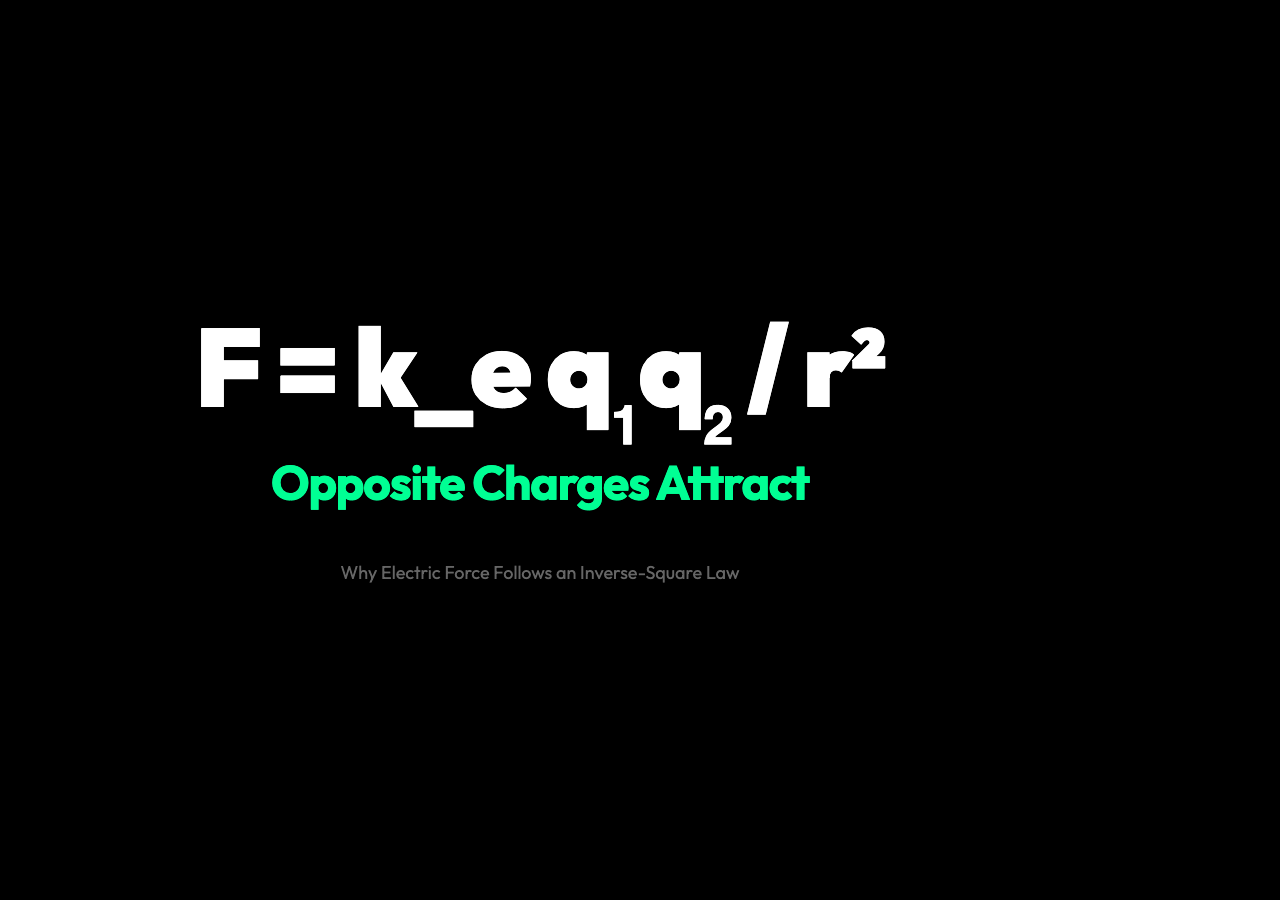
In 1785, Charles-Augustin de Coulomb published a law that described how electric charges push and pull on each other across empty space. He had no electrons, no field theory, no Maxwell’s equations. He had a torsion balance, some small spheres, and a willingness to measure what he saw. The result was one of the cleanest quantitative relationships in all of physics:
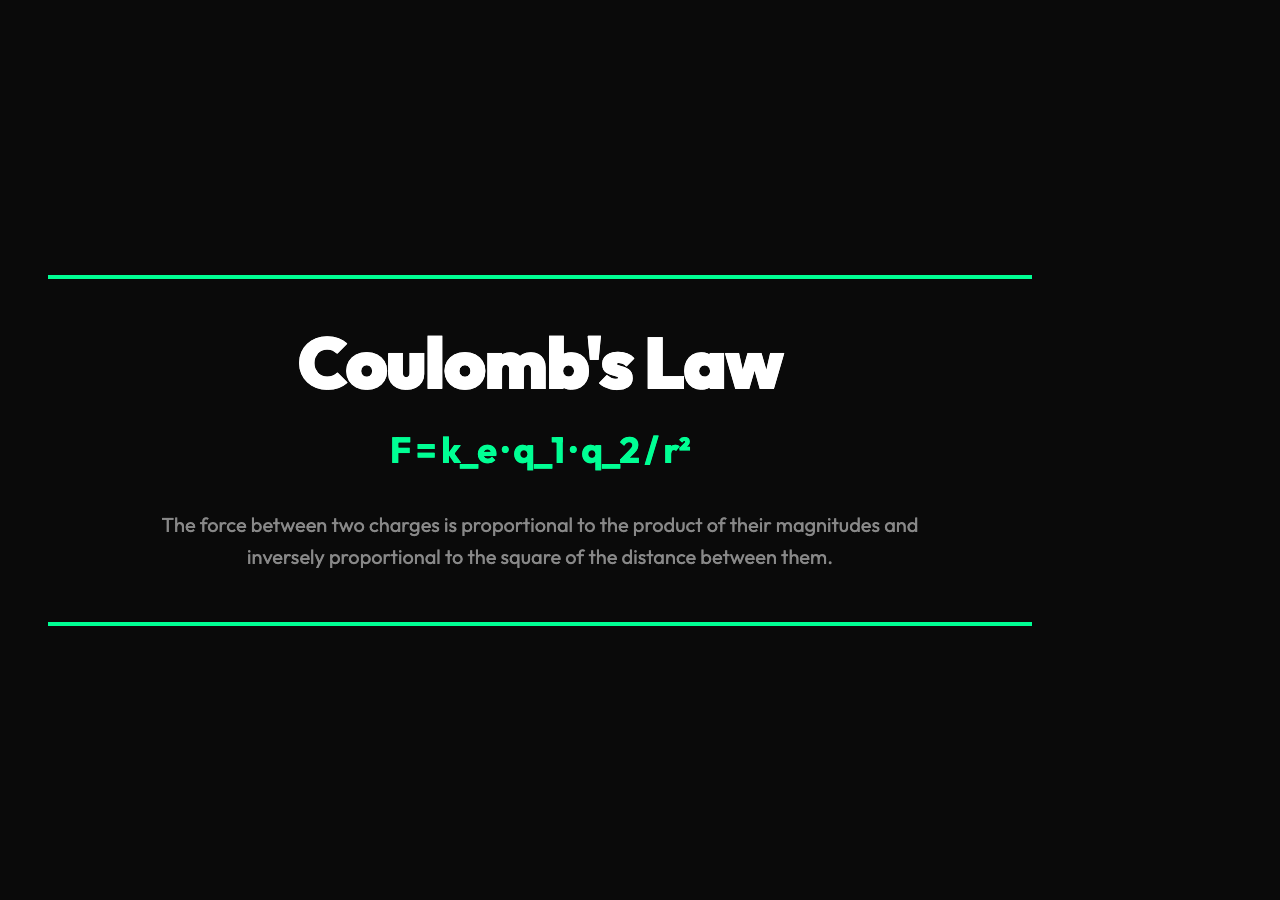
F = k_e · q₁ · q₂ / r²
The force is proportional to the product of the two charges and inversely proportional to the square of the distance between them. That single sentence — in the form of an equation — describes every attraction and repulsion between charged objects in the universe. A balloon rubbed on your hair. Lightning. The bonds holding molecules together. All of it flows from that relationship.
The interesting part is not the equation itself. The interesting part is everything the equation implies.
What the Inverse-Square Does
Most physical relationships involve direct proportionality. Double the input, double the output. But Coulomb’s law does something subtler: the force drops with the square of the distance, not the distance itself. That is not a minor detail.
When the distance doubles, the force doesn’t halve — it falls to one quarter. When it triples, the force is one ninth. This is the geometry of a field spreading through three-dimensional space. Imagine a burst of light from a point source: the same amount of energy spreads over a sphere whose surface area grows as 4πr². Intensity (power per unit area) therefore falls as 1/r². Force between charges follows the same mathematical fate because the electromagnetic field propagates at the speed of light through space.
This is not an assumption built into Coulomb’s law. It is a consequence of what happens when anything — light, gravity, sound — spreads outward from a point. The inverse-square is the signature of a field diluting itself across the geometry of a sphere.
Attraction, Repulsion, and What That Means for Stability
The sign in Coulomb’s law carries information. When two charges have the same sign — both positive or both negative — their product q₁q₂ is positive, and the force is positive: they repel. When the signs are opposite, the product is negative, and the force is negative: they attract.
This is why atoms hold together. The positively charged nucleus attracts the negatively charged electrons. This is why chemical bonds form. This is why your hair stands up after you rub a balloon on it — charge transfers, opposite charges induce attraction between the balloon and the hair, and the hair reaches toward the balloon.
But note the tension: attraction brings charges together, and as they approach, the force grows stronger (1/r² again). Two opposite charges released near each other accelerate toward each other, gaining speed as the distance shrinks. Unless something stops them, they collide. The only thing that prevents collapse is angular momentum or quantum mechanics — depending on the scale.
For electrons orbiting a nucleus, it’s quantum mechanics. The electron cannot spiral into the nucleus because its position is described by a probability distribution, not a classical trajectory. Without quantum mechanics, every atom would be a tiny catastrophe.
The Superposition Principle: Forces Add
Coulomb’s law describes the force between exactly two charges. But the real world has many charges, and they all exert forces on each other simultaneously. This is where the law’s simplicity becomes powerful: the total force on any charge is the vector sum of the forces from all other charges. This is the superposition principle, and it holds for electromagnetic forces in classical physics.
In the interactive visualization, you can place two charges and observe the force vectors between them. Then add a third charge. The field lines shift. The force vectors adjust. The total force on each charge updates in real time according to vector addition. This is not an approximation — it is an exact property of electromagnetic interactions.
What this means practically: you cannot “cancel out” a force from one direction by adding a charge in another direction in a way that leaves the first force unchanged. Every charge you add changes the force on every existing charge. The system is fully coupled.
What You Can and Cannot See
The visualization shows electric field lines emanating from charges — straight lines from positive charges, curves terminating on negative charges. These lines are a map of direction: at any point in space, a test charge would feel a force tangent to the field line passing through that point.
But field lines are not physical objects. They are a visualization tool. The actual field exists everywhere in space, not just along the drawn lines, and its strength at any point is given by the vector sum of contributions from every charge in the system.
What makes Coulomb’s law remarkable is that it makes predictions that match observation with extraordinary precision across scales from 10⁻¹⁵ meters (nuclear dimensions) to at least 10⁷ meters (laboratory bench to low orbit). No other law of classical physics has been tested across such a vast range of distances.
The inverse-square has one more implication worth noting: if the exponent were not exactly 2, electromagnetic phenomena would not be conservative, and the concept of electric potential energy would be meaningless. The 2 is not approximate. Measurements constrain it to within 2×10⁻⁹ of unity. Nature is not negotiating.
Coulomb’s law is one of the few physical relationships that survives unchanged from the 18th century to today — not because physicists stopped looking, but because nothing in the data has forced them to revise it. Every charge in the universe attracts or repels every other charge with a force that depends only on their magnitudes and the distance between them. No mechanism mediates this. No field is assumed — it emerges from the observation. That simplicity is the point. The laws that last are the ones that don’t need a story.
If you change the distance between two charges, the force changes instantly across the entire universe. That’s not a local effect. It’s a statement about how distance itself works in electromagnetism — and why the geometry of space is not just a stage where physics happens, but a participant in it.