Light always finds the fastest route between two points. That single idea, formalized by Pierre de Fermat in the 1660s, explains why light bends at boundaries, why prisms separate colors, why optical fibers trap signals, and why GPS satellites must account for signal bending through the atmosphere to pinpoint your location. The principle is geometrically counterintuitive — the shortest path is rarely the fastest. Yet every time you take a photograph, make a phone call, or navigate somewhere new, you are relying on nature’s relentless optimization of travel time. Fermat gave that optimization a name, and optics has never been the same.
The Problem with Straight Lines
Imagine standing on dry ground, looking at a fish underwater. The fish appears to be at a shallower depth than it actually is — a classic optical illusion caused by light bending as it travels from water into air.
Or consider GPS satellites orbiting 20,000 kilometers above you. The signals they send don’t arrive by a straight line — they bend through the atmosphere, arriving slightly delayed, and your phone must account for that bend to calculate your position correctly.
These two situations seem unrelated. They are not. Both are consequences of one principle that governs all of optics: light takes the path that minimizes travel time.
Fermat’s Principle: Nature Optimizes Time
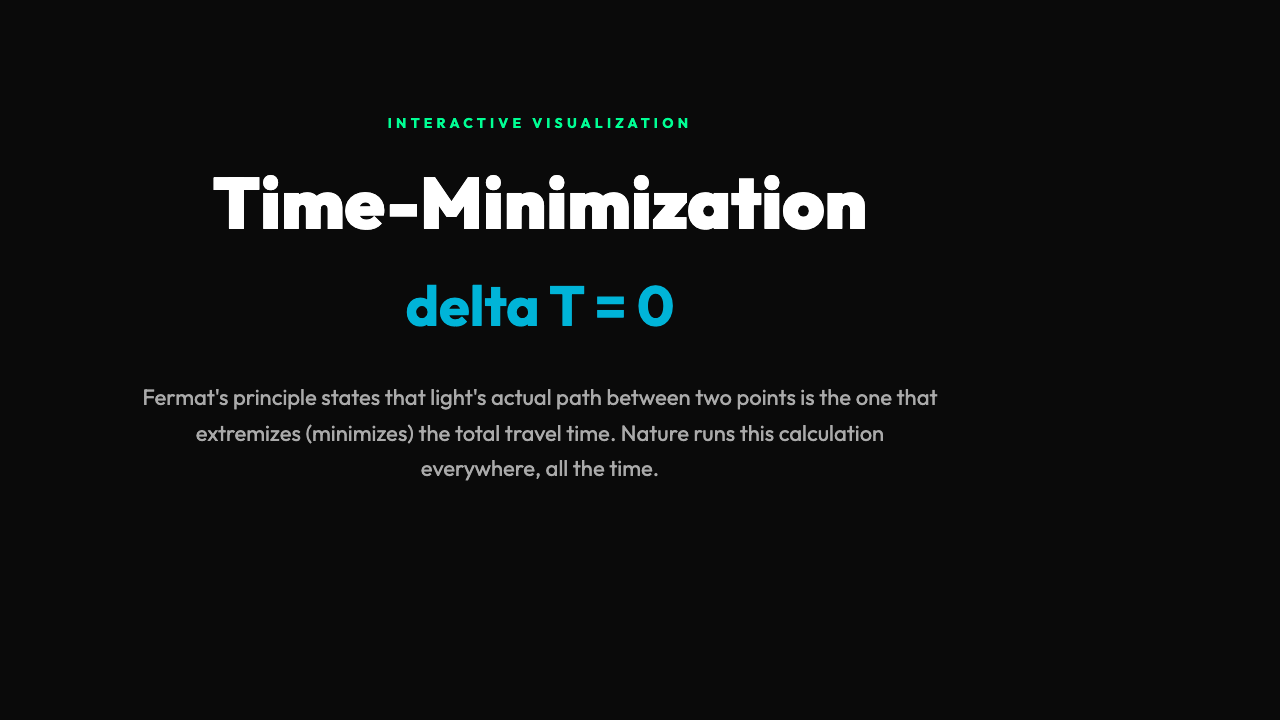
Pierre de Fermat formalized this idea in the 1660s. He proposed that when light travels between two points, it selects the path that requires the least time — not the shortest distance, not the straightest line, but the fastest route.
This is a subtle but powerful distinction. The straight line between two points is usually the shortest distance. But if part of that straight line passes through a slow medium — like water or glass — the total travel time may be longer than a bent path that avoids the slow material as much as possible.
Light does not consciously calculate. It simply always behaves as if it is searching for the fastest path. Fermat’s Principle is the mathematical statement of that behavior.
From Principle to Law: Snell’s Law Emerges
When light passes from one medium into another — air into glass, for example — the boundary forces the light path to bend. The angle of that bend is not arbitrary. It follows directly from minimizing travel time.
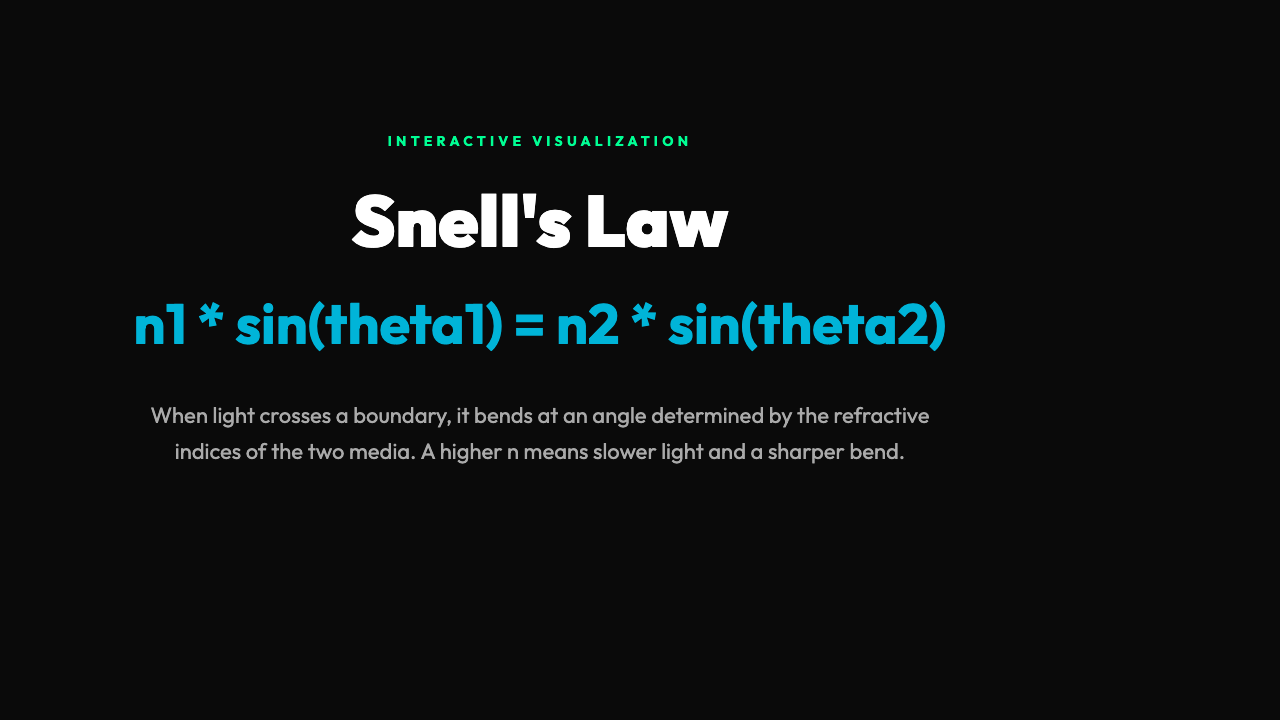
The governing equation is Snell’s Law: n₁ · sin(θ₁) = n₂ · sin(θ₂), where n is the refractive index of each medium and θ is measured from the boundary normal. A higher refractive index means light travels more slowly in that material.
Using a concrete example: light going from air (n₁ = 1.0) into glass (n₂ = 1.5) at an incident angle of 30°. The refracted angle works out to:
θ₂ = arcsin(1.0/1.5 × sin(30°)) = arcsin(0.333) ≈ 19.5°
Light bends more toward the normal when entering a slower, denser medium.
A Numbers Check: Does the Bent Path Actually Save Time?
Consider point A in air and point B inside glass, separated by a boundary. A straight line through both media is geometrically shortest — but a significant portion of that path drags through slow glass (where light travels at 0.67c).
The alternative: a bent path that takes a slightly longer route through air but a much shorter route through glass. Air is fast (light travels at c there); glass is slow. The slightly longer air segment is more than compensated by the drastically shorter glass segment. The bent path wins on total time.
The time difference per photon is small — on the order of nanoseconds over centimeter-scale distances. But nature runs this calculation quadrillions of times per second across every photon in view, and the principle holds without exception over any distance scale.
What Fermat’s Principle Explains
This principle unifies virtually every optical phenomenon:
Refraction — the apparent bending of submerged objects, the function of lenses, the operation of prisms. All of these arise from light selecting minimum-time paths across media boundaries.
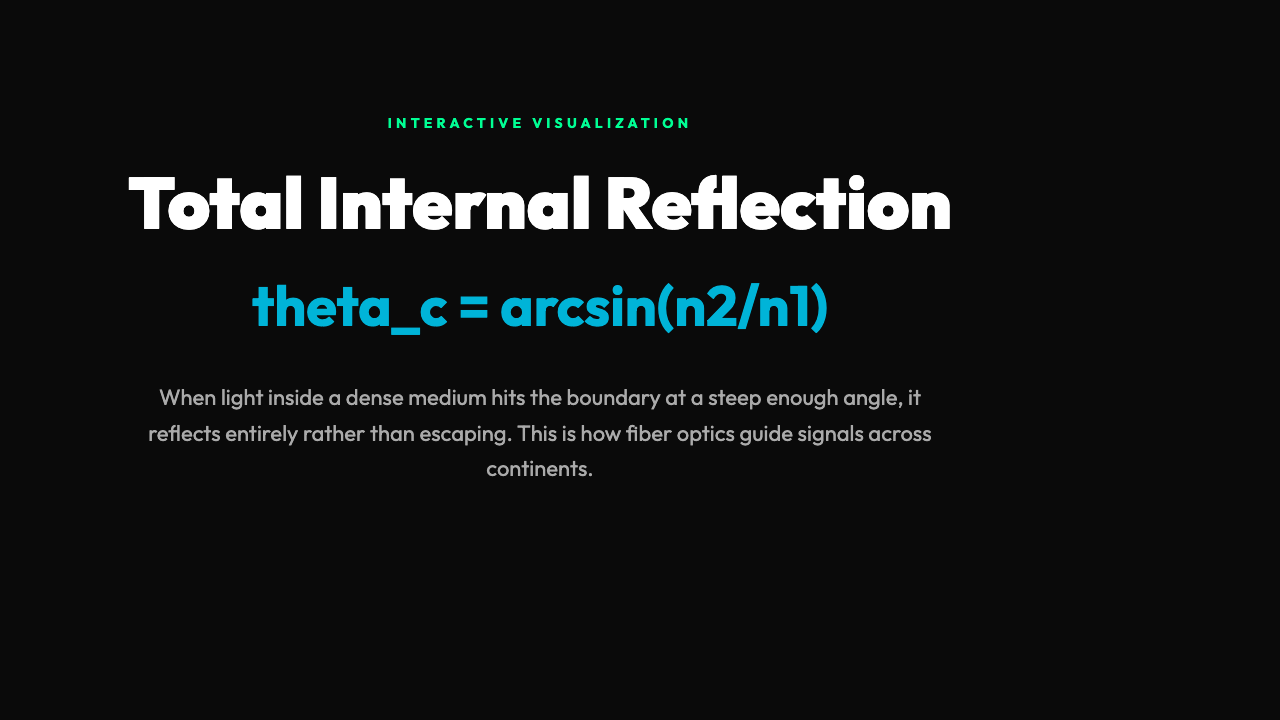
Total Internal Reflection — when light inside glass or water hits a boundary at a steep enough angle, it reflects entirely rather than escaping. This is the fastest path available under the constraint — and it is the operating principle behind every fiber optic cable on Earth.
Dispersion — white light spreading into a rainbow through a prism. Different wavelengths travel at different speeds in glass (n varies slightly), so the minimum-time path differs for each color. This is why red bends least and violet bends most.
The Technology Running on Fermat’s Principle
Every lens in every camera, microscope, telescope, and eyeglass prescription is designed by solving for minimum-time paths. Lens makers have used Fermat’s principle as their foundation for centuries.
Fiber optic cables — the physical internet backbone spanning ocean floors and continental interiors — function entirely through repeated total internal reflection. Light bounces inside a glass fiber along the fastest possible route between two points, confined by boundary reflections that always send it back into the faster medium.
The GPS system that billion-dollar satellites provide depends on this principle too. GPS signals bend through the atmosphere, which is not a single uniform medium but a gradient of changing refractive index. Each bend follows a minimum-time trajectory. Without accounting for these bends, GPS positioning would be off by meters — enough to misroute emergency responders.
Why the Shortest Path Is Not the Fastest
Fermat’s principle sounds simple, but its consequences are genuinely counterintuitive. Our everyday intuition says “straight is fastest.” Fermat says “not always.” The straight path through a slow medium is geometrically tempting but physically wasteful. Nature does not do geometry — it does time optimization.
This is why lenses are shaped the way they are, why prisms separate light, why fiber optics work, and why your phone knows where you are. The principle has held without exception since Fermat proposed it, and it will govern every future optical system we build.
Light always finds the fastest route between two points.