A domain name looks like the most public record on the internet. It is published in DNS, indexed by every certificate authority, copied into spam lists, and echoed by every web crawler that ever visited the site. The protocol designed to expose who owns it — WHOIS — still works in 2026, but the answer it returns is no longer the answer most people expect.
For about thirty years, typing whois example.com at a shell prompt would give you a registrant name, an email, a phone number, and a postal address. Since 25 May 2018, the General Data Protection Regulation has made most of those fields toxic to publish. The protocol kept running. The fields kept arriving. They just stopped saying what they used to say.
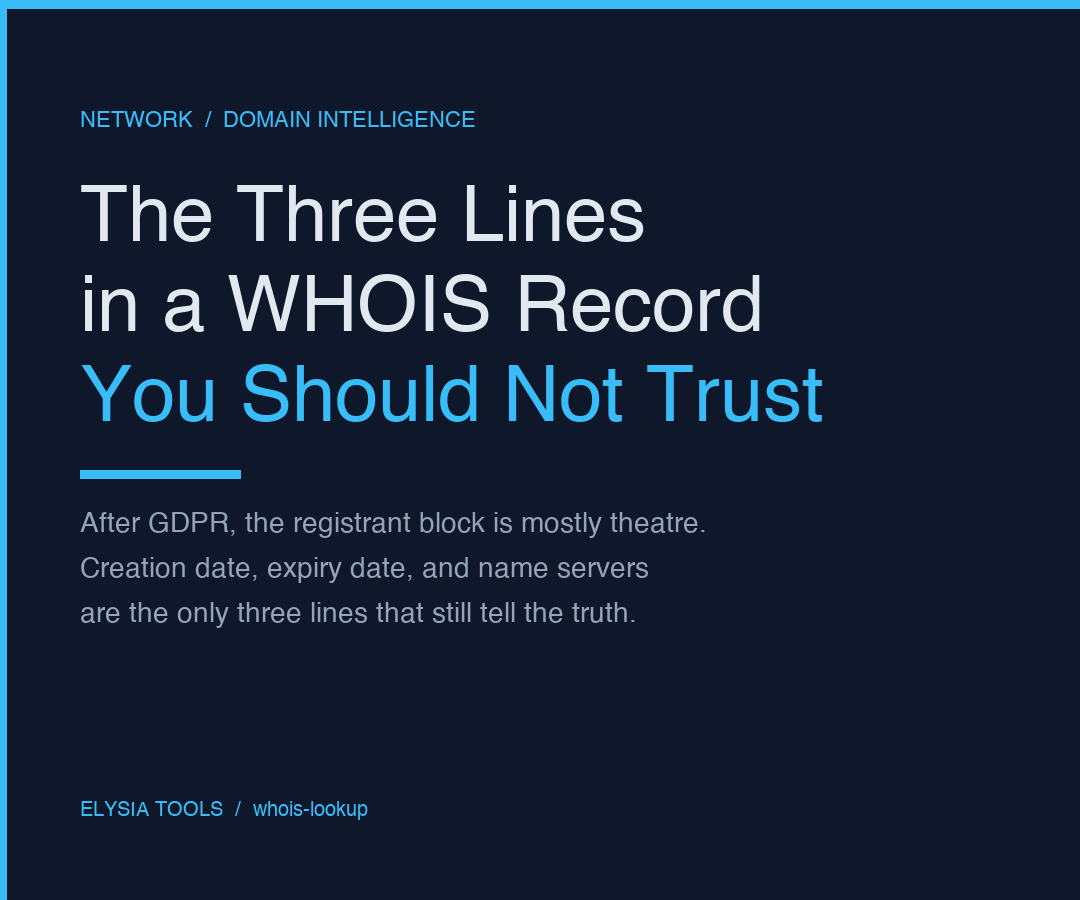
If you have not run a WHOIS lookup recently, the result will look surprisingly hollow. The data is still there, the syntax is the same, the format is unchanged, and almost every useful piece of information has been replaced with the words REDACTED FOR PRIVACY. The trick is learning which three lines in that record are still honest, and which three are now decorative. Most of the dashboards that call themselves “domain intelligence tools” do not make that distinction. They hand you the redacted fields as if they were facts.
The three lines that still tell the truth
When a registrar redacts a domain on GDPR grounds, it redacts fields, not the whole record. Three fields cannot be redacted without breaking how the domain system works, and those are the three that are worth your time.
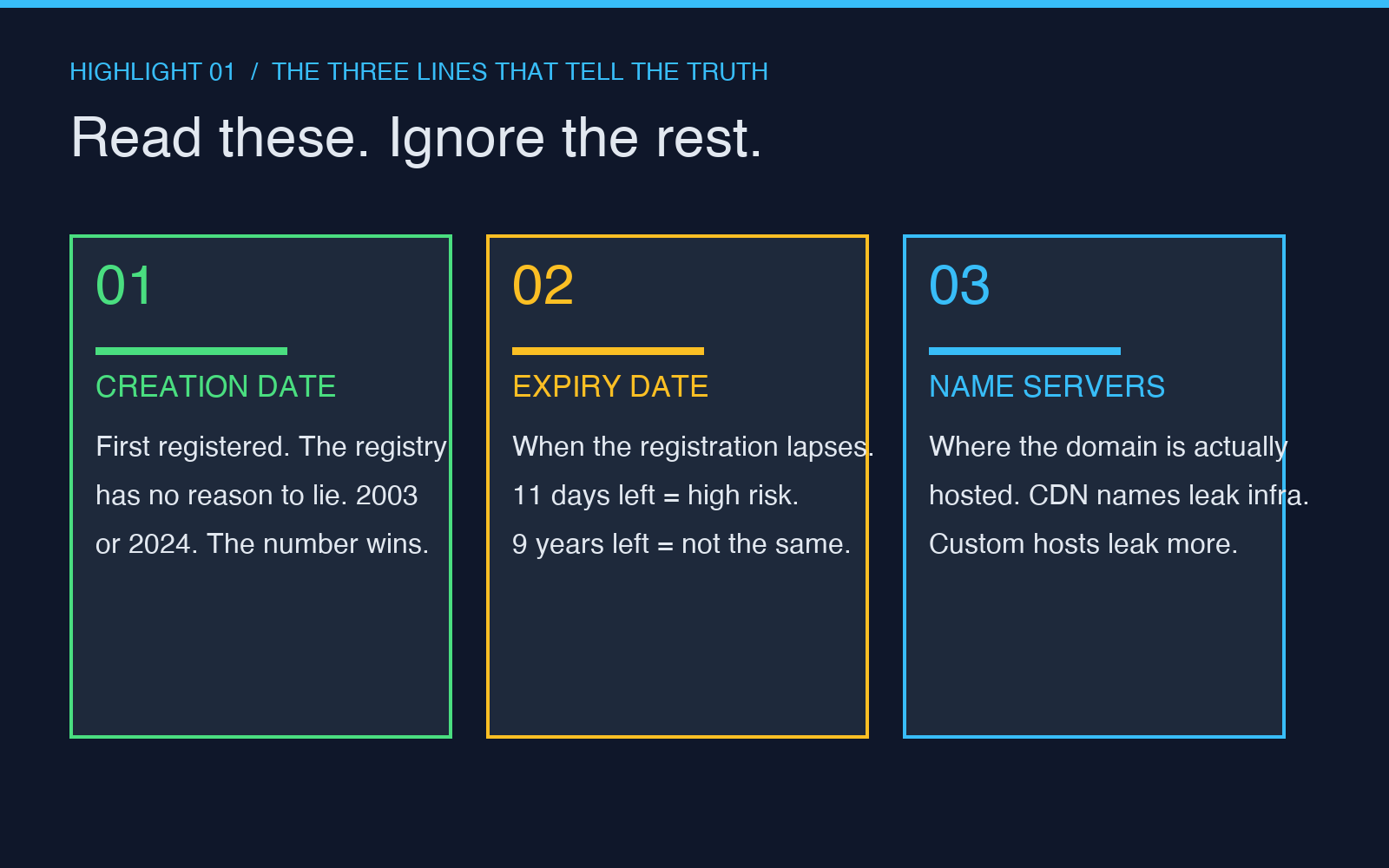
Creation date. When the domain was first registered, by which registry, and under which TLD. The registry of record has no reason to lie about when it accepted the registration, and the registrar cannot retroactively change it. If a vendor tells you a domain was “first registered in 2019” but the creation date is 2003, one of those statements is wrong, and the creation date is the one that survives.
Expiry date. When the current registration lapses if the owner does not renew. This is the single most useful number for risk scoring a domain you have never seen before. A domain that expires in eleven days is not the same risk as one that expires in nine years, and the WHOIS record is the only place on the open internet that tells you the difference.
Name servers. The actual DNS hosts the domain is pointed at. These are not redacted because the domain will not resolve without them being public. Name servers leak information. A domain pointed at ns1.cloudflare.com tells you it is behind Cloudflare. A domain pointed at ns-cloud-a1.googledomains.com tells you it sits on Google Workspace DNS. A domain pointed at a custom host like ns1.shady-vps-2024.example tells you something else entirely. The name server line is the most underused risk signal in the whole record.
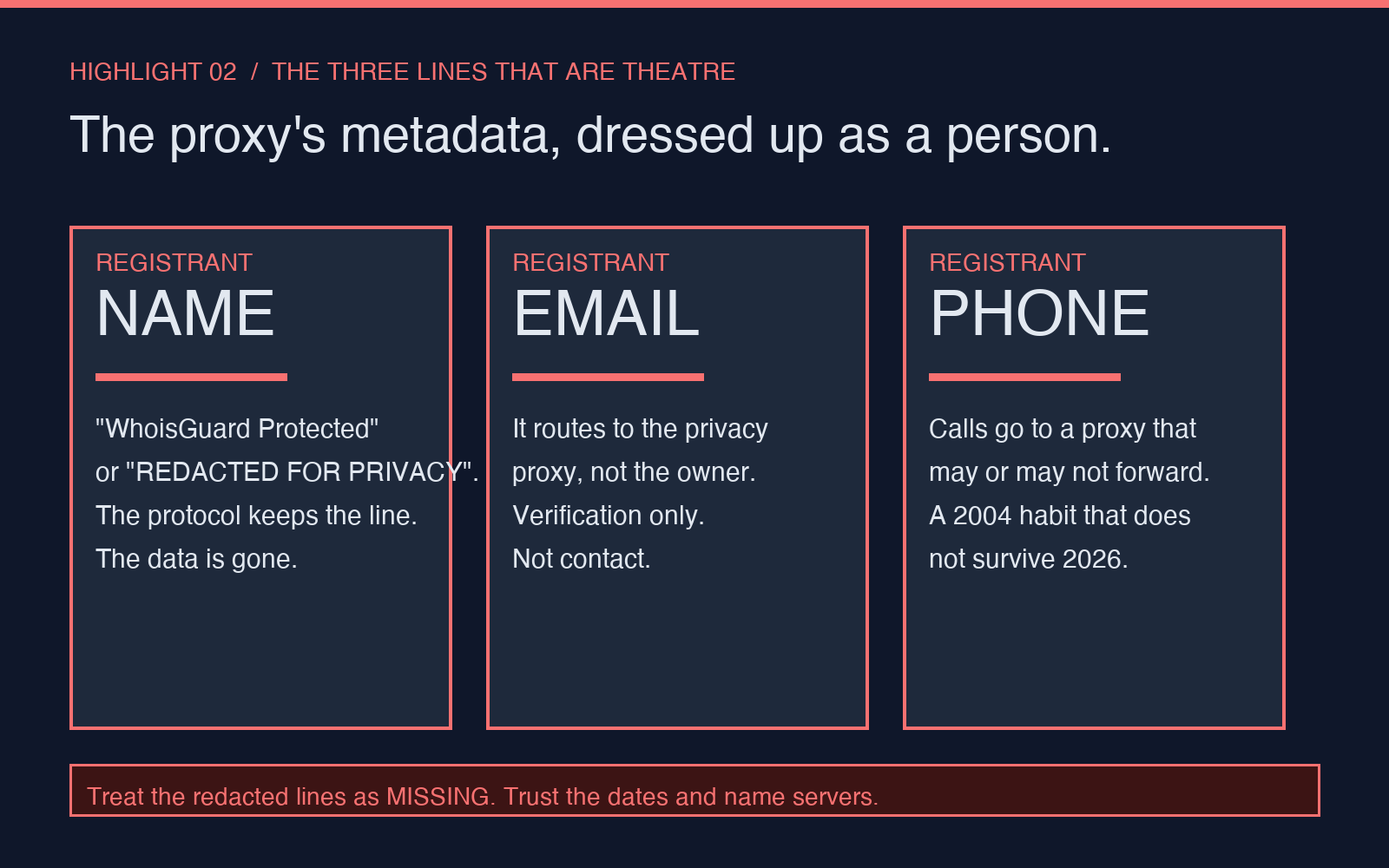
The three lines that are now mostly theatre
Everything that used to identify the actual human or organization behind a domain is, in 2026, almost always a proxy. The proxy is the registrar’s privacy service, or a third-party WHOIS privacy vendor like WhoisGuard, Domains By Proxy, or Contact Privacy. The lines look like data. They are not data.
Registrant name. If you see “REDACTED FOR PRIVACY”, that is the honest case. If you see a real-looking name, it might be the proxy service’s name (e.g., “WhoisGuard Protected”), the name of a small registrar that did not implement the redaction correctly, or a registrant who opted in to public data. In the first two cases, you have learned nothing. In the third, you have learned that the domain owner is unusually open.
Registrant email. The protocol still requires an email field, and the registrar will not redact the technical contact email, because that is how verification and transfer requests reach the owner. So the line is populated, but it is the proxy’s email, not the owner’s. Emailing it does not reach the person you think it reaches.
Registrant phone. Same story. The phone number is the proxy’s. The proxy may forward calls, may not, and may have stopped doing so years ago. Calling the number on a WHOIS record to reach a domain owner is a habit from 2004 that does not survive 2026.
For most of the 2000s, the WHOIS record was the spine of the domain ownership question. After GDPR, the spine broke, and the lines that remain are mostly the proxy’s metadata, dressed up in a syntax that still looks like a person.
Why this matters more than it used to
The reason this matters is that domain-name abuse has not slowed down. Phishing kits, business email compromise, drop-catcher domains, and fraudulent storefronts all use fresh registrations, and the investigator trying to chase them down has fewer and fewer open records to work with. The old playbook — “look up the WHOIS, email the registrant, wait 48 hours” — produces a polite auto-reply from a privacy proxy in 2026, where in 2010 it produced a real person.
Two of the most useful questions in a domain investigation are when was this domain first registered and where is it actually hosted. The first tells you whether the site is a six-year-old business that might be legitimate, or a six-day-old registration that is, almost by definition, not. The second tells you which infrastructure company to ask for abuse reports, and which country’s legal system to file a subpoena in if the abuse persists. Neither of those questions is answerable from a “REDACTED FOR PRIVACY” line. Both are answerable from the three lines I called out earlier.
The trap that catches most people is treating the redacted fields as missing data and the non-redacted fields as trustworthy. The opposite is closer to the truth. The redacted fields are missing. The non-redacted fields are the ones the registry cannot redact, which makes them the ones that survived for technical, not privacy, reasons.
How to read a WHOIS record in 2026
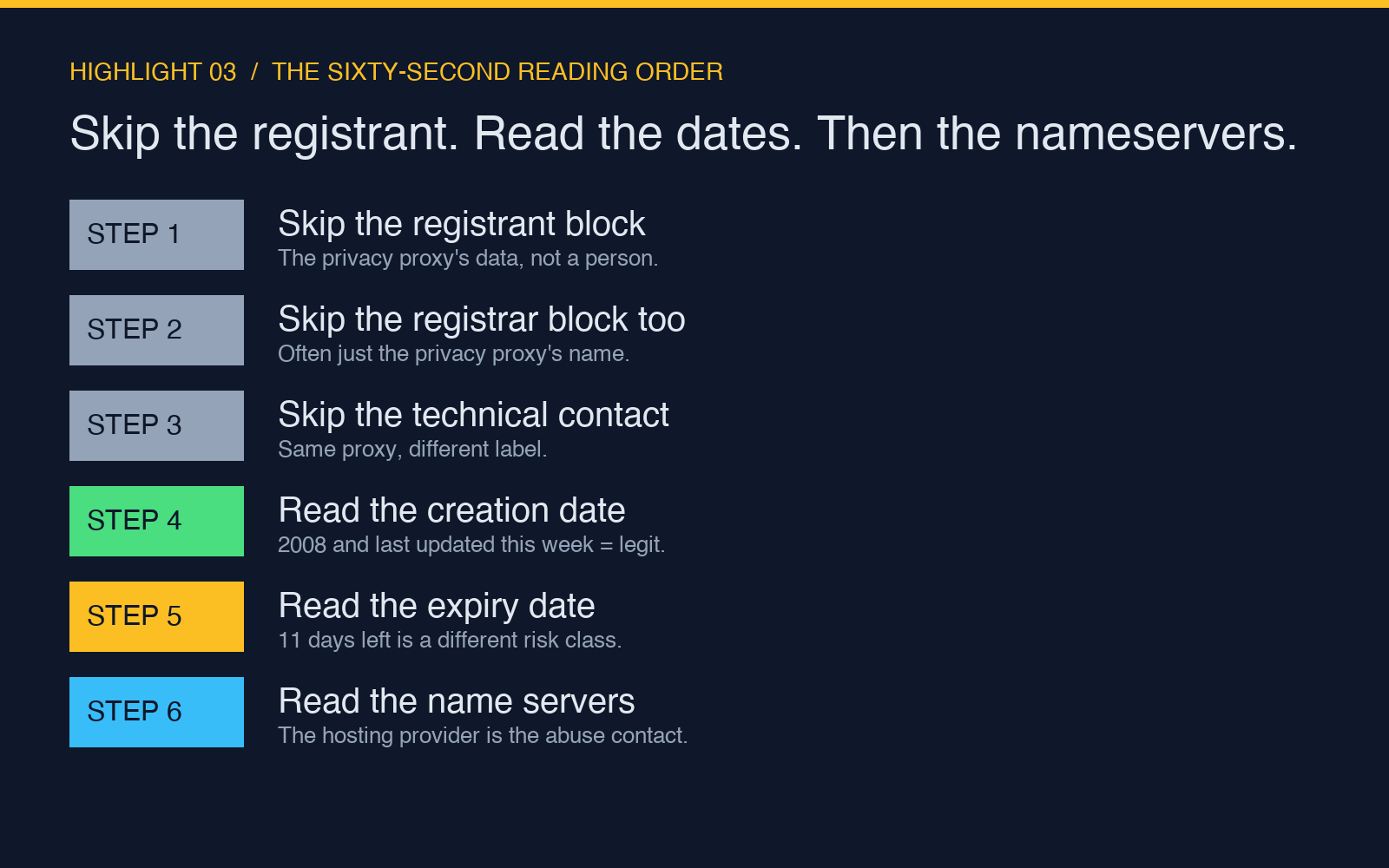
A practical reading order, if you have only sixty seconds:
Skip the registrant block. The registrar block is a coin flip between useful and decorative, depending on whether the registrar is also acting as the privacy proxy. The technical contact block is the proxy’s metadata. Go straight to the dates and the name servers.
Read the creation date and the last-updated date together. If the domain was registered in 2008 and last updated last week, the owner is actively maintaining it. If it was registered last month and updated last month, you are looking at a freshly thrown domain, and the only honest question is what it is going to be used for. The 5-day Add Period after a registrar change is worth knowing about — for those five days the new registrar’s WHOIS server may be the only one that returns the updated record.
Read the name servers. If they belong to a large CDN or hosting provider, the domain is sitting on rented infrastructure, and an abuse report to that provider will be the fastest way to get the site taken down. If the name servers belong to a small, custom-named host, the domain is probably running on a single VPS somewhere, and the abuse report will go to the VPS provider, not the registrar. Knowing which one you are talking to is the difference between a 4-hour takedown and a 4-week one.
That is the whole job. The rest of the record is not for you, and the registrar that published it knows it.
The pattern behind the proxy
The deeper shift here is about trust, not about redacted fields. For thirty years, WHOIS was a directory. You could trust the registrant name to be a real person, the email to reach a real inbox, and the phone to ring. None of those assumptions has been true for eight years. The protocol still pretends. The fields still look like a person. The directory is closed.
What replaced the directory is not a single thing, but a stack of small signals: the creation date, the expiry date, the name servers, the certificate transparency logs, the passive DNS data, the hosting provider’s abuse queue. None of them is as complete as the old WHOIS was. Together, they tell you almost everything the old WHOIS told you, plus a few things the old WHOIS never could — like which other domains the same infrastructure hosts, and how recently the certificate was issued.
The mistake is to keep reaching for the old directory out of habit. The right move is to learn the three lines that still mean something, and to ignore the rest of the record the way you have already learned to ignore the comments section of a news article: it is still formatted like content, it is still technically public, and it stopped being information a long time ago.
If you want to see what a modern WHOIS lookup actually returns, you can run one against any domain at the Elysia Tools WHOIS Lookup. The tool shows the raw record, the redacted fields marked, and the dates you can actually use, so you can see for yourself which lines still tell the truth and which lines are now just the protocol’s way of staying polite. For a quick way to do the same check programmatically — useful when you have a list of fifty domains from a phishing report — the DNS Query tool sits one click away, and so does the CIDR Calculator for the rare cases where the WHOIS record hands you an IP block to interpret.
More domain and network tools live in the Elysia Tools network category — they are free, they run in the browser, and they were built for the kind of investigation where the protocol keeps changing underneath you.