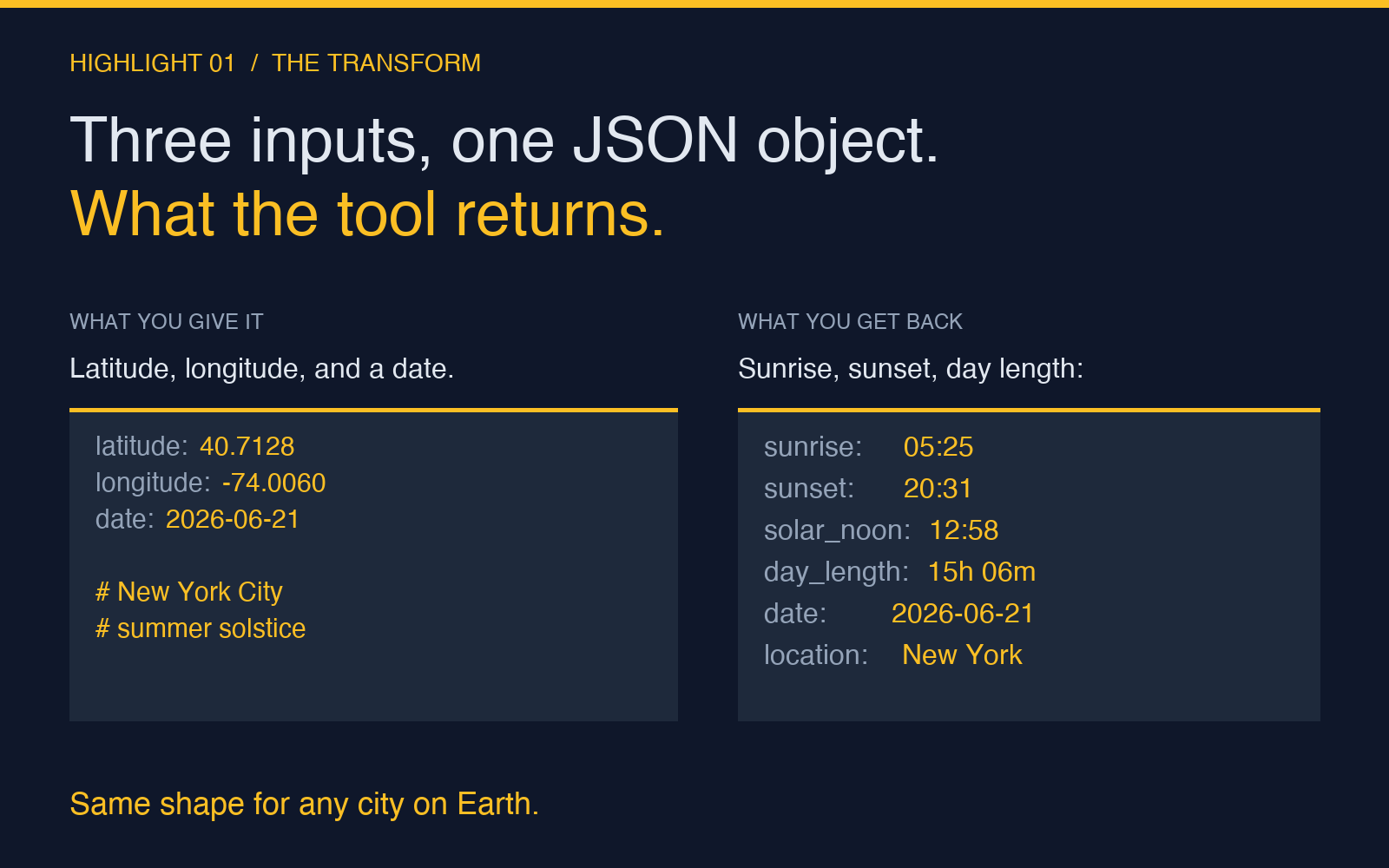
Every daylight calculator returns the same four numbers: sunrise, sunset, solar noon, and day length. Run one for New York on June 21 and you get 05:25 / 20:31 / 12:58 / 15h 06m. Run it again for Boston, same date, and the answer shifts. Not by minutes. By which minutes.
That gap is the whole story. The numbers look exact because they are. The interpretation underneath them is what breaks.
The Daylight Calculator takes three inputs — latitude, longitude, and a date — and returns a clean JSON object. You can also feed it a city by name, swap the date for tomorrow or next winter, and watch the entire shape of the day move. Most people stop at the first answer. The interesting part is what the second one tells you about the first.
What the tool is actually doing
Behind the four numbers sits a closed-form astronomical model. The calculator derives the sun’s apparent position for a given moment using the declination angle (the 23.4° axial tilt) and the equation of time (the 16-minute annual drift between a sundial and a clock). It then solves for the moment the sun’s center crosses the horizon at -0.83° to account for atmospheric refraction and the sun’s apparent radius.
That -0.83° is where most surprises come from. It is not the moment the sun touches the horizon. It is the moment the upper edge of the sun becomes visible after bending through the atmosphere. Move to a higher elevation, or pick a different refraction model, and the answer shifts by a minute or two.
The four inputs that move the answer
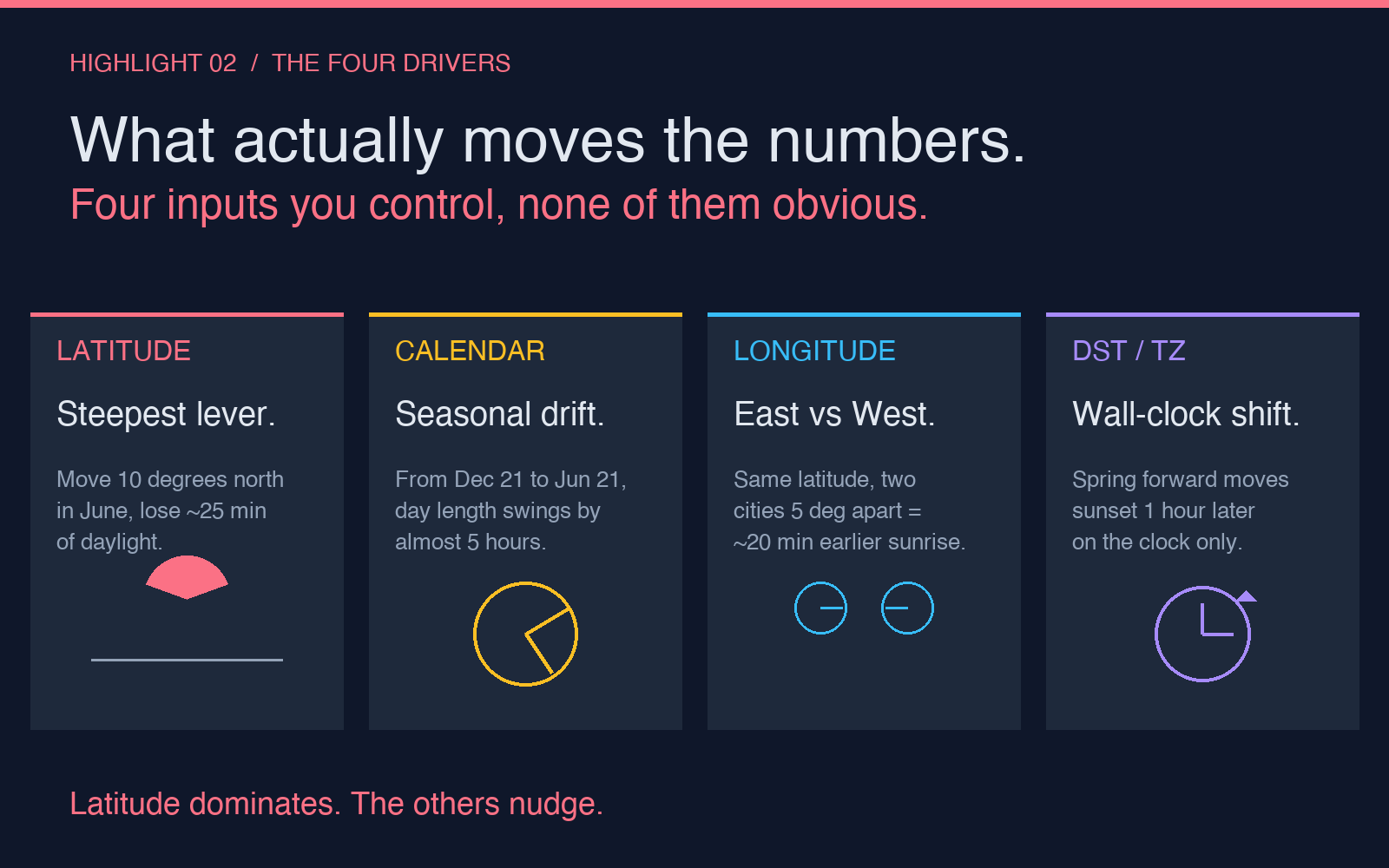
If you run the same date across different inputs, the day length number changes in roughly the order below. The first lever dominates. The rest nudge.
- Latitude. This is the steepest lever. Move 10 degrees north in June and you lose about 25 minutes of daylight. Move to the Arctic Circle and the answer is “the sun does not set.” The calculator handles this gracefully; the rule breaks at the polar circles, and the tool returns a sentinel value rather than a fake number.
- Calendar position. Day length swings seasonally. The 6-month arc from the December solstice to the June solstice moves day length by almost 5 hours at 40 degrees north. The change is fastest at the equinoxes and slows to zero at the solstices themselves, which is why a daylight calculator run for March 21 and March 22 returns very similar numbers, while one for March 21 and April 21 returns wildly different ones.
- Longitude within the same time zone. This is the one that breaks casual expectations. Two cities at the same latitude, but 5 degrees of longitude apart, see sunrise about 20 minutes earlier for the eastern one. The wall-clock time is the same because the time zone is the same, but the actual sun is offset. The calculator returns local-clock times, so you cannot tell from the answer alone that one of the cities is closer to solar noon than the other.
- Daylight Saving Time. The clock jumps forward an hour in March and back an hour in November. The sun does not move. The calculator returns the same solar time either way, but the wall-clock answer is shifted by 60 minutes for the half of the year when DST is active. If you compare answers across a DST transition, the daylight length number is the same, but the sunrise/sunset clock times look like they shifted by an hour for no reason.
That fourth one is the one most apps hide. A weather app that quietly adds or subtracts an hour when DST flips does not tell you it did so. A daylight calculator, run twice across a DST transition with the same inputs, will show the wall-clock numbers shift while the underlying day length stays the same. That difference is the gap between “solar time” and “what your phone says.”
What the numbers still do not tell you
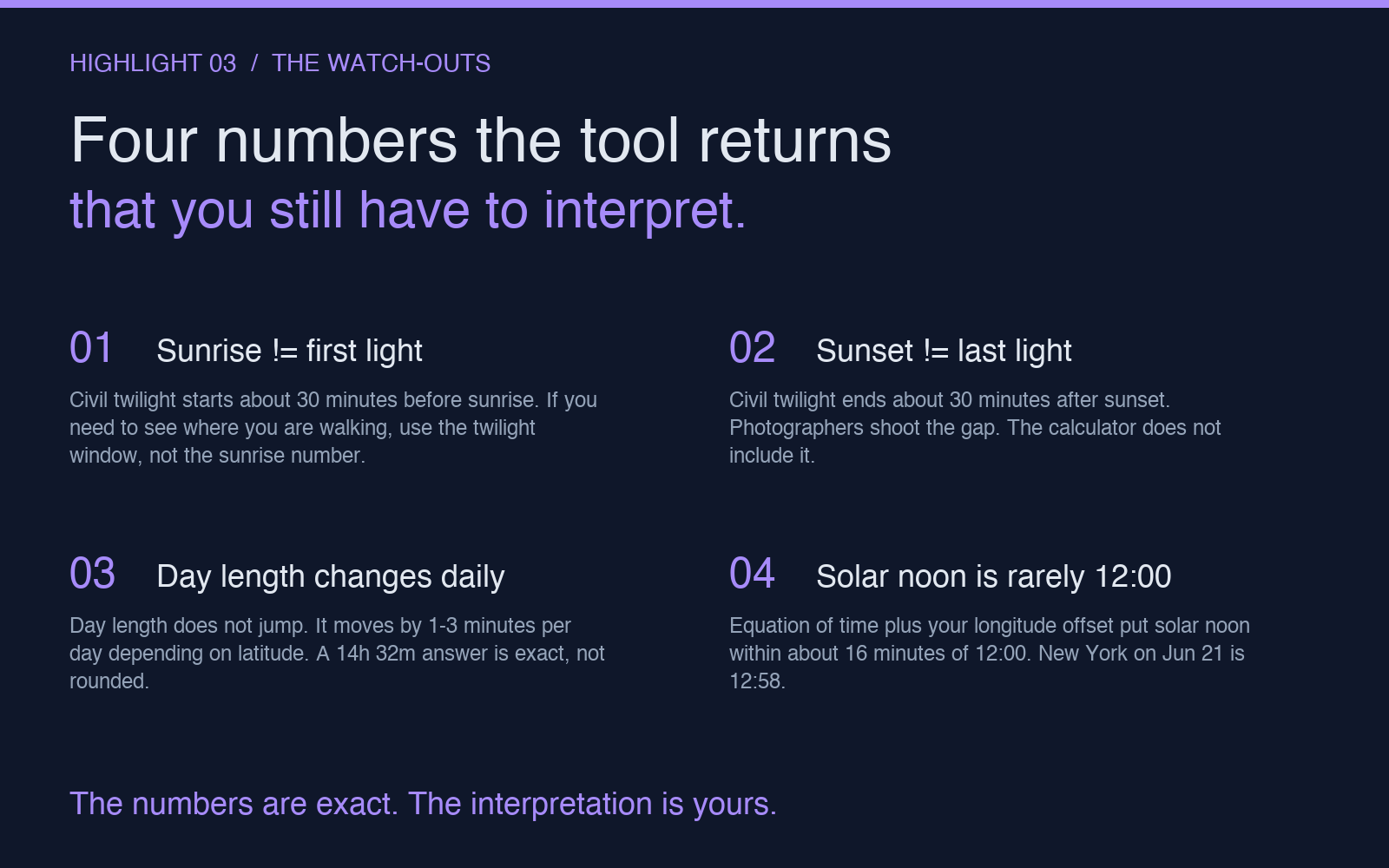
Even when the model is exact, four things still need interpretation. None of them are bugs. All of them are things the tool returns and you have to read carefully.
- Sunrise is not first light. Civil twilight begins about 30 minutes before sunrise. If you need to see where you are walking, plan around the twilight window, not the sunrise number. The calculator returns sunrise, not the moment you stop needing a headlamp.
- Sunset is not last light. Civil twilight ends about 30 minutes after sunset. Photographers shoot the gap. Astronomers wait for astronomical twilight to end, which is another 30 minutes after that. The calculator does not include any of these. It returns the moment the upper edge of the sun disappears below the horizon.
- Day length changes every day. It does not jump. It moves by 1 to 3 minutes per day, depending on latitude and season. A daylight calculator answer of 14h 32m is exact, not rounded. If you compare that to yesterday’s 14h 30m, the day got 2 minutes longer. That is a real measurement, not noise.
- Solar noon is rarely 12:00. The equation of time plus your longitude offset within your time zone put solar noon somewhere around 12:00, give or take 16 minutes, and shifted east or west depending on where you sit in the time zone. New York on June 21 is at 12:58. The calculator returns the real solar noon, not the nominal 12:00 you might expect from a clock face.
How to use the answer without getting fooled
The cleanest pattern is to run the tool twice, for the same city, on adjacent dates, and compare the four numbers. The shape of the day tells you what season you are in. The east-west difference between two cities at the same latitude tells you how much the time zone is masking. The DST transition is visible in the wall-clock numbers but invisible in the day length.
For anything time-sensitive — photography, solar panel planning, flight scheduling, religious observances tied to sunrise or sunset — the answer is exact, but the “when” depends on which definition of sunrise or sunset you need. The four numbers from the calculator are the starting point. The interpretation is yours.
If you want to see how the numbers move, open the Daylight Calculator and try the same city on December 21 and June 21. Then try two cities at the same latitude on the same date. The 4-minute correction the calculator quietly adds for atmospheric refraction, the 16-minute drift the equation of time introduces, and the 60-minute DST wall-clock shift all become visible when you compare the answers side by side. That is what the four numbers are for.
Explore more daylight and astronomy tools at elysiatools.com.