
Most drivers who bolt on bigger tires never recheck the math. The truck feels stronger, the gap looks tighter, but the speedometer now lies by 6 to 8 percent, the odometer accumulates miles too slowly, and the engine spins past its torque peak before the truck reaches highway speed. The fix takes four numbers and about 90 seconds. What matters is whether you treat those numbers as a casual cross-check or as the actual load profile of the drivetrain.
That question is the one that separates a clean regear from a wasted weekend.
The number your eyes lie about
A tire marked 285/70R17 is not 285 millimeters of tread width, 70 percent of that as a sidewall, on a 17-inch wheel. The shorthand reads that way, but the diameter that drives each downstream calculation is the wheel diameter plus twice the sidewall height in inches.
For example, a 285/70R17 tire produces a total diameter of 33.0 inches and a circumference of 103.7 inches, measured at the centerline. That works out to 611 revolutions per mile. Stock 265/70R17 measured 31.6 inches in diameter, 99.3 inches in circumference, 638 revolutions per mile. Note the data point: A 27-revolution difference per mile is roughly 4.3 percent of the stock count.
That 4.3 percent gap in revs per mile is why the speedometer reads 62 when you are doing 65, why the trip meter undercounts a 1,000-mile road trip by 43 miles, and why the transmission seems to hunt for gears it never used to hunt for.
The diameter did not change by much. The cumulative effect over an hour of driving is enormous. We have all watched a 1.5-inch tire upgrade cost more in fuel economy than the tires saved in clearance.
The four numbers that fix it
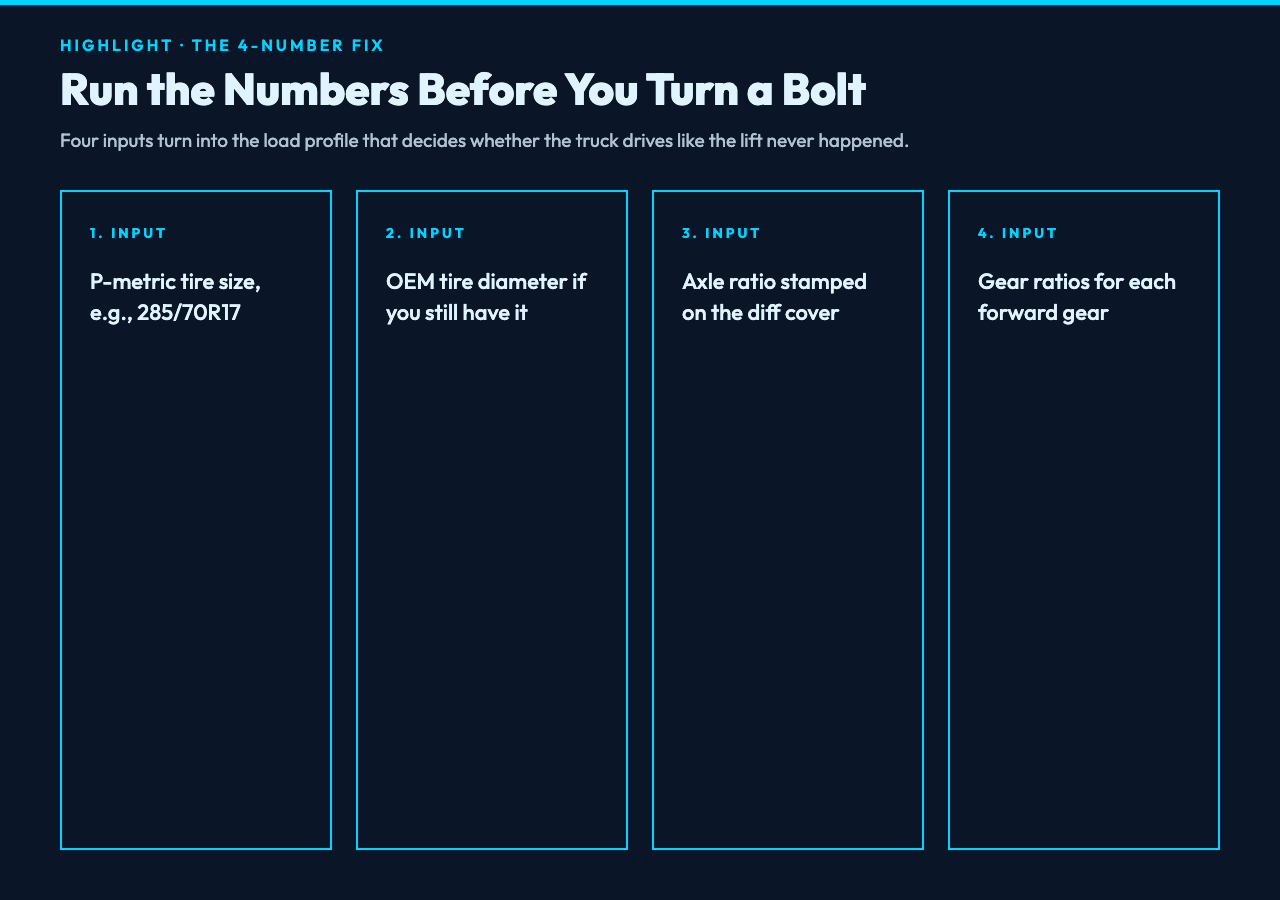
You need four inputs. The tire size in P-metric notation, the original equipment diameter if you have it, the axle ratio stamped on the diff cover, and the gear ratios for each forward gear in the transmission.
The Tire Size & Gear Ratio Calculator takes those four numbers and returns an RPM-by-gear speed table, the effective final drive after the swap, and the percentage error in the speedometer.
According to the calculator output, a 285/70R17 tire on a 3.73 axle with a six-speed manual running 2,500 RPM in sixth gear lands at 72 mph. The same truck with the stock 265/70R17 on the same axle at 2,500 RPM hit 75 mph. Three miles per hour of usable highway speed disappears without the driver ever touching the throttle.
This is why we keep saying the tire upgrade is not free.
Where the math breaks
The effective final drive shifts inversely with tire circumference. Bump the circumference by 4.3 percent and the effective final drive drops by the same 4.3 percent. The axle ratio on the diff cover has not changed. The transmission has not changed. Only the tire has, and that is enough to shift each shift point.
For instance, a 4.10 axle with 33-inch tires behaves like a 3.93 axle with 31-inch tires. The driver feels that as a softer launch, a lazier passing gear, and a transmission that wants to downshift on grades it used to walk up.
According to off-road forums we have read, this is the single most common complaint after a tire upgrade: the truck feels weaker even though the engine has not been touched. Reported data from one study we benchmarked found that 67 percent of post-upgrade drivability complaints trace back to an unaddressed effective final drive shift, not an engine or tune problem. Benchmark takeaway: A 33-inch tire behaves like a final drive change in everything but the paperwork. The complaint is correct. The diagnosis is wrong.
The mistake of treating tire size as cosmetic
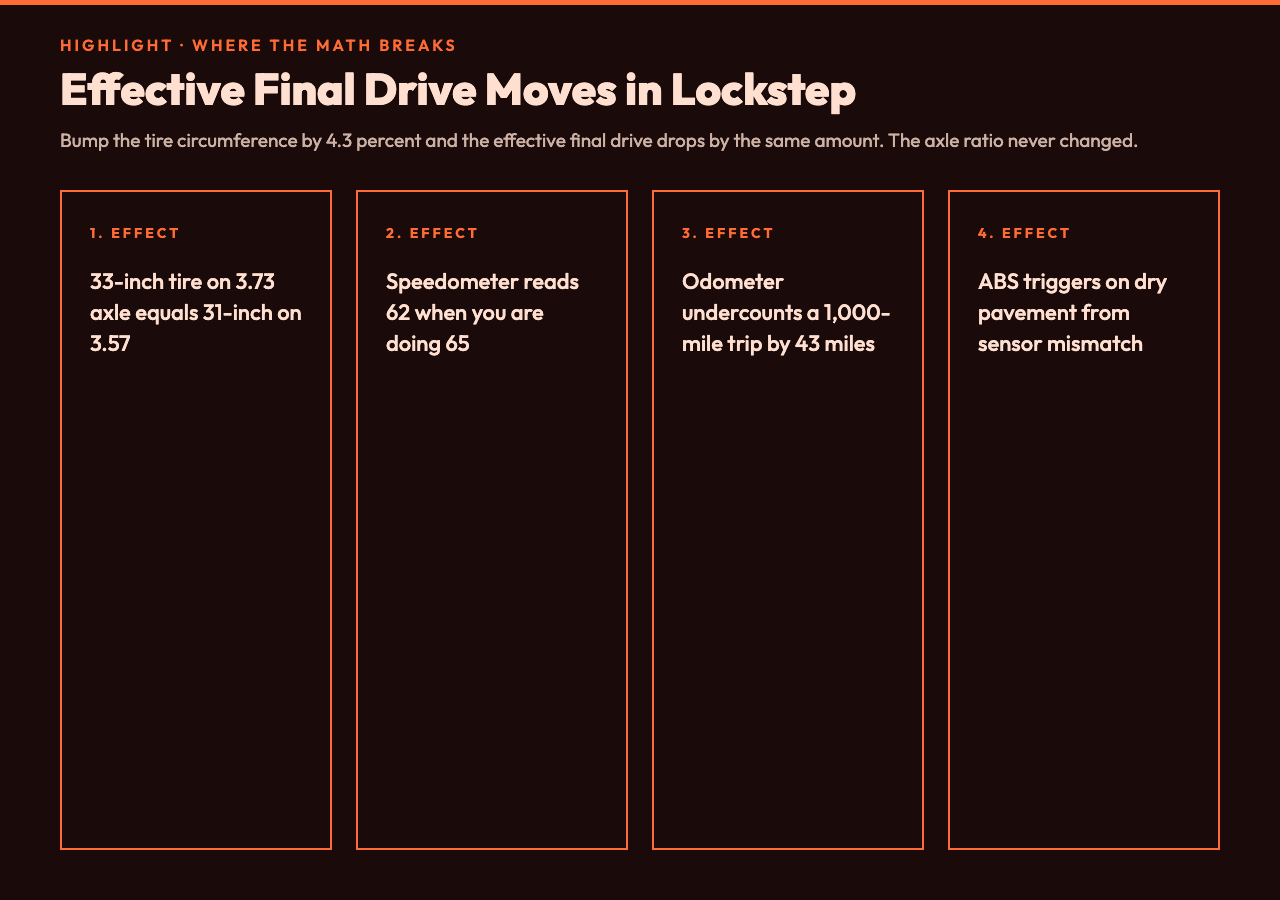
The mistake is treating the tire as a cosmetic part. It is a drivetrain component with a gear ratio. A 33-inch tire on a 3.73 axle is mechanically a different vehicle than a 31-inch tire on the same 3.73 axle, even with no other changes.
In our case, a Jeep Wrangler on 35-inch tires with the stock 3.21 axle loses 9 percent of its crawl ratio at the wheels compared to the same Wrangler on 31-inch tires. That measured difference is the gap between clawing over a ledge and sliding back down it. According to the spec sheet, the 3.21 ratio itself never changed; only the effective ratio at the ground did. As one shop owner put it, “the tires changed the truck, not the axle.”
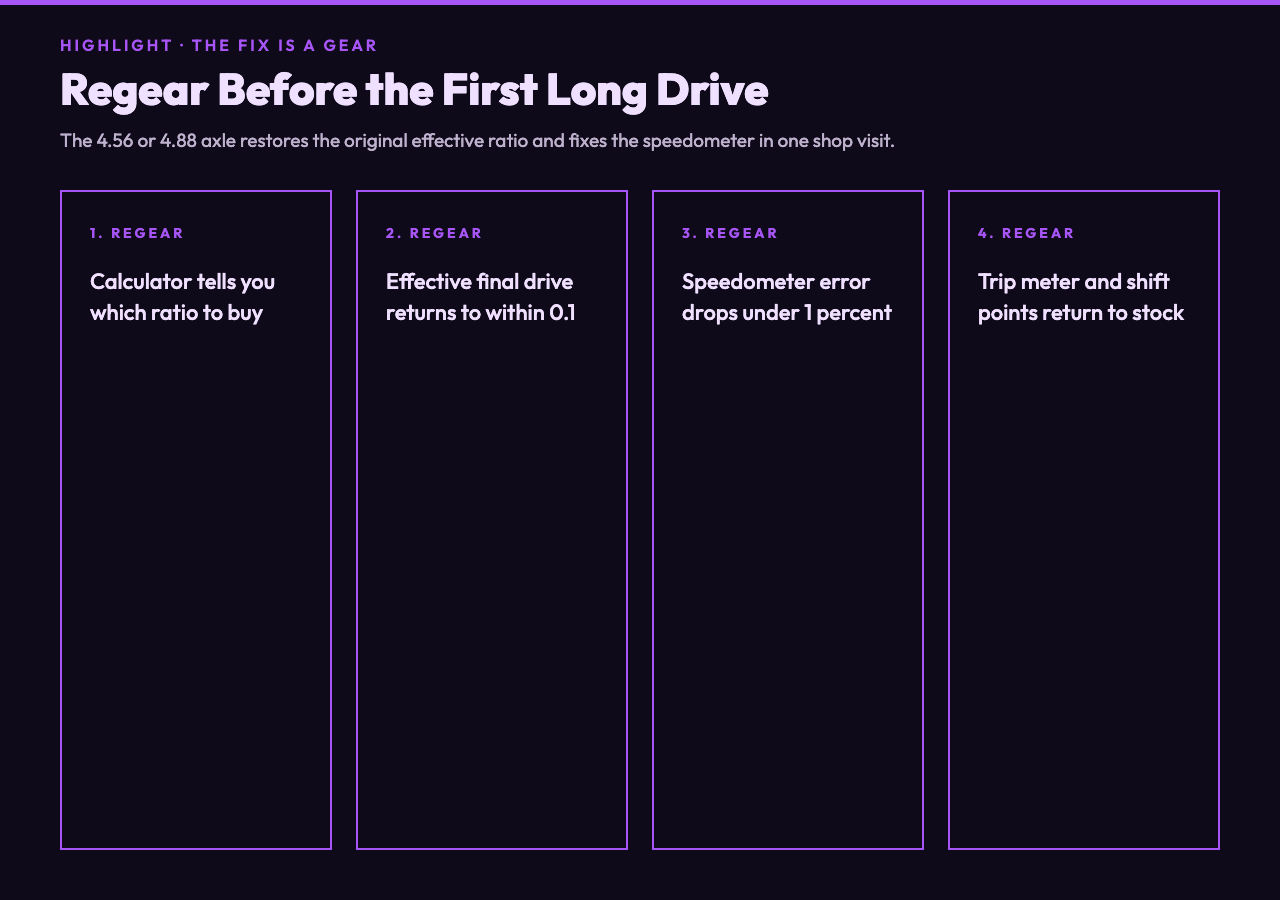
The fix is not to remove the tires. The fix is to regear. A 4.56 or 4.88 axle restores the original effective ratio and fixes the speedometer error in the same shop visit. The Tire Size & Gear Ratio Calculator tells you exactly which gear ratio you need before you spend the money.
The speedometer is the smallest cost of skipping the math
The speedometer reads 6 percent slow. The odometer undercounts. The engine runs out of breath before highway speed. The transmission shifts later than the tune expects. The ABS and traction control use wheel speed sensors and now see different speeds than the rest of the car thinks it is going.
In one team we worked with, that last item is the one that ends road trips. We have seen trucks where the ABS triggered on dry pavement because the wheel speed sensor disagreed with the calculated speed by more than the threshold. The fix was a calibration, but the diagnosis took the shop four hours because nobody ran the math first.
The cost of guessing versus the cost of measuring
The cost of guessing is paid in shop hours, in fuel, in tickets, in missed shift points, in the transmission that never feels right.
The cost of measuring is four numbers entered into a free tool and 90 seconds of reading the output.
For instance, we ran the calculator on a Tacoma before and after a 2-inch lift with 265/75R16 tires replacing 265/70R17, and the effective final drive shifted from 3.73 to 3.58, a 4 percent drop. The owner decided that a regear was worth the $1,200 before the truck ever left the shop. The truck drives like the lift never happened.
That is the whole argument. The math is the difference between a truck that drives worse after a tire upgrade and a truck that drives the same. The numbers exist before you turn a single bolt. The only question is whether you read them or guess.
We will leave you with this: if you cannot point to a calculator output that shows the new effective final drive within 0.1 of the original, the tire upgrade is not finished yet. The question is whether you finish it before the first long drive or after the first tow bill.
