
Buffer pH is not a guess — it is a ratio. The Henderson-Hasselbalch equation ties pH to the exact ratio of conjugate base to weak acid, and the pH & Buffer Calculator wraps that math into a two-mode field calculator that handles phosphate, Tris, HEPES, MOPS, acetate, citrate, bicarbonate, and a custom pKa pathway — with temperature correction for Tris baked in. This guide walks through what the equation actually predicts, where each common buffer system sits on the pH ladder, and how to use the tool to plan a workable buffer instead of just confirming the one you already made. For the underlying concentration math, the Molarity / Dilution C1V1 Calculator and the Molecular Weight Calculator sit one click away.
Henderson-Hasselbalch in one paragraph
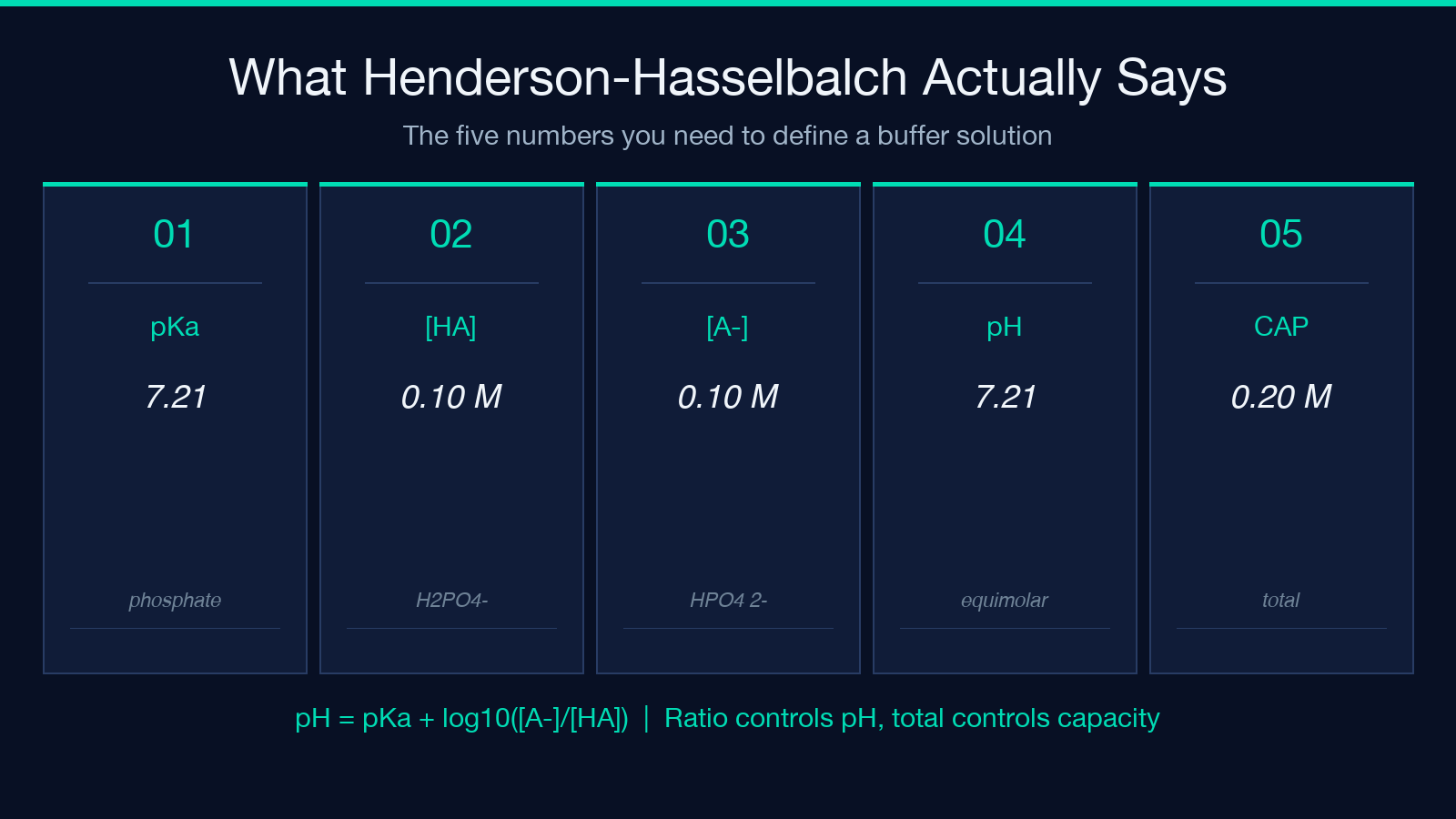
For a weak acid HA dissociating into H+ and its conjugate base A-, the equilibrium constant Ka equals the activity of products over reactants. Take the negative log of both sides and rearrange, and you get the textbook form: pH = pKa + log10([A-]/[HA]). The whole calculator is built around this relation. When you know the acid concentration, the base concentration, and the pKa, the tool returns pH. When you know the target pH, the tool returns the ratio of base to acid you need at a chosen total concentration.
Notice the ratio term is what matters, not the absolute concentrations. A 0.10 M acetate / 0.10 M acetate buffer and a 0.01 M / 0.01 M acetate buffer both give pH = pKa. Halving the total concentration does not change the pH; it only changes the buffer capacity, which is the buffer’s resistance to pH shift when you add strong acid or base. The ratio is what Henderson-Hasselbalch encodes; capacity is a separate concern that lives in the total concentration and the pKa distance.
How to read the pH ladder
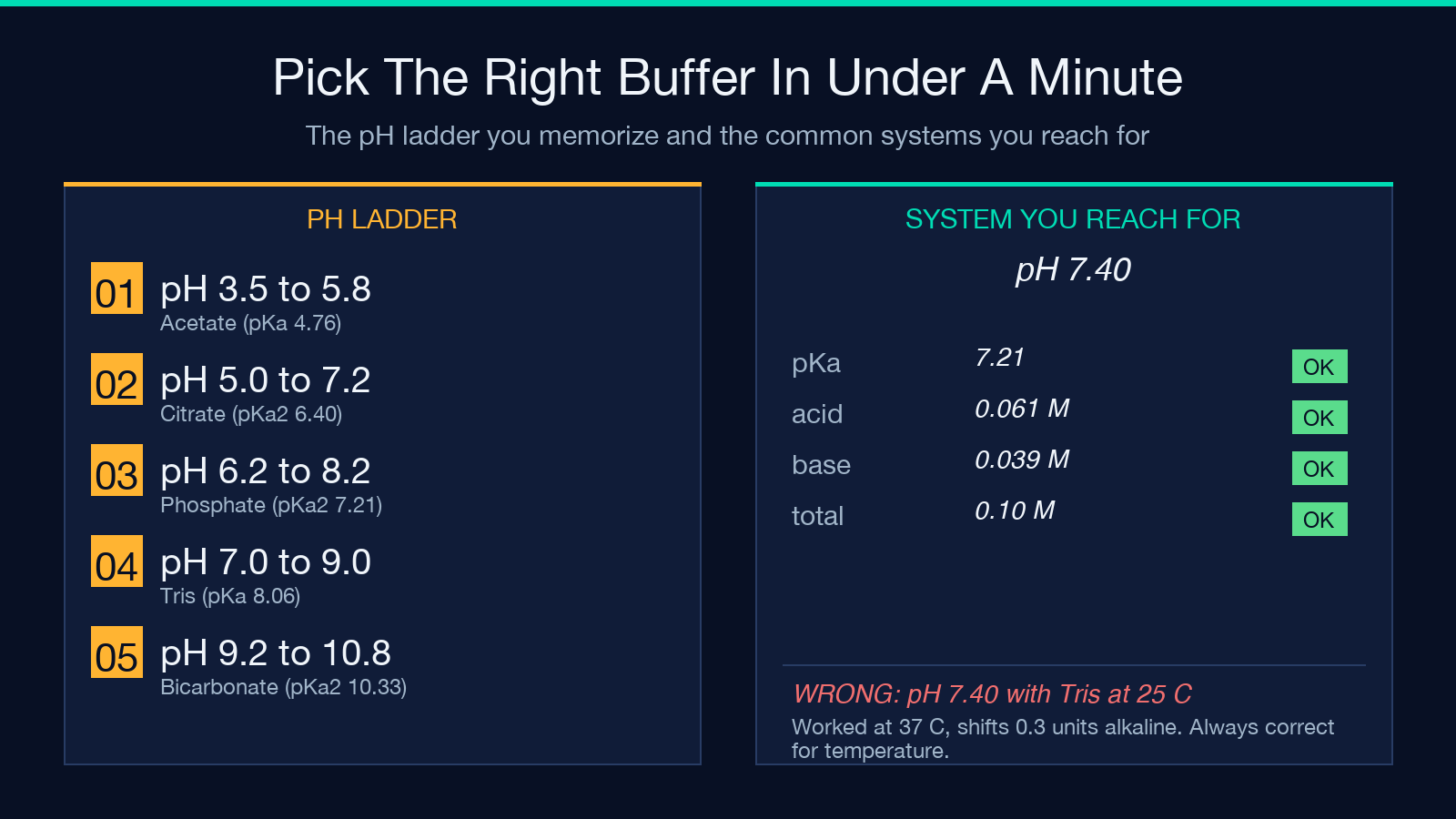
Useful pH range for a buffer is roughly pKa ± 1 unit. Outside that range, the ratio term becomes either very small (lots of HA, almost no A-) or very large (lots of A-, almost no HA), and the buffer loses the ability to soak up additional acid or base. Pick a buffer whose pKa is close to your target pH. Phosphate (pKa2 = 7.21) is the right choice for the physiological range around 7.4. Tris (pKa around 8.06 at 25 °C) is a good choice for biochemistry workflows that run slightly basic. Acetate (pKa 4.76) is the right choice for the acidic range covering dye work and protein purification at low pH. HEPES (pKa 7.55) and MOPS (pKa 7.20) are zwitterionic Good buffers that hold steady pH around neutral without coordinating metal ions, which matters when you are working with enzymes that bind divalent cations. If you are designing the reaction the buffer goes into, the Chemical Equation Balancer helps you check the stoichiometry of the acid-base neutralization you are building around.
Running the tool in find-pH mode
Switch the calculator to Find pH from acid/base ratio. Pick the buffer system from the dropdown — phosphate, acetate, Tris-HCl, HEPES, MOPS, citrate, bicarbonate, or custom. The pKa field auto-fills with the right value for the preset, but you can override it if you are working at a non-standard temperature or with a non-standard salt. Enter the acid concentration in mol/L as [HA] and the base concentration as [A-]. Set the temperature; for Tris, the tool applies a temperature correction (pKa drops roughly 0.028 units per °C), and for other buffer systems the temperature input is informational and the pKa stays at 25 °C. The result is the pH of the resulting solution, reported to your chosen number of decimal places. For an equimolar phosphate buffer at 0.1 M acid and 0.1 M base with pKa 7.21, the tool returns pH = 7.21.
Running the tool in find-ratio mode
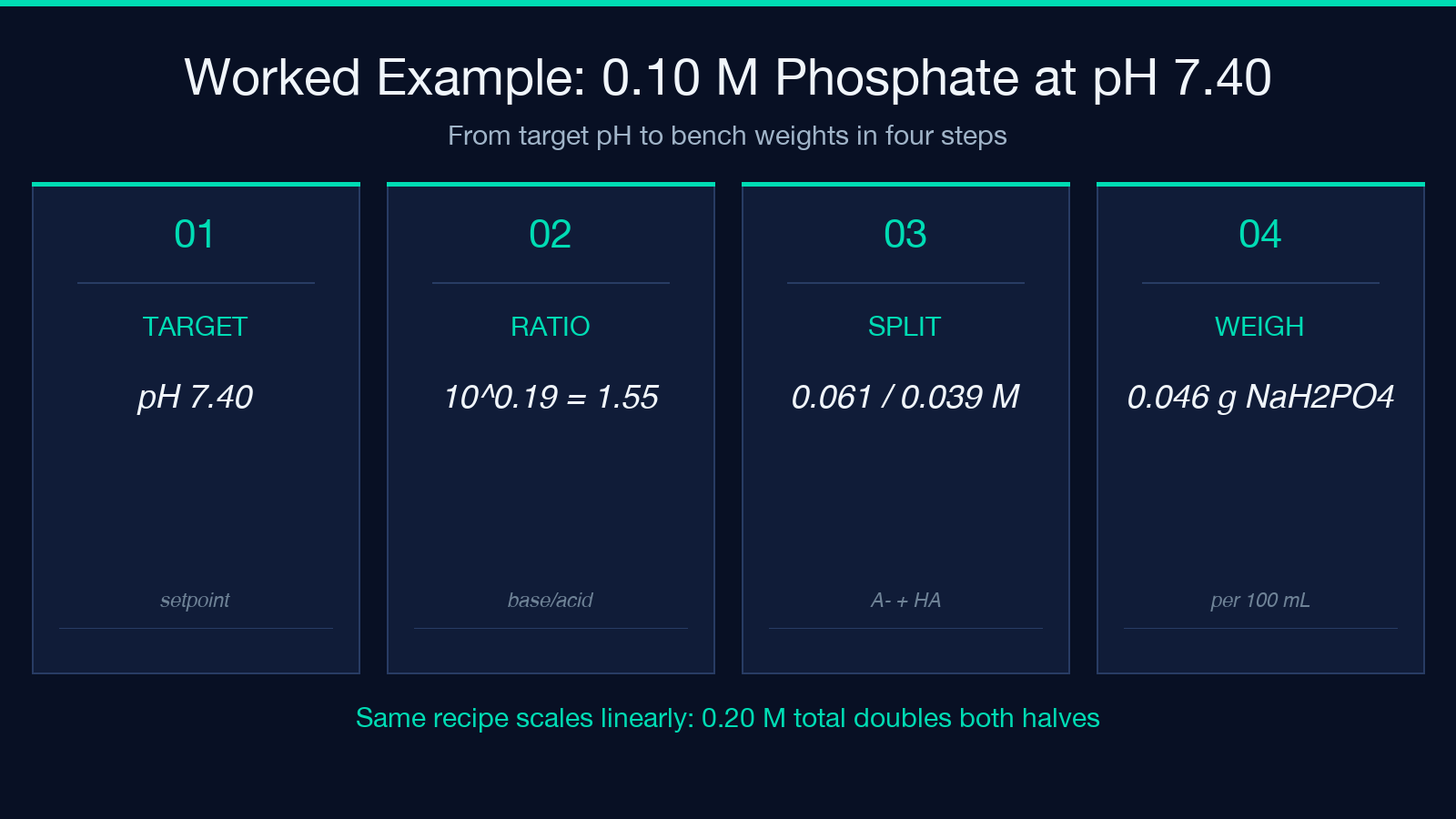
Switch the calculator to Find ratio needed for target pH. Pick the buffer system, set the target pH, and set the total buffer concentration. The tool computes the ratio [A-]/[HA] from the equation, then splits that ratio into absolute concentrations that sum to the total. For a target pH of 7.40 with phosphate at 0.10 M total, the ratio is 10^(7.40 – 7.21) = 1.55, so the tool reports roughly 0.061 M acid and 0.039 M base. This is the workflow you use when you are preparing a buffer from scratch and you know the pH you want, not the chemistry you have on the bench.
Common pitfalls when planning a buffer
Three traps come up repeatedly. First, the ratio term uses the concentration of the deprotonated form [A-] over the protonated form [HA], not the pKa-adjusted concentration. If you weigh out monosodium phosphate (the monobasic form, NaH2PO4) you are adding HA. If you weigh out disodium phosphate (the dibasic form, Na2HPO4) you are adding A-. Mixing the two in a 1:1 molar ratio gives pH = pKa. Second, the temperature correction for Tris is real and easy to miss — a buffer prepared at 25 °C and used at 37 °C shifts by about 0.3 pH units in the alkaline direction. The tool applies the correction only when the buffer system is Tris; for other buffers you should look up the temperature coefficient separately. Third, total concentration sets buffer capacity, not pH. If you need 100 mM buffering against addition of 5 mM strong acid, plan the recipe with that capacity in mind — the calculator reports the ratio but does not warn you when your total concentration is too low to absorb the perturbation you expect. For the bench math on how to dilute a stock solution to that total, the Molarity / Dilution C1V1 Calculator is the right companion.
When Henderson-Hasselbalch breaks down
The equation is a textbook approximation. It assumes activities equal concentrations, which is fine for dilute buffers in the 0.01 to 0.1 M range but breaks down at high ionic strength. It assumes the only relevant species are HA and A-, which is fine away from the second pKa of a polyprotic acid but breaks down if you are working near pKa1 or pKa3 of citrate. It assumes temperature-induced pKa shifts are negligible, which is roughly true for phosphate and HEPES but materially wrong for Tris. Finally, the equation does not predict buffer capacity — for that, you need a separate titration approach or a buffer capacity calculator. The pH & Buffer Calculator is built for the common case where these complications are not the limiting factor, and it gives you a fast, reliable answer for the daily question of “what ratio do I mix, and what pH do I get.”
Choosing between buffer systems at a glance
Use this decision ladder when you need to pick a system in under a minute. For pH 3.5 to 5.8, use acetate (pKa 4.76). For pH 5.0 to 7.2, use citrate (pKa2 6.40) or MES if you need a non-coordinating alternative. For pH 6.2 to 8.2, use phosphate (pKa2 7.21) or HEPES (pKa 7.55) when you need to avoid metal-ion binding. For pH 7.0 to 9.0, use MOPS (pKa 7.20) near the lower end or Tris (pKa 8.06) toward the upper end; remember Tris temperature corrections. For pH 9.2 to 10.8, use bicarbonate (pKa2 10.33) or carbonate. For pH 9.0 to 11.0 with non-coordinating requirements, use CHES or CAPS. The calculator covers the eight most common systems and leaves you a custom pKa pathway for anything outside that list. When the buffer is feeding an enzyme assay, the Enzyme Kinetics Calculator (Michaelis-Menten) is the natural next step after the pH is set.
Verifying the calculator’s output against bench data
A useful sanity check is the equimolar case. Mix any buffer at 1:1 acid:base and the predicted pH should equal the pKa. If you measure 7.18 with a pH meter for an equimolar phosphate buffer, you are within calibration of the textbook pKa 7.21. Another useful sanity check is the ten-fold ratio. The predicted pH should differ from the pKa by exactly 1.0 unit. If you mix 1:10 acid:base for phosphate, the predicted pH drops to 6.21; if you mix 10:1, it rises to 8.21. The calculator will reproduce both of these results to the precision you set with the decimal places input. If your bench measurement disagrees by more than 0.05 units, the most likely culprits are the pH meter calibration, the actual content of the buffer salts (especially for hydrated forms), and the temperature of the measurement.
The Henderson-Hasselbalch equation is short, but the practical workflow around buffers touches ratios, pKa shifts, temperature, capacity, and polyprotic complications. The pH & Buffer Calculator at Elysia Tools covers the everyday case where you know the buffer system and either the ratio or the target pH, and you need a fast, reliable answer. Use find-pH mode to confirm a buffer you already mixed, and find-ratio mode to plan a buffer from scratch. Browse related tools at elysiatools.com for the rest of the chemistry and biochemistry toolkit.
