
The Postman collection you ship to QA has to behave like the OpenAPI spec the backend team wrote — same parameters, same examples, same auth headers, same baseUrl variable — or the next regression catches a mismatch nobody remembers signing off on. Most teams keep the spec and the collection in two folders that drift in opposite directions, and the gap shows up three weeks later when someone runs Newman in CI and the bearer token comes through as the literal string Bearer {{token}} instead of the resolved header. The OpenAPI to Postman Collection converter collapses that gap by reading your openapi.yaml (or swagger.json, OpenAPI 3.x or Swagger 2.0), walking the paths tree, and emitting a v2.1.0 collection JSON that imports cleanly into Postman and runs in Newman without manual editing. Folders fall out of the URL trie or your tag groups, parameters map to path/query/header slots, request bodies are generated from JSON Schema with deterministic sample values, security schemes turn into bearer/basic/apiKey auth helpers, and server URLs become {{baseUrl}} plus the variable entries Newman expects.
What the converter actually does
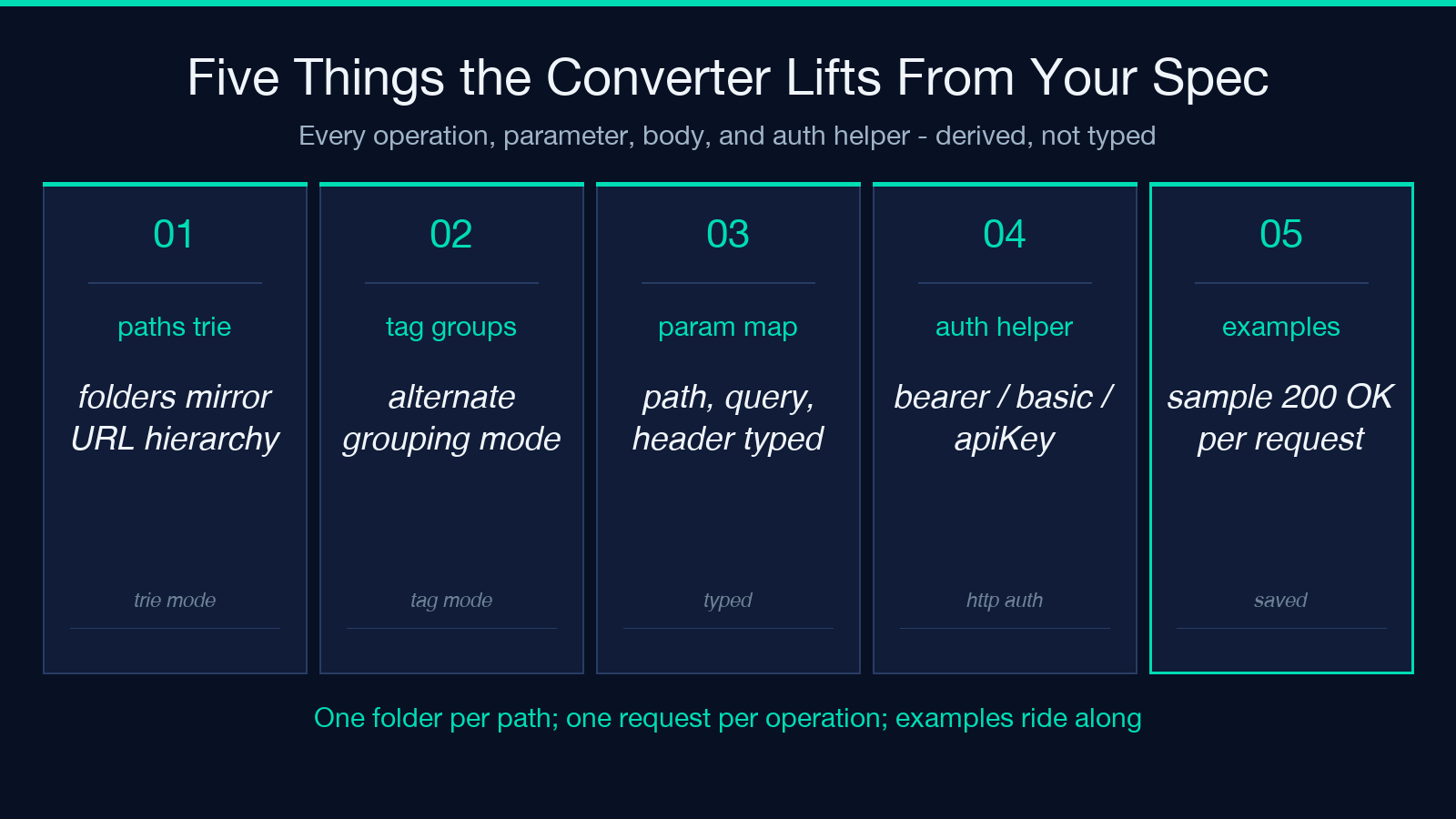
The converter treats your spec as the source of truth and builds a Postman collection where every operation in paths becomes one request item under a folder that mirrors your URL hierarchy. For a Pet Store-style spec with /pets, /pets/{petId}, and /store/inventory, you end up with three folders (pets, pets/{petId}, store/inventory), and the folder nesting follows the path trie unless you ask for tag grouping instead. If you set groupBy: tags, /pets and /store/inventory move into separate folders named after the tags array on each operation, which is what most teams want for contract tests that target a specific subsystem.
Path parameters, query parameters, and header parameters are pulled from each operation’s parameters array and turned into Postman URL variables, query-string slots, and header rows in the request editor. Path parameters are typed against the schema ({petId} becomes an integer field when the schema says type: integer, format: int64), and required-vs-optional shows up in the collection’s variable metadata so the runner can fail fast on missing values. The converter does not invent parameters that the spec never declared — if a parameter is in the spec, it lands in the collection; if it is not, it stays out, which is what you want for a contract test.
How schemas become JSON bodies
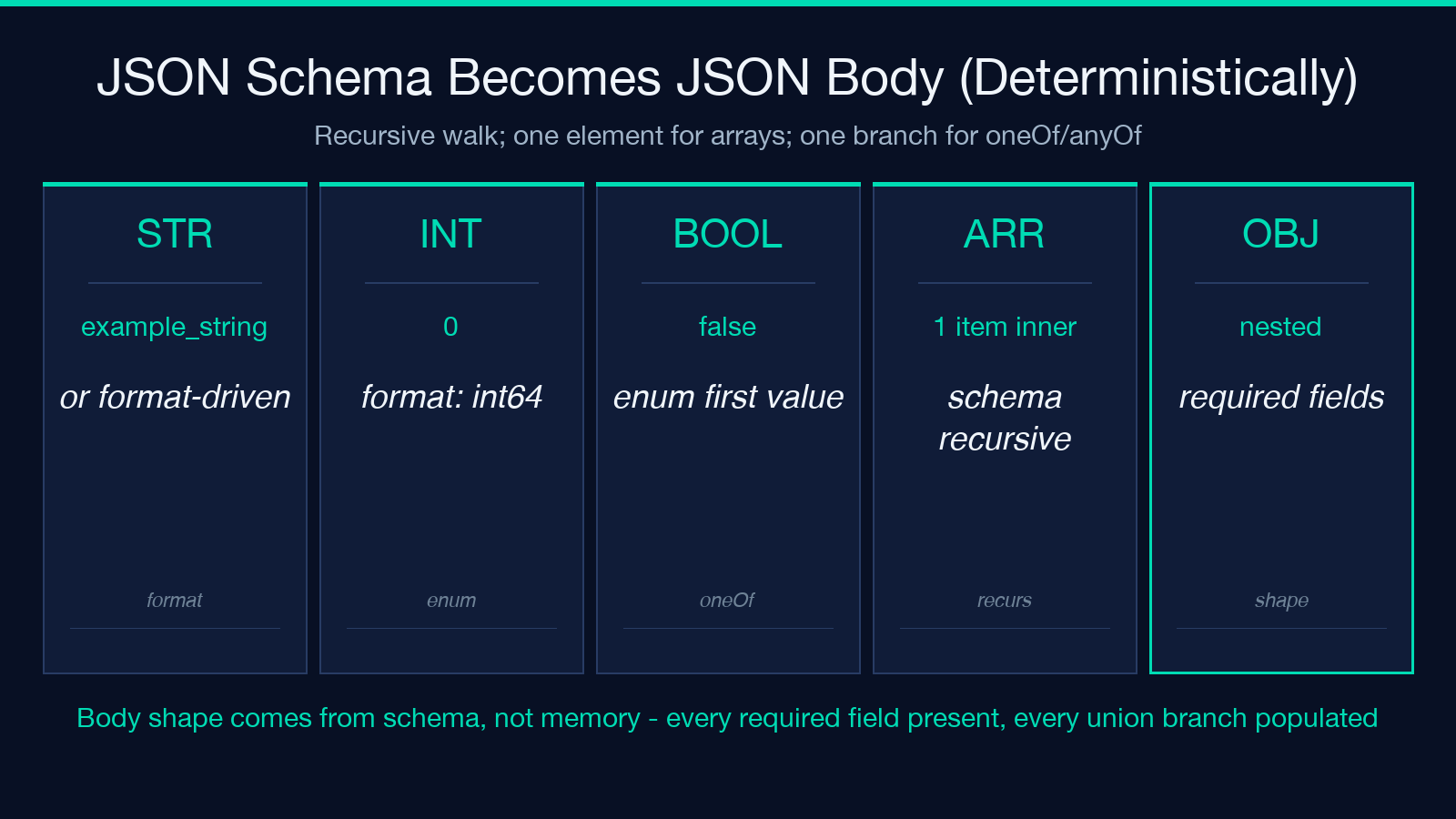
Request bodies with application/json content get filled from the matching requestBody.content['application/json'].schema block, and the converter walks the schema recursively to build a deterministic sample payload. String fields become plausible-looking values ("example_string" if no example is given, or format: email becomes something at an example.com domain), integers become 0, booleans become false, enums cycle through the first value, and arrays get one element of the inner schema. The point is not realism — the point is shape: every required field is present, every nested object is built, and oneOf/anyOf unions get one branch populated so the request editor shows the full tree.
This is where a lot of hand-built collections fall over. A developer copies the spec, opens Postman, and types the first request body by memory; they remember id, name, status, and forget category, tags, photoUrls. Newman sends a 422, the developer adds the missing field, the test passes, and the missing field gets added to the spec a week later by accident. The converter inverts the flow: the schema is the body, and the body is the schema. For the full menu of available spec examples, see the OpenAPI/Swagger Samples reference — every shape the converter can emit is already there as a runnable fixture.
Auth translation without surprise
Each entry under components.securitySchemes (or the top-level securityDefinitions in Swagger 2.0) becomes one auth helper in the Postman collection. type: http, scheme: bearer becomes a bearer-token helper that injects Authorization: Bearer {{bearerToken}}. type: http, scheme: basic becomes a basic helper that prompts for username and password. type: apiKey, in: header, name: X-API-Key becomes a header row at the request level. type: oauth2 becomes a multi-step helper with authorizationUrl, tokenUrl, and scopes populated from the spec.
The converter does not try to actually fetch a token — Postman handles that at request time. It only writes the helper definition so the collection knows what credentials to ask for. If your spec declares security: [] on individual operations (intentionally unauthenticated, like /health or /login), those operations get no auth helper, which is what you want for a /login endpoint that itself cannot require auth. If the spec is missing securitySchemes entirely, every request gets no auth, and the runner has to add it later — that is the most common reason a collection behaves differently in CI than in the Postman GUI, and the OpenAPI / Swagger Validator is the right place to catch it before the converter runs.
Server URLs and variables
server.url entries become {{baseUrl}} in the collection, and each entry under server.variables becomes a variable definition on the same {{baseUrl}} slot. For a spec with servers: [{ url: 'https://{environment}.example.com/v1', variables: { environment: { default: 'api', enum: ['api','staging'] } } }], the collection has {{baseUrl}} = https://api.example.com/v1 by default, and an environment variable with default api and two enum values. Postman lets you swap the variable per environment without editing the collection, which is the whole point of using {{baseUrl}} instead of hardcoding a URL into every request.
For multi-server specs (one spec, three environments — production, staging, sandbox) the converter writes each server as a separate variable entry, and you can pick one as the active default. Newman picks the active one based on the environment file you pass via --env-var, so the same collection runs against staging in PR checks and production in nightly regression with zero edits.
Example responses and contract tests
The converter harvests every responses.200.content['application/json'].example (or examples.<name>.value) and saves it as the example response on the matching request item. In Postman, you can then write a pm.response.json() test that asserts against the example shape, and the test passes as long as the server still returns the documented structure. The minute the server changes the field name or the response status, the test fails and the team knows before the change reaches production.
This is the loop that turns an OpenAPI spec into a living contract test. If you want a worked example of the request-response pairs side by side, browse the Postman Collections – API Testing sample set — every folder has both the request and the matching 200 OK body, and the same shape lands in the converter output for any spec that declares those examples. For payloads beyond JSON (file uploads, multipart, form-urlencoded), the converter preserves the content-type and forwards the schema-driven sample into the body field with the right enctype flag.
Newman compatibility and CI
A v2.1.0 Postman collection JSON is also a Newman runnable, and the converter emits that shape exactly. Newman takes the file via --folder for a single folder run or via -e environment.json for variable injection. For CI on a merge request, the canonical recipe is: validate the spec, convert to collection, run Newman against staging, fail the merge on any 4xx/5xx that was a 2xx in the spec example. The validator and the converter are two halves of the same gate; running them in sequence is what catches drift before it ships.
If your CI step also needs to gate on spec changes between branches — for example, “did this PR remove an endpoint that consumers still call?” — wire in the OpenAPI Diff Breach Detector before the converter. The diff tool emits a JSON of removed/added/changed operations, and the converter only runs if the diff is empty (or, with a --allow-breaking flag, deliberately accepted). The three together form a clean spec-to-CI pipeline.
Common pitfalls when shipping the collection
Three things still go wrong even with a clean spec and a clean converter run. First, an application/x-www-form-urlencoded body with a oneOf schema lands as a flat list of key-value pairs in Postman, but Newman reads them in declaration order; if your oneOf branches declare overlapping keys, Newman picks whichever the schema resolver returns first and the request looks random. Second, nullable: true on OpenAPI 3.0 fields does not survive into 3.1 cleanly — the converter emits a null example, which passes the schema validator but breaks clients that assert non-null. Third, a discriminator without mapping produces a union type that Postman cannot navigate in the request editor; the request still goes through, but the developer cannot pick the variant they want without editing the raw JSON.
For any of these, the fix is to repair the spec, not the collection. The OpenAPI to TypeScript Generator can cross-check the spec from the consumer side — if your TypeScript client types declare a non-null field but your spec allows null, the contract is broken before any HTTP runs. And if your downstream task is to feed the API responses into a spreadsheet for QA evidence, the XLSX API To Sheet tool imports the response JSON directly into a row-based workbook without re-typing.
End-to-end pipeline
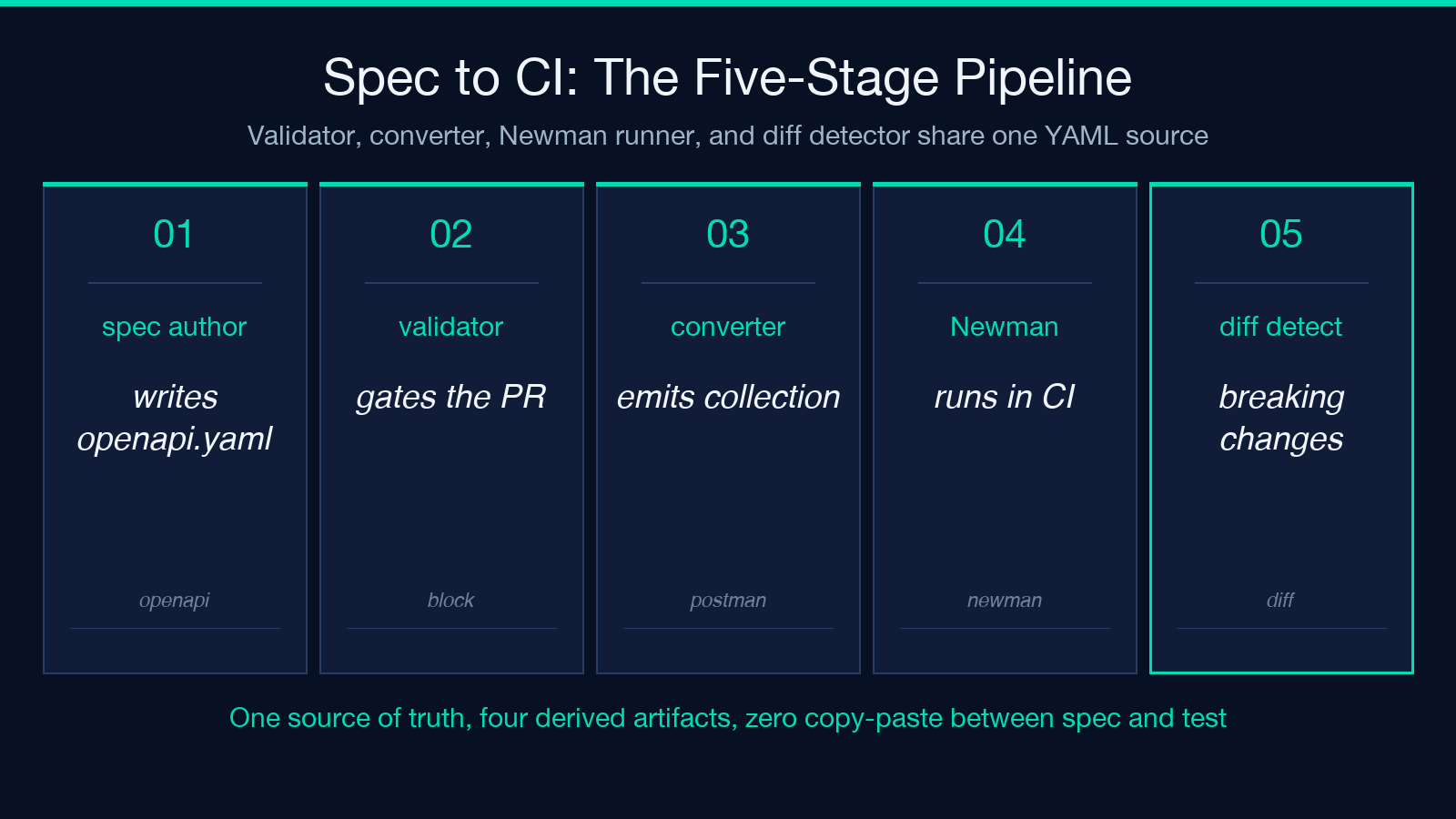
The cleanest pipeline is: spec author writes openapi.yaml → OpenAPI / Swagger Validator gates the PR → OpenAPI to Postman Collection emits the contract test → Newman runs the contract test in CI on every commit → OpenAPI Diff Breach Detector flags breaking changes on a separate job → OpenAPI to TypeScript Generator emits the client types from the same spec. One source of truth, four derived artifacts, zero copy-paste between spec and test. Explore more tools at elysiatools.com.
