Newton-Raphson doubles the digits you trust each step. Most root-finders trade one correct bit for every two iterations; a well-tuned Newton iteration on a smooth, non-vanishing function squares that error in a single update. That single fact is why every black-box solver eventually wraps it, why every yield-curve fitter pulls it out for the second pass, and why every root-finder for nonlinear equations quietly hides a Newton step behind a fallback. The Newton-Raphson Root Finder at Elysia Tools exposes the iteration table the textbook sketches — initial guess, f(x), f'(x), the next x, and the convergence criterion — so you can see why the method converges in four iterations where bisection still needs twenty.
The one-line method, in one line
Start from any x₀ where f is differentiable. Update with x_{k+1} = x_k − f(x_k)/f'(x_k). Stop when |f(x)| < tolerance or |Δx| < tolerance·max(1, |x|). The slope f'(x_k) tells you how far you have to travel along the tangent to reach the root; the next guess is wherever that tangent crosses zero. If f’ vanishes, the tangent is horizontal and the update explodes — that’s the entire failure mode, and the Newton-Raphson Root Finder reports it explicitly rather than silently looping.
Why convergence is quadratic, not linear
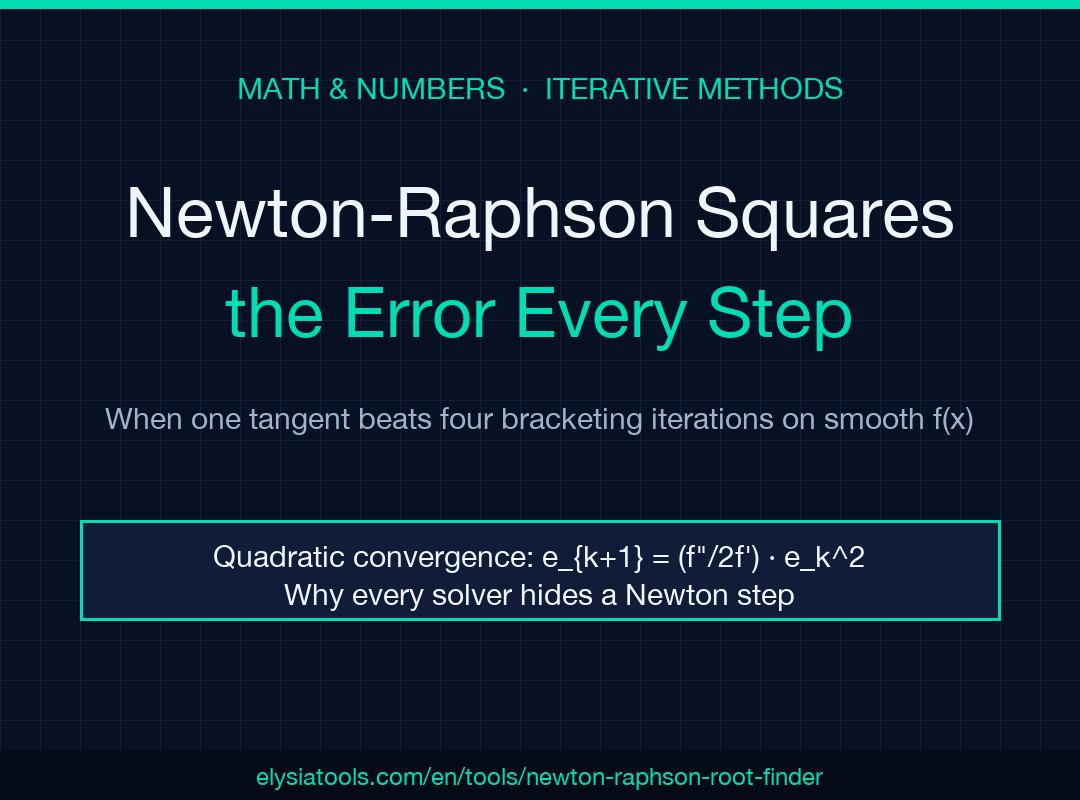
If the true root is r and your current error is e_k = x_k − r, then Taylor expansion gives f(x_k) = f'(r)·e_k + ½·f”(r)·e_k² + O(e_k³). For a simple root, f'(r) ≠ 0, so the iteration error satisfies e_{k+1} ≈ (f”(r)/(2·f'(r))) · e_k². The next error is the square of the current one — that’s the quadratic convergence. A bisection step halves the interval; a Newton step squares the error. From 0.1 you get 0.01, then 1e-4, then 1e-8. The canonical x² − 2 from x₀ = 1 needs four iterations to reach √2 ≈ 1.4142135624 to ten digits; bisection needs twenty-seven iterations of the interval [1, 2].
The three places where it fails — and how to avoid them
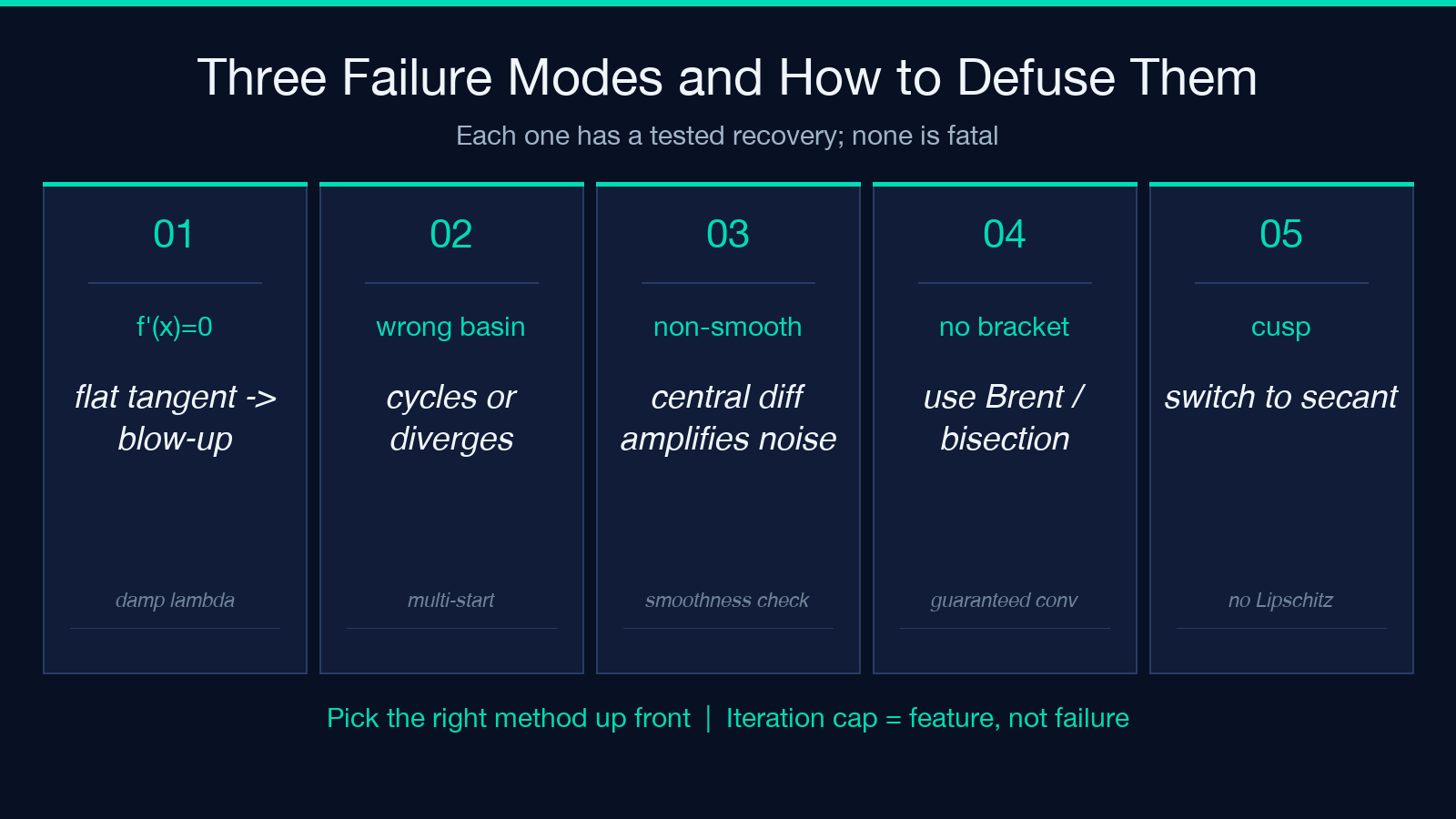
The first failure is a zero derivative at the current iterate. If f'(x_k) ≈ 0 the tangent is flat, the update blows up, and a single step lands far from the root. Fix by damping (x_{k+1} = x_k − λ·f(x_k)/f'(x_k) with λ ∈ (0, 1)), or by switching to a bracketing method when |f'(x_k)| < ε. The second failure is the starting guess in the wrong basin. Newton’s method converges locally to whichever root lies in the basin of attraction of x₀; a starting guess on the far side of a stationary point cycles or diverges. The Dottie number (the fixed point of cos(x) = x) converges from any starting guess because cos is a contraction, but x³ − 2x + 2 = 0 has three basins and the wrong guess lands you on a complex root. The third failure is a wildly non-smooth f. A function with cusps, jumps, or near-discontinuities has f'(x) that doesn’t track f(x). Don’t use Newton’s method on these; use bisection or a secant variant. The Newton-Raphson Root Finder accepts an analytic derivative or falls back to a central-difference f’ — both fail loudly when the function isn’t smooth.
When to reach for it
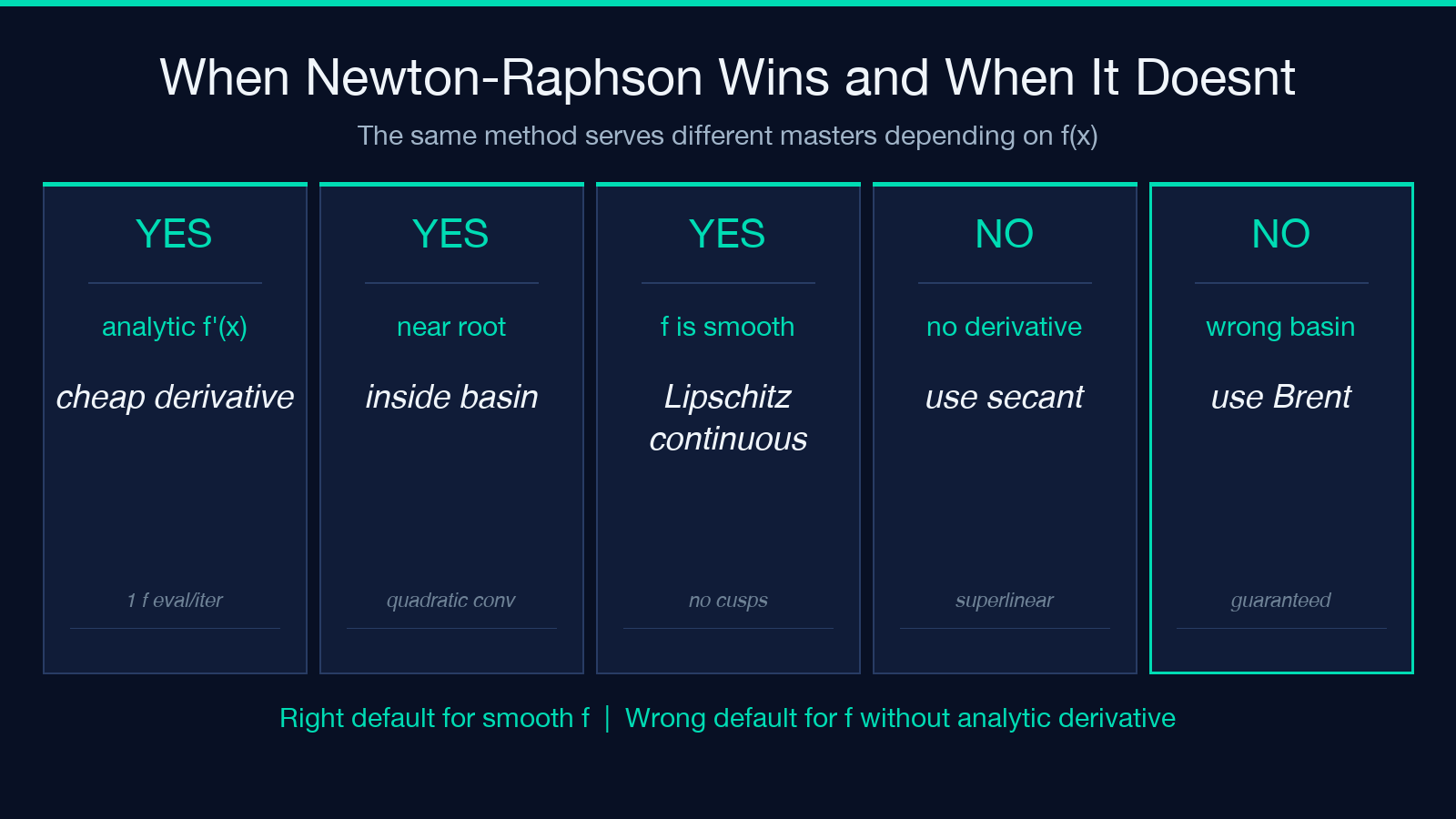
Newton-Raphson is the right default when the derivative is cheap (analytic, not from finite differences) or the cost of an extra evaluation is dominated by the cost of a Newton step, when you’re close to the root (any reasonable x₀ within the basin of attraction), and when you need <6 correct digits and can afford to handle a single failure mode.
When Newton’s method is the wrong tool
The method is the wrong choice when the function has a discontinuous derivative or is not Lipschitz, when you need a guaranteed-converging iteration (use Brent’s method, which brackets and uses a Newton-like inverse-quadratic step), or when the starting guess is unreliable and a bracketing initial scan (bisection) is cheap. A f(x) with cusps or near-discontinuities lies in this category — the analytic derivative is undefined there, and the central-difference fallback amplifies the noise.
The iteration table, with a real example
Take f(x) = x² − 2 with x₀ = 1, derivative f'(x) = 2x:
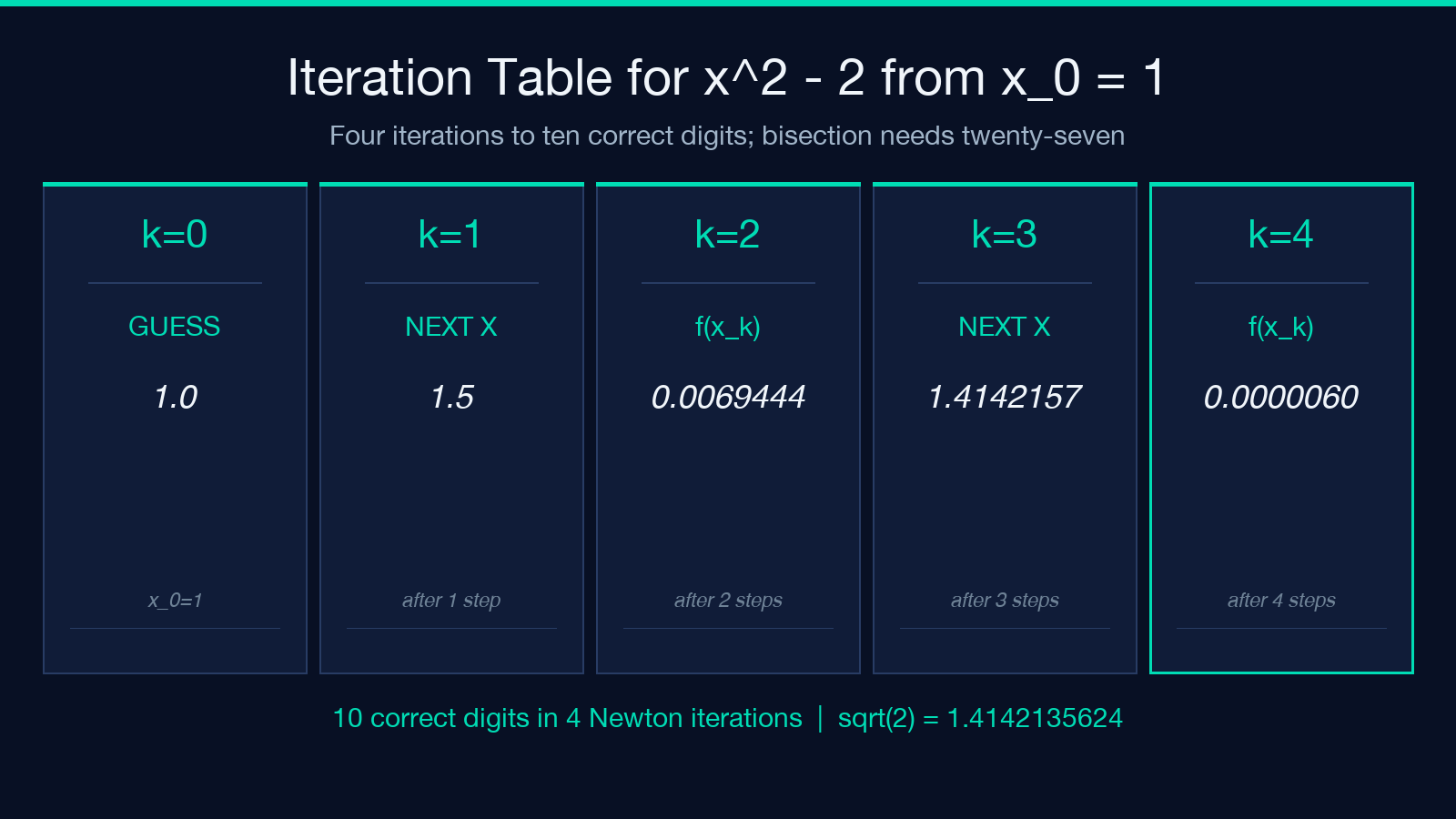
| k | x_k | f(x_k) | next x |
|---|---|---|---|
| 0 | 1.0 | −1.0 | 1.5 |
| 1 | 1.5 | 0.25 | 1.4166667 |
| 2 | 1.4166667 | 0.0069444 | 1.4142157 |
| 3 | 1.4142157 | 0.0000060 | 1.4142136 |
Four iterations, ten correct digits. Bisection starting from [1, 2] needs twenty-seven iterations of the interval to reach the same precision. The Newton-Raphson Root Finder emits exactly this table when you supply f(x) = x^2 – 2 and start at 1.
Dottie number: where convergence beats intuition
f(x) = cos(x) − x has f'(x) = −sin(x) − 1, which is never zero. That makes every real starting guess land in a single basin of attraction, and the iteration converges to 0.7390851332… from anywhere in the reals. This is the textbook example of a function where Newton’s method has a single fixed point and converges globally. The iteration table on the Newton-Raphson Root Finder page shows the same six-iteration dance from x₀ = 0, x₀ = 1, and x₀ = 5.
Putting it together
Newton-Raphson is the right answer for almost every smooth nonlinear equation with a reasonable starting guess. The four-iteration cost of x² − 2 is faster than bisection’s twenty-seven. The single failure mode — zero derivative — is detectable and recoverable. The single global-convergence risk — wrong basin — is detectable by trying multiple starting guesses. The Newton-Raphson Root Finder makes the iteration table visible, so you can see quadratic convergence in action. Explore more tools at elysiatools.com.