
Minimal sum-of-products is not a stylistic preference, it is a physical fact about your circuit. Every product term you leave in the expression is a two-input AND gate you have to buy, place, and route. Quine–McCluskey plus an exact minimum cover turns a sprawling truth table into the fewest gates that behave identically on all inputs. This is the working guide to the Boolean Algebra Simplifier (Karnaugh Map) tool on Elysia Tools, which reports the minimal SOP, a Gray-coded K-map, the canonical Σm form, and a truth-table verification.
The Absorb Nothing Example
Start with the smallest instructive case: AB + A'B. Two terms, four literals, and nothing to gain from reading it twice. Factoring B out gives B(A + A'), and since A + A' = 1, the whole expression collapses to B. The Boolean Algebra Simplifier confirms this from the other direction. It reads the ON-set as Σm(1, 3) for two variables, finds exactly one prime implicant, and reports the minimal SOP as F = B with one term and one literal.
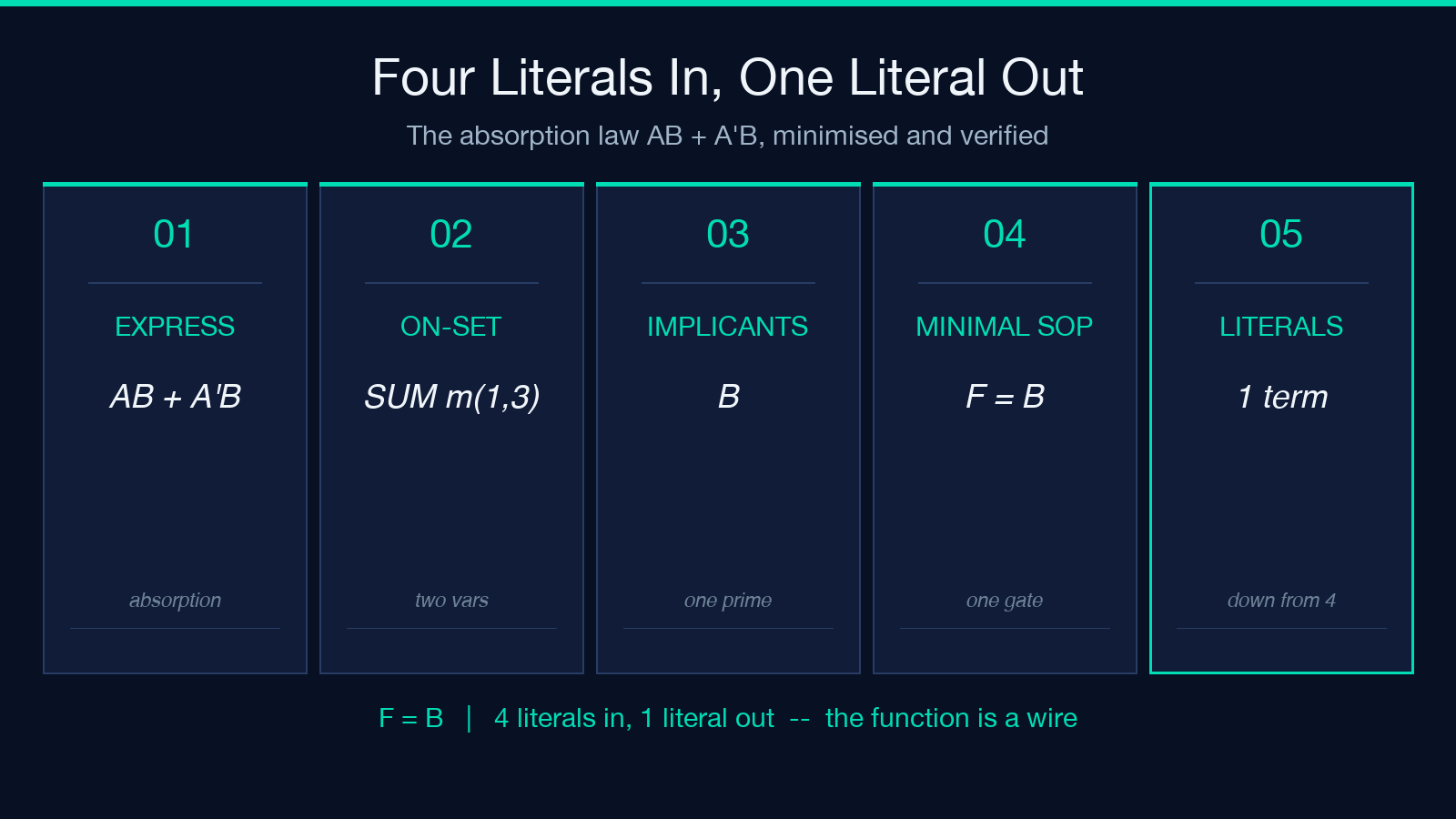
The Karnaugh map for that result is worth staring at. In Gray code order the columns run 0 then 1, and the entire B = 1 column is lit while the B = 0 column is dark. A column of two adjacent 1s in a 2-variable map is a group of size 2^n, which means one literal with no variable in it. That single lit column is the entire answer, and the map shows you why no smaller expression exists. When you run the verification pass, all four assignments match the original, which is the step most hand-simplification skips.
Why Prime Implicants Come First
The reason you cannot just greedily pick large K-map groups is that a large group can be legal and still wrong. Quine–McCluskey sidesteps the visual guesswork by working through combinations algebraically. It builds the full minterm list, merges pairs differing in one variable, merges the merges, and keeps only the terms that cannot be expanded further. Those survivors are the prime implicants.
An essential prime implicant is one that covers at least one minterm no other prime covers. If any minterm is covered by exactly one prime implicant, that prime must appear in the final answer — there is no alternative. Essentials get locked in first, and only then does the algorithm look at the remaining uncovered minterms to decide whether another prime is needed or whether two smaller primes together do the job at lower cost. That last step is the exact minimum cover, and it is what separates a real minimizer from a heuristic one.
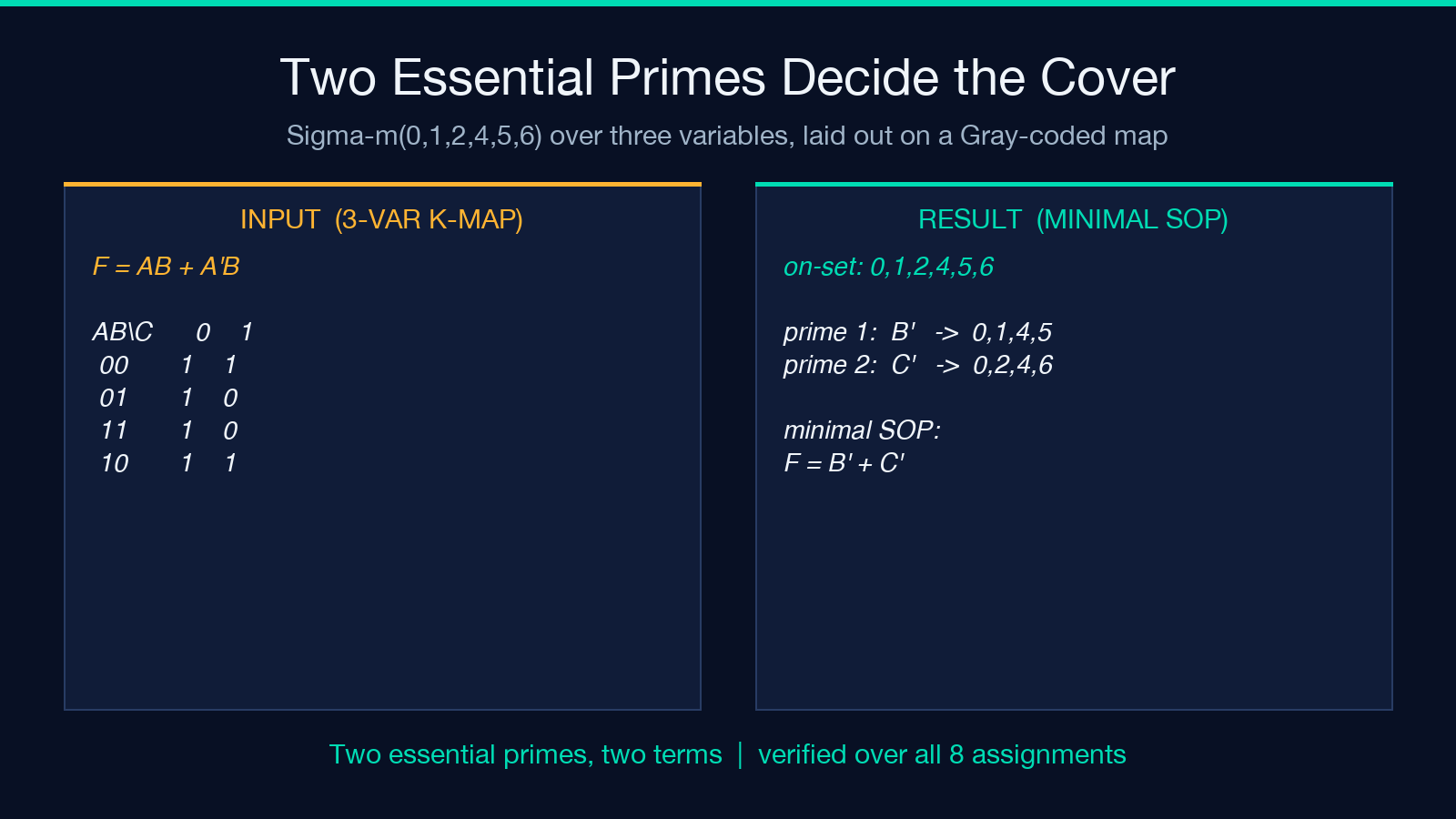
You can see the essential-prime logic in the second worked example on the same tool. For three variables with ON-set Σm(0, 1, 2, 4, 5, 6), Quine–McCluskey finds two prime implicants. B' covers minterms 0, 1, 4, 5 and C' covers 0, 2, 4, 6. Both are essential, because minterm 1 is only reachable through B' and minterm 2 is only reachable through C'. Two terms, two literals, and no cheaper cover exists. Load that minterm list into the Boolean Algebra Simplifier in Minterms mode to watch the essential-prime selection happen step by step rather than taking it on faith.
The Two Input Modes
The tool accepts a function in either of two forms, and the choice changes what the verification step can prove. In Expression mode you write switching-algebra notation directly: + for OR, · or simple juxtaposition for AND, ' or ! for NOT, ^ for XOR, and parentheses for grouping, over at most four variables A through D. The tool parses the expression, evaluates it across the full assignment space, and only then simplifies, which means the original is always the ground truth.
In Minterms mode you supply the indices where the function is 1, for example 0,1,2,4,5,6, along with the variable count. Here the ON-set is the specification, so there is no expression to mis-parse and nothing to normalize. This is the mode to reach for when the requirement arrives from a truth table, a datasheet timing table, or a scan-chain dump rather than from a designer writing equations. The 3-variable K-map for the Σm example above is laid out in Gray code with rows 00, 01, 11, 10, and reading the lit cells off it recovers B' + C' by eye before any algorithm runs.
One caveat on XOR: XOR is not a fundamental switching-algebra operator over GF(2). The parser accepts ^ as a convenience, but a term containing it is not a product of literals, so it will not appear in a valid sum-of-products. If your design genuinely needs XOR, express it as (A'B + AB') so the minimizer has literals to work with.
The Karnaugh Map Is a Coverage Picture
A Karnaugh map is a truth table folded into a grid so that adjacent cells always differ by exactly one variable. That adjacency property is the whole reason the map works: a group of 2^n adjacent 1s collapses to a term with n fewer literals, and wrap-around edges count as adjacent, which is why Gray code ordering exists. Two 1s side by side give you one term. Four in a square give two terms over two variables.
The map is also where you can sanity-check a result the algorithm claims. If the tool returns a minimal SOP, lay each term back onto the map as the set of cells it covers and confirm the union equals the ON-set with no stray cells outside it. A term covering a 0 cell is not an implicant at all, and a result that does that is wrong regardless of how elegant it looks. The verification output is a separate belt-and-braces check: it evaluates the simplified function and the original across every assignment in the truth table and reports whether they match.
For four variables the map becomes a 4×4 grid and group counting gets genuinely interesting, since a group of 16 is the all-ones function, 8-cell groups span a row or column, and 4-cell groups can be 2×2 squares or 1×4 lines. Because the tool accepts up to four variables and renders the Gray-coded map directly, you can use the map as a cross-check on any hand simplification before committing it to RTL.
Where the Gate Count Comes From
The practical payoff of a minimal SOP is that it maps one-to-one onto hardware. Each product term of n literals becomes an n-input AND gate. Each sum between terms becomes an OR gate. Inverters for complemented literals are usually free in a modern standard-cell library, so the count that actually hurts is the number of terms and the fan-in of each.
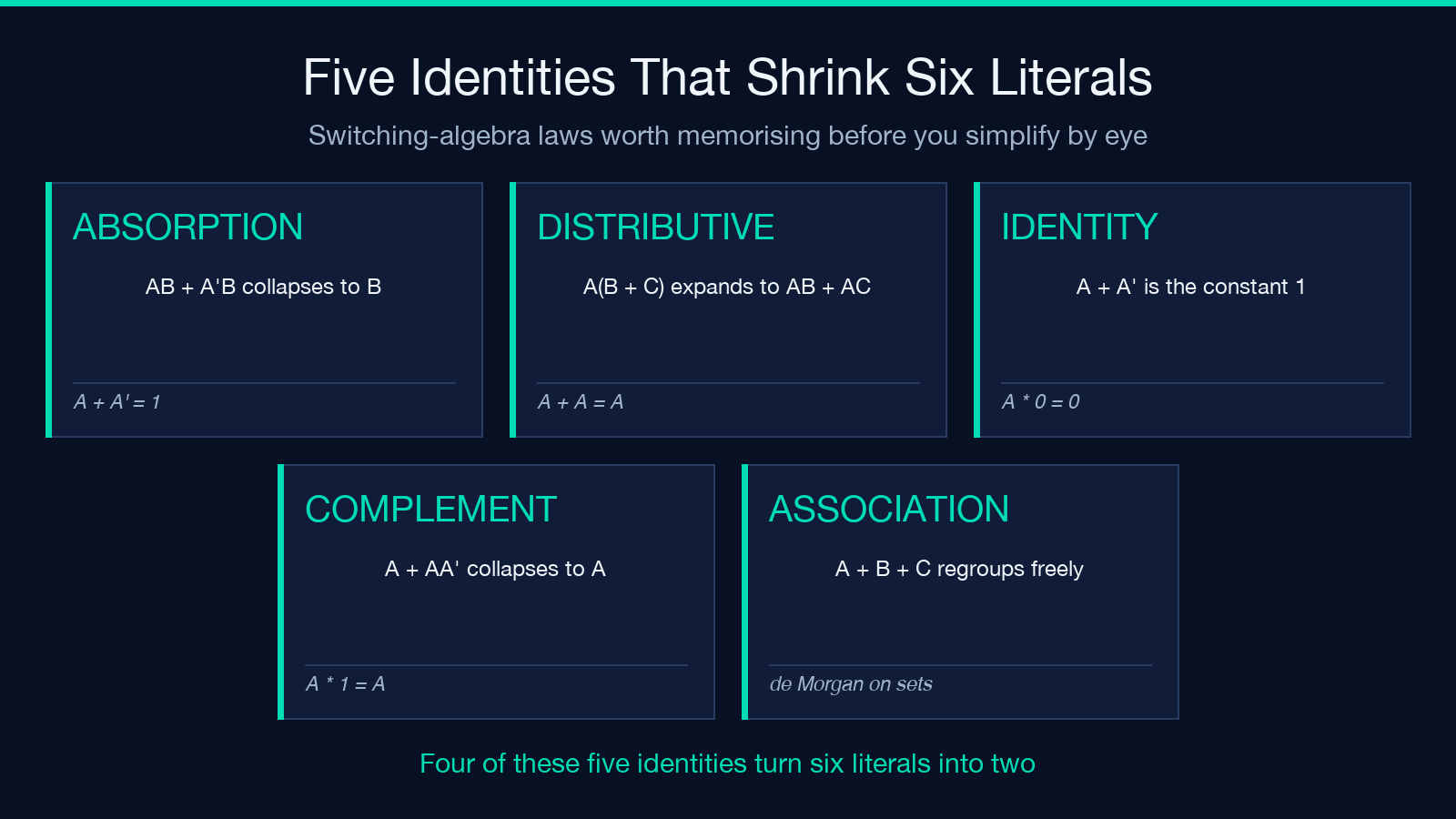
Compare the two examples directly. AB + A'B minimises to one term with one literal, so the whole function is a wire. The Σm(0,1,2,4,5,6) function minimises to two terms of one literal each, so it is a single 2-input OR gate. In neither case do you need a single AND gate. A naive reduction that stopped at the canonical form would have produced three terms of three literals for the Σm case, which is a 3-input AND into a 3-input OR, materially more silicon and more delay for an identical truth table.
This is exactly the class of arithmetic that makes the tool worth running before review rather than after. Reach for the Boolean Algebra Simplifier whenever a synthesiser hands you a netlist, a Verilog assign chain, a mux tree, or a decoded state machine and you want to know the floor. Browse the rest of the catalogue at elysiatools.com/en/tools for the wider engineering toolkit.
Verification Is the Deliverable
A simplification is only worth shipping if you can show it is equivalent, and equivalence over a truth table is finite and therefore checkable. That is why the tool’s verification pass matters more than its algebra. It walks every assignment the variables admit, two variables give four rows and four variables give sixteen, and compares the original against the minimal SOP.
Read that output as a contract rather than a formality. A match means the two functions agree on every possible input, which is the strongest statement you can make about a digital design short of a formal equivalence proof. A mismatch means either the parser read your expression differently from what you meant, or a term got dropped during covering, and both are worth chasing before you accept the result. The Σm example reports a match across all eight assignments; the AB + A'B case reports one across all four.
There is a cheap way to catch parser drift early. Write the function twice in two notations that should agree, for example AB + A'B and (A AND B) OR ((NOT A) AND B), run both, and confirm the tool returns the same canonical Σm. If the two disagree, the fault is in how the expression was read, not in the minimisation, and you have caught a typo before it ever reached a schematic.
Dual-Key Reasoning for Review
Before you accept any minimal SOP as a design, put the original and the simplified form side by side and ask two separate questions. First, are they equivalent? That question the verification pass answers exhaustively and you should trust it. Second, is the result what you actually wanted, or merely the smallest expression for something you specified by mistake? These are not the same question, and minimisers cannot tell the difference.
A missing minterm in your input list is the classic way the second failure shows up. You write Σm(0, 1, 2, 4, 5, 6) intending a parity detector, and get a clean two-term result that turns out to be neither parity nor its complement. The algorithm did exactly what you asked. Expanding to 4 variables to make the map more readable is also a trap: unused variables add rows and columns of duplicated cells and inflate the minterm indices, since the indices are positional and depend on the variable count.
A third trap is timing. Minimising for literal count is not the same as minimising for depth. A two-level SOP has uniform depth by construction, which is why two-level logic is so easy to reason about, but if you need a critical path shorter than two gate delays you are past what plain minimisation can give you and should be restructuring the function or using a multi-level technique instead.
When to Skip the Minimiser Entirely
There are honest cases where running the tool is wasted effort. If your synthesis flow already runs a competent minimiser, the answer is already in the netlist and your second run adds nothing but confidence. If the function has one or two variables, hand simplification is faster than typing the expression, as AB + A'B → B demonstrates. If the inputs are minterms with no clear structure and you only need any working expression rather than the provable minimum, a canonical Σm expansion is already correct.
The tool earns its keep in the crowded middle. Dense minterm sets across three or four variables, expressions assembled from a decode tree or a mux chain, and anything that arrived as generated RTL are exactly the cases where the minimal SOP is not obvious and where gate count turns into area and delay you have to defend. The right habit is to run it early, read the K-map before you read the answer, and let the verification output close the case.
Try the Σm(0, 1, 2, 4, 5, 6) example and the AB + A'B example on the Boolean Algebra Simplifier to see the essential-prime selection and the verified equivalence in one pass. More worked digital-logic examples live at Elysia Tools Samples if you want input-output pairs you can copy into your own flow.
