
A Rockall score is two numbers, not one. The same five findings about a bleeding patient produce a pre-endoscopic score and a complete score, and the two ladders that grade those numbers do not agree about what a given integer means. On the Rockall Score calculator the integer 3 is a high-risk result before the endoscope and an intermediate-risk result after it.
That gap is not a rounding artifact. The complete score is the pre-endoscopic score plus whatever the endoscopy finds, so the complete number can only climb. But the risk bands attached to each number were drawn for different jobs, and they were never aligned. A patient who looks calm on the ward and turns out to have a visible vessel on endoscopy can move from the lowest pre-endoscopic band straight into the middle of the complete ladder, and the summary that most people carry in their head will not tell you that happened.
One Bleed, Two Ladders
The Rockall score was published for acute upper gastrointestinal haemorrhage in 1996, and it comes in two forms that share a name and almost nothing else. The pre-endoscopic form uses three bedside findings only: age, shock, and comorbidity. It ranges from 0 to 7 and is available the moment the patient reaches the emergency department, before anyone has pushed a scope. The complete form adds two endoscopic findings, the diagnosis and the stigmata of recent haemorrhage, and ranges from 0 to 11.
The tool takes five selections and returns both numbers in the same object, which is the practical reason to use it rather than a paper chart. It also reports the component breakdown so you can see which finding carried the weight, and it labels each of the two numbers separately.
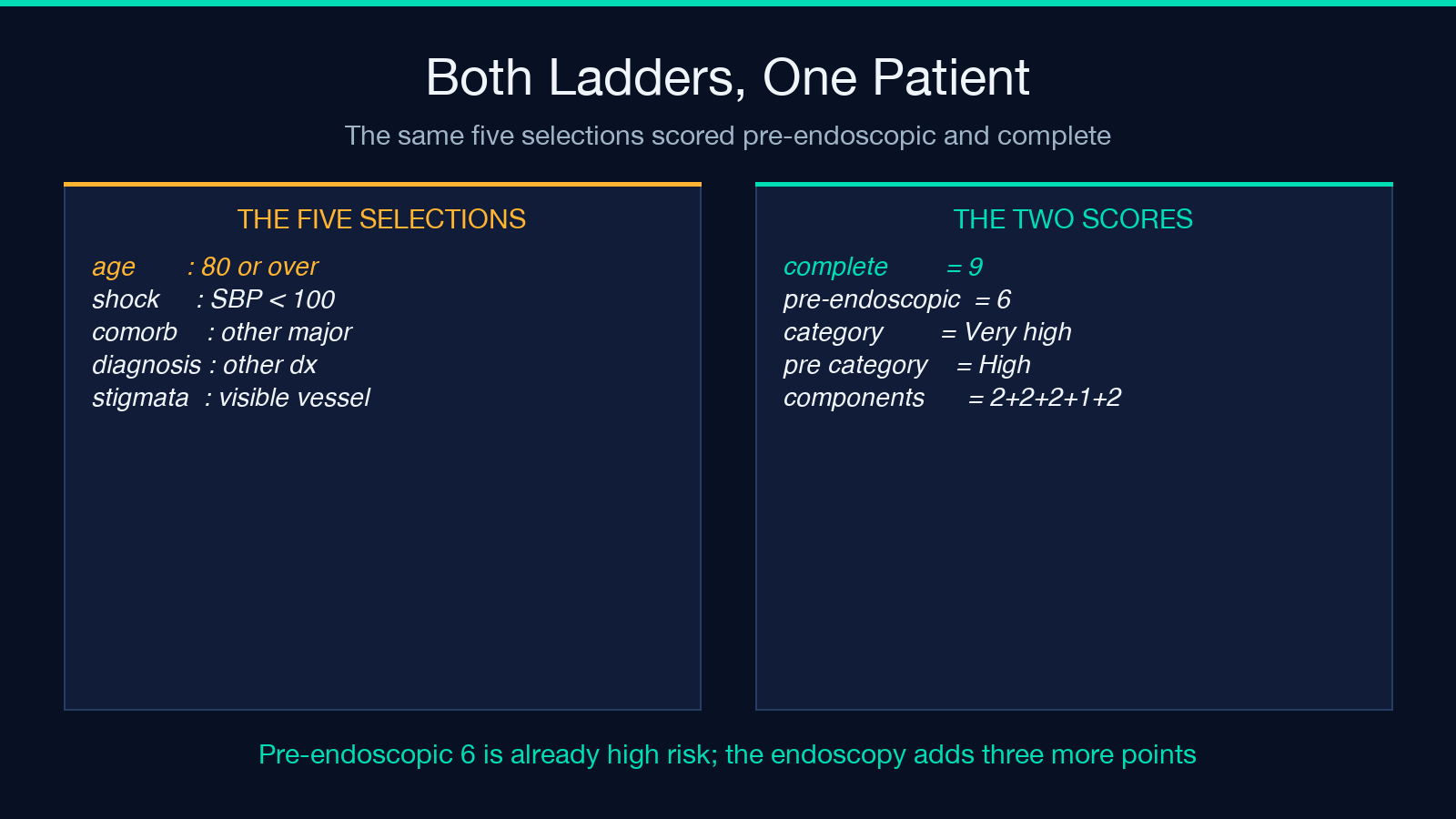
For an 80-year-old with hypotension, heart failure, a peptic ulcer and a visible vessel, the complete score is 9 and the pre-endoscopic score is 6. Six is already a high-risk result on the bedside ladder, and the endoscopy adds three more points, pushing the complete score into the top band. That is the intended behaviour: the endoscopy is supposed to refine the picture, not confirm it.
The Five Components and What Earns Each Point
- Age — 0 points under 60, 1 point for 60 to 79, 2 points for 80 and over.
- Shock — 0 points when systolic pressure is at least 100 and heart rate is under 100, 1 point for tachycardia, 2 points for hypotension with systolic pressure under 100.
- Comorbidity — 0 points for no major comorbidity, 2 points for another major illness such as cardiac disease, 3 points for renal failure, liver failure, or disseminated malignancy.
- Endoscopic diagnosis — 0 points for a Mallory-Weiss tear or no lesion, 1 point for all other diagnoses, 2 points for upper gastrointestinal malignancy.
- Stigmata of recent haemorrhage — 0 points for none or a dark spot only, 2 points for blood in the lumen, an adherent clot, or a visible vessel.
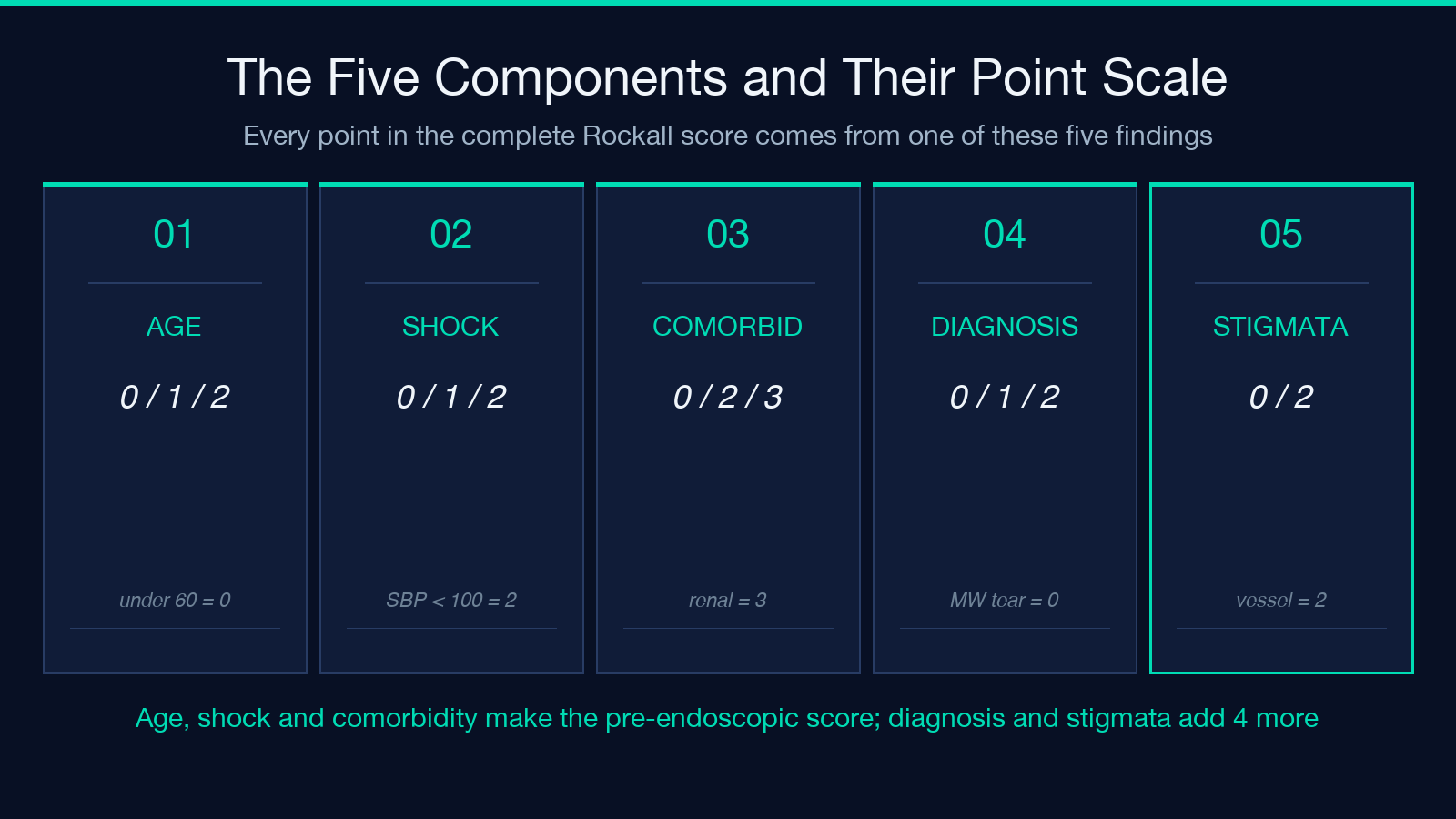
Read those five lines as two groups rather than one. The first three components are the pre-endoscopic score, capped at 7. The last two are the endoscopy, worth up to 4 points between them. Everything else in the article is a consequence of that split.
The bands the tool reports for each number are also different from each other. On the complete ladder, 0 to 2 is low risk, 3 to 4 is intermediate, 5 to 7 is high, and 8 to 11 is very high. On the pre-endoscopic ladder, 0 is low, 1 to 2 is moderate, and 3 or more is high. Neither band table is a subset of the other.
The Same 3, Two Different Labels
Take a 72-year-old admitted after vomiting blood, with systolic pressure of 85, no significant comorbidity, and an endoscopy showing a Mallory-Weiss tear with no stigmata of bleeding.
The pre-endoscopic score is 1 for age plus 2 for hypotension plus 0 for comorbidity, which is 3. The tool labels that a high pre-endoscopic risk, on the reasoning that you should manage as a high-risk bleed until the endoscopy clarifies what is happening.
The complete score is 3 as well, because the Mallory-Weiss tear scores 0 and there are no stigmata. The tool labels that intermediate risk, meaning inpatient observation, planned endoscopic therapy, and monitoring for rebleeding.
The same integer, produced by the same patient, carries a high-risk label in one field and an intermediate-risk label in the other. If you read only the number, you will believe the endoscopy softened the picture. What actually happened is that the endoscopy confirmed the bleeding had stopped on its own, while the bedside findings never stopped being concerning.
Now run it the other way. A 45-year-old with systolic pressure of 120, heart rate of 80, no comorbidity, a duodenal ulcer, and a visible vessel at endoscopy scores 0 pre-endoscopically, the lowest band on the bedside ladder, and 3 on the complete scale once the ulcer and the vessel are counted. The endoscopy added three points and moved the patient from the bottom band of the bedside ladder into the intermediate band of the complete ladder, while the ward view said there was nothing to worry about.
Four Bands on the Complete Ladder
The complete score is graded on four bands, and the tool states each one with its interpretation. At 0 to 2 the risk is low: roughly 4.9 percent rebleeding and about 0 percent mortality, with early discharge or outpatient management considered after clinical assessment. At 3 to 4 the risk is intermediate, and the recommendation is inpatient observation with planned endoscopic therapy and rebleeding monitoring. At 5 to 7 the risk is high, and the recommendation is inpatient monitoring with early therapeutic endoscopy. At 8 to 11 the risk is very high, and the recommendation is intensive monitoring, urgent intervention, and possibly ICU-level care.
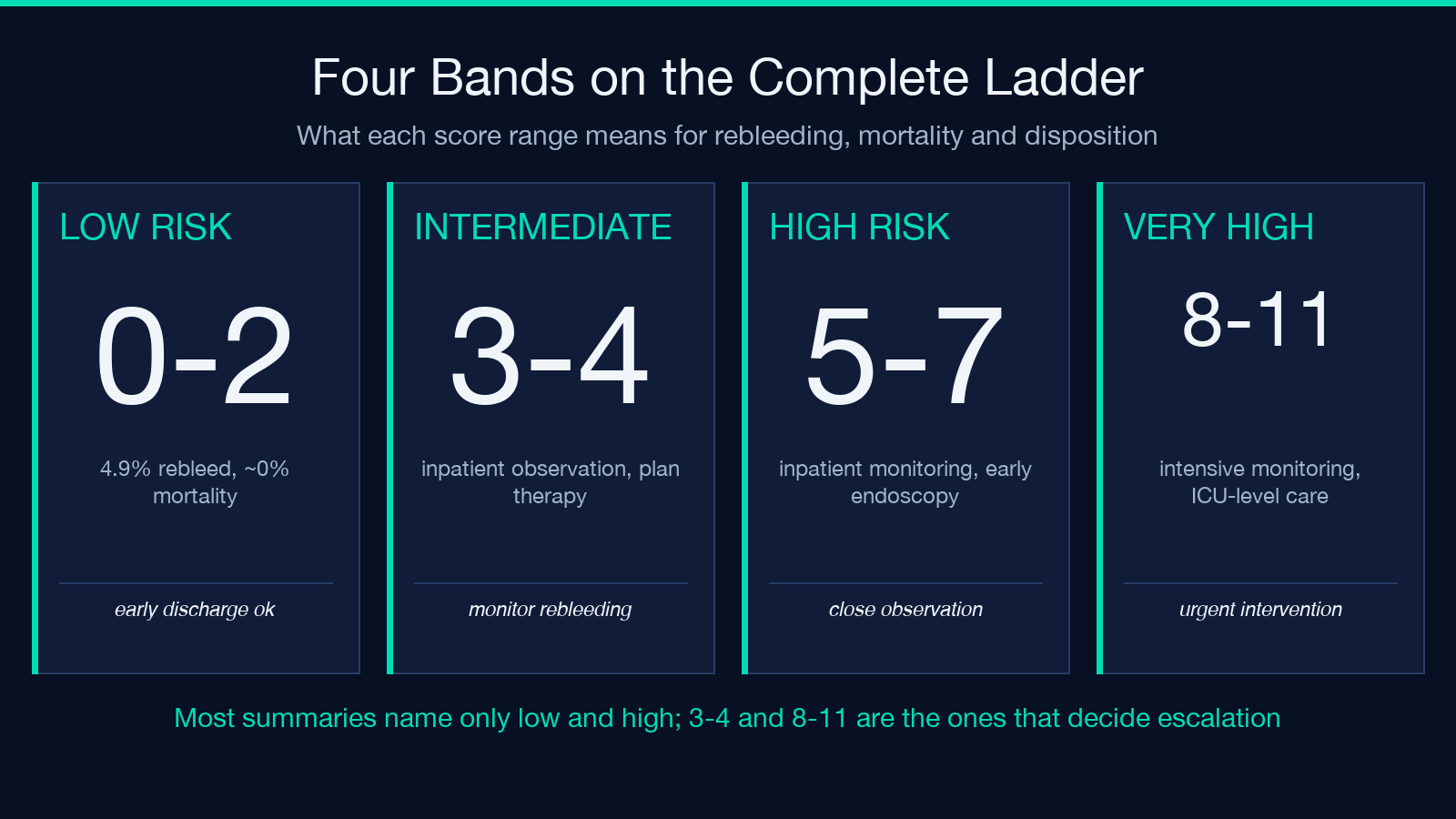
Most one-line summaries of this tool mention only two of those four, and they are the outer two: low risk up to 2, high risk from 5 upward. The 3 to 4 intermediate band and the 8 to 11 very high band are the ones that decide whether a patient is observed or escalated, and both are invisible to a summary that stops at low and high.
The pre-endoscopic ladder is even shorter and uses different words again: low at 0, moderate at 1 to 2, high at 3 or above. There is no very high band on the bedside side at all, because the bedside side cannot reach 8.
Where the Points Are Not Evenly Spread
Three quirks in the point allocation cause most of the surprises. The first is comorbidity. It is the only component that can reach 3 points, and it takes 3 points for renal failure, liver failure, or disseminated malignancy. One comorbidity condition therefore carries more weight than a visible vessel at endoscopy, which is worth 2. If you want to grade the liver disease that earns that 3, the Child-Pugh Score is the tool built for it.
The second is stigmata, which is binary. There is no 1-point stigmata. A dark spot only scores 0, and anything from fresh blood through an adherent clot to a spurting vessel scores 2 in a single jump. The score therefore cannot distinguish a trivial pigmented spot from no stigmata whatsoever, and it treats the whole spectrum of active bleeding as one two-point event.
The third is the diagnosis component, which scores a Mallory-Weiss tear and a completely normal endoscopy identically, at 0. The reasoning is that both are low-rebleed lesions, and the score is not trying to separate them. But the consequence is that the diagnosis component contributes almost nothing to distinguishing a benign tear from a lesion nobody found.
What the Score Cannot Tell You
The Rockall score is a bedside stratification aid, and it inherits every limitation of the examination behind it. Two observers who disagree about whether a patient is drowsy, or whether the face is drooping, will produce different totals, and the score does not adjust for that uncertainty.
It also does not model treatment or timing. It does not know whether endoscopy happened at hour one or hour twenty, whether the patient was already on a proton pump inhibitor, or whether the blood pressure responded to fluids before the score was filled in. It does not weigh the shock component beyond a systolic cutoff, and it does not use the heart rate except to separate tachycardia from a normal rate when the pressure is adequate.
For patients on oral anticoagulants, the HAS-BLED Score answers a different question: not how bad this bleed is, but how likely the next one is. For chronic comorbidity burden rather than acute severity, the Charlson Comorbidity Index is the more precise instrument. And when a patient lands in the very high band and ICU-level care is being considered, the general severity tool is the APACHE II Score. None of these tools replaces the others; the point is that a score with a blind spot should be paired with one that covers it.
Reading the Result Object
The tool returns JSON, and the fields are worth knowing because they let you audit the arithmetic rather than trust a label. The total field carries the complete score, preEndoscopic carries the bedside score, and components breaks out age, shock, comorbidity, diagnosis, and stigmata individually. You can confirm that total equals preEndoscopic plus the two endoscopic components without leaving the output.
Two pairs of fields carry the interpretation. category and interpretation describe the complete score, and preEndoscopicCategory and preEndoscopicInterpretation describe the bedside score. The method field names the instrument, and the model field names the source: Rockall TA et al. Gut 1996;38(3):316-321, plus the standing caveat that this is not medical advice.
Reading components before category is the habit worth building. A total of 4 tells you almost nothing on its own. A total of 4 that is 3 points of comorbidity and 1 point of diagnosis tells you the patient was sick before the bleed started, which is a different conversation entirely from a total of 4 that is 2 points of shock and 2 points of stigmata.
Where This Fits Next
The Rockall score rewards a discipline that most calculators do not: it makes you answer the bedside questions before you are allowed to answer the endoscopic ones, and then it shows you both answers side by side. That is exactly the failure mode it was designed to fix, because the endoscopy is what you remember and the bedside findings are what you skip.
If you want to see the whole catalogue rather than one instrument at a time, browse the Health category or explore more tools at elysiatools.com. Two numbers, two ladders, and one endoscopy that can move a patient in a direction the bedside view never suggested.
