You Can’t Predict This. Neither Can the Best Computer on Earth.
Two identical pendulums. Same weight. Same length. Same gravity. One starts at 89.999 degrees. The other at 90.001. After 20 seconds, they are doing completely different things.
This is not metaphor. This is the double pendulum — and it is the most honest science experiment you can run in a browser. The rules governing it were solved in the 18th century. The rules are perfect. The predictions are not. This is chaos, and it changes how you think about prediction in weather, markets, and everything else.
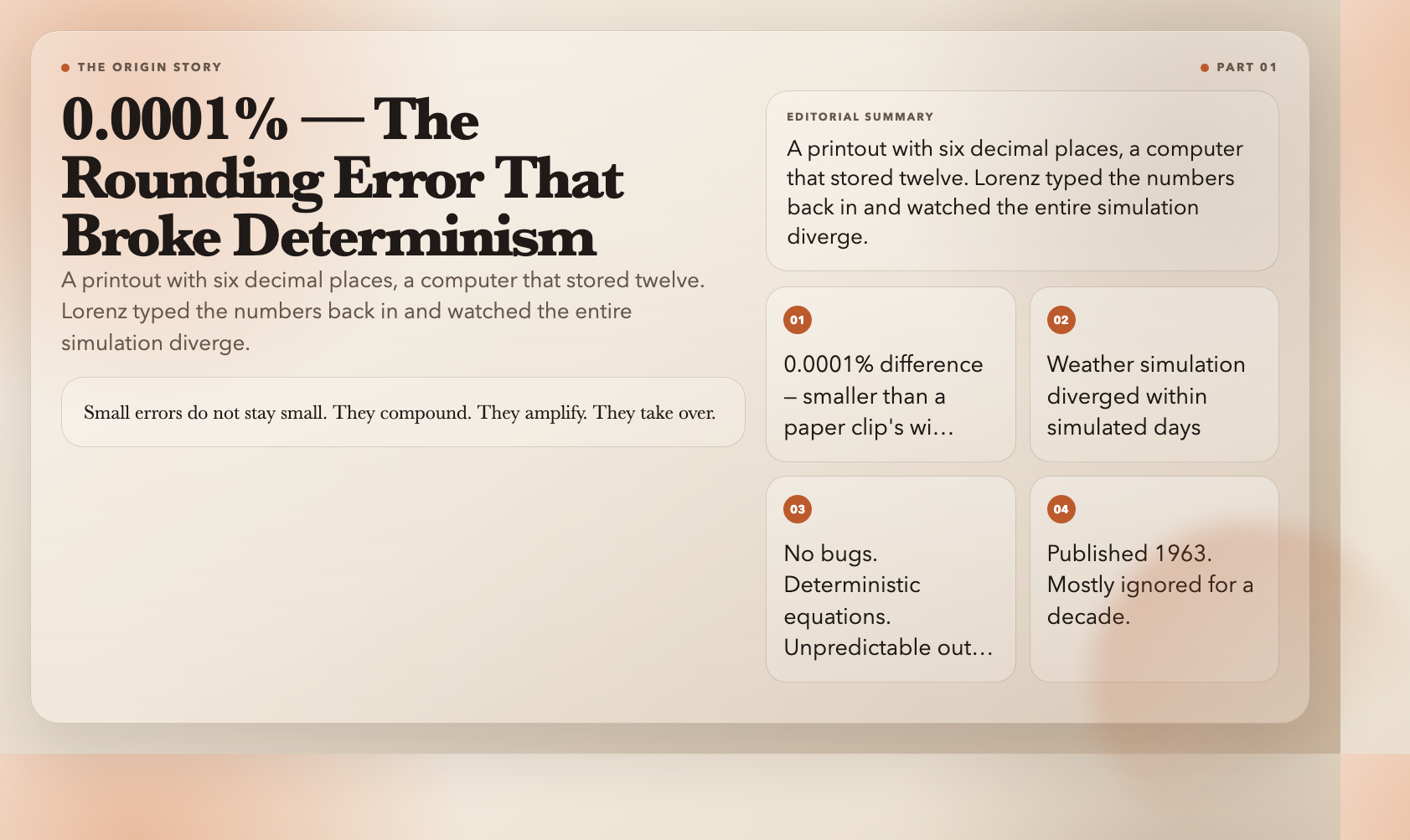
In 1961, Edward Lorenz restarted a weather simulation mid-run to save time, typing numbers from a printout that showed six decimal places while the computer stored twelve. The difference: 0.0001%. A rounding error no wider than a paper clip. Within a few simulated days, the second run showed weather the first never produced. There were no bugs. Small errors do not stay small, he found. They compound. They amplify. They take over.
How Lorenz Accidentally Broke Determinism
Edward Lorenz was not trying to philosophize. In 1961, running a weather simulation on a Royal McBee computer at MIT, he restarted from the middle of a previous run to save time — typing numbers from a printout rather than beginning from scratch. The printout showed six decimal places. The computer stored twelve. The difference: 0.0001%. A rounding error no larger than a paper clip’s width.
The simulation diverged. Within a few simulated days, the second run showed weather patterns the first never produced. Lorenz checked his code twice. There were no bugs. He published quietly in 1963 in the New York Academy of Sciences. The paper sat mostly uncited for a decade.
What he had found: small errors in initial conditions do not stay small. They compound. They amplify. They take over.
This is chaos. Not randomness — deterministic chaos. The rules are perfect. The predictions are not.
The Royal Society in London eventually called Lorenz’s 1963 paper one of the most influential papers in the history of physics — not for weather prediction, but for what it revealed about the limits of determinism itself.
The Hair-Width That Breaks Prediction
The double pendulum is two masses hanging from two arms under nothing but gravity. The equations governing it — the Lagrangian equations for two coupled oscillators — were solved in the 18th century. You can fit them on one page. No stochastic terms. No hidden variables.
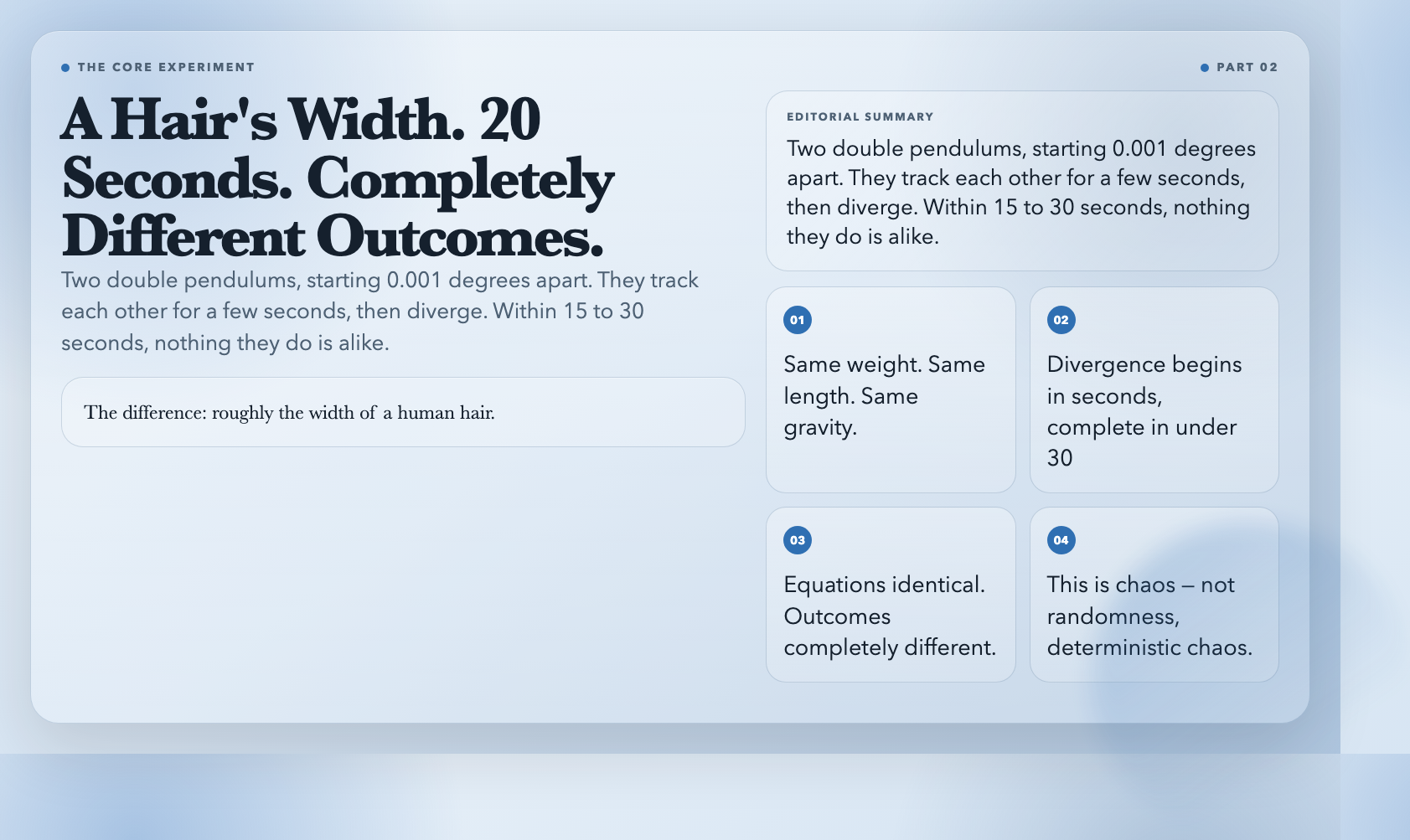
Start one at 89.999 degrees. Start another at 90.001 degrees. Watch for 20 seconds.
They track each other for the first few seconds. Then they diverge. Within 15 to 30 seconds, they will be doing things that have nothing in common — even though every force, every acceleration, every equation is identical.
The difference: roughly the width of a human hair.
This is not a measurement problem. You cannot measure a pendulum’s angle to infinite decimal places — thermal noise, quantum effects, and background radiation make infinite precision physically impossible. The universe does not cooperate with Laplace’s thought experiment.
Even in simulation, floating-point arithmetic rounds at each computation step. Over thousands of steps, rounding errors cascade. This is arithmetic — not a bug in your code, a feature of arithmetic itself.
Phase Space: Where Chaos Becomes Visible
Open the visualization and look at the phase space plot — it graphs the first arm’s angle against its angular velocity continuously.
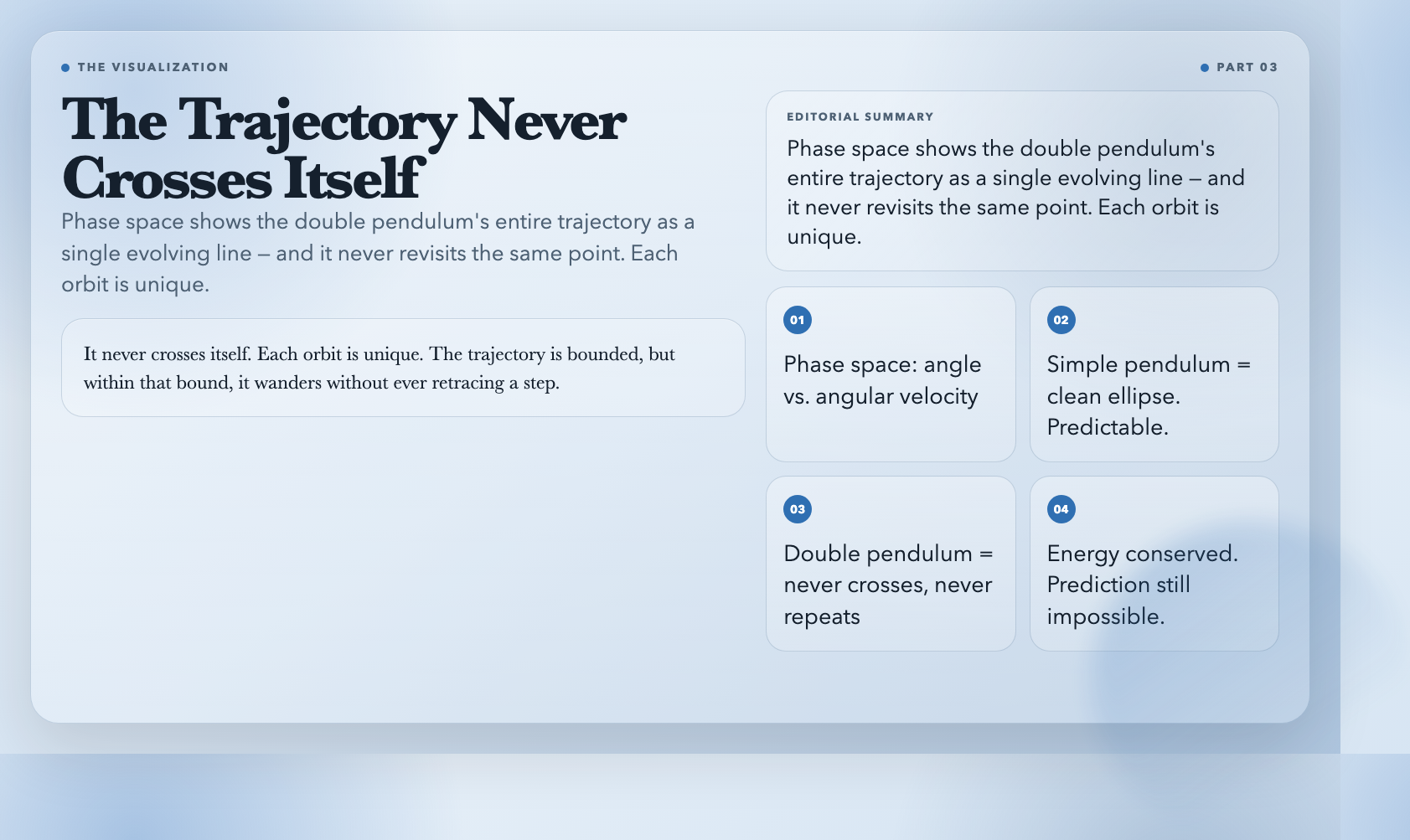
For a simple pendulum, this plot is a clean ellipse. Closed. Periodic. You can look at any point and know exactly where the system goes next.
For the double pendulum, the trajectory does something haunting: it never crosses itself. Each orbit is unique. The trajectory is bounded — total energy constrains it to a finite region — but within that region, it wanders without ever retracing a step.
Then watch the energy chart at the same time. Total mechanical energy is perfectly constant. Kinetic and potential trade places continuously, but the sum never drifts. Conservation holds perfectly.
This is the cruelest part of chaos: the constraints that govern the system tell you exactly what is possible, and nothing about which possibility the system will choose at any given moment.
The Butterfly Effect Is Not a Metaphor
When meteorologists say hurricane forecasting has a 10-day wall — that predictions beyond 10 days are no better than random guesses regardless of model sophistication — they are not being modest. They are describing a mathematical limit of the atmosphere as a chaotic system.
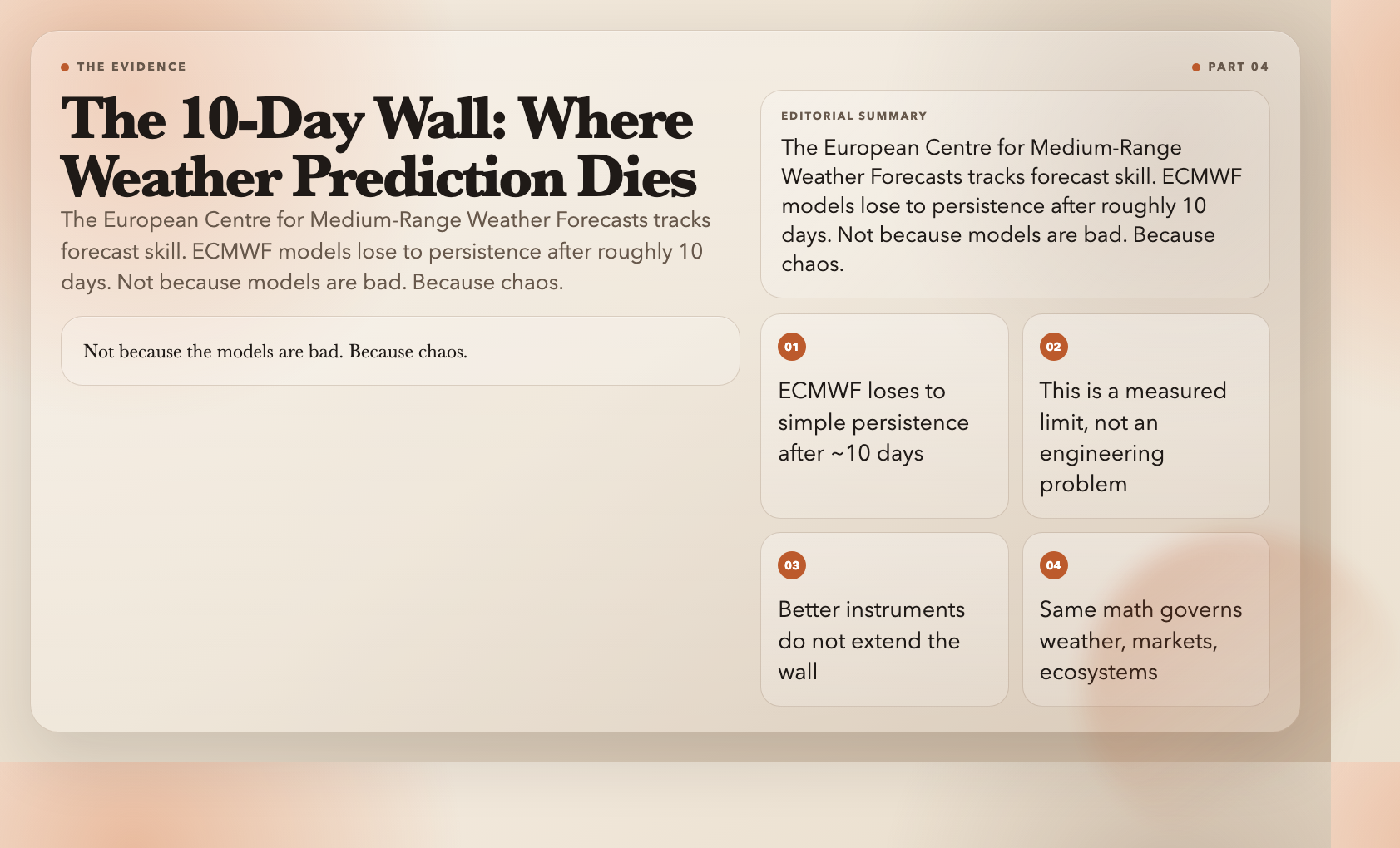
The 10-day forecast wall is not an opinion. It is measured. The European Centre for Medium-Range Weather Forecasts tracks forecast skill against persistence (just using today’s weather as tomorrow’s prediction). ECMWF models lose to persistence after roughly 10 days. Not because the models are bad. Because chaos.
Turbulent fluids have resisted theoretical solution for 200 years — partly because turbulence is chaotic, and small perturbations in a fluid (a breath, a door slam, temperature differences) grow and produce large-scale patterns that cannot be reliably predicted. The Navier-Stokes equations are deterministic. They do not give you the weather inside a cloud.
Ecological models produce famously different outcomes from tiny changes in initial population estimates. A 2013 study in *Nature* showed that coral reef fish populations could be predicted to survive or go extinct based on starting conditions that differed by less than 1%.
Markets do the same thing. A 2010 *Nature* paper demonstrated that 1% differences in initial market conditions — within normal measurement noise — produced fundamentally different price trajectories in laboratory markets.
The double pendulum is not a toy. It is a proof of concept for limits that show up everywhere that matters.
Try It Yourself
Here is a free, browser-based simulation — no account, no install:
Double Pendulum Chaos — Interactive Visualization
Press Multi-Trail. Five pendulums start simultaneously with microscopically different starting angles. Watch them stay together for a few seconds. Then watch them fan out. That is the butterfly effect. That is why the best computers on Earth cannot give you a reliable weather forecast three weeks from now.
Watch the phase space plot while it happens — each trajectory unique, none crossing, following laws written in the 18th century.
Watch the energy chart — total constant, kinetic and potential trading endlessly, conservation perfect, prediction impossible.
Slide the Initial Angle from 90° to 91°. One degree. Watch the trajectory reorganize completely.
Press Multi-Trail and just watch. Five pendulums. Same start. Different ends. The most honest image in science.
What the Double Pendulum Actually Teaches
The double pendulum says something uncomfortable about every complex system: the universe has rules, and those rules do not give you the future.
This was true in 1900. It will be true in 2100. It is a mathematical limit, not an engineering problem.
Most systems that matter — markets, weather, ecosystems, the trajectory of your work — are at least partially chaotic. Understanding this focuses you. You stop spending energy on futile precision and start building resilience, adaptation, and the ability to respond well.
The double pendulum asks one question that applies to weather, markets, careers, and startups: do you want to predict the future, or do you want to be able to respond to it?
The rules give you the second. They will never give you the first.
The next time someone tells you they know what happens next — in markets, in policy, in your industry — remember the hair-width problem. Remember that the best computers on Earth cannot predict weather three weeks from now. And remember that the rules are perfect, the predictions are not, and the ability to respond well is the only skill that actually compounds.