# 8 Free Astronomy Tools That Make the Night Sky Actually Useful
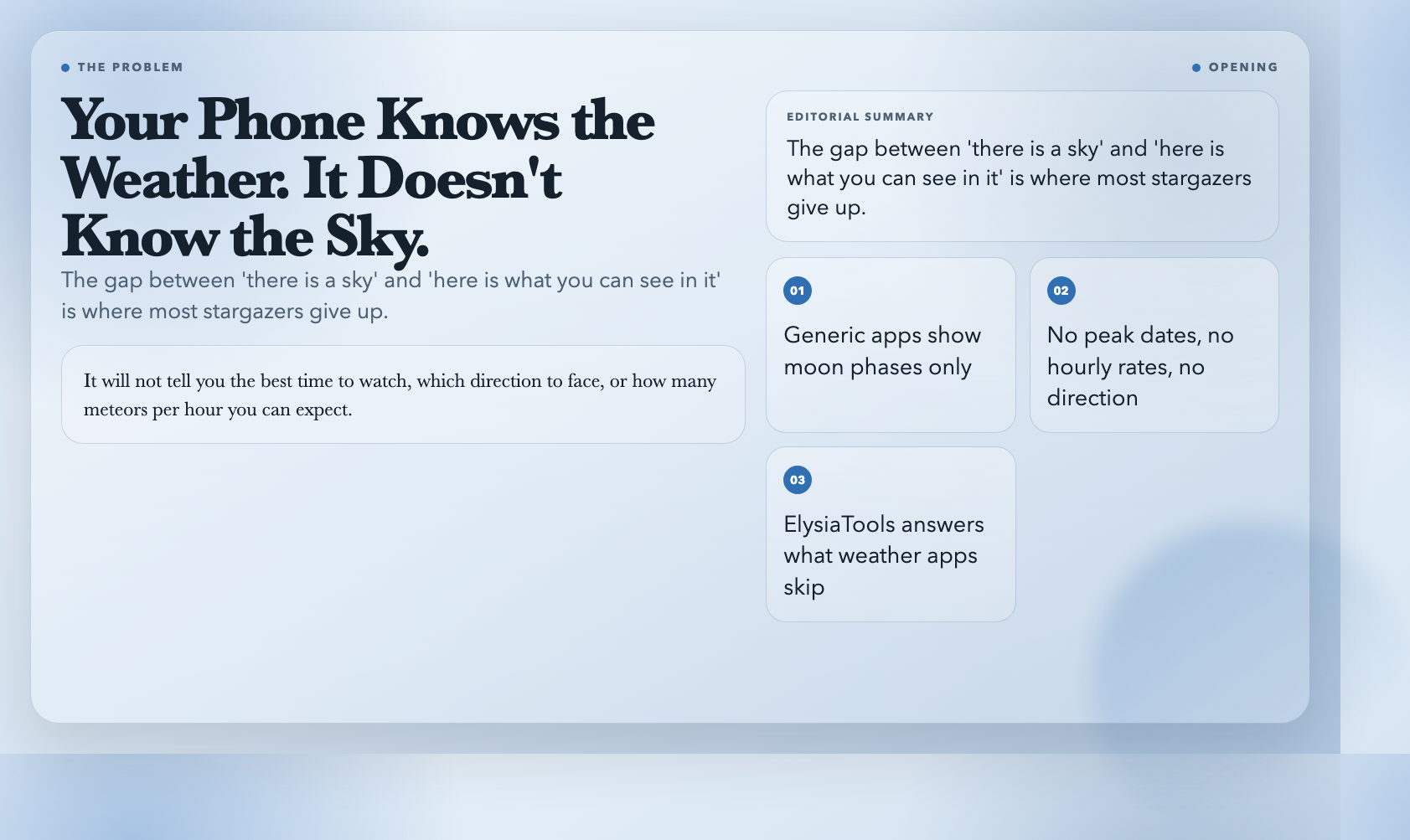
The Perseid meteor shower peaks in 90 days. Your phone’s stock weather app will tell you the temperature. It will not tell you the best time to watch, which direction to face, or how many meteors per hour you can expect. That gap — between “there is a sky” and “here is what you can see in it” — is where most people give up on stargazing.
The tools on ElysiaTools do not need an account. They run in a browser. They do not sell your data. And together they form a rough astronomy companion that covers the three things stargazers actually need: *when to look*, *where to look*, and *what you are looking at*.
Here are 8 free tools worth knowing about.
1. Meteor Shower Predictor
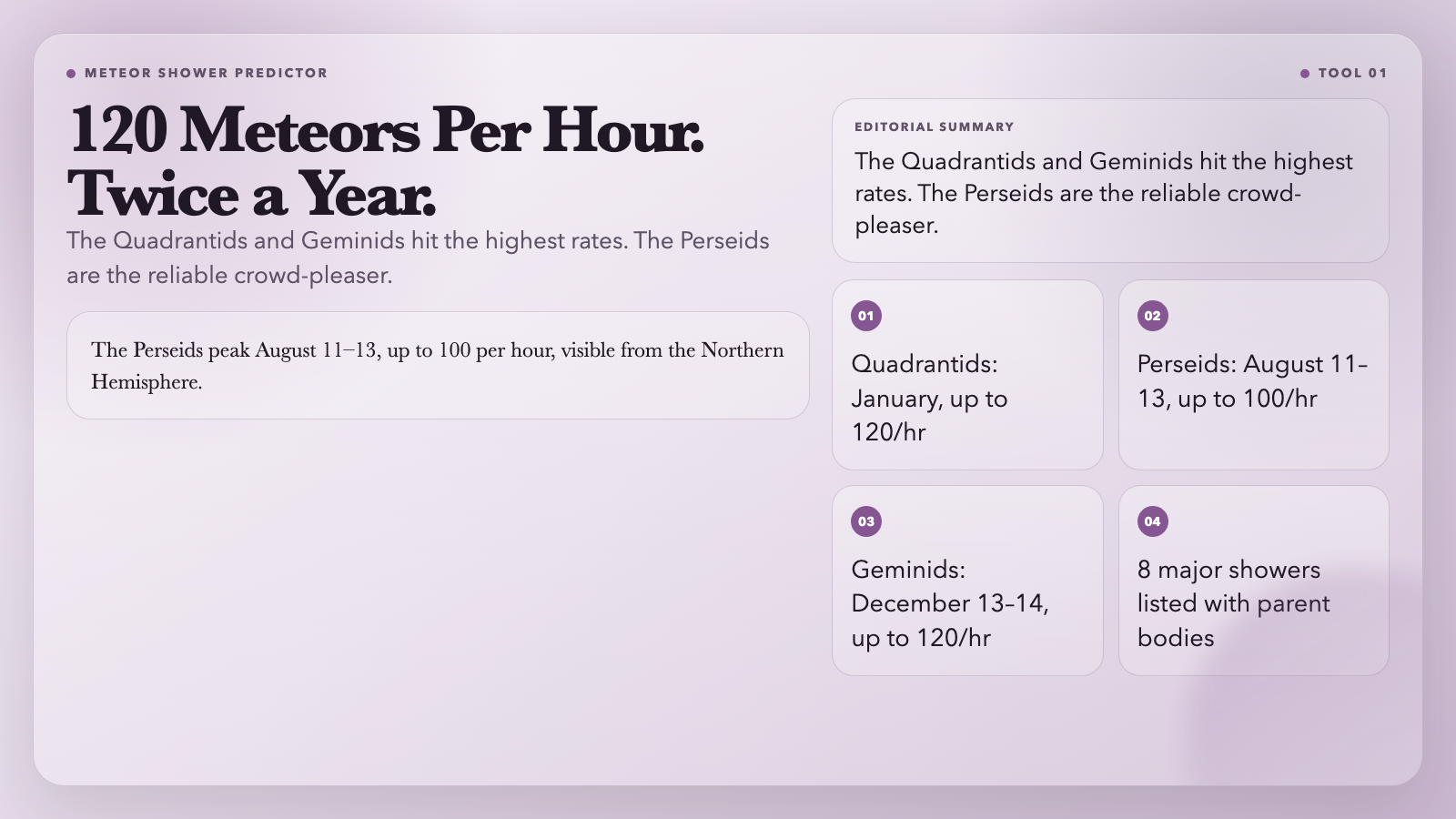
Most astronomy apps show you a moon phase and call it a day. The Meteor Shower Predictor does the actual work: it lists all eight major annual meteor showers — Quadrantids, Lyrids, Perseids, Orionids, and the rest — with peak dates, expected hourly rates, parent bodies, and hemisphere visibility.
The Quadrantids peak at up to 120 meteors per hour in January. The Geminids hit the same rate in December. The Perseids are the crowd-pleaser: August 11–13, up to 100 per hour, visible from the Northern Hemisphere.
For each shower you get the peak date, duration window, the comet or asteroid that spawns it, and a visibility rating. You can filter by hemisphere and choose upcoming-only mode so it only shows what is relevant from today forward.
The output includes practical viewing tips: find dark skies, let your eyes adapt for 20–30 minutes, use red light to preserve night vision, and check the moon phase before you drive anywhere.
2. Blue Hour Calculator
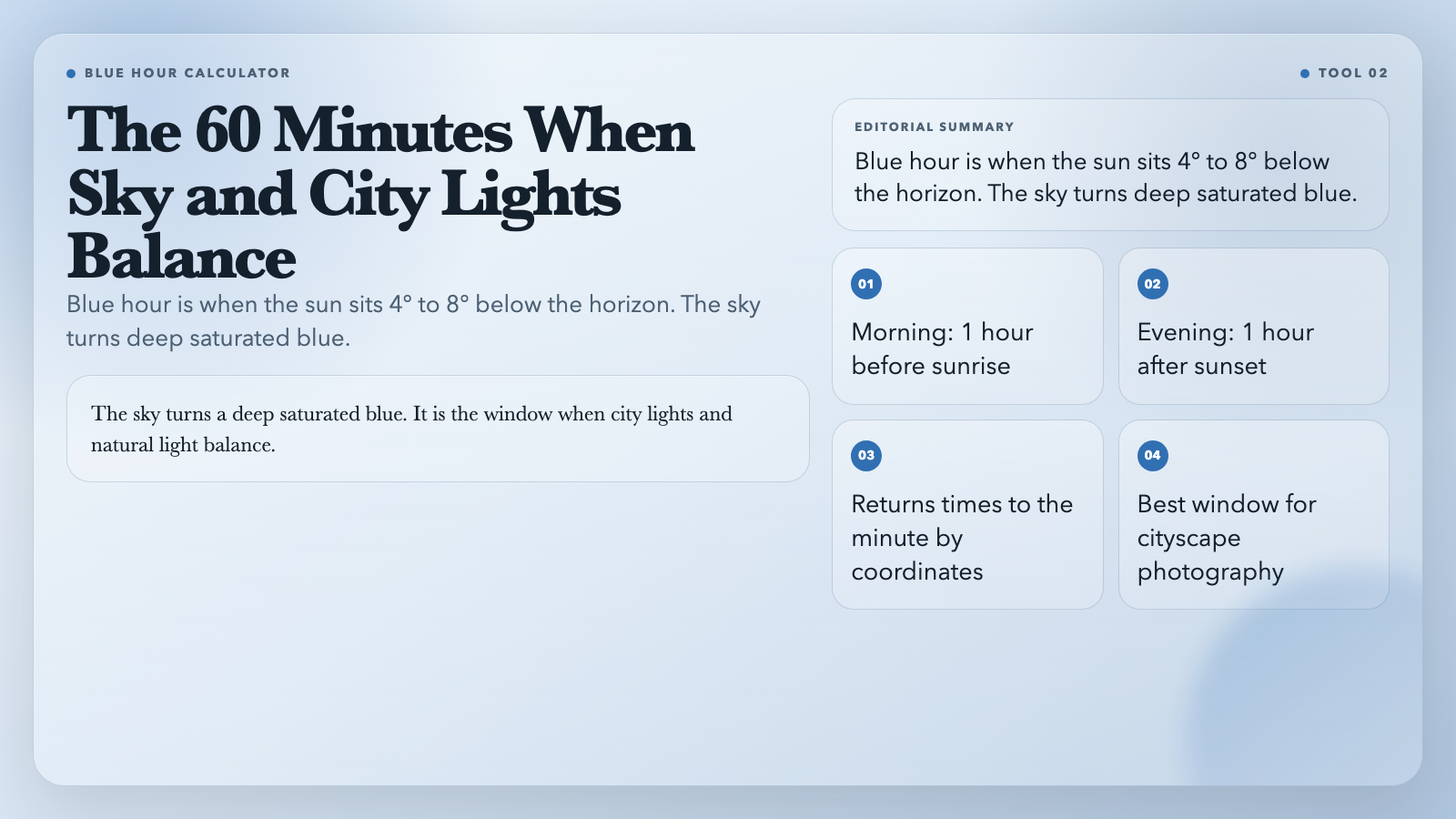
Sunset is dramatic. The 60 minutes that follow are often more interesting — when the sun is between 4° and 8° below the horizon and the sky turns a deep saturated blue. This is the blue hour. It is the window when city lights and natural light balance, and it is the moment photographers plan entire shoots around.
The Blue Hour Calculator takes a latitude, longitude, and date, and returns the exact morning and evening blue hour windows for that location. It calculates solar declination based on the day of year, then derives the hour angle for sunrise and sunset, and returns the blue hour start and end times to the minute.
You also get photography tips baked in: use a tripod, try long exposures, combine artificial lights with the blue sky for contrast. If you have ever shown up at “sunset” and found the sky was already dark, this tool is the difference between guessing and knowing.
3. Golden Hour Calculator
If blue hour is the 60 minutes after sunset, golden hour is the 60 minutes before sunrise and after sunset when the sun sits between 0° and 6° above the horizon. The light travels through more atmosphere, scattering blue wavelengths and leaving warm reds and oranges. Portrait photographers, real estate agents, and cinematographers fight for this window.
The Golden Hour Calculator works like the blue hour tool — latitude, longitude, date in, golden hour windows out. The morning window is sunrise minus 1 hour to sunrise. The evening window is sunset to sunset plus 1 hour.
Duration varies by latitude and season. At high latitudes in summer, golden hour can stretch to 90 minutes or more. Near the equator it collapses to 30 minutes. This tool tells you which applies to your exact coordinates.
4. Daylight Calculator
If you want one number that tells you whether an astronomy session is worth the trouble, it is hours of daylight. The Daylight Calculator gives you sunrise time, sunset time, and total daylight hours for any location and date.
The calculation uses solar declination based on the day of year — the same math that powers the blue and golden hour tools, but simpler output. Input your coordinates and a date, and it returns the full daylight window.
This is useful for planning any outdoor observation session, not just astronomy. If you are scouting a dark-sky location for a future date, you can check whether it will be light until 8 PM or 6 PM, and plan travel accordingly.
5. Great Circle Distance
Here is a question that stargazing apps rarely answer: how far are you from the point directly beneath what you are looking at? The Great Circle Distance calculates the shortest path between two points on a spherical Earth — which is not a straight line on a flat map, and not the route your GPS usually suggests.
Why does this matter for astronomy? Meteor showers, eclipses, and satellite passes are often visible only from specific geographic regions. If an event is centered over the North Atlantic, knowing whether you are 800 km or 3,000 km from that region tells you whether to set an alarm or sleep through it.
The tool uses the Haversine formula. Input two coordinate pairs, get the distance in kilometers or miles. No account, no API key, no waiting.
6. Midpoint Calculator
If you want to meet someone halfway to a dark-sky site, or you are trying to figure out which city is geographically centered between two locations you are traveling from, the Midpoint Calculator does exactly what the name says.
Input two locations by coordinates, and it returns the geographic midpoint. This is the point on Earth’s surface that is equidistant from both inputs — not the halfway point on a flat map projection, but the actual center of the great circle route.
This has a less obvious but genuinely useful application: if you are coordinating a stargazing group across two distant cities, the midpoint gives you a defensible meeting point that minimizes everyone’s travel.
7. UTM Zone Calculator
Latitude and longitude are fine for most purposes. But if you work with GPS data, military coordinates, or USGS mapping systems, UTM (Universal Transverse Mercator) is the coordinate system you are actually working in. UTM divides the world into 60 zones, each 6° of longitude wide.
The UTM Zone Calculator takes a latitude and longitude and tells you which UTM zone and hemisphere designator apply. For a point at 40.7° N, 74° W — New York City — the answer is zone 18T. This matters when you are importing coordinates into CAD software, GIS platforms, or older mapping tools that expect UTM notation.
Most people will not need this daily. But if you have ever imported a coordinate file into a tool and wondered why it rendered in the wrong ocean, this is probably where the problem lives.
8. Bearing Calculator
Great Circle Distance tells you how far apart two points are. Bearing Calculator tells you which direction you need to face — the initial bearing, or forward azimuth, from point A to point B.
For astronomy, this is useful when you know a meteor shower’s radiant point (the constellation from which the meteors appear to originate) and you want to orient yourself correctly. The Perseids radiate from Perseus in the northeast. If you know the bearing from your location to the Perseid radiant, you know exactly where to look.
The calculation accounts for the curvature of the Earth and returns the bearing in degrees clockwise from north. A bearing of 45° means northeast. 180° means south. It is simple math with consequences for anyone pointing a camera or a telescope.
The Gap Between Free and Useful
These eight tools share a common trait: they answer a specific question that a generic app does not. The Meteor Shower Predictor does not just tell you it is dark — it tells you how many shooting stars to expect. The Blue Hour Calculator does not describe golden light in poetic terms — it gives you a time window to the minute.
That specificity is the point. The night sky is free. These tools do not make it less free — they make it legible.
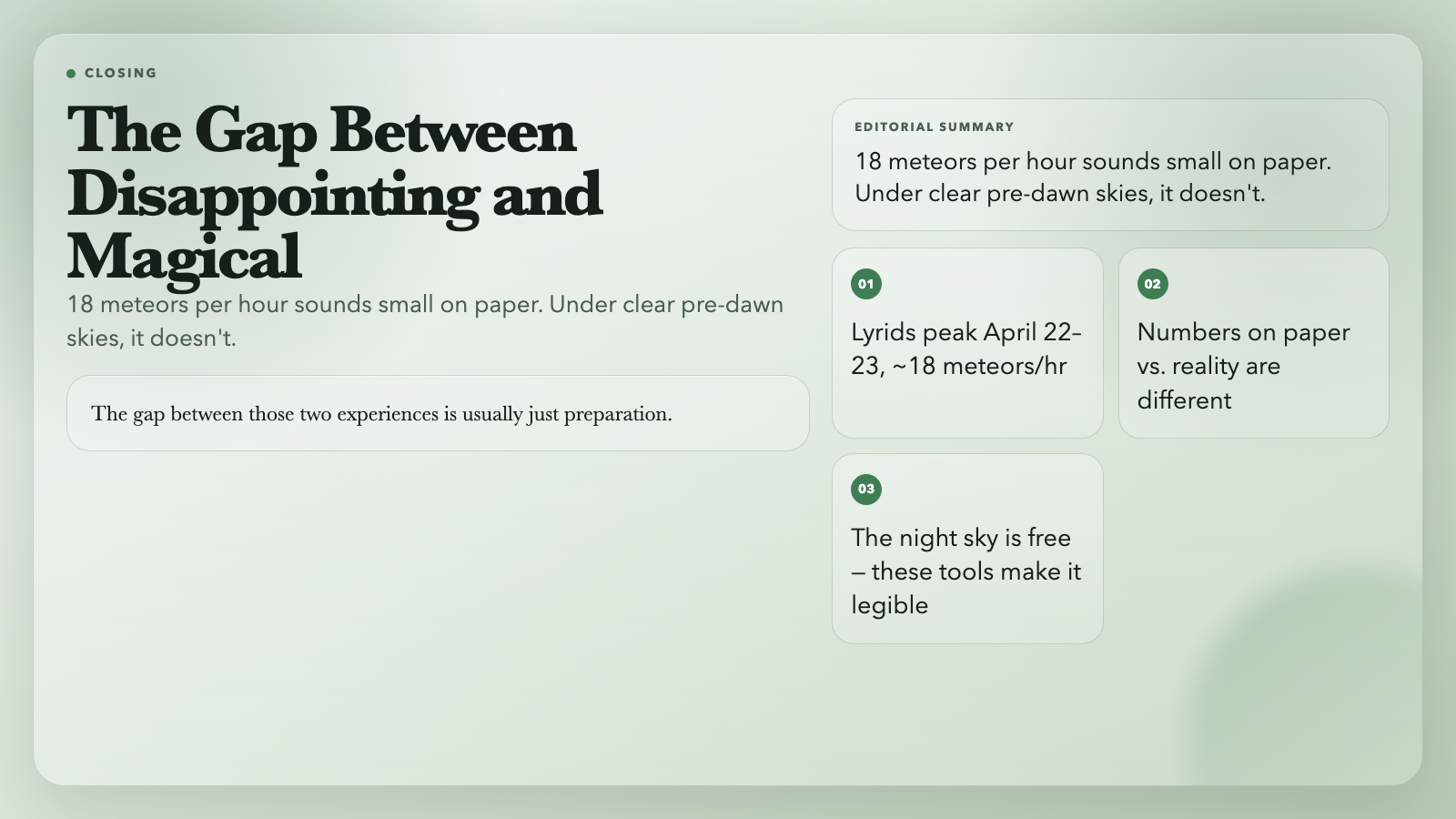
The Lyrids peak again in 8 days. April 22–23, pre-dawn, about 18 meteors per hour under clear skies. That number is small enough to feel disappointing on paper and large enough to feel magical in person. The gap between those two experiences is usually just preparation.